
BuddhistCatholicContemplativeEvangelicalGeneral ChristianHinduJewishLatter-day SaintMuslimNew VisionsProgressive Christian
Beliefs
- Buddhist
- Catholic
- Contemplative
- Evangelical
- General Christian
- Hindu
- Jewish
- Latter-day Saint
- More Voices
- Muslim
- New Visions
- Pagan
- Progressive Christian
Topics
- Religion News
- Food and Religion
- Sports and Religion
- Religious Art
- Religious Music and Entertainment
- Religious Events
- History and Religion
- Style and Religion
- Politics and Religion
- Women in Religion
- Recreation Outdoors and Religion
- Business Finance and Religion
- Careers Workplace and Religion
- Education and Religion
- Family Parenting and Religion
- Health Fitness and Religion
- Home and Religion
- Relationships and Religion
- Technology and Religion
- Travel and Religion
Columnists
- Buddhist Columnists
- Business Finance and Religion Columnists
- Careers Workplace and Religion Columnists
- Catholic Columnists
- Contemplative Columnists
- Education and Religion Columnists
- Evangelists Columnists
- Family Parenting and Religion Columnists
- General Christian Columnists
- Health Fitness and Religion Columnists
- Hindu Columnists
- History and Religion Columnists
- Home and Religion Columnists
- Jewish Columnists
- More Voices Columnists
- Latter Day Columnists
- Muslim Columnists
- New Visions Columnists
- Nonreligious Columnists
- Pagan Columnists
- Politics and Religion Columnists
- Progressive Columnists
- Recreation Outdoors and Religion Columnists
- Relationships and Religion Columnists
- Religion News Columnists
- Religious Art Columnists
- Religious Events Columnists
- Religious Music and Entertainment Columnists
- Sports and Religion Columnists
- Style and Religion Columnists
- Technology and Religion Columnists
- Travel and Religion Columnists
- Women in Religion Columnists
Resource Library
- 2026 Calendar
- Library of World Religions
- The 100 Most Holy Places on Earth
- Patheos Answers
- Podcasts
- Videos
- Faith Leaders Database
- Anglican Episcopalian
- Bahai
- Baptist
- Buddhism
- Christianity
- Confucianism
- Eastern Orthodoxy
- Hinduism
- Holiness and Pentecostal
- ISKCON
- Islam
- Judaism
- Lutheran
- Methodist
- The Church of Jesus Christ of Latter-day Saints
- New Age
- Paganism
- Presbytarian and Reformed
- Protestantism
- Religion Behind the Scenes
- Roman Catholic
- Scientology
- Shia Islam
- Sikhism
- Sufism
- Sunni Islam
- Taoism
- Zen
- See all religions
Research Tools
 Ad-Free & Subscriber Log-In Subscription Support
Ad-Free & Subscriber Log-In Subscription Support
Follow Patheos 

- Trending:
- Forgiveness
- |
- Marriage
- |
- Consciousness
- |
- Death Penalty
- |
- Election
- |
- Halloween

- Home
- History and Religion
- When the U.S. Supreme Court Didn’t Ban School Prayer
When the U.S. Supreme Court Didn’t Ban School Prayer
Last updated on: November 11, 2022 at 10:09 pm by Barbara O'Brien
When the U.S. Supreme Court Didn’t Ban School Prayer 2022-11-11T22:09:39-06:00 Barbara O'Brien
Patheos Explore the world's faith through different perspectives on religion and spirituality! Patheos has the views of the prevalent religions and spiritualities of the world.
It has been sixty years since a U.S. Supreme Court decision ended class recitations of prayers in public schools. Yet after all this time some Americans still complain about it. After every sort of calamity, a conservative politician or cleric somewhere is sure to claim, “This happened because they banned school prayer and took God out of schools.” Never mind that it’s absurd to think an omnipresent God could be kicked out of anyplace by a court decision. And for sixty years there has been a campaign to somehow let God back into public schools. For example, recently the Texas legislature mandated that public schools must display donated “In God We Trust” signs. There have been many efforts over the years to require public schools to post the Ten Commandments.
Before the 1960s, it was common — but not universal — for public school teachers to lead their classes in a school prayer every day. And then the Supreme Court declared the recitations unconstitutional. According to what amounts to widely believed folklore, the Supreme Court banned school prayers because “the atheists” somehow cleverly forced the Court to kick God out of schools. One sometimes hears that Bibles are banned from schools also, and that students who get caught praying are put on detention. All of that is nonsense.
The U.S. Supreme Court has never prohibited public school students from praying in school. It has been truly said that as long as there are math tests, there will be school prayer. What the Court decided was that government cannot get involved in writing, or leading, or promoting prayer or other religious observance, in public school or anywhere else. So let’s look at the real story of the decision that limited — but did not end — school prayer, Engel v. Vitale, 370 U.S. 421 (1962), and what it was the Court actually decided.
How the Challenge to School Prayer Began
Our story begins in 1951, when the New York Board of Regents adopted a new policy. The state Board of Regents is responsible for the general supervision of all educational activities within New York, and in 1951 the Regents wanted schools to develop “moral and spiritual training.” As part of this, the Regents adopted what was called the “Regent’s Prayer” to be recited daily in classrooms: “Almighty God, we acknowledge our dependence upon Thee, and we beg Thy blessings upon us, our parents, our teachers and our Country.”
The Regents thought this prayer was generic enough that a follower of any religion could say it. (But note that amicus briefs would be filed with the courts in support of Mr. Engel and the other parents by the American Jewish Committee and the Synagogue Council of America, which suggests those Jewish organizations did not think the prayer appropriate for Jewish children.) The Regents also said that students could remain silent or leave the room if they didn’t wish to say the prayer. Further, teachers and administrators were not to single out or penalize students who chose not to pray.
Some public schools in New York opted out of the prayer entirely. But it was adopted by others, including the Union Free School District in New Hyde Park, a village on Long Island. Some of the parents objected. One of the parents, Steven Engel, was a founding member of the New York Civil Liberties Union, which sponsored the suit that was filed by Engel and four other parents to stop the recitation of the prayer. Mr. Engle and another of the parents were Jewish. One parent was a Unitarian, one an agnostic, and one an atheist. What united them was the opinion that the state of New York was wrong to impose even a generic prayer upon children of many different faiths or no faith.
The Engle v. Vitale Challenge to School Prayer
The parents filed suit against William Vitale, president of the local school board, in state court to stop the prayer. Some members of the community were angry. “I was so taken aback by the negative reaction because I felt all along that we had done the right thing,” Engel said years later. “We received midnight calls (and calls) through the night, obscene calls and letters. Someone burned a cross under the gas tank of the car of my neighbor (and fellow plaintiff) Larry Ross.” Engel remembered his children were taunted at school.
The parents did not meet with success in the New York court system. The plaintiffs lost before the Supreme Court of New York in 1959, the Appellate Division of the Supreme Court of New York in 1960, and the Court of Appeals of New York in 1961. Then the case went to the U.S. Supreme Court.
In June 1962, the U.S. Supreme Court ruled 6-1 that New York’s prayer policies violated the establishment clause of the First Amendment of the U.S. Constitution. (Two justices, Felix Frankfurter and Byron White, did not take part in the decision. The lone dissent was from Justice Potter Stewart.)
The Establishment Clause
And here is the establishment clause, the very first clause of the Bill of Rights: “Congress shall make no law respecting an establishment of religion.” “Establishment of religion” refers to an official state-sponsored religion, such as the Church of English in the U.K.
The establishment clause explicitly denies the U.S. Congress the power to establish a state religion. This is the very clause that Thomas Jefferson called a “wall of separation between church and state.” The clause doesn’t mean that Congress must be hostile to religion, just that it can’t show favoritism by promoting or benefiting one religious tradition over others.
Originally the Bill of Rights didn’t apply to states, just the federal government. But then the Fourteenth Amendment, ratified in 1868, provided that “No State shall make or enforce any law which shall abridge the privileges or immunities of citizens of the United States.” In other words, states could not violate the rights of citizens enumerated in the federal Constitution. And over the years the U.S. Supreme Court has overruled many state laws, citing the Fourteenth Amendment, because the laws violated some right that the U.S. Constitution protects for U.S. citizens. Years before Engel v. Vitale the Court had already decided that all of the First Amendment was binding on state and local government also.
Justice Black’s Decision
The New York state courts had decided that the Regent’s Prayer didn’t amount to an establishment of religion. Justice Hugo Black, who wrote the Supreme Court’s majority decision, disagreed. This is from his opinion.
The petitioners contend, among other things, that the state laws requiring or permitting use of the Regents’ prayer must be struck down as a violation of the Establishment Clause because that prayer was composed by governmental officials as a part of a governmental program to further religious beliefs. For this reason, petitioners argue, the State’s use of the Regents’ prayer in its public school system breaches the constitutional wall of separation between Church and State. We agree with that contention, since we think that the constitutional prohibition against laws respecting an establishment of religion must at least mean that, in this country, it is no part of the business of government to compose official prayers for any group of the American people to recite as a part of a religious program carried on by government.
Later in the decision, Justice Black quoted James Madison, who was the author of the First Amendment.
“[I]t is proper to take alarm at the first experiment on our liberties. . . . Who does not see that the same authority which can establish Christianity, in exclusion of all other Religions, may establish with the same ease any particular sect of Christians, in exclusion of all other Sects? That the same authority which can force a citizen to contribute three pence only of his property for the support of any one establishment may force him to conform to any other establishment in all cases whatsoever?”
What Engel v. Vitale Changed
What changed is that the group recitation of prayers in public school classrooms eventually stopped, although not right away. A lot of other areas where religion and school activity overlap — for example, singing Christmas carols at a school recital, or religious invocations at graduations and football games — were not addressed in Engel v. Vitale but would be in later decisions.
The public reaction to the Engel v. Vitale decision was nothing short of hysterical. You’d have thought the Soviets had nuked Chicago. Part of the problem was that newspaper headlines blared SCHOOL PRAYERS BANNED, and a lot of people never got into the nuances of what Justice Black actually decided or why he decided it. As far as many people were concerned, religion — by which they usually meant Christianity — was under attack.
Immediately after Engel, nineteen states announced they would not be ending school prayer recitations in class. A Gallup poll taken soon after the Engel decision showed that 78 percent of Americans opposed it. There were no end of speeches and editorials against the decision. Even roadside billboards demanded prayer be brought back into school. There were calls to either impeach the justices or buy them Bibles. There were calls to amend the Constitution to strip out the establishment clause. There were demonstrations and letter-writing campaigns and many vows of defiance. But Engel v. Vitale became settled law, nonetheless.
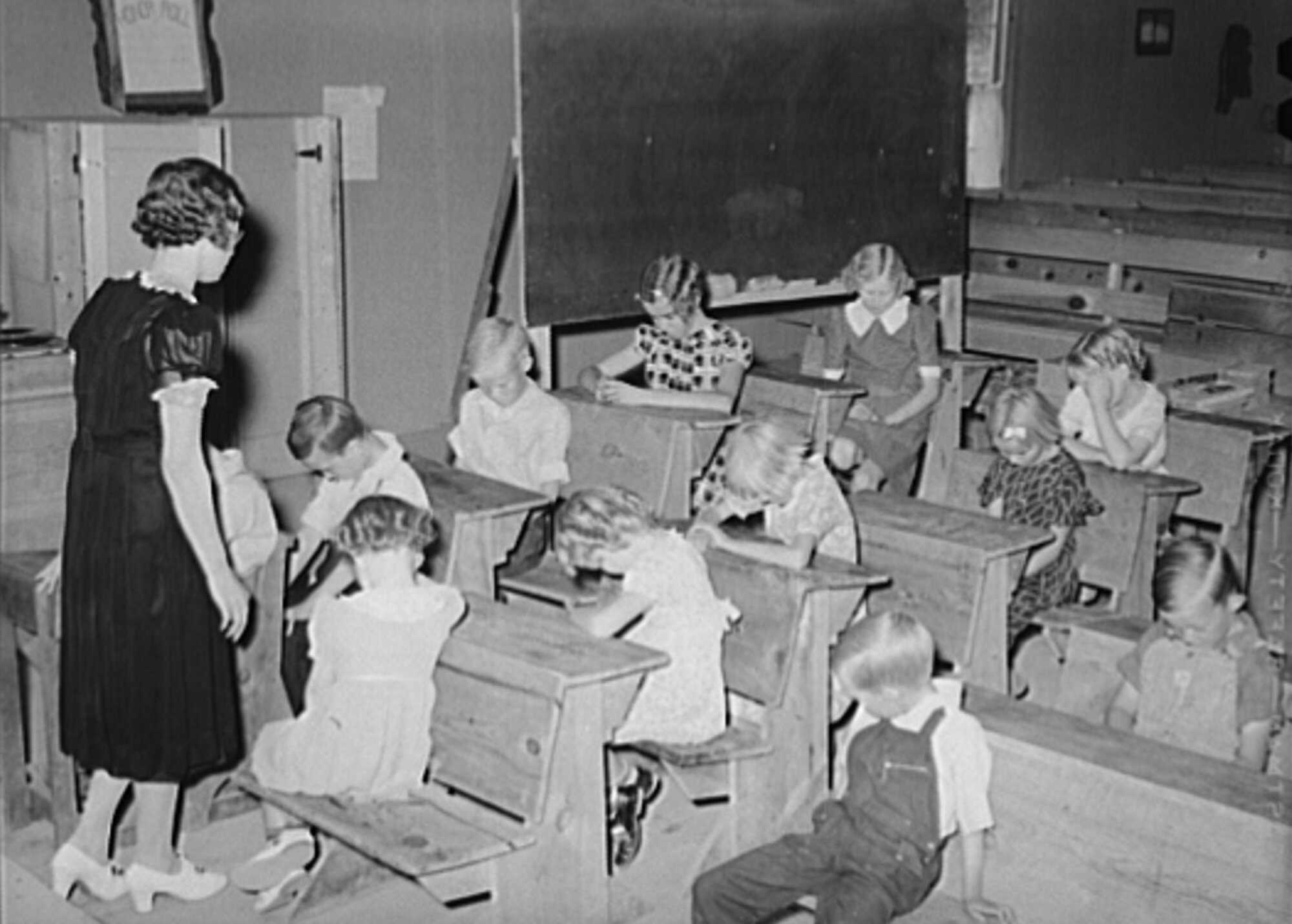
Students pray in a U.S. classroom, 1940. Source: Library of Congress
Politics and Religion
Education and Religion
U.S. Supreme Court and Religion
Previous Post

November 5, 2022
Piety and Peril: Life in Medieval Irish Monasteries
Next Post
November 12, 2022 The Problem With Bible Readings in U.S. Public Schools
Browse Our Archives
Select a Category Buddhism Christianity Daoism Hinduism Indigenous religions Islam Judaism Mysticism New Age Origins of religion Paganism Popes Popular Religious Movements Protestantism Psychology and religion Religion and current events Religion and folklore Religion and News Media Religion and politics Religious Art and Music Religious Freedom Religious mistakes Religious philosophy Religious scriptures Religious Violence science and religion Spiritualism Technology and religion The Catholic Church The Dalai Lama The Reformation Uncategorized
Select a Month September 2026 August 2026 July 2026 June 2026 April 2026 March 2026 February 2026 January 2026 December 2025 November 2025 October 2025 September 2025 August 2025 July 2025 June 2025 May 2025 April 2025 March 2025 February 2025 January 2025 December 2024 November 2024 October 2024 September 2024 August 2024 July 2024 June 2024 May 2024 April 2024 March 2024 February 2024 January 2024 December 2023 November 2023 October 2023 September 2023 August 2023 July 2023 June 2023 May 2023 April 2023 March 2023 February 2023 January 2023 December 2022 November 2022 October 2022 September 2022 August 2022
Follow Us!
TAKE THE
Religious Wisdom Quiz
According to Jeremiah 31:31, what did God promise to make with His people?
Select your answer to see how you score.
A new kingdom A new temple A new law A new covenant
Related posts from The Religious History Nerd

I Watched the Towers Fall. Here's What You...

Barring Mamdani From 9/11 Lets the Enemy Win

Is 'Separation of Church and State' Really a...

The President and the Pope: An Unprecedented Rift
TRENDING AT PATHEOS History and Religion

Looking at the Largest Orthodox Cathedral on Earth
There is often a considerable amount of anger and, shall we...

The Problem with False Prophets
Miller’s Station UMC| 10/18/26| Anchor Verse: Jeremiah 23: 1, 9-23 I...

Emotion in Early Christianity by Andrew Crislip
Andrew Crislip’s Emotion in Early Christianity examines an often overlooked dimension of...

16 Spiritual Touchstones for a More Grounded Life
After decades of spiritual study, here are 16 principles I try...

Catholic Evangelization: Sharing Your Faith Every Day
Welcome back to the Graceful Awakening mini-series called, “From Faith to Mission.” ...

The Pillar of the Boatmen: the Ancient Monument...
The Pillar of the Boatmen is a Romano-Gaulish sculpture that dates from...
view all History and Religion blogs
Ad-Free & Subscriber Log-In Subscription Support
- About Us
- 2026 Calendar
- Videos
- Podcasts
- Library of World Religions
- Faith In Media Tracker
- Advertise With Us
- Write for Us
- Privacy Policy
- Terms of Service
- Do Not Sell My Data
- Contact Us
- Radiant Digital
- Manage Newsletter Subscriptions
- Unsubscribe From Notifications
- Sitemap
Copyright 2008-2026, Patheos. All rights reserved.
Subscription Support Ad-Free & Subscriber Log-In
Follow Patheos