
BuddhistCatholicContemplativeEvangelicalGeneral ChristianHinduJewishLatter-day SaintMuslimNew VisionsProgressive Christian
Beliefs
- Buddhist
- Catholic
- Contemplative
- Evangelical
- General Christian
- Hindu
- Jewish
- Latter-day Saint
- More Voices
- Muslim
- New Visions
- Pagan
- Progressive Christian
Topics
- Religion News
- Food and Religion
- Sports and Religion
- Religious Art
- Religious Music and Entertainment
- Religious Events
- History and Religion
- Style and Religion
- Politics and Religion
- Women in Religion
- Recreation Outdoors and Religion
- Business Finance and Religion
- Careers Workplace and Religion
- Education and Religion
- Family Parenting and Religion
- Health Fitness and Religion
- Home and Religion
- Relationships and Religion
- Technology and Religion
- Travel and Religion
Columnists
- Buddhist Columnists
- Business Finance and Religion Columnists
- Careers Workplace and Religion Columnists
- Catholic Columnists
- Contemplative Columnists
- Education and Religion Columnists
- Evangelists Columnists
- Family Parenting and Religion Columnists
- General Christian Columnists
- Health Fitness and Religion Columnists
- Hindu Columnists
- History and Religion Columnists
- Home and Religion Columnists
- Jewish Columnists
- More Voices Columnists
- Latter Day Columnists
- Muslim Columnists
- New Visions Columnists
- Nonreligious Columnists
- Pagan Columnists
- Politics and Religion Columnists
- Progressive Columnists
- Recreation Outdoors and Religion Columnists
- Relationships and Religion Columnists
- Religion News Columnists
- Religious Art Columnists
- Religious Events Columnists
- Religious Music and Entertainment Columnists
- Sports and Religion Columnists
- Style and Religion Columnists
- Technology and Religion Columnists
- Travel and Religion Columnists
- Women in Religion Columnists
Resource Library
- 2026 Calendar
- Library of World Religions
- The 100 Most Holy Places on Earth
- Patheos Answers
- Podcasts
- Videos
- Faith Leaders Database
- Anglican Episcopalian
- Bahai
- Baptist
- Buddhism
- Christianity
- Confucianism
- Eastern Orthodoxy
- Hinduism
- Holiness and Pentecostal
- ISKCON
- Islam
- Judaism
- Lutheran
- Methodist
- The Church of Jesus Christ of Latter-day Saints
- New Age
- Paganism
- Presbytarian and Reformed
- Protestantism
- Religion Behind the Scenes
- Roman Catholic
- Scientology
- Shia Islam
- Sikhism
- Sufism
- Sunni Islam
- Taoism
- Zen
- See all religions
Research Tools
 Ad-Free & Subscriber Log-In Subscription Support
Ad-Free & Subscriber Log-In Subscription Support
Follow Patheos 

- Trending:
- Forgiveness
- |
- Marriage
- |
- Consciousness
- |
- Death Penalty
- |
- Election
- |
- Halloween

- Home
- Catholic
- History and Religion
- Piety and Peril: Life in Medieval Irish Monasteries
Piety and Peril: Life in Medieval Irish Monasteries
Last updated on: November 7, 2022 at 1:40 pm by Barbara O'Brien
Piety and Peril: Life in Medieval Irish Monasteries 2022-11-07T13:40:06-06:00 Barbara O'Brien
Patheos Explore the world's faith through different perspectives on religion and spirituality! Patheos has the views of the prevalent religions and spiritualities of the world.
The 6th to 8th centuries were a golden age for Irish monasteries. The hand copying of books first became a monastic practice in Ireland, at a time when Europe was dealing with the fall of Rome and the start of the Dark Ages. Until the 13th century every book produced in Europe was hand copied by Christian monks, and it was the Irish who refined the medieval art of book making (in the publishing sense!) and taught the rest of Europe. Irish monasteries were also centers of a renaissance in Celtic art. In this post I want to say more about the early history of Irish monasteries and why they were so special and so important.
Please note: History preserved a great deal of information about the lives of Irish monks but not as much about nuns, although we know there were nuns. One runs into the same problem with the history of Buddhist monasticism in China and elsewhere. In this post I’m going to adopt a practice that’s common among English-speaking Buddhists — using monastic and monastics as a gender-neutral term when referring to both nuns and monks, in the assumption that whatever was happening among monks could have been happening with nuns as well. Although we don’t always know.
The First Irish Monasteries
It’s believed monasticism was introduced to the Irish by Saint Patrick (ca. 385-461). Of course, at the very beginning there were no monasteries in Ireland. So at first most of those who took on the monastic life became hermits, following the practice of the Desert Fathers of Egypt. In his book How the Irish Saved Civilization, Thomas Cahill said the Irish hermits called themselves the Green Martyrs. “The Green Martyrs were those who, leaving behind the comforts and pleasures of ordinary human society, retreated to the woods, or to a mountaintop, or to a lonely island — to one of the green no-man’s-lands outside tribal jurisdictions — there to study the scriptures and commune with God,” Cahill wrote.
But soon small communities of monastics formed, usually living in small beehive-shaped huts near a church. In the 6th century the many monasteries that sprang up in Ireland were like small villages, usually contained within a wall. And while exact numbers are elusive, it’s believed that during this period the Irish population had a higher percentage of monastics than anywhere else in Europe.
Saints and Scholars
Possibly the first formal Irish monastic community was established by women in Kildare under the leadership of Saint Brigid (ca. 451-525). Another early monastic deserving of special mention was Saint Finnian of Clonard (470–549), who received monastic training in Wales and brought it back to Ireland. Finian is remembered as a gifted teacher who attracted students from the continent as well as throughout Ireland. Through the influence of Finian and other Irish monastics who valued scholarship, Irish monasteries became known as centers of learning. Monastics studied the work of great theologians and also the classics of Greece and Rome. This is reflected in the many books they left us that they hand copied. Ireland became the land of Saints and Scholars.
The Irish were the first European people who converted to Christianity without becoming Roman citizens first. So while the Catholic Church of the European continent had been shaped by Roman civilization, Irish monasticism developed in ways that were more, well, Irish. In the established monastic system of Europe, a bishop had exclusive jurisdiction within a given area or diocese. But Ireland in the 6th century wasn’t organized by diocese, and Irish monasteries formed loose networks based on whatever saint had founded them. In those days there was no Archbishop of Ireland or equivalent, and the Pope was very far away, so the Irish monastic system was less rigidly hierarchical and enjoyed unusual freedom of religious and artistic expression.
Life in medieval Irish monasteries was austere. Usually recitation of morning prayers began at dawn, and this might be followed by readings from the Gospels. Then monastics began their assigned work. Their only meal for the day would be at 3 p.m., “except during times of famine.” The work they did might include farm work, cooking, or building maintenance as well as book copying or other crafts. They continued the older craft of Celtic metalwork, creating such treasures as the Ardagh Chalice. Monastics were pastors and ministers to local laypeople and teachers of their children. Monastics also preserved much Irish history, folklore, and poetry.
And Then Came the Peril
Vikings first raided the Irish coast in 795. They soon realized that the richest places to plunder were the monasteries. Irish monasteries had defenses against ordinary thieves, but not Vikings. The raids continued into the 9th century, and the 10th. For a time Vikings occupied and controlled Dublin. Eventually the Vikings were defeated at Clontarf by High King Brian Boru in 1014, and the raids stopped. But until then, Irish monasteries remained in peril. Many monasteries were looted several times over periods of years. Many were completely destroyed. Irish monasticism continued after the Vikings were defeated, but it was not the same.
The illiterate raiders ruined books by ripping off and keeping the elaborate leather binders and tossing away the pages. The beautiful metalwork, often inlaid with gold, was of course highly prized. Coastal monasteries sent many items to places further inland, thought to be safer. This is how the famous Book of Kells came to be at Kells, roughly 50 km or 30 miles from the coast. More often monastics hastily buried books and precious metalware when they heard Vikings were coming. But if the community was massacred, as was often the case, there was no one to remember where objects were buried.
So it was that the Ardagh Chalice and several other exquisite items of metalwork were found in 1868 by two boys digging for potatoes. “In modern times, and still today, a farmer’s spade will occasionally uncover some lost treasure,” Thomas Cahill wrote in How the Irish Saved Civilization. Some hand-copied books were in the possession of families for generations, often out of sight until hard times caused the books to be put up for auction. So, much has been saved. But much was lost.
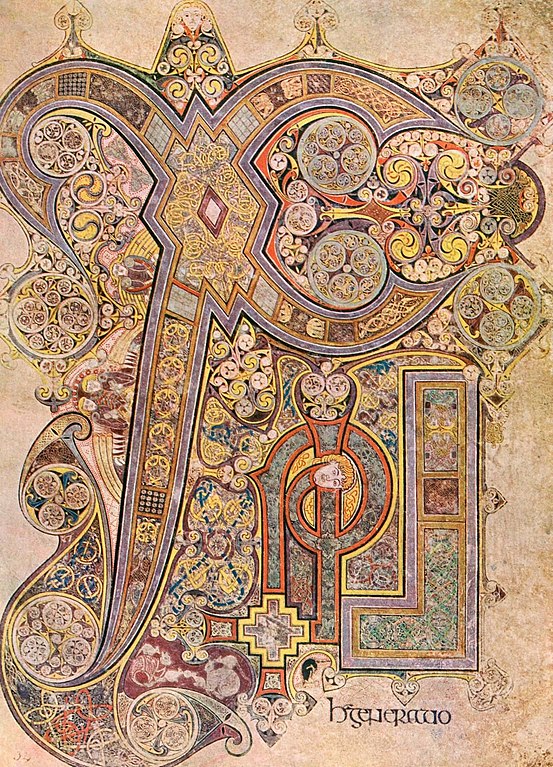
From the Book of Kells, ca. 800 CE, the illuminated Greek letters chi (Χ) and rho (Ρ), the first two letters of Christ (Χριστός). Source: Wikimedia Commons, public domain.
Catholic
Religious Art
Previous Post

November 2, 2022
Monastic Book Production in the Middle Ages
Next Post
November 10, 2022 When the U.S. Supreme Court Didn't Ban School Prayer
Browse Our Archives
Select a Category Buddhism Christianity Daoism Hinduism Indigenous religions Islam Judaism Mysticism New Age Origins of religion Paganism Popes Popular Religious Movements Protestantism Psychology and religion Religion and current events Religion and folklore Religion and News Media Religion and politics Religious Art and Music Religious Freedom Religious mistakes Religious philosophy Religious scriptures Religious Violence science and religion Spiritualism Technology and religion The Catholic Church The Dalai Lama The Reformation Uncategorized
Select a Month September 2026 August 2026 July 2026 June 2026 April 2026 March 2026 February 2026 January 2026 December 2025 November 2025 October 2025 September 2025 August 2025 July 2025 June 2025 May 2025 April 2025 March 2025 February 2025 January 2025 December 2024 November 2024 October 2024 September 2024 August 2024 July 2024 June 2024 May 2024 April 2024 March 2024 February 2024 January 2024 December 2023 November 2023 October 2023 September 2023 August 2023 July 2023 June 2023 May 2023 April 2023 March 2023 February 2023 January 2023 December 2022 November 2022 October 2022 September 2022 August 2022
Follow Us!
TAKE THE
Religious Wisdom Quiz
Which city did David conquer and make his capital?
Select your answer to see how you score.
Bethel Gibeon Jerusalem Hebron
Related posts from The Religious History Nerd

The President and the Pope: An Unprecedented Rift
What Was the Avignon Papacy and Why Is...
Thomas Aquinas on the Morality of War

TRENDING AT PATHEOS History and Religion

Looking at the Largest Orthodox Cathedral on Earth
There is often a considerable amount of anger and, shall we...

The Problem with False Prophets
Miller’s Station UMC| 10/18/26| Anchor Verse: Jeremiah 23: 1, 9-23 I...

Emotion in Early Christianity by Andrew Crislip
Andrew Crislip’s Emotion in Early Christianity examines an often overlooked dimension of...

16 Spiritual Touchstones for a More Grounded Life
After decades of spiritual study, here are 16 principles I try...

Catholic Evangelization: Sharing Your Faith Every Day
Welcome back to the Graceful Awakening mini-series called, “From Faith to Mission.” ...

The Pillar of the Boatmen: the Ancient Monument...
The Pillar of the Boatmen is a Romano-Gaulish sculpture that dates from...
view all History and Religion blogs
Ad-Free & Subscriber Log-In Subscription Support
- About Us
- 2026 Calendar
- Videos
- Podcasts
- Library of World Religions
- Faith In Media Tracker
- Advertise With Us
- Write for Us
- Privacy Policy
- Terms of Service
- Do Not Sell My Data
- Contact Us
- Radiant Digital
- Manage Newsletter Subscriptions
- Unsubscribe From Notifications
- Sitemap
Copyright 2008-2026, Patheos. All rights reserved.
Subscription Support Ad-Free & Subscriber Log-In
Follow Patheos