
BuddhistCatholicContemplativeEvangelicalGeneral ChristianHinduJewishLatter-day SaintMuslimNew VisionsProgressive Christian
Beliefs
- Buddhist
- Catholic
- Contemplative
- Evangelical
- General Christian
- Hindu
- Jewish
- Latter-day Saint
- More Voices
- Muslim
- New Visions
- Pagan
- Progressive Christian
Topics
- Religion News
- Food and Religion
- Sports and Religion
- Religious Art
- Religious Music and Entertainment
- Religious Events
- History and Religion
- Style and Religion
- Politics and Religion
- Women in Religion
- Recreation Outdoors and Religion
- Business Finance and Religion
- Careers Workplace and Religion
- Education and Religion
- Family Parenting and Religion
- Health Fitness and Religion
- Home and Religion
- Relationships and Religion
- Technology and Religion
- Travel and Religion
Columnists
- Buddhist Columnists
- Business Finance and Religion Columnists
- Careers Workplace and Religion Columnists
- Catholic Columnists
- Contemplative Columnists
- Education and Religion Columnists
- Evangelists Columnists
- Family Parenting and Religion Columnists
- General Christian Columnists
- Health Fitness and Religion Columnists
- Hindu Columnists
- History and Religion Columnists
- Home and Religion Columnists
- Jewish Columnists
- More Voices Columnists
- Latter Day Columnists
- Muslim Columnists
- New Visions Columnists
- Nonreligious Columnists
- Pagan Columnists
- Politics and Religion Columnists
- Progressive Columnists
- Recreation Outdoors and Religion Columnists
- Relationships and Religion Columnists
- Religion News Columnists
- Religious Art Columnists
- Religious Events Columnists
- Religious Music and Entertainment Columnists
- Sports and Religion Columnists
- Style and Religion Columnists
- Technology and Religion Columnists
- Travel and Religion Columnists
- Women in Religion Columnists
Resource Library
- 2026 Calendar
- Library of World Religions
- The 100 Most Holy Places on Earth
- Patheos Answers
- Podcasts
- Videos
- Faith Leaders Database
- Anglican Episcopalian
- Bahai
- Baptist
- Buddhism
- Christianity
- Confucianism
- Eastern Orthodoxy
- Hinduism
- Holiness and Pentecostal
- ISKCON
- Islam
- Judaism
- Lutheran
- Methodist
- The Church of Jesus Christ of Latter-day Saints
- New Age
- Paganism
- Presbytarian and Reformed
- Protestantism
- Religion Behind the Scenes
- Roman Catholic
- Scientology
- Shia Islam
- Sikhism
- Sufism
- Sunni Islam
- Taoism
- Zen
- See all religions
Research Tools
 Ad-Free & Subscriber Log-In Subscription Support
Follow Patheos 

- Trending:
- Advent
- |
- Forgiveness
- |
- Thanksgiving
- |
- Election
- |
- Seasonal Holidays
- |
- Marriage

- Home
- Catholic
- History and Religion
- Monastic Book Production in the Middle Ages
Monastic Book Production in the Middle Ages
Last updated on: November 7, 2022 at 8:35 am by Barbara O'Brien
Monastic Book Production in the Middle Ages 2022-11-07T08:35:16-06:00 Barbara O'Brien
Patheos Explore the world's faith through different perspectives on religion and spirituality! Patheos has the views of the prevalent religions and spiritualities of the world.
Monastic book production in the Middle Ages began in Ireland. This is recorded in the book How the Irish Saved Civilization by Thomas Cahill. The book tells the story of how Irish Christian monks preserved much of the knowledge and literature of Greek and Roman antiquity after the fall of Rome, thereby saving civilization. The Irish monks did this by copying every manuscript they could find. They didn’t stop at Bibles. They copied Virgil’s Aeneid and the treatises of Cicero and Plato’s Republic. And more. And then they traveled eastward to Britain and the European continent to spread knowledge of book making and love of literature. From the 5th to the 13th century every book produced in Europe was hand copied by Christian monks.
Thomas Cahill died recently, which inspired me to re-read How the Irish Saved Civilization. The book was a best seller that caused quite a stir when it was first published in 1995. It received glowing reviews, although some critics griped that Cahill’s claims for the role of the Irish in saving civilization was overstated. Still, it’s a grand book that begins in 406, right before great hosts of barbarian tribes — Visigoths, Ostrogoths, Vandals, Franks, etc., who in turn were being invaded by Huns — swarmed across a frozen Rhine River in Gaul to attack the Roman legions on the other side. By about 476 the western half of the Roman Empire, including all of it in modern-day Italy, had disappeared. Rome’s fall began the Dark Ages. Thomas Cahill argued that had the Irish monks not made copies of the great books of antiquity, they might have been forever lost.
Ireland was never part of Rome’s civilization. By most accounts it was a wild and violent place. Some time late in the 4th century a 16-year-old boy of Britain named Patricius was captured by Irish raiders and sold into slavery in Ireland. After six years of hardship he escaped and returned to his family. Patricius became a priest and returned to Ireland to convert the Irish to Christianity. Today Patricius is better known as Saint Patrick (ca. 385-461; in Irish Gaelic, he is Naomh Pádraig). Patrick introduced Christian monasticism to the Irish, who took to it with much enthusiasm. Monasteries multiplied. By 600 CE the Irish were the most monasticized people in Europe.
How Medieval Christian Monks Produced Books
Monastic book production in the Middle Ages was more than just copying. The monks were involved in all aspects of book creation, including the materials. Paper had been invented in China about 150 CE, but there was no paper in Europe before the 11th century or so. Instead, monks made parchment from animal hides that were cleaned, stretched, and bleached. The best quality parchment, called vellum, was made from calves’ skin. The finished pages were sewn into leather bindings with thongs. In the later Middle Ages, large books often were bound with wooden boards covered in leather, which made them very heavy.
The monks who did the copying were called scriptores, and they worked in large rooms called scriptoriums that were filled with wooden chairs and writing tables. Usually a rule of silence was maintained during working hours. A senior monk would supervise, maintaining discipline and assigning pages to be copied. Some sources say the scriptores worked only during daylight to avoid the fire hazard of candles, but Cahill’s Irish monks left us accounts of working late into the night. And we know the scriptores did not always enjoy their work, because sometimes they left complaints in the margins.
Illuminated Books
The illumination of books meant decorating them with painted illustrations and ornamentation, usually using inks mixed with silver and gold. Illumination probably began in Muslim countries with the decoration of Qurans. In Europe, the great age of illumination is said to have begun about 1100 CE, but the Celts of Britain and Ireland were producing illuminated books much earlier. One of the most celebrated illuminated books is the Book of Kells, believed to have been created about 800 CE. The Book of Kells contains the four Gospels with some other texts, in Latin. It is considered the finest example of “insular” art (from insula, “island”), a style that originated in Ireland and spread to Britain. Insular art combined traditional Celtic and Anglo-Saxon styles and motifs.
Creating an illuminated book required planning the pages in advance, determining where there would be text and where there would be illustration. The vellum pages were marked with lines for the text, leaving blanks for the art. The text was written first, usually in black ink but sometimes in gold or another color. After pages were proofread, another monk would add chapter titles and subtitles in a bright colored ink. Then the page was passed on to the illuminator, who painted the images and added the gold illumination.
Obviously, a labor-intensive illuminated book was an expensive thing. A particularly gorgeous Bible would have been the pride of any church or monastery housing it. In the later Middle Ages, illuminated prayer books, or books of hours, were much in demand by the wealthy nobility of Europe. These books probably were big money-makers for the monasteries. And this may have been why the monastic monopoly on book production ended in the 14th century, when laypeople went into the illuminated book business. But the hand-copied book industry was dealt a fatal blow in 1452, when Johannes Gutenberg used movable type and a printing press to publish a Bible.
Next: Piety and Peril: Life in Medieval Irish Monasteries
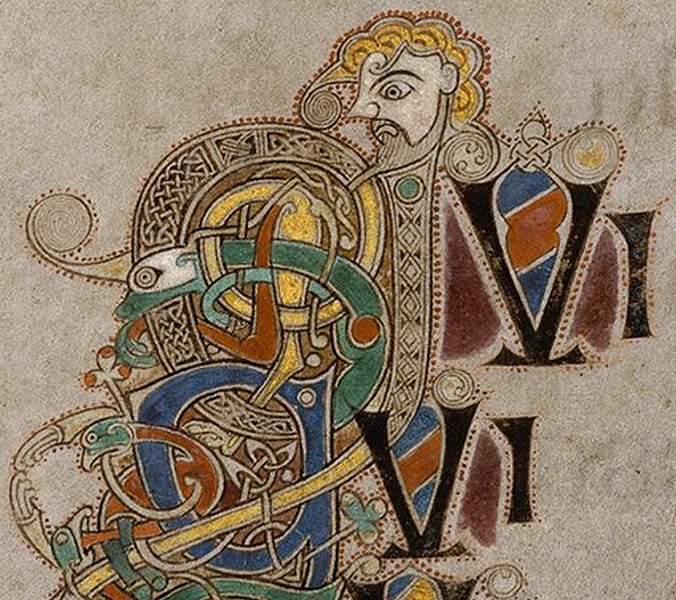
A detail from the Book of Kells. Source: Wikimedia Commons, public domain.
Catholic
Religious Art

Next Post

November 5, 2022 Piety and Peril: Life in Medieval Irish Monasteries
Browse Our Archives
Select a Category Buddhism Christianity Daoism Hinduism Indigenous religions Islam Jaina Judaism Mysticism New Age Origins of religion Paganism Popes Popular Religious Movements Protestantism Psychology and religion Religion and current events Religion and folklore Religion and News Media Religion and politics Religious Art and Music Religious Freedom Religious mistakes Religious philosophy Religious scriptures Religious Violence science and religion Spiritualism Technology and religion The Catholic Church The Dalai Lama The Reformation Uncategorized
Select a Month November 2026 October 2026 September 2026 August 2026 July 2026 June 2026 April 2026 March 2026 February 2026 January 2026 December 2025 November 2025 October 2025 September 2025 August 2025 July 2025 June 2025 May 2025 April 2025 March 2025 February 2025 January 2025 December 2024 November 2024 October 2024 September 2024 August 2024 July 2024 June 2024 May 2024 April 2024 March 2024 February 2024 January 2024 December 2023 November 2023 October 2023 September 2023 August 2023 July 2023 June 2023 May 2023 April 2023 March 2023 February 2023 January 2023 December 2022 November 2022 October 2022 September 2022 August 2022
Follow Us!
TAKE THE
Religious Wisdom Quiz
Which book of the Bible contains the "Armor of God" passage?
Select your answer to see how you score.
Ephesians Galatians Romans Colossians
Related posts from The Religious History Nerd
The President and the Pope: An Unprecedented Rift
What Was the Avignon Papacy and Why Is...
Thomas Aquinas on the Morality of War

TRENDING AT PATHEOS History and Religion

God and the Contingency of This World
The great Catholic philosopher Aquinas and the great Lutheran philosopher Leibniz developed...

Pope Francis and The Devil – A Pagan...
According to his private diaries, Pope Francis saw visions of the devil...

Rock N' Roll-- Morphing into/for a New Generation...
Well, should we be grateful, or is rock n' roll just dead? ...

Ansley Gordon Brings Faith and Fresh Stories to...
For screenwriter and actress Ansley Gordon, Christmas has always been about more...

Chris Pratt on Veterans, Faith, “The Way of...
For Chris Pratt, service is not something that ends when a person...

Chapter 5, Sarah: The Quest for Safety in...
Open and Relational Theology & Social Psychology About this series: This series...
view all History and Religion blogs
Ad-Free & Subscriber Log-In Subscription Support
- About Us
- 2026 Calendar
- Videos
- Podcasts
- Library of World Religions
- Faith In Media Tracker
- Advertise With Us
- Write for Us
- Privacy Policy
- Terms of Service
- Do Not Sell My Data
- Contact Us
- Radiant Digital
- Manage Newsletter Subscriptions
- Unsubscribe From Notifications
- Sitemap
Copyright 2008-2026, Patheos, part of the Radiant Digital network of media brands. All rights reserved.
Subscription Support Ad-Free & Subscriber Log-In
Follow Patheos