
BuddhistCatholicContemplativeEvangelicalGeneral ChristianHinduJewishLatter-day SaintMuslimNew VisionsProgressive Christian
Beliefs
- Buddhist
- Catholic
- Contemplative
- Evangelical
- General Christian
- Hindu
- Jewish
- Latter-day Saint
- More Voices
- Muslim
- New Visions
- Pagan
- Progressive Christian
Topics
- Religion News
- Food and Religion
- Sports and Religion
- Religious Art
- Religious Music and Entertainment
- Religious Events
- History and Religion
- Style and Religion
- Politics and Religion
- Women in Religion
- Recreation Outdoors and Religion
- Business Finance and Religion
- Careers Workplace and Religion
- Education and Religion
- Family Parenting and Religion
- Health Fitness and Religion
- Home and Religion
- Relationships and Religion
- Technology and Religion
- Travel and Religion
Columnists
- Buddhist Columnists
- Business Finance and Religion Columnists
- Careers Workplace and Religion Columnists
- Catholic Columnists
- Contemplative Columnists
- Education and Religion Columnists
- Evangelists Columnists
- Family Parenting and Religion Columnists
- General Christian Columnists
- Health Fitness and Religion Columnists
- Hindu Columnists
- History and Religion Columnists
- Home and Religion Columnists
- Jewish Columnists
- More Voices Columnists
- Latter Day Columnists
- Muslim Columnists
- New Visions Columnists
- Nonreligious Columnists
- Pagan Columnists
- Politics and Religion Columnists
- Progressive Columnists
- Recreation Outdoors and Religion Columnists
- Relationships and Religion Columnists
- Religion News Columnists
- Religious Art Columnists
- Religious Events Columnists
- Religious Music and Entertainment Columnists
- Sports and Religion Columnists
- Style and Religion Columnists
- Technology and Religion Columnists
- Travel and Religion Columnists
- Women in Religion Columnists
Resource Library
- 2026 Calendar
- Library of World Religions
- The 100 Most Holy Places on Earth
- Patheos Answers
- Podcasts
- Videos
- Faith Leaders Database
- Anglican Episcopalian
- Bahai
- Baptist
- Buddhism
- Christianity
- Confucianism
- Eastern Orthodoxy
- Hinduism
- Holiness and Pentecostal
- ISKCON
- Islam
- Judaism
- Lutheran
- Methodist
- The Church of Jesus Christ of Latter-day Saints
- New Age
- Paganism
- Presbytarian and Reformed
- Protestantism
- Religion Behind the Scenes
- Roman Catholic
- Scientology
- Shia Islam
- Sikhism
- Sufism
- Sunni Islam
- Taoism
- Zen
- See all religions
Research Tools
 Ad-Free & Subscriber Log-In Subscription Support
Ad-Free & Subscriber Log-In Subscription Support
Follow Patheos 

- Trending:
- Forgiveness
- |
- Marriage
- |
- Consciousness
- |
- Death Penalty
- |
- Election
- |
- Halloween

- Home
- Interfaith
- History and Religion
- Jefferson’s Wall of Separation Between Church and State
Jefferson’s Wall of Separation Between Church and State
Last updated on: November 23, 2022 at 11:58 am by Barbara O'Brien
Jefferson’s Wall of Separation Between Church and State 2022-11-23T11:58:45-06:00 Barbara O'Brien
Patheos Explore the world's faith through different perspectives on religion and spirituality! Patheos has the views of the prevalent religions and spiritualities of the world.
There is no more controversial phrase in U.S. history than Thomas Jefferson’s “wall of separation between church and state.” It first appeared in a letter written by Jefferson in 1802, while he was President of the United States, and it began to turn up in Supreme Court opinions in the 19th century.
Jefferson’s metaphorical wall of separation between church and state is routinely disparaged by religious conservatives to this day. Many Christian Nationalists want to abolish it. Some members of the current U.S. Supreme Court seem determined to knock it down also. Let’s take a look at where the phrase comes from and what Thomas Jefferson meant by it.
Established Religion in Early Connecticut
Our story begins in Connecticut. In the early days of the United States, several states had established religions. In Connecticut, this was the Congregational church. Congregationalism was originally Puritanism, and Puritans were early settlers in the territory that would become Connecticut. The charter that established the Colony of Connecticut, issued by King Charles II in 1662, affirmed that Connecticut would continue to be a Puritan colony. This bit of history is explained in more detail here.
Anyone living in Connecticut who was not a Puritan/Congregationalist could be fined, banished, imprisoned, or confined in stocks. Early in the 1700s the colony liberalized its laws a bit and gave Christians of other denominations, or “dissenters,” permission to live in Connecticut without punishment. However, the “dissenters” had to register with the town clerk, and they were still required to pay taxes to support Puritan/Congregational churches. Jewish congregations were not allowed to incorporate in Connecticut until 1843.
After independence, the Congregational church remained the established church of the state of Connecticut. And this takes us to a letter written to President Thomas Jefferson by some Baptists in Danbury, Connecticut.
The Danbury Baptists Write to President Jefferson
You can read the entire letter on this National Archives web page. The letter is from the Danbury Baptist Association, which consisted of twenty-six Baptists churches, mostly in western Connecticut. The letter is dated “after 17 October 1801.” The National Archives note says, “At its October 1800 meeting, the association initiated a petition movement to redress the grievances of the dissenting minority against the Congregationalist majority in the region.”
The Baptists wanted to rally other “dissenter” denominations to call for repeal of all Connecticut laws supporting established religion. At an 1801 meeting, it was resolved to write to the newly inaugurated — on March 4, 1801 — President Jefferson, to get his endorsement for their cause. They knew that President Jefferson opposed establishment of religion and that he wrote the bill that had disestablished the Anglican church in Virginia.
Here is a portion of the letter, complete with original spelling.
Our Sentiments are uniformly on the side of Religious Liberty—That Religion is at all times and places a Matter between God and Individuals—That no man aught to suffer in Name, person or effects on account of his religious Opinions—That the legetimate Power of civil Goverment extends no further than to punish the man who works ill to his neighbour: But Sir, our constitution of goverment is not specific. Our antient charter, together with the Laws made coincident therewith, were adopted as the Basis of our goverment, At the time of our revolution; and such had been our Laws & usages, & such still are; that religion is consider’d as the first object of Legislation; & therefore what religious privileges we enjoy (as a minor part of the State) we enjoy as favors granted, and not as inalienable rights: and these favors we receive at the expence of such degrading acknowledgements as are inconsistant with the rights of freemen.
President Jefferson’s Reply to the Danbury Baptists
Jefferson’s reply, dated January 1, 1802, also can be read online at the National Archives website. Here is the paragraph that Americans are still arguing about (emphasis added) —
Believing with you that religion is a matter which lies solely between Man & his God, that he owes account to none other for his faith or his worship, that the legitimate powers of government reach actions only, & not opinions, I contemplate with sovereign reverence that act of the whole American people which declared that their legislature should “make no law respecting an establishment of religion, or prohibiting the free exercise thereof,” thus building a wall of separation between Church & State. Adhering to this expression of the supreme will of the nation in behalf of the rights of conscience, I shall see with sincere satisfaction the progress of those sentiments which tend to restore to man all his natural rights, convinced he has no natural right in opposition to his social duties.
Whether Jefferson’s letter had much effect I do not know, but Connecticut did disestablish the Congregational church in 1818.
What Jefferson, and Madison, Meant
In this letter, Jefferson clearly was using the wall of separation between church and state as a metaphor to explain the establishment and free exercise clauses of the First Amendment to the Constitution — “Congress shall make no law respecting an establishment of religion, or prohibiting the free exercise thereof.” “Establishment of religion” is explained in more detail in the previous post, Thomas Jefferson v. Establishment of Religion.
James Madison was the author of the First Amendment, and he and Jefferson had a well documented history of supporting each other’s work in the matter of religious liberty. (See also James Madison and Religious Liberty.) If you claim to be an “originalist,” dedicated to interpreting the Constitution to mean what the men who wrote it meant, you must accept that the establishment clause means what Madison and Jefferson said it meant. But this is something many conservatives, both religious and political, in the U.S. have refused to do lo these many years.
Madison and Jefferson believed that neither the government nor society should be allowed to coerce people to attest to religious beliefs or engage in religious practices. And this protection of individual liberty, in Jefferson’s words, extends to “the Jew and the Gentile, the Christian and Mahometan, the Hindoo, and Infidel of every denomination.” We might have preferred that Jefferson had not used the word “infidel,” but let’s go on.
True First Amendment Originalism
In brief, from their writing it’s clear that by “establishment of religion” Madison and Jefferson weren’t just referring to the designation of an official state religion, but any action taken by government that might coerce citizens into sectarian religious acts or penalize citizens for their beliefs. Originally this prohibition only applied to the federal government. But then the Fourteenth Amendment, ratified in 1868, provided that “No State shall make or enforce any law which shall abridge the privileges or immunities of citizens of the United States.” Courts have determined that this, in effect, makes the First Amendment (and other amendments) applicable to state and local governments as well.
The Wall of Separation and the Supreme Court
The “wall of separation between church and state” first appeared in a Supreme Court opinion in Reynolds v. United States (1879). In this case, the Court decided that members of the Church of Latter-Day Saints were not exempt from polygamy laws because of their religious beliefs. In the majority opinion, Chief Justice Morrison Waite also quoted Jefferson’s Virginia Statute for Religious Liberty and James Madison’s “Memorial and Remonstrance against Religious Assessments.” The Chief Justice argued that it was not a violation of “free exercise” to require the Saints to obey laws everyone else obeyed.
Justice Hugo Black’s opinion in Everson v. Board of Education (1947) was the first that applied the First Amendment’s establishment clause to the states. In this case a New Jersey taxpayer objected to tax money being used to help pay for buses for parochial school students. Justice Black referred to Jefferson’s 1802 letter, saying, “The First Amendment has erected a wall between church and state. That wall must be kept high and impregnable. We could not approve the slightest breach.” However, “New Jersey has not breached it here.” The majority argued that transportation to and from schools was a benefit to the students and their parents, not to a church.
This was a 5-4 decision, and only the first of many that made fine distinctions of exactly where the wall stood. See also When the U.S. Supreme Court Didn’t Ban School Prayer and The Problem With Bible Readings in U.S. Public Schools.
Conservatives Still Don’t Like It
The argument one hears, over and over and over and over and over, etc., from religious conservatives is that the words “wall of separation between church and state” do not appear in the U.S. Constitution. Therefore, there is no such wall.
However, again, Jefferson used the phrase as a metaphor to explain the establishment and free exercise clauses of the First Amendment, which is definitely in the Constitution. It’s very common for judges to refer to the writings of the founders when discussing constitutional issues, in order to clarify what the founders meant. And, again, if we’re trying to be “originalists,” these clauses mean what Madison and Jefferson said they mean. And Jefferson said they erect a wall of separation between church and state.
Next: Arguments against separation of church and state.
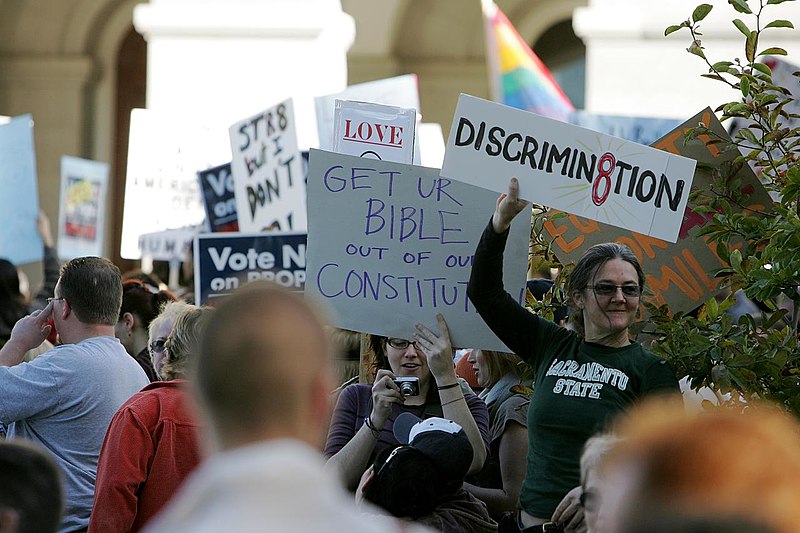
People protesting the passage of Proposition 8, the anti-gay marriage initiative, at the California State Capitol in Sacramento on Sunday, November 9, 2008. Photo copyright Kelly B. Huston. Source: Wikimedia Commons, Creative Commons Attribution 2.0 Generic license.
Interfaith
General Christian
Previous Post

November 18, 2022
Thomas Jefferson v. Establishment of Religion
Next Post
November 23, 2022 Arguments Against the Wall of Separation Between Church and State
Browse Our Archives
Select a Category Buddhism Christianity Daoism Hinduism Indigenous religions Islam Judaism Mysticism New Age Origins of religion Paganism Popes Popular Religious Movements Protestantism Psychology and religion Religion and current events Religion and folklore Religion and News Media Religion and politics Religious Art and Music Religious Freedom Religious mistakes Religious philosophy Religious scriptures Religious Violence science and religion Spiritualism Technology and religion The Catholic Church The Dalai Lama The Reformation Uncategorized
Select a Month September 2026 August 2026 July 2026 June 2026 April 2026 March 2026 February 2026 January 2026 December 2025 November 2025 October 2025 September 2025 August 2025 July 2025 June 2025 May 2025 April 2025 March 2025 February 2025 January 2025 December 2024 November 2024 October 2024 September 2024 August 2024 July 2024 June 2024 May 2024 April 2024 March 2024 February 2024 January 2024 December 2023 November 2023 October 2023 September 2023 August 2023 July 2023 June 2023 May 2023 April 2023 March 2023 February 2023 January 2023 December 2022 November 2022 October 2022 September 2022 August 2022
Follow Us!
TAKE THE
Religious Wisdom Quiz
Which major world religion traces its ancestry back to Abraham, along with Christianity and Judaism?
Select your answer to see how you score.
Hinduism Islam Buddhism Sikhism
Related posts from The Religious History Nerd

I Watched the Towers Fall. Here's What You...

Barring Mamdani From 9/11 Lets the Enemy Win

Is 'Separation of Church and State' Really a...

The President and the Pope: An Unprecedented Rift
TRENDING AT PATHEOS History and Religion

Nearly every morning, I make the drive to Detroit with my high-school-age...

The Real AI Story Is Adoption Without Trust
Artificial intelligence has crossed a political threshold. It is no longer a...

A new article, written by Jeff Lindsay and Gale L. Pooley,...

Swimfan: Forgotten Aughts Pleasures
This is a recovery effort. In 2002, My Big Fat Greek Wedding...

Top Three Anti-Catholic Lies About Catholicism
This is my initial transcript for the video, "THE 3 WORST...

Pope Leo Celebrates Mass for Nurses & Docs...
I don't have any idea how he did it, but Pope Leo...
view all History and Religion blogs
Ad-Free & Subscriber Log-In Subscription Support
- About Us
- 2026 Calendar
- Videos
- Podcasts
- Library of World Religions
- Faith In Media Tracker
- Advertise With Us
- Write for Us
- Privacy Policy
- Terms of Service
- Do Not Sell My Data
- Contact Us
- Radiant Digital
- Manage Newsletter Subscriptions
- Unsubscribe From Notifications
- Sitemap
Copyright 2008-2026, Patheos. All rights reserved.
Subscription Support Ad-Free & Subscriber Log-In
Follow Patheos