
BuddhistCatholicContemplativeEvangelicalGeneral ChristianHinduJewishLatter-day SaintMuslimNew VisionsProgressive Christian
Beliefs
- Buddhist
- Catholic
- Contemplative
- Evangelical
- General Christian
- Hindu
- Jewish
- Latter-day Saint
- More Voices
- Muslim
- New Visions
- Pagan
- Progressive Christian
Topics
- Religion News
- Food and Religion
- Sports and Religion
- Religious Art
- Religious Music and Entertainment
- Religious Events
- History and Religion
- Style and Religion
- Politics and Religion
- Women in Religion
- Recreation Outdoors and Religion
- Business Finance and Religion
- Careers Workplace and Religion
- Education and Religion
- Family Parenting and Religion
- Health Fitness and Religion
- Home and Religion
- Relationships and Religion
- Technology and Religion
- Travel and Religion
Columnists
- Buddhist Columnists
- Business Finance and Religion Columnists
- Careers Workplace and Religion Columnists
- Catholic Columnists
- Contemplative Columnists
- Education and Religion Columnists
- Evangelists Columnists
- Family Parenting and Religion Columnists
- General Christian Columnists
- Health Fitness and Religion Columnists
- Hindu Columnists
- History and Religion Columnists
- Home and Religion Columnists
- Jewish Columnists
- More Voices Columnists
- Latter Day Columnists
- Muslim Columnists
- New Visions Columnists
- Nonreligious Columnists
- Pagan Columnists
- Politics and Religion Columnists
- Progressive Columnists
- Recreation Outdoors and Religion Columnists
- Relationships and Religion Columnists
- Religion News Columnists
- Religious Art Columnists
- Religious Events Columnists
- Religious Music and Entertainment Columnists
- Sports and Religion Columnists
- Style and Religion Columnists
- Technology and Religion Columnists
- Travel and Religion Columnists
- Women in Religion Columnists
Resource Library
- 2026 Calendar
- Library of World Religions
- The 100 Most Holy Places on Earth
- Patheos Answers
- Podcasts
- Videos
- Faith Leaders Database
- Anglican Episcopalian
- Bahai
- Baptist
- Buddhism
- Christianity
- Confucianism
- Eastern Orthodoxy
- Hinduism
- Holiness and Pentecostal
- ISKCON
- Islam
- Judaism
- Lutheran
- Methodist
- The Church of Jesus Christ of Latter-day Saints
- New Age
- Paganism
- Presbytarian and Reformed
- Protestantism
- Religion Behind the Scenes
- Roman Catholic
- Scientology
- Shia Islam
- Sikhism
- Sufism
- Sunni Islam
- Taoism
- Zen
- See all religions
Research Tools
 Ad-Free & Subscriber Log-In Subscription Support
Ad-Free & Subscriber Log-In Subscription Support
Follow Patheos 

- Trending:
- Forgiveness
- |
- Marriage
- |
- Consciousness
- |
- Death Penalty
- |
- Election
- |
- Halloween

- Home
- History and Religion
- The Evolution of Witches
The Evolution of Witches
Last updated on: October 19, 2022 at 10:43 pm by Barbara O'Brien
The Evolution of Witches 2022-10-19T22:43:21-05:00 Barbara O'Brien
Patheos Explore the world's faith through different perspectives on religion and spirituality! Patheos has the views of the prevalent religions and spiritualities of the world.
The last post was on the history of witches and how the European witch was mostly an invention of the Catholic Church in the Middle Ages. Now let’s look more closely at the evolution of witches, especially the classic Hallowe’en witch, in religion and popular culture.
Hallowe’en itself definitely has origins in pre-Christian European paganism. It evolved from a Celtic festival that marked the end of harvest and the beginning of winter — Samhain in Ireland, or Calan Gaeaf in Wales. This was a time when the aes sídhe, or fairies, were about, along with many other frightening creatures of myth. And the souls of the dead were able to invisibly visit their old homes.
Historians and anthropologists insist that witches, or anything resembling witches, were not part of Celtic pagan culture, however. (Or warlocks, either. The original Merlin of pre-Christian Welsh folklore was not a sorcerer but a bard named Myrddin who had a gift of prophecy.) There was a belief in German paganism, the Odin-worshiping people, that there were magicians who could do harm to others by casting spells, but that’s about it. The notion that the women persecuted as witches in the Middle Ages were the remnants of some older pagan tradition is a fanciful notion first popularized in the early 20th century, they say.
The earliest illustrations of witches do not depict green women wearing black dresses and pointed hats. Generally witches were drawn to look like older peasant women, in common peasant woman clothes. Sometimes they were bare-headed and naked. So how did these early examples evolve into the Hallowe’en witch?
Why Witches Wear Pointy Hats
I’ve always thought the coolest thing about witches is the hat. The classic witch hat made its first appearance in 18th century children’s book illustrations in Britain. No one knows why. There are many theories, and this 2013 article by Katy Waldman at Slate explores several of them. The theories all seem a bit strained to me, however. For example, it’s safe to assume that the tall, pointed felt hats found on 6,000-year-old Chinese mummies were not an influence on 18th century European illustrators, especially since the mummies weren’t discovered until the 20th century.
Tall, black felt hats with broad brims were common headgear in western Europe for men and women in the 17th and 18th centuries, but not pointed black felt hats with broad brims. I believe the only pointed hats that would have been familiar in 18th century western Europe were the tall, pointed hennins worn by noblewomen in the late Middle Ages. Those were long out of style by the 18th century, but they were still remembered. In the early Middle Ages, in parts of Europe, Jewish men were required to wear a pointed brimmed hat, but they didn’t look that much like witch’s hats to me.

My suspicion is that some popular 18th century illustrator drew witches with pointy hats, and it caught with other illustrators. However the hat originated, I think we can all agree that the classic witch hat reached its peak of rakish style on the head of the actress Margaret Hamilton, in the 1939 film The Wizard of Oz. The head costume designer for the film was a fellow named Adrian Greenburg, but I don’t know if he is the one who designed the awesome hat.
Why Witches Fly on Broomsticks
Sarah Pruitt wrote for the History Channel that the first witch to admit to riding brooms through the air was Guillaume Edelin, a priest from Saint-Germain-en-Laye, near Paris. Edelin was arrested for practicing witchcraft in 1453 after publicly criticizing the Church’s increasingly hysterical warnings about witches. He confessed under torture but was not executed, as he surely would have been a century later.
Stories about witches riding broomsticks were known to have circulated before Guillaume Edelin’s confession. No one can say how the stories originated. One anthropologist has suggested a connection to a pagan practice of farmers, who danced around under the full moon astride a pitchfork or broomstick to ensure bountiful crops. Maybe. Another proposal is that medieval witches’ brews contained plants with hallucinogenic properties — belladonna, henbane, mandrake, etc. — that caused people to believe they were flying on brooms. But that assumes there were real witches who brewed things. History these days assumes witches were mostly figments of collective imagination.
Some of these plants, henbane and mandrake especially, have been used in medicines going back to far more ancient times (note that these are very dangerous, poisonous plants). And once upon a time women applied drops of the very poisonous belladonna to their eyes to make their eyes more beautiful (note that prolonged use caused blindness). It’s not impossible there were people experimenting with making medicines who got too big a dose and imagined themselves flying. That doesn’t tell us where they got the brooms, though.
Herbs are also suggested to be the source of a witch’s green skin. I’m not sure that witches were always supposed to have green skin, although several in popular culture these days certainly do.
The Continuing Evolution of Witches
The witch of the Middle Ages was a purely evil creature who worked for Satan. By the 19th century, the witches of popular fiction had evolved into a far more varied crew. It was during this period that witches lost their connection to Satan and went to work for themselves. There were still evil witches, but there also were benevolent fairy witches and sorceresses of various temperaments. By the late 19th century people were imagining connections between witches and pre-Christian paganism that the scholars say really are not valid.
In the 20th century, more witches became benevolent. Who could be more wholesome than Glenda, the Witch of the South of The Wizard of Oz? (Although in the musical Wicked she’s a bit more complicated.) Or Samantha of the popular 1960s television sitcom Bewitched, played by Elizabeth Montgomery? Or Hermione Granger of the Harry Potter books and films? The witches of Hocus Pocus are a tad more alarming, of course.
My sense of things is that we no longer want to believe in witches as evil female hell-beings who work for Satan. We’d rather imagine them as benevolent women with special powers who step in to save the day now and then. That’s another kind of evolution, isn’t it?
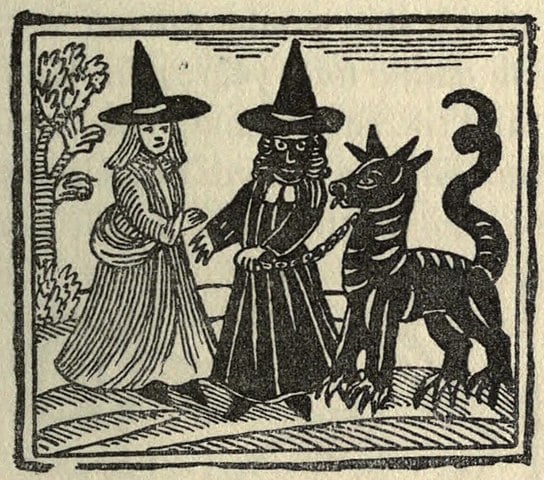
Woodcut illustration, 1720, showing two witches and a “great beast.” Credit: Wellcome Library, London. Via Wikimedia Commons, CC BY 4.0
Previous Post
October 17, 2022
A History of Witches
Next Post

October 23, 2022 Presentism in Religious History
Browse Our Archives
Select a Category Buddhism Christianity Daoism Hinduism Indigenous religions Islam Judaism Mysticism New Age Origins of religion Paganism Popes Popular Religious Movements Protestantism Psychology and religion Religion and current events Religion and folklore Religion and News Media Religion and politics Religious Art and Music Religious Freedom Religious mistakes Religious philosophy Religious scriptures Religious Violence science and religion Spiritualism Technology and religion The Catholic Church The Dalai Lama The Reformation Uncategorized
Select a Month September 2026 August 2026 July 2026 June 2026 April 2026 March 2026 February 2026 January 2026 December 2025 November 2025 October 2025 September 2025 August 2025 July 2025 June 2025 May 2025 April 2025 March 2025 February 2025 January 2025 December 2024 November 2024 October 2024 September 2024 August 2024 July 2024 June 2024 May 2024 April 2024 March 2024 February 2024 January 2024 December 2023 November 2023 October 2023 September 2023 August 2023 July 2023 June 2023 May 2023 April 2023 March 2023 February 2023 January 2023 December 2022 November 2022 October 2022 September 2022 August 2022
Follow Us!
TAKE THE
Religious Wisdom Quiz
Which harvest festival is also called the Feast of Booths?
Select your answer to see how you score.
Hanukkah Purim Passover Sukkot
Related posts from The Religious History Nerd

I Watched the Towers Fall. Here's What You...

Barring Mamdani From 9/11 Lets the Enemy Win

Sarvastivada: An Extinct Buddhist Sect That's Still With...

Is 'Separation of Church and State' Really a...
TRENDING AT PATHEOS History and Religion

In one sense walking into Westminster Abbey is like walking down the...

'Super Scam Me' Exposes AI Jon Bon Jovi...
Leslie Pickett believed she was in a relationship with Jon Bon Jovi....

The Brazilian Remake of Kendricks' 'Flywheel' Opens in...
“Flywheel,” the story that launched the Kendrick Brothers’ filmmaking career is getting...

The Dangers of Gradual Accommodation (Winking at Sin)
Recently, the “law of gradualness” resurfaced during the opening of a weeklong,...

The Iron Gates and the Lion of the...
Yesterday, I didn't finish my report about, well, yesterday. So I'll...

The Image: On the Horror of Capitalism and...
The Image Then went the Pharisees, and took counsel how they might...
view all History and Religion blogs
Ad-Free & Subscriber Log-In Subscription Support
- About Us
- 2026 Calendar
- Videos
- Podcasts
- Library of World Religions
- Faith In Media Tracker
- Advertise With Us
- Write for Us
- Privacy Policy
- Terms of Service
- Do Not Sell My Data
- Contact Us
- Radiant Digital
- Manage Newsletter Subscriptions
- Unsubscribe From Notifications
- Sitemap
Copyright 2008-2026, Patheos. All rights reserved.
Subscription Support Ad-Free & Subscriber Log-In
Follow Patheos