
BuddhistCatholicContemplativeEvangelicalGeneral ChristianHinduJewishLatter-day SaintMuslimNew VisionsProgressive Christian
Beliefs
- Buddhist
- Catholic
- Contemplative
- Evangelical
- General Christian
- Hindu
- Jewish
- Latter-day Saint
- More Voices
- Muslim
- New Visions
- Pagan
- Progressive Christian
Topics
- Religion News
- Food and Religion
- Sports and Religion
- Religious Art
- Religious Music and Entertainment
- Religious Events
- History and Religion
- Style and Religion
- Politics and Religion
- Women in Religion
- Recreation Outdoors and Religion
- Business Finance and Religion
- Careers Workplace and Religion
- Education and Religion
- Family Parenting and Religion
- Health Fitness and Religion
- Home and Religion
- Relationships and Religion
- Technology and Religion
- Travel and Religion
Columnists
- Buddhist Columnists
- Business Finance and Religion Columnists
- Careers Workplace and Religion Columnists
- Catholic Columnists
- Contemplative Columnists
- Education and Religion Columnists
- Evangelists Columnists
- Family Parenting and Religion Columnists
- General Christian Columnists
- Health Fitness and Religion Columnists
- Hindu Columnists
- History and Religion Columnists
- Home and Religion Columnists
- Jewish Columnists
- More Voices Columnists
- Latter Day Columnists
- Muslim Columnists
- New Visions Columnists
- Nonreligious Columnists
- Pagan Columnists
- Politics and Religion Columnists
- Progressive Columnists
- Recreation Outdoors and Religion Columnists
- Relationships and Religion Columnists
- Religion News Columnists
- Religious Art Columnists
- Religious Events Columnists
- Religious Music and Entertainment Columnists
- Sports and Religion Columnists
- Style and Religion Columnists
- Technology and Religion Columnists
- Travel and Religion Columnists
- Women in Religion Columnists
Resource Library
- 2026 Calendar
- Library of World Religions
- The 100 Most Holy Places on Earth
- Patheos Answers
- Podcasts
- Videos
- Faith Leaders Database
- Anglican Episcopalian
- Bahai
- Baptist
- Buddhism
- Christianity
- Confucianism
- Eastern Orthodoxy
- Hinduism
- Holiness and Pentecostal
- ISKCON
- Islam
- Judaism
- Lutheran
- Methodist
- The Church of Jesus Christ of Latter-day Saints
- New Age
- Paganism
- Presbytarian and Reformed
- Protestantism
- Religion Behind the Scenes
- Roman Catholic
- Scientology
- Shia Islam
- Sikhism
- Sufism
- Sunni Islam
- Taoism
- Zen
- See all religions
Research Tools
 Ad-Free & Subscriber Log-In Subscription Support
Ad-Free & Subscriber Log-In Subscription Support
Follow Patheos 

- Trending:
- Forgiveness
- |
- Marriage
- |
- Consciousness
- |
- Death Penalty
- |
- Election
- |
- Halloween

- Home
- Jewish
- History and Religion
- Publishing Jewish Books in 16th Century Venice
Publishing Jewish Books in 16th Century Venice
Last updated on: October 16, 2022 at 1:32 pm by Barbara O'Brien
Publishing Jewish Books in 16th Century Venice 2022-10-16T13:32:26-05:00 Barbara O'Brien
Patheos Explore the world's faith through different perspectives on religion and spirituality! Patheos has the views of the prevalent religions and spiritualities of the world.
This post tells the story of publishing Jewish books in 16th century Venice. What was likely the first commercial publishing company of books in Hebrew began operation in Venice in 1515, and it produced wonderful editions of Hebrew scriptures, including the first printed Talmud.
This is the fourth in a series on how printing technology affected the world’s religions. Johannes Gutenberg built the first printing press in Europe and published the first of his famous Bibles in 1452. What is believed to be the first printed book that was entirely in Hebrew followed in 1475. This was a book of commentaries on the Pentateuch by Rabbi Shlomo ben Itzhak, also known as Rashi (1040-1105), and it was printed in Italy.
The rabbis of Europe hailed the new printing technology as avodat ha-kodesh (‘holy work’). Print technology really was a gift to the Jews of Europe. Before there was printing, many Jewish communities had very limited access to Jewish books. Printing supported the learning and practice of Judaism and the preservation of tradition. And the dissemination of books opened up networks of communication among communities across Europe and eventually beyond Europe.
The Jewish Community of Venice
In the 16th century, this was the Republic of Venice. The island-city of Venice was the capital, but the Republic extended into what is now the Italian mainland. There is evidence that Ashkenazi Jews from central Europe had lived in the Republic of Venice since at least the 13th century. Then in 1492, Ferdinand and Isabelle expelled the Sephardic Jews from Spain. The Sepharadim scattered to many parts of the world, and many of them came to Venice.
For a long time Jews were not allowed to live in the city, and so they settled on the mainland. In 1516 Venice officials set aside a seven-acre section of the city exclusively for Jews. This neighborhood of the city was completely surrounded by canals and had been the site of a foundry — in the Italian of the time, a getto. Yes, this was one of the the first Jewish ghettos. But in the 16th century, the Jews of the Venice ghetto prospered and enjoyed social and business relationships with the city’s non-Jewish residents. In fact, the ghetto became a cultural hub. Historians point out that William Shakespeare’s play The Merchant of Venice, written in the late 1590s, could only have been set in Venice. No where else in 16th century Europe did Jew and gentile interact as freely as did the characters of the play.
Venice also became a publishing center for Hebrew books. Nearly one-third of all Hebrew books printed in Europe before 1650 were printed in Venice. And this happened in spite of the fact that the Republic of Venice, for a time anyway, prohibited Jews from publishing books.
The First Rabbinical Bible
The first publisher of Hebrew books in Venice was a Christian from Antwerp named Daniel Bomberg. Even Bomberg had a hard time getting government permission to print books in Hebrew. Several applications were denied. Eventually he paid the government of Venice the sum of 500 gold ducats — which was, um, a lot — for a ten-year license to publish in Hebrew.
Bomberg set up a printing shop in 1515 and acquired a partner/assistant named Felice da Prato (in some sources, his name is Felix Pratensis), a Christian friar who had been born and raised Jewish. In 1517 the pair published the first Rabbinical Bible. This edition had four parts, each with its own title page. Three are in Hebrew: the Torah (or Pentateuch); the Neviʾim, or books of the Prophets; and the Ketuvim (or Hagiographa). The final section presents the scriptures in Aramaic. The scriptures were typeset in columns next to commentaries on the texts by renowned rabbinical scholars. Felice da Prato edited the work. And the edition was improbably dedicated to Pope Leo X.
The Jews of Venice refused to accept Felice da Prato’s Rabbinical Bible (which was probably intended for Hebrew scholars, both Jew and Christian). It wasn’t just the dedication; they also objected to some of Felice da Prato’s choices of commentary. They would wait for another edition, thanks. Bomberg published a revised and improved edition of the Rabbinical Bible in 1525, edited by the entirely Jewish Yaaqov ben Chayyim.
The First Printed Talmud
Daniel Bomberg also published the first printed Talmud, which presents rabbinical law. The Babylonian Talmud was printed in twelve volumes and the Jerusalem Talmud in four volumes between 1520 and 1523. These were edited by Cornelius Adelkind, another Jew converted to Christianity. Bomberg’s editions of the Talmud were praised both for their accuracy and their typographical beauty and sophistication.
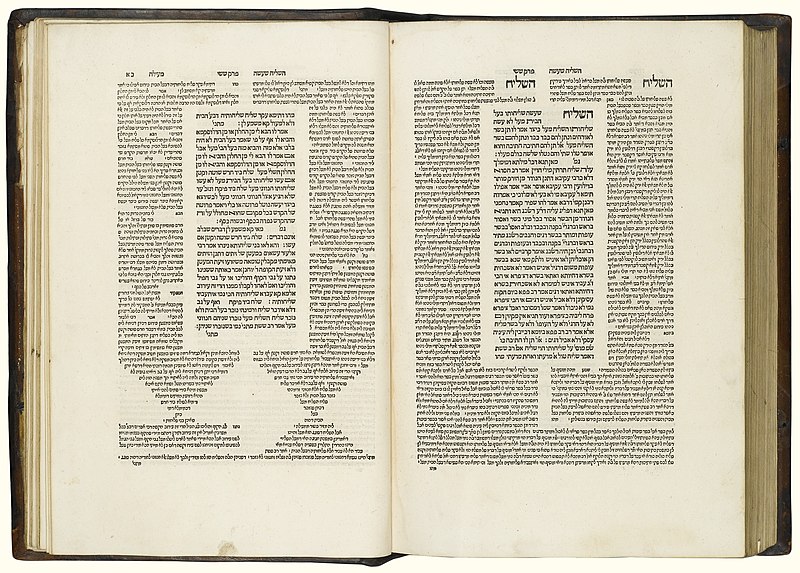
Daniel Bomberg’s Babylonian Talmud, published 1519-1523. Source: Wikimedia Commons, public domain.
Daniel Bomberg’s publishing house would go on to print nearly 200 editions of Hebrew books. Not all of these titles survive. Some were destroyed in Inquisitions. But those that do survive are among the most valuable of all rare books. In 2015 a Bomberg Babylonian Talmud sold at Sotheby’s in New York for $9 million.
A Great Publishing Tradition
The story of Bomberg’s publishing house is, of course, just the beginning of the larger story of Jewish publishing, which continues to this day. After Bomberg, Venice remained a center of Jewish book publishing for some time, but it was not the only center. Soon Hebrew scriptures were being published throughout Europe and beyond Europe. As I noted in another column, in the 16th century, a large Jewish community in Constantinople became prolific publishers of Hebrew books. Jewish publishers did not limit themselves to scriptures but also produced published popular books in Yiddish.
Other columns in this series on printing the scriptures:
The Impact of Printing on Religion: Buddhism in East Asia
The Printing Press and the Reformation
The Impact of Printing on Religion: Printing the Quran
Jewish
Technology and Religion
Previous Post
October 11, 2022
The Impact of Printing on Religion: Printing the Quran
Next Post
October 17, 2022 A History of Witches
Browse Our Archives
Select a Category Buddhism Christianity Daoism Hinduism Indigenous religions Islam Judaism Mysticism New Age Origins of religion Paganism Popes Popular Religious Movements Protestantism Psychology and religion Religion and current events Religion and folklore Religion and News Media Religion and politics Religious Art and Music Religious Freedom Religious mistakes Religious philosophy Religious scriptures Religious Violence science and religion Spiritualism Technology and religion The Catholic Church The Dalai Lama The Reformation Uncategorized
Select a Month September 2026 August 2026 July 2026 June 2026 April 2026 March 2026 February 2026 January 2026 December 2025 November 2025 October 2025 September 2025 August 2025 July 2025 June 2025 May 2025 April 2025 March 2025 February 2025 January 2025 December 2024 November 2024 October 2024 September 2024 August 2024 July 2024 June 2024 May 2024 April 2024 March 2024 February 2024 January 2024 December 2023 November 2023 October 2023 September 2023 August 2023 July 2023 June 2023 May 2023 April 2023 March 2023 February 2023 January 2023 December 2022 November 2022 October 2022 September 2022 August 2022
Follow Us!
TAKE THE
Religious Wisdom Quiz
What is the Hebrew name for the first five books of the Bible?
Select your answer to see how you score.
Mishnah Apocrypha Tanakh Torah
Related posts from The Religious History Nerd

George Washington's Letter to Touro Synagogue
What Became of the Conversos of Spain?

The Ten Commandments: Back to School?

The Ancient Origins of the Great Flood Story
TRENDING AT PATHEOS History and Religion

Emotion in Early Christianity by Andrew Crislip
Andrew Crislip’s Emotion in Early Christianity examines an often overlooked dimension of...

16 Spiritual Touchstones for a More Grounded Life
After decades of spiritual study, here are 16 principles I try...

Catholic Evangelization: Sharing Your Faith Every Day
Welcome back to the Graceful Awakening mini-series called, “From Faith to Mission.” ...

The Pillar of the Boatmen: the Ancient Monument...
The Pillar of the Boatmen is a Romano-Gaulish sculpture that dates from...

In one sense walking into Westminster Abbey is like walking down the...

'Super Scam Me' Exposes AI Jon Bon Jovi...
Leslie Pickett believed she was in a relationship with Jon Bon Jovi....
view all History and Religion blogs
Ad-Free & Subscriber Log-In Subscription Support
- About Us
- 2026 Calendar
- Videos
- Podcasts
- Library of World Religions
- Faith In Media Tracker
- Advertise With Us
- Write for Us
- Privacy Policy
- Terms of Service
- Do Not Sell My Data
- Contact Us
- Radiant Digital
- Manage Newsletter Subscriptions
- Unsubscribe From Notifications
- Sitemap
Copyright 2008-2026, Patheos. All rights reserved.
Subscription Support Ad-Free & Subscriber Log-In
Follow Patheos