
BuddhistCatholicContemplativeEvangelicalGeneral ChristianHinduJewishLatter-day SaintMuslimNew VisionsProgressive Christian
Beliefs
- Buddhist
- Catholic
- Contemplative
- Evangelical
- General Christian
- Hindu
- Jewish
- Latter-day Saint
- More Voices
- Muslim
- New Visions
- Pagan
- Progressive Christian
Topics
- Religion News
- Food and Religion
- Sports and Religion
- Religious Art
- Religious Music and Entertainment
- Religious Events
- History and Religion
- Style and Religion
- Politics and Religion
- Women in Religion
- Recreation Outdoors and Religion
- Business Finance and Religion
- Careers Workplace and Religion
- Education and Religion
- Family Parenting and Religion
- Health Fitness and Religion
- Home and Religion
- Relationships and Religion
- Technology and Religion
- Travel and Religion
Columnists
- Buddhist Columnists
- Business Finance and Religion Columnists
- Careers Workplace and Religion Columnists
- Catholic Columnists
- Contemplative Columnists
- Education and Religion Columnists
- Evangelists Columnists
- Family Parenting and Religion Columnists
- General Christian Columnists
- Health Fitness and Religion Columnists
- Hindu Columnists
- History and Religion Columnists
- Home and Religion Columnists
- Jewish Columnists
- More Voices Columnists
- Latter Day Columnists
- Muslim Columnists
- New Visions Columnists
- Nonreligious Columnists
- Pagan Columnists
- Politics and Religion Columnists
- Progressive Columnists
- Recreation Outdoors and Religion Columnists
- Relationships and Religion Columnists
- Religion News Columnists
- Religious Art Columnists
- Religious Events Columnists
- Religious Music and Entertainment Columnists
- Sports and Religion Columnists
- Style and Religion Columnists
- Technology and Religion Columnists
- Travel and Religion Columnists
- Women in Religion Columnists
Resource Library
- 2026 Calendar
- Library of World Religions
- The 100 Most Holy Places on Earth
- Patheos Answers
- Podcasts
- Videos
- Faith Leaders Database
- Anglican Episcopalian
- Bahai
- Baptist
- Buddhism
- Christianity
- Confucianism
- Eastern Orthodoxy
- Hinduism
- Holiness and Pentecostal
- ISKCON
- Islam
- Judaism
- Lutheran
- Methodist
- The Church of Jesus Christ of Latter-day Saints
- New Age
- Paganism
- Presbytarian and Reformed
- Protestantism
- Religion Behind the Scenes
- Roman Catholic
- Scientology
- Shia Islam
- Sikhism
- Sufism
- Sunni Islam
- Taoism
- Zen
- See all religions
Research Tools
 Ad-Free & Subscriber Log-In Subscription Support
Ad-Free & Subscriber Log-In Subscription Support
Follow Patheos 

- Trending:
- Forgiveness
- |
- Marriage
- |
- Consciousness
- |
- Death Penalty
- |
- Election
- |
- Halloween

- Home
- Catholic
- History and Religion
- The True Story of the Mozart Requiem Mass
The True Story of the Mozart Requiem Mass
Last updated on: December 6, 2022 at 10:50 am by Barbara O'Brien
The True Story of the Mozart Requiem Mass 2022-12-06T10:50:48-06:00 Barbara O'Brien
Patheos Explore the world's faith through different perspectives on religion and spirituality! Patheos has the views of the prevalent religions and spiritualities of the world.
The 1984 film Amadeus — and the stage play on which it was based — took liberties with history, including the story behind the composition of the Mozart Requiem in D Minor. But the real story is just as dramatic and is the stuff of legend — and wild conspiracy theories. So let’s try to sort fact from fiction.
The year was 1791, and the young Austrian composer Wolfgang Mozart was enjoying a prolific period. That year he completed two operas. One was Die Zauberflöte (The Magic Flute), to be performed at a theater owned by the librettist, Emanuel Schikaneder. The other opera was La clemenza di Tito (The Clemency of Titus), which had been commissioned by the court of the Emperor Leopold II. In 1791 Mozart also composed several other of his most popular works, including the Clarinet Concerto in A major (K 622) and the beloved short choral work Ave verum corpus.
A Stranger and a Commission
In July 1791, the story goes, a “gray stranger” came to Mozart’s apartment in Vienna to commission a funeral mass, a Requiem. The stranger said he represented a patron who wished to be anonymous. We know the stranger was Anton Leitgeb, son of the mayor of Vienna, and the patron was Leitgeb’s employer, Count Franz von Walsegg-Stuppach. And it’s probable that Mozart knew who these people were, also.
The Count wanted a Requiem to honor his late wife. According to some sources, Mozart had been the Count’s second choice as a composer. The commission originally had been offered to Mozart’s rival composer Antonio Salieri, who claimed to be too busy to take it. It should be noted the Count was known to commission music from composers and then claim he wrote it himself. This was a not uncommon practice among the nobility.
Mozart had struggled with financial setbacks in past years. He really wasn’t very good at living within his means. In 1791 his situation was improving somewhat, and he was paying off some of his debts. Still, he may have felt he couldn’t afford to turn down a customer, especially one who paid half in advance. He agreed to compose the Requiem without revealing himself as the composer. The mass was to be performed on February 14, 1792, the first anniversary of the Count’s wife’s death.
Mozart’s Requiem
This much we know to be true: In late August or early September, Mozart traveled to Prague for the premier of La clemenza di Tito. Die Zauberflöte premiered in Vienna at the end of September, with Mozart conducting. Mozart’s final opera was a huge success, with several sold-out performances. Around this time he also finished the composition of the Clarinet Concerto in A major. And he began work on the Requiem. In November he also produced a cantata that was performed for the opening of a New Masonic temple, on November 18. And there was a new baby in the Mozart household, Franz Xaver Wolfgang Mozart, born July 26.
So we know that Mozart was working hard and was probably short on sleep. We know that on November 20 or so, he became bedridden with pain, swelling, a rash, and vomiting. It’s widely reported he continued to work on the requiem in spite of his illness. And we know that Mozart died in the early morning of December 5, 1791. He was 35 years old.
The Conspiracy Theories
After his death Mozart became the center of a cult of celebrity, and his music was more popular than ever. Mozart’s celebrity was no doubt fueled by his wife’s account of his death. Constanze Mozart claimed that her husband had been unwell since early September. Writing the Requiem drained Mozart, she said, because he believed all along he was writing the funeral mass for himself, and his health deteriorated over several weeks.
Further, Constanze said, he believed he had been poisoned. Newspapers quickly picked up on the poisoning claim and repeated it. The story got even better over time. Some years later Constanze claimed that six months before his death, Mozart announced he had been given a slow-acting poison, and the poisoner had commissioned him to write his own Requiem mass.
But who, then, poisoned Mozart? Over the years fingers were pointed at the Freemasons, allegedly because Mozart had revealed Masonic secrets in Die Zauberflöte. Exactly what those secrets were must still be secret. In the early 20th century a German politician and infamous anti-Semite named Hermann Ahlwardt blamed Jews for poisoning Mozart. Ahlwardt didn’t live long enough to experience Hitler and the Third Reich, but he would have fit right in. Shortly after Ahlwardt’s claims, a German neuropsychiatrist named Mathilde Ludendorff, who was the wife of Gen. Erich Ludendorff of World War I fame, proposed that Mozart was murdered by a secret Jewish-Jesuit-Freemason cabal. The composer was killed, she said, for refusing to write music in the Italian style (which was not true). And the ultimate goal was to establish a cosmopolitan Jewish world-state. Yes, this was nuttiness worthy of QAnon. No, she was not joking.
Was It Salieri? Or Streptococcus?
The first person to point the finger at Antonio Salieri was the Russian poet Aleksandr Pushkin (1799–1837), who wrote a short play about the alleged homicide called Mozart and Salieri. This play was the basis of an opera by Nicolai Rimsky-Korsakov in 1898 and eventually the stage play Amadeus by Peter Shaffer that was made into the film. There are reports that toward the end of his life Salieri did claim to have murdered Mozart, but Salieri was almost certainly psychologically impaired at the time.
Today’s medical experts say the most likely culprit, given the symptoms, was an infectious disease, not poison. A 2009 issue of The Annals of Internal Medicine presented detailed evidence that there had been an epidemic of streptococcus infections in Vienna at the time Mozart died, and streptococcus certainly would have accounted for his symptoms. But so would a lot of other diseases.
An Incomplete Work
Let’s go back to December 1791. Constanze Mozart was a widow with two small children and no means of support. And she was left with an unfinished Requiem mass. She worried that if she couldn’t deliver a finished composition, Count Franz von Walsegg-Stuppach might ask for his money back, never mind withhold the second payment. Her task was to find a composer to work anonymously so that she could give the Count a finished work that could be claimed to be entirely by Mozart. However, she also had the finished parts of the Mozart Requiem played at Mozart’s memorial mass, which possibly frustrated any plans by the Count to claim the work was his.
Mozart’s last manuscript was given to a succession of composers, some of whom tweaked it a bit before handing it back. The task finally was taken up by Franz Xaver Süssmayr, a friend and sometime collaborator of Mozart’s. The manuscript delivered to the Count in 1792 was partly Mozart and partly Süssmayr. But which parts?
I have seen claims that Mozart wrote only half of the Mozart Requiem, but I argue he wrote more than that. We have extant manuscript of the Requiem in Mozart’s hand, so there are parts we know for certain he did write. We know he completely finished the first movement, the Introitus, with all vocal and orchestra parts. For a large part of the rest of it he finished the vocal parts but just some of the instrumentation.
What Süssmayr Wrote
This semi-finished section includes the Kyrie and most of the Sequentia and Offertorium, although the last part of the Sequentia, the Lacrimosa, was left unfinished. (It’s speculated that the opening measures of the Lacrimosa were the last notes Mozart ever wrote.) Again, the parts sung by the chorus and soloists in these section were composed, mostly at least, by Mozart. Further, Mozart had provided an outline, or a skeleton, for Süssmayr to go by for the orchestration. (This page will show you what I’m talking about here.)
There were three parts of a standard Requiem mass — the Sanctus, Benedictus, and Agnus Dei — missing from Mozart’s manuscript that were added by Süssmayr. Scholars say Süssmayr borrowed themes from Mozart’s other works for these bits. Süssmayr also finished the Lacrimosa and ended the Requiem by repeating the Introitus music with the words of the Lux aeterna. The manuscript finished by Süssmayr was delivered to Count Franz von Walsegg-Stuppach with Mozart’s forged signature and dated, oddly, 1792. Over the years other composers have picked up Mozart’s manuscript and attempted to finish the Requiem in different ways. But the Süssmayr version is still standard.
The Count did indeed attempt to claim the work as his own composition, but most listeners didn’t buy it. It was too good. Many guessed it was the Requiem Mozart was writing when he died. Ten years later, the Count finally admitted that the Requiem was written by Mozart.
What Mozart Wrote
Mozart could have written a perfectly lovely Requiem mass that Count Franz von Walsegg-Stuppach might credibly have claimed as his own, but he didn’t. It seems to me he set out to write a masterpiece that no one could mistake for an amateur’s work. The Mozart Requiem is one of the most frequently performed works of the western choral repertoire to this day. Nearly any list of Top Ten Great Choral Works of All Time you’ll ever find will include the Mozart Requiem.
There’s no better way to get to know a piece of music than to perform it, and I’ve been privileged to be in several choruses performing the Mozart Requiem over the years. And it knocks me out, every time. Mozart was at the top of his game in this work. Yes, the Süssmayr parts do fall short. I personally think the Sanctus is a snooze that doesn’t sound anything like Mozart. And I’ve never met a musician who agreed with Süssmayr’s decision to end the piece by repeating the music from the beginning. But, all together, it’s still a wonder.
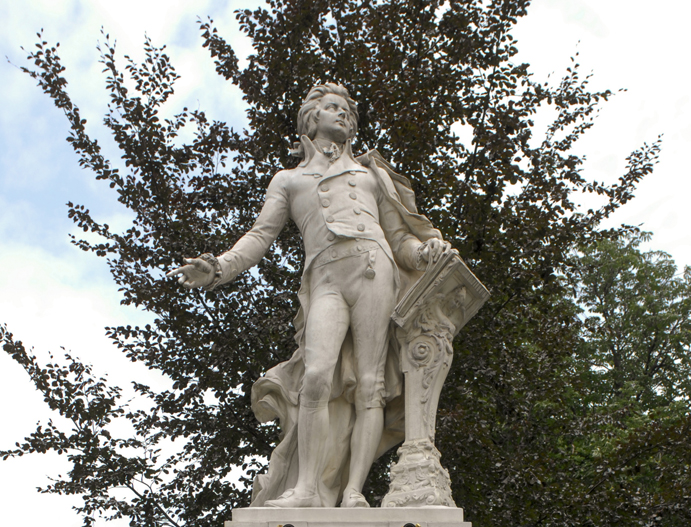
A statue of Mozart located in the Burggarten of the Hofburg Palace, Vienna. Sculpted by Viktor Tilgner. Source: Andrew Shiva / Wikipedia / CC BY-SA 4.0
Catholic
Religious Music & Entertainment
Previous Post

September 6, 2022
Rabi’a of Basra, Sufi Saint of Islam
Next Post

September 17, 2022 The Mahabodhi Temple, Site of the Buddha's Enlightenment
Browse Our Archives
Select a Category Buddhism Christianity Daoism Hinduism Indigenous religions Islam Judaism Mysticism New Age Origins of religion Paganism Popes Popular Religious Movements Protestantism Psychology and religion Religion and current events Religion and folklore Religion and News Media Religion and politics Religious Art and Music Religious Freedom Religious mistakes Religious philosophy Religious scriptures Religious Violence science and religion Spiritualism Technology and religion The Catholic Church The Dalai Lama The Reformation Uncategorized
Select a Month September 2026 August 2026 July 2026 June 2026 April 2026 March 2026 February 2026 January 2026 December 2025 November 2025 October 2025 September 2025 August 2025 July 2025 June 2025 May 2025 April 2025 March 2025 February 2025 January 2025 December 2024 November 2024 October 2024 September 2024 August 2024 July 2024 June 2024 May 2024 April 2024 March 2024 February 2024 January 2024 December 2023 November 2023 October 2023 September 2023 August 2023 July 2023 June 2023 May 2023 April 2023 March 2023 February 2023 January 2023 December 2022 November 2022 October 2022 September 2022 August 2022
Follow Us!
TAKE THE
Religious Wisdom Quiz
I prayed while serving wine to the king, and my sad face led to permission for my mission. Who am I?
Select your answer to see how you score.
Ezra Nehemiah Daniel Mordecai
Related posts from The Religious History Nerd

The President and the Pope: An Unprecedented Rift
What Was the Avignon Papacy and Why Is...
Thomas Aquinas on the Morality of War

TRENDING AT PATHEOS History and Religion

The Problem with False Prophets
Miller’s Station UMC| 10/18/26| Anchor Verse: Jeremiah 23: 1, 9-23 I...

Emotion in Early Christianity by Andrew Crislip
Andrew Crislip’s Emotion in Early Christianity examines an often overlooked dimension of...

16 Spiritual Touchstones for a More Grounded Life
After decades of spiritual study, here are 16 principles I try...

Catholic Evangelization: Sharing Your Faith Every Day
Welcome back to the Graceful Awakening mini-series called, “From Faith to Mission.” ...

The Pillar of the Boatmen: the Ancient Monument...
The Pillar of the Boatmen is a Romano-Gaulish sculpture that dates from...

In one sense walking into Westminster Abbey is like walking down the...
view all History and Religion blogs
Ad-Free & Subscriber Log-In Subscription Support
- About Us
- 2026 Calendar
- Videos
- Podcasts
- Library of World Religions
- Faith In Media Tracker
- Advertise With Us
- Write for Us
- Privacy Policy
- Terms of Service
- Do Not Sell My Data
- Contact Us
- Radiant Digital
- Manage Newsletter Subscriptions
- Unsubscribe From Notifications
- Sitemap
Copyright 2008-2026, Patheos. All rights reserved.
Subscription Support Ad-Free & Subscriber Log-In
Follow Patheos