
BuddhistCatholicContemplativeEvangelicalGeneral ChristianHinduJewishLatter-day SaintMuslimNew VisionsProgressive Christian
Beliefs
- Buddhist
- Catholic
- Contemplative
- Evangelical
- General Christian
- Hindu
- Jewish
- Latter-day Saint
- More Voices
- Muslim
- New Visions
- Pagan
- Progressive Christian
Topics
- Religion News
- Food and Religion
- Sports and Religion
- Religious Art
- Religious Music and Entertainment
- Religious Events
- History and Religion
- Style and Religion
- Politics and Religion
- Women in Religion
- Recreation Outdoors and Religion
- Business Finance and Religion
- Careers Workplace and Religion
- Education and Religion
- Family Parenting and Religion
- Health Fitness and Religion
- Home and Religion
- Relationships and Religion
- Technology and Religion
- Travel and Religion
Columnists
- Buddhist Columnists
- Business Finance and Religion Columnists
- Careers Workplace and Religion Columnists
- Catholic Columnists
- Contemplative Columnists
- Education and Religion Columnists
- Evangelists Columnists
- Family Parenting and Religion Columnists
- General Christian Columnists
- Health Fitness and Religion Columnists
- Hindu Columnists
- History and Religion Columnists
- Home and Religion Columnists
- Jewish Columnists
- More Voices Columnists
- Latter Day Columnists
- Muslim Columnists
- New Visions Columnists
- Nonreligious Columnists
- Pagan Columnists
- Politics and Religion Columnists
- Progressive Columnists
- Recreation Outdoors and Religion Columnists
- Relationships and Religion Columnists
- Religion News Columnists
- Religious Art Columnists
- Religious Events Columnists
- Religious Music and Entertainment Columnists
- Sports and Religion Columnists
- Style and Religion Columnists
- Technology and Religion Columnists
- Travel and Religion Columnists
- Women in Religion Columnists
Resource Library
- 2026 Calendar
- Library of World Religions
- The 100 Most Holy Places on Earth
- Patheos Answers
- Podcasts
- Videos
- Faith Leaders Database
- Anglican Episcopalian
- Bahai
- Baptist
- Buddhism
- Christianity
- Confucianism
- Eastern Orthodoxy
- Hinduism
- Holiness and Pentecostal
- ISKCON
- Islam
- Judaism
- Lutheran
- Methodist
- The Church of Jesus Christ of Latter-day Saints
- New Age
- Paganism
- Presbytarian and Reformed
- Protestantism
- Religion Behind the Scenes
- Roman Catholic
- Scientology
- Shia Islam
- Sikhism
- Sufism
- Sunni Islam
- Taoism
- Zen
- See all religions
Research Tools
 Ad-Free & Subscriber Log-In Subscription Support
Follow Patheos 

- Trending:
- Advent
- |
- Forgiveness
- |
- Thanksgiving
- |
- Election
- |
- Seasonal Holidays
- |
- Marriage

- Home
- Hindu
- History and Religion
- The Mahabodhi Temple, Site of the Buddha’s Enlightenment
The Mahabodhi Temple, Site of the Buddha’s Enlightenment
Last updated on: August 14, 2023 at 1:41 pm by Barbara O'Brien
The Mahabodhi Temple, Site of the Buddha’s Enlightenment 2023-08-14T13:41:20-05:00 Barbara O'Brien
Patheos Explore the world's faith through different perspectives on religion and spirituality! Patheos has the views of the prevalent religions and spiritualities of the world.
The Mahabodhi Temple is believed to mark the place where the Buddha realized enlightenment. This is the central, foundational event in the tradition of Buddhism. But the temple was neglected for centuries, and its origins forgotten, until it caught the attention of European scholars and archeologists in the 19th century. Today the restored temple is an object of reverence but also of heated sectarian dispute between Buddhists and Hindus. It has twice been the target of terrorist attacks.
The temple is located at Bodh Gaya, in the Bihar state of north eastern India, which borders Nepal. Buddhist history says that it was here that the Buddha sat in meditation under a pipal tree (Ficus religiosa), called the Bodhi Tree, until he realized enlightenment. Historians aren’t certain exactly when the Buddha lived, but the enlightenment probably happened late in the 5th century BCE, give or take.
According to Buddhist history, the first Mahabodhi Temple at Bodh Gaya was built by the Emperor Ashoka, a patron of Buddhism who reigned most of what is now India and a great deal more from about 269 BCE to 232 BCE. The stump of an Ashoka Pillar is still standing there. This temple may have been replaced in the 1st or 2nd century CE. The current temple probably dates to the 5th or 6th century CE, and it remains one of the oldest brick structures in India.
A Long Stagnation
Although Buddhism began in India, beginning about the 6th century CE it began a gradual decline. By the 12th century most of what remained of Buddhism on the Indian subcontinent was concentrated in three large monasteries in what is now the Indian state of Bihar and in two more located on the lower Ganges in what is now Bangladesh. These were all destroyed by invading Turkic armies in the late 12th and early 13th centuries. There may have been a few Buddhists in Bodh Gaya as late as the 15th century, but not after.
Although the memory of Mahabodhi Temple and the significance of Bodh Gaya were lost in India, they were not forgotten in other nations where Buddhism flourished.
A Chance Discovery
Dr. Francis Buchanan (1762-1829; sometimes Dr. Francis Buchanan-Hamilton) was a Scottish surgeon and amateur botanist who spent several years in India and southeast Asia. At one point Buchanan was part of a diplomatic expedition to Burma, now called Myanmar. In 1797, as part of his work in Burma, he published an essay titled On the Religion and Literature of the Burmese. The essay contains what is believed to be the first usage of the English construction Buddhism.
Buchanan later spent time in Nepal, mostly cataloging native plants. Nepal was predominantly Hindu, but Buchanan realized the Newar people of the Kathmandu Valley employed symbolisms similar to the Buddhists of Burma. He proposed there was a connection between the Newar and Burmese religions.
In 1811, this same Dr. Francis Buchanan and some assistants were traveling in northeastern India when they came across the ruins of an old temple. The ruins were inhabited by a group of Hindu ascetics who did not know its origins. But Buchanan recognized that the weathered stone carvings of the temple included images of the Buddha, very much like what he had seen in Burma.
Then Came the British Orientalists
At the time Buchanan made his discovery, India had been governed by the Muslim rulers of the Moghul Empire since the 16th century. But the British East India Company had moved in, building factories and trading posts and establishing communities of British expats. By the time Buchanan found the ruins of the Mahabodhi Temple, the East India Company was the real power in India. And many of the British expats in India were genuinely interested in learning about India’s history and culture.
These orientalists, as they were called, realized that India must have an ancient history, but the Indians themselves seemed to know little about anything that had happened before the Moghuls. Eventually some westerners gained literacy in Sanskrit and could read old texts themselves. They also consulted classical Greek texts about India dating back to Alexander the Great’s time, and very slowly a long-lost history of ancient India began to emerge.
A British diplomat in Nepal named Brian Hodgson (1800-1894) made enormous contributions to understanding early Buddhist history and its origins in India. Largely thanks to his work, westerners finally came to understand the significance of the Buddha. And they realized the significance of the Mahabodhi Temple as marking the place of the Buddha’s enlightenment.
The Mahabodhi Temple Restored
In 1857 a revolt against the East India Company caused the British government to step in and assume direct control of India. This marked the end of the Mughal Empire and the beginning of the British Raj. In the 1880s the British colonial government of India decided to restore the Mahabodhi Temple, in response to complaints about its deplorable condition. The government turned to Sir Alexander Cunningham (1814-1893), a British Army engineer, to lead this effort.
Cunningham’s excavations found remnants of the earlier temples, including some of the original temple built by Ashoka. Among other long-lost objects, he located the Vajrasana, or “diamond throne,” a carved stone slab thought to have been placed by Ashoka on the very spot he believed the Buddha must have meditated. He also replaced the dying Bodhi tree with a sapling from the same plant, and that’s the tree that stands there today.
Still, more work needed to be done. In 1885 the British poet Sir Edwin Arnold published a series of articles about the Mahabodhi Temple that drew more attention to the site. Asian Buddhists began to speak up, including Anagarika Dharmapala (1864-1933), a Buddhist activist of British Ceylon (now Sri Lanka) who also helped initiate an independence movement. Dharmapala campaigned to have the temple returned to Buddhist control, a request that met with resistance from Hindu clergy. Many Hindus had come to regard the Buddha as an incarnation of Vishnu, and they considered Mahabodhi to be their temple, too, especially since a sect of Hinduism had been using it since the Buddhists abandoned it.
An Uneasy Compromise
After India gained its independence from the United Kingdom in 1947, the Mahabodhi Temple complex became the responsibility of the state government of Bihar. Bihar established a management committee to be made up of five Hindus (including the chair) and four Buddhists. The Bodhgaya Temple Management Committee still is in charge today, although in 2013 policy was changed to allow the Gaya District Magistrate to act as chairman even if he isn’t Hindu. There is also an advisory committee that includes representatives of Buddhism from several other countries.
This arrangement has never satisfied most Buddhists, who want complete control, and who want Hindu symbols, such as representations of Vishnu and Shiva, removed from the temple. The controversy is ongoing.
Terrorist Attacks
In July 2013, a series of ten bombs went off around Mahabodhi. The temple, and the Bodhi tree, were undamaged. Five people, including two Buddhist monks, were injured. Three other bombs planted in the area were discovered and defused. Eventually members of Muslim group, the Indian Mujahideen, were arrested and convicted of the bombing. Another bombing was attempted in 2018, while His Holiness the Dalai Lama was in Bodh Gaya. It’s possible His Holiness was the target. Fortunately there were no serious injuries or damage. Those convicted of this bombing were members of Jamaat-ul-Mujahideen Bangladesh, also a Muslim group.
The Temple Today
The temple today is a UNESCO World Heritage site. According UNESCO, the present temple is one of the earliest and most imposing structures built entirely in brick from the Gupta period. The temple complex covers nearly 12 acres; the main pyramid temple is 180 feet tall. Next to the temple is a huge pipal tree (the one planted by Sir Alexander Cunningham in the 19th century) said to be a direct descendant of the Buddha’s Bodhi Tree.
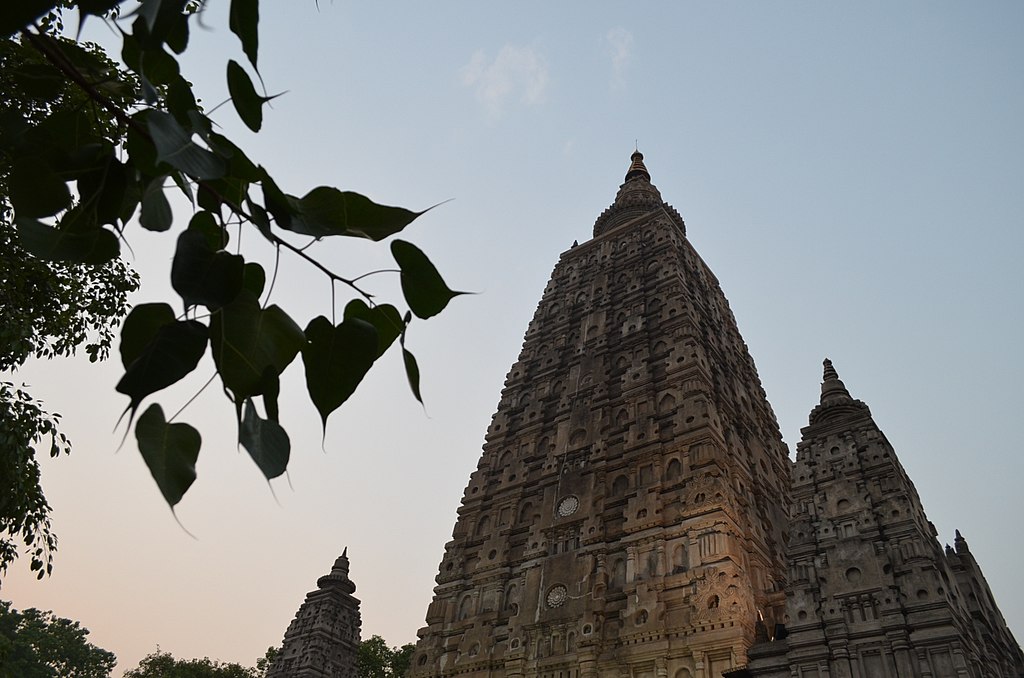
The Mahabodhi Temple in 2013. Source: Matt Stabile, Wikimedia Commons, cc-by-2.0
Hindu
Buddhism
Previous Post
September 11, 2022
The True Story of the Mozart Requiem Mass
Next Post

September 23, 2022 The Myth of the Christian Nation
Browse Our Archives
Select a Category Buddhism Christianity Daoism Hinduism Indigenous religions Islam Jaina Judaism Mysticism New Age Origins of religion Paganism Popes Popular Religious Movements Protestantism Psychology and religion Religion and current events Religion and folklore Religion and News Media Religion and politics Religious Art and Music Religious Freedom Religious mistakes Religious philosophy Religious scriptures Religious Violence science and religion Spiritualism Technology and religion The Catholic Church The Dalai Lama The Reformation Uncategorized
Select a Month November 2026 October 2026 September 2026 August 2026 July 2026 June 2026 April 2026 March 2026 February 2026 January 2026 December 2025 November 2025 October 2025 September 2025 August 2025 July 2025 June 2025 May 2025 April 2025 March 2025 February 2025 January 2025 December 2024 November 2024 October 2024 September 2024 August 2024 July 2024 June 2024 May 2024 April 2024 March 2024 February 2024 January 2024 December 2023 November 2023 October 2023 September 2023 August 2023 July 2023 June 2023 May 2023 April 2023 March 2023 February 2023 January 2023 December 2022 November 2022 October 2022 September 2022 August 2022
Follow Us!
TAKE THE
Religious Wisdom Quiz
In Hebrews, what two things does the word of God judge?
Select your answer to see how you score.
The thoughts and attitudes of the heart Good and evil Right and wrong Truth and lies
Related posts from The Religious History Nerd
Stop Putting Fake Quotes in the Buddha's Mouth
The Kalama Sutta: What the Buddha Didn't Say

Sarvastivada: An Extinct Buddhist Sect That's Still With...
TRENDING AT PATHEOS History and Religion

Stop Making Thanksgiving Problematic And Just Give Thanks
“What if, today, we were grateful for everything?” –Charlie Brown I...

Sunday Readings: Stay Awake and Hope
The First Sunday of Advent begins a new liturgical year, and the...

Are You a Scrooge or an Ebenezer?
A Call to Remember As the Christmas season begins, will we remember...

Noah’s Ark Archaeologists: Gopher Wood or Should We...
Ancient wood, a boat-shaped formation and dates that invite a second look:...

Smart people saying smart things (11.24.26)
Please take time to listen to Perry Bacon, Sarah Posner, Adam Serwer,...

The Contingency of Our Technology
Last week we were hit with a raft of massive technology outages....
view all History and Religion blogs
Ad-Free & Subscriber Log-In Subscription Support
- About Us
- 2026 Calendar
- Videos
- Podcasts
- Library of World Religions
- Faith In Media Tracker
- Advertise With Us
- Write for Us
- Privacy Policy
- Terms of Service
- Do Not Sell My Data
- Contact Us
- Radiant Digital
- Manage Newsletter Subscriptions
- Unsubscribe From Notifications
- Sitemap
Copyright 2008-2026, Patheos, part of the Radiant Digital network of media brands. All rights reserved.
Subscription Support Ad-Free & Subscriber Log-In
Follow Patheos