
BuddhistCatholicContemplativeEvangelicalGeneral ChristianHinduJewishLatter-day SaintMuslimNew VisionsProgressive Christian
Beliefs
- Buddhist
- Catholic
- Contemplative
- Evangelical
- General Christian
- Hindu
- Jewish
- Latter-day Saint
- More Voices
- Muslim
- New Visions
- Pagan
- Progressive Christian
Topics
- Religion News
- Food and Religion
- Sports and Religion
- Religious Art
- Religious Music and Entertainment
- Religious Events
- History and Religion
- Style and Religion
- Politics and Religion
- Women in Religion
- Recreation Outdoors and Religion
- Business Finance and Religion
- Careers Workplace and Religion
- Education and Religion
- Family Parenting and Religion
- Health Fitness and Religion
- Home and Religion
- Relationships and Religion
- Technology and Religion
- Travel and Religion
Columnists
- Buddhist Columnists
- Business Finance and Religion Columnists
- Careers Workplace and Religion Columnists
- Catholic Columnists
- Contemplative Columnists
- Education and Religion Columnists
- Evangelists Columnists
- Family Parenting and Religion Columnists
- General Christian Columnists
- Health Fitness and Religion Columnists
- Hindu Columnists
- History and Religion Columnists
- Home and Religion Columnists
- Jewish Columnists
- More Voices Columnists
- Latter Day Columnists
- Muslim Columnists
- New Visions Columnists
- Nonreligious Columnists
- Pagan Columnists
- Politics and Religion Columnists
- Progressive Columnists
- Recreation Outdoors and Religion Columnists
- Relationships and Religion Columnists
- Religion News Columnists
- Religious Art Columnists
- Religious Events Columnists
- Religious Music and Entertainment Columnists
- Sports and Religion Columnists
- Style and Religion Columnists
- Technology and Religion Columnists
- Travel and Religion Columnists
- Women in Religion Columnists
Resource Library
- 2026 Calendar
- Library of World Religions
- The 100 Most Holy Places on Earth
- Patheos Answers
- Podcasts
- Videos
- Faith Leaders Database
- Anglican Episcopalian
- Bahai
- Baptist
- Buddhism
- Christianity
- Confucianism
- Eastern Orthodoxy
- Hinduism
- Holiness and Pentecostal
- ISKCON
- Islam
- Judaism
- Lutheran
- Methodist
- The Church of Jesus Christ of Latter-day Saints
- New Age
- Paganism
- Presbytarian and Reformed
- Protestantism
- Religion Behind the Scenes
- Roman Catholic
- Scientology
- Shia Islam
- Sikhism
- Sufism
- Sunni Islam
- Taoism
- Zen
- See all religions
Research Tools
 Ad-Free & Subscriber Log-In Subscription Support
Ad-Free & Subscriber Log-In Subscription Support
Follow Patheos 

- Trending:
- Forgiveness
- |
- Marriage
- |
- Consciousness
- |
- Death Penalty
- |
- Election
- |
- Halloween

- Home
- Muslim
- History and Religion
- Rabi’a of Basra, Sufi Saint of Islam
Rabi’a of Basra, Sufi Saint of Islam
Last updated on: September 8, 2022 at 3:09 pm by Barbara O'Brien
Rabi’a of Basra, Sufi Saint of Islam 2022-09-08T15:09:26-05:00 Barbara O'Brien
Patheos Explore the world's faith through different perspectives on religion and spirituality! Patheos has the views of the prevalent religions and spiritualities of the world.
Rābiʿah al-ʿAdawīyah (713/17–801), also called Rabi’a of Basra or Rabi’a Basri, was a woman, poet, and mystic who made significant contributions to Islam.
According to traditional stories, Rabi’a was born into a poor family of Basra, in what is now Iraq, then sold into slavery when her parents died. Her practices of piety and prayer impressed her master, who freed her. She spent much of the rest of her life in the desert outside Basra, living independently, writing her poems, and worshiping God
We have little in the way of verifiable historical facts about the life of Rabi’a of Basra, but we know something about the effects of her life. In particular she influenced the development of Sufism, a significant movement within Islamic history.
What Is Sufism?
You may know of the two major branches of Islam, the Shi’a and the Sunni. Sufism is not a separate branch but a movement found within both branches, although the majority of Sufis today are Sunni. Sufism might be explained as a way to practice Islam that emphasizes introspection and closeness to God.
Tradition says that Sufism can be traced to Ali ibn Abi Talib (598 – 661), a nephew and son-in-law of the Prophet Muhammad (570 – 632). It’s possible that Sufism began as a form of Islamic asceticism. Very broadly, religious asceticism is about achieving spiritual purity by rejecting worldly things, including material and sensual pleasures. But beginning about the 8th century — the lifetime of Rabi’a of Basra — Sufism also turned toward mysticism. Sufism today is often explained as mystical Islam.
Okay, So What Is Mysticism?
Mysticism is a word that covers a huge variety of practices and experiences. It is sometimes used derisively to mean “superstitious nonsense,” but it isn’t necessarily superstitious. The best short definition I have found is at the Online Etymology Dictionary, “any mode of thought or life in which reliance is placed upon a spiritual illumination believed to transcend ordinary powers of understanding.” If you want more details, check out the Stanford Encyclopedia of Philosophy. Mysticism in the Abrahamic religions, which includes Islam, often is about engaging in practices to enable a direct experience of God.
Rabi’a of Basra’s Mysticism
Rabi’s is said to have fasted, prayed, performed prostrations, and kept all-night vigils. But her central mystical practice was go focus all her being on love of God. And this love was love for its own sake, without thought of reward. She considered both fear of damnation and hope for eternity in paradise to be impediments. In one of her poems, Rabi’a wrote that she carried a torch in one hand and a bucket of water in the other. With these, she would set fire to heaven and put out the fires of hell, “So that voyagers to God can rip the veils / And see the real goal.”
In her book Women of Sufism: A Hidden Treasure (Shambhala, 2003), Camille Adams Helminski wrote that Rabi’a of Basra was the first person who “clearly expressed the relationship with the Divine in the language we have come to recognize as particularly Sufic, by referring to God as the Beloved.” Her words expressed a deep intimacy with God.
Kings have locked their doors
and each lover is alone with his love.Here, I am alone with you.
[From “O my Lord, the stars glitter,” English version by Charles Upton.]
Rabi’a of Basra’s Legacy
Women in patriarchal cultures generally are only recorded in history through association with famous men. There are many stories of interactions between Rabi’a and a renowned Islamic scholar named Hasan al-Basri (642 – 728). It’s possible they met, although Rabi’a would still have been an adolescent when Hasan died. So the stories are probably just stories. Much of what we know about Rabi’a today comes from the writings of Attar of Nishapur (ca. 1145 – 1221), a Sufi poet and scholar of Persia. It’s assumed that Attar was less of a historian than a hagiographer.
Still, Rabi’a’s life seems to have made a genuine impression on Sufism. She helped shape it into what it became today, a tradition associated with peace and tolerance. She certainly influenced Sufi’s rich tradition of poetry, which includes the popular work of Jalal al-Din Muhammad Rumi (1207 – 1273) , better known in the West as Rumi. And she set a standard that Sufism is not about asceticism alone. It is also about love.
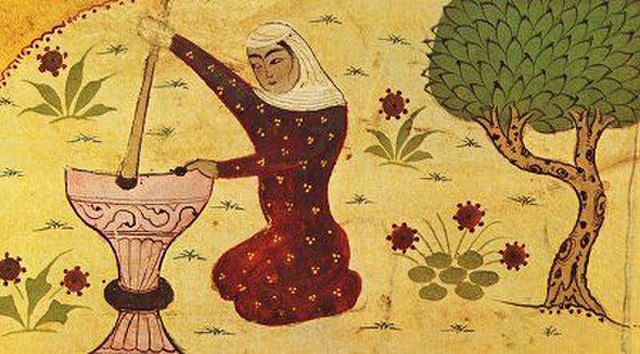
Traditional image of Rābiʻa al-ʻAdawiyya al-Qaysiyya, date unknown. Public domain, via Wikimedia Commons
Muslim
Previous Post

September 5, 2022
Saint Paul's Chapel of Trinity Church: The Little Chapel That Stood
Next Post

September 11, 2022 The True Story of the Mozart Requiem Mass
Browse Our Archives
Select a Category Buddhism Christianity Daoism Hinduism Indigenous religions Islam Judaism Mysticism New Age Origins of religion Paganism Popes Popular Religious Movements Protestantism Psychology and religion Religion and current events Religion and folklore Religion and News Media Religion and politics Religious Art and Music Religious Freedom Religious mistakes Religious philosophy Religious scriptures Religious Violence science and religion Spiritualism Technology and religion The Catholic Church The Dalai Lama The Reformation Uncategorized
Select a Month September 2026 August 2026 July 2026 June 2026 April 2026 March 2026 February 2026 January 2026 December 2025 November 2025 October 2025 September 2025 August 2025 July 2025 June 2025 May 2025 April 2025 March 2025 February 2025 January 2025 December 2024 November 2024 October 2024 September 2024 August 2024 July 2024 June 2024 May 2024 April 2024 March 2024 February 2024 January 2024 December 2023 November 2023 October 2023 September 2023 August 2023 July 2023 June 2023 May 2023 April 2023 March 2023 February 2023 January 2023 December 2022 November 2022 October 2022 September 2022 August 2022
Follow Us!
TAKE THE
Religious Wisdom Quiz
Who brought to Jesus the woman taken in adultery?
Select your answer to see how you score.
The Pharisees The Apostles The Disciples The Publicans
Related posts from The Religious History Nerd

Barring Mamdani From 9/11 Lets the Enemy Win
What Became of the Conversos of Spain?

Myanmar Earthquake: Mosques and Temples Destroyed
TRENDING AT PATHEOS History and Religion

The Problem with False Prophets
Miller’s Station UMC| 10/18/26| Anchor Verse: Jeremiah 23: 1, 9-23 I...

Emotion in Early Christianity by Andrew Crislip
Andrew Crislip’s Emotion in Early Christianity examines an often overlooked dimension of...

16 Spiritual Touchstones for a More Grounded Life
After decades of spiritual study, here are 16 principles I try...

Catholic Evangelization: Sharing Your Faith Every Day
Welcome back to the Graceful Awakening mini-series called, “From Faith to Mission.” ...

The Pillar of the Boatmen: the Ancient Monument...
The Pillar of the Boatmen is a Romano-Gaulish sculpture that dates from...

In one sense walking into Westminster Abbey is like walking down the...
view all History and Religion blogs
Ad-Free & Subscriber Log-In Subscription Support
- About Us
- 2026 Calendar
- Videos
- Podcasts
- Library of World Religions
- Faith In Media Tracker
- Advertise With Us
- Write for Us
- Privacy Policy
- Terms of Service
- Do Not Sell My Data
- Contact Us
- Radiant Digital
- Manage Newsletter Subscriptions
- Unsubscribe From Notifications
- Sitemap
Copyright 2008-2026, Patheos. All rights reserved.
Subscription Support Ad-Free & Subscriber Log-In
Follow Patheos