
BuddhistCatholicContemplativeEvangelicalGeneral ChristianHinduJewishLatter-day SaintMuslimNew VisionsProgressive Christian
Beliefs
- Buddhist
- Catholic
- Contemplative
- Evangelical
- General Christian
- Hindu
- Jewish
- Latter-day Saint
- More Voices
- Muslim
- New Visions
- Pagan
- Progressive Christian
Topics
- Religion News
- Food and Religion
- Sports and Religion
- Religious Art
- Religious Music and Entertainment
- Religious Events
- History and Religion
- Style and Religion
- Politics and Religion
- Women in Religion
- Recreation Outdoors and Religion
- Business Finance and Religion
- Careers Workplace and Religion
- Education and Religion
- Family Parenting and Religion
- Health Fitness and Religion
- Home and Religion
- Relationships and Religion
- Technology and Religion
- Travel and Religion
Columnists
- Buddhist Columnists
- Business Finance and Religion Columnists
- Careers Workplace and Religion Columnists
- Catholic Columnists
- Contemplative Columnists
- Education and Religion Columnists
- Evangelists Columnists
- Family Parenting and Religion Columnists
- General Christian Columnists
- Health Fitness and Religion Columnists
- Hindu Columnists
- History and Religion Columnists
- Home and Religion Columnists
- Jewish Columnists
- More Voices Columnists
- Latter Day Columnists
- Muslim Columnists
- New Visions Columnists
- Nonreligious Columnists
- Pagan Columnists
- Politics and Religion Columnists
- Progressive Columnists
- Recreation Outdoors and Religion Columnists
- Relationships and Religion Columnists
- Religion News Columnists
- Religious Art Columnists
- Religious Events Columnists
- Religious Music and Entertainment Columnists
- Sports and Religion Columnists
- Style and Religion Columnists
- Technology and Religion Columnists
- Travel and Religion Columnists
- Women in Religion Columnists
Resource Library
- 2026 Calendar
- Library of World Religions
- The 100 Most Holy Places on Earth
- Patheos Answers
- Podcasts
- Videos
- Faith Leaders Database
- Anglican Episcopalian
- Bahai
- Baptist
- Buddhism
- Christianity
- Confucianism
- Eastern Orthodoxy
- Hinduism
- Holiness and Pentecostal
- ISKCON
- Islam
- Judaism
- Lutheran
- Methodist
- The Church of Jesus Christ of Latter-day Saints
- New Age
- Paganism
- Presbytarian and Reformed
- Protestantism
- Religion Behind the Scenes
- Roman Catholic
- Scientology
- Shia Islam
- Sikhism
- Sufism
- Sunni Islam
- Taoism
- Zen
- See all religions
Research Tools
 Ad-Free & Subscriber Log-In Subscription Support
Ad-Free & Subscriber Log-In Subscription Support
Follow Patheos 

- Trending:
- Forgiveness
- |
- Marriage
- |
- Consciousness
- |
- Death Penalty
- |
- Election
- |
- Halloween

- Home
- Buddhism
- History and Religion
- The Trials of Kumarajiva the Translator
The Trials of Kumarajiva the Translator
Last updated on: August 25, 2022 at 2:39 pm by Barbara O'Brien
The Trials of Kumarajiva the Translator 2022-08-25T14:39:33-05:00 Barbara O'Brien
Patheos Explore the world's faith through different perspectives on religion and spirituality! Patheos has the views of the prevalent religions and spiritualities of the world.
Kumarajiva (344–413 CE) is remembered for translating many significant Buddhist scriptures from Sanskrit into Chinese. His influence on the development of Buddhism in China cannot be overstated. And he accomplished this while being caught up in outrageous political upheavals and intrigues in China.
For example, Kumarajiva spent several years of his life as the hostage of a rogue warlord. But in order to appreciate what Kumarajiva went through, you need a bit of background into China’s history.
Big Troubles In China
During Kumarajiva’s lifetime China was not a unified country. When the Han Dynasty ended in 220 CE, China fractured into many small kingdoms. The space of time from 220 to 589 CE is called the “Six Dynasties” period, because southern China was ruled by six short-lived, successive dynasties.
But the situation in northern China, where our story takes place, was more chaotic. In about the year 300, nomadic tribes from the west and north invaded northern China and split it up among themselves. In the period from 304 to 439, sixteen dynasties rose and fell in north China.
Buddhism Comes from the West
Buddhism had been introduced to China in the 1st century CE, mostly by monks from central Asia who followed Silk Road merchants eastward into north China. (See “The Edicts of Ashoka” for more on how Buddhism spread from India to central Asia.)
And this brings us to Kumarajiva, who was from Kucha. Kucha (now Kuqa) was an ancient city-state that is in today’s southwest China, Aksu Prefecture. In much earlier times it was an oasis on the Silk Road, and in Kumarajiva’s day it was a place where the cultures of China, India, and central Asia mingled. And it was also predominantly Buddhist.
Kumarajiva’s father was a Buddhist scholar from India, and his mother was said to be from Kuchan nobility. He was given a rigorous education in Buddhist texts from early childhood. He received Buddhist monk ordination at the age of 20.
Kumarajiva Becomes a Hostage
Fu Jian (337–385), ruled one of the sixteen dynasties of north China, the Former Qin Dynasty. His capital was Chang’an, which today is called Xi’an, Shaanxi Province. Fu Jian was a great supporter of Buddhism. Among other things, he sent the first Buddhist missionaries into the Korean Peninsula to establish Buddhism there. However, Fu Jian also wanted to unify north China under his rule, and he launched a lot of attacks on the other dynasties to accomplish that. North China was not a peaceful place.
In about 382, Fu Jian sent his general Lü Guang with a large army to subdue the region around Kucha. He also told Lü Guang to escort the renowned monk Kumarajiva safely back to Chang’an. Note that the distance between Kucha/Kuqa and Chang’an/Xi’an is 1,484 air miles, or 2,389 kilometers, so this was a significant undertaking.
Lü Guang’s campaign in the far west eventually would succeed, but not before Fu Jian suffered serious military setbacks and, in 385, was assasinated by a rival. Former Qin itself would end in 394.
Kumarajiva’s Captivity
Lü Guang had an army but no lord to report to. So he took over some territory in northwest China and declared himself an emperor and founder of what scholars would call the Later Liang Dynasty. Kumarajiva would be his prisoner for a total of sixteen years.
Why Lü Guang kept Kumarajiva captive is not clear, as Lü was not known to be interested in Buddhism. It’s possible he thought that since Kumarajiva was some kind of holy man, his presence would ward off evil spirits.
It’s also not known with any certainty how Kumarajiva spent his days as Lü Guang’s prisoner. It’s believed he spent his time learning to read and write Chinese, which is certainly possible. There is a popular story that Lü Guang forced the celibate Kumaajiva to marry, but I suspect that’s a folk tale.
Kumarajiva Rescued
Kumarajiva was rescued in 401 after Yao Xing (366–416) of the Later Qin — which had replaced the Former Qin — ordered his armies to defeat Lü Guang and bring Kumarajiva to Chang’an. Kamarajiva spent the remaining years of his life not just translating, but also runnng a translation academy to teach younger scholars how to clearly render the subtle meanings in the Sanskrit texts into Chinese.
Much of Kumarajiva’s work focused on a school of Buddhist philosophy called Madhyamaka, which is foundational to the schools of Buddhism that would develop in China, Tibet, Japan, Korea, and elsewhere in east Asia. Through his translations, and through his many students, correspondents, and collaborators, he raised understanding of Madhyamaka far above what it had been before in China.
For those familiar with Buddhist scriptures — the roughtly thirty-five texts Kumarajiva gave to China include the Lotus Sutra, the Vimalakirti Sutra, the Diamond Sutra, and Nagarjuna’s Fundamental Verses on the Middle Way. In most cases Kumarajiva’s translation remains the canonical version in the Chinese Buddhist canon. The quality of Kumarajiva’s work remains relevant to this day. Many of the original texts are lost, and scholars still rely on Kumarajiva’s translations. A substantial portion of Mahayana sutras that are available in English were translated from Kumarajiva.
You can read more about the adventures of Buddhism in China in my book, The Circle of the Way: A Concise History of Zen from the Buddha to the Modern World (Shambhala, 2019).
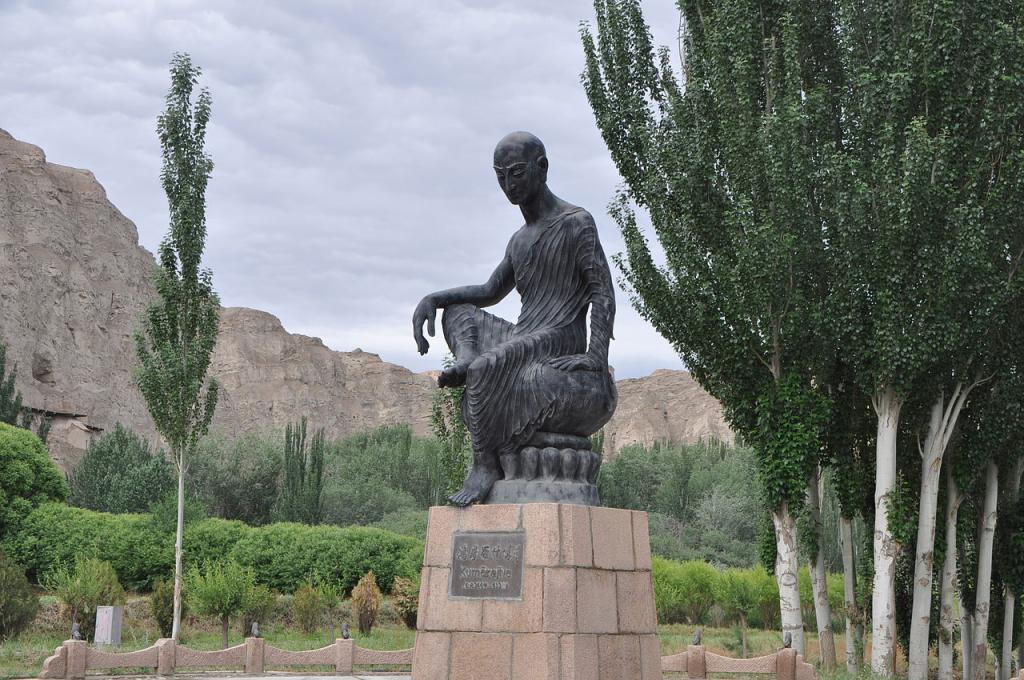
Statue of Kumarajiva in front of Kizil Caves, Kuqa, Xinjiang, China. Photo by Yoshi Canopus. Creative Commons Attribution-Share Alike 3.0 Unported license.
Buddhism
Previous Post

August 22, 2022
The Saint Bartholomew's Day Massacre
Next Post
August 29, 2022 The Ten Commandments and the Origins of Law
Browse Our Archives
Select a Category Buddhism Christianity Daoism Hinduism Indigenous religions Islam Judaism Mysticism New Age Origins of religion Paganism Popes Popular Religious Movements Protestantism Psychology and religion Religion and current events Religion and folklore Religion and News Media Religion and politics Religious Art and Music Religious Freedom Religious mistakes Religious philosophy Religious scriptures Religious Violence science and religion Spiritualism Technology and religion The Catholic Church The Dalai Lama The Reformation Uncategorized
Select a Month September 2026 August 2026 July 2026 June 2026 April 2026 March 2026 February 2026 January 2026 December 2025 November 2025 October 2025 September 2025 August 2025 July 2025 June 2025 May 2025 April 2025 March 2025 February 2025 January 2025 December 2024 November 2024 October 2024 September 2024 August 2024 July 2024 June 2024 May 2024 April 2024 March 2024 February 2024 January 2024 December 2023 November 2023 October 2023 September 2023 August 2023 July 2023 June 2023 May 2023 April 2023 March 2023 February 2023 January 2023 December 2022 November 2022 October 2022 September 2022 August 2022
Follow Us!
TAKE THE
Religious Wisdom Quiz
How old was Abraham when Sarah died?
Select your answer to see how you score.
147 years 127 years 137 years 117 years
Related posts from The Religious History Nerd

Sarvastivada: An Extinct Buddhist Sect That's Still With...

A Goddess Who Swapped Bodies to Prove Gender...

The Beat Zen Movement: When Zen Became Cool
TRENDING AT PATHEOS History and Religion

In one sense walking into Westminster Abbey is like walking down the...

'Super Scam Me' Exposes AI Jon Bon Jovi...
Leslie Pickett believed she was in a relationship with Jon Bon Jovi....

The Brazilian Remake of Kendricks' 'Flywheel' Opens in...
“Flywheel,” the story that launched the Kendrick Brothers’ filmmaking career is getting...

The Dangers of Gradual Accommodation (Winking at Sin)
Recently, the “law of gradualness” resurfaced during the opening of a weeklong,...

The Iron Gates and the Lion of the...
Yesterday, I didn't finish my report about, well, yesterday. So I'll...

The Image: On the Horror of Capitalism and...
The Image Then went the Pharisees, and took counsel how they might...
view all History and Religion blogs
Ad-Free & Subscriber Log-In Subscription Support
- About Us
- 2026 Calendar
- Videos
- Podcasts
- Library of World Religions
- Faith In Media Tracker
- Advertise With Us
- Write for Us
- Privacy Policy
- Terms of Service
- Do Not Sell My Data
- Contact Us
- Radiant Digital
- Manage Newsletter Subscriptions
- Unsubscribe From Notifications
- Sitemap
Copyright 2008-2026, Patheos. All rights reserved.
Subscription Support Ad-Free & Subscriber Log-In
Follow Patheos