
BuddhistCatholicContemplativeEvangelicalGeneral ChristianHinduJewishLatter-day SaintMuslimNew VisionsProgressive Christian
Beliefs
- Buddhist
- Catholic
- Contemplative
- Evangelical
- General Christian
- Hindu
- Jewish
- Latter-day Saint
- More Voices
- Muslim
- New Visions
- Pagan
- Progressive Christian
Topics
- Religion News
- Food and Religion
- Sports and Religion
- Religious Art
- Religious Music and Entertainment
- Religious Events
- History and Religion
- Style and Religion
- Politics and Religion
- Women in Religion
- Recreation Outdoors and Religion
- Business Finance and Religion
- Careers Workplace and Religion
- Education and Religion
- Family Parenting and Religion
- Health Fitness and Religion
- Home and Religion
- Relationships and Religion
- Technology and Religion
- Travel and Religion
Columnists
- Buddhist Columnists
- Business Finance and Religion Columnists
- Careers Workplace and Religion Columnists
- Catholic Columnists
- Contemplative Columnists
- Education and Religion Columnists
- Evangelists Columnists
- Family Parenting and Religion Columnists
- General Christian Columnists
- Health Fitness and Religion Columnists
- Hindu Columnists
- History and Religion Columnists
- Home and Religion Columnists
- Jewish Columnists
- More Voices Columnists
- Latter Day Columnists
- Muslim Columnists
- New Visions Columnists
- Nonreligious Columnists
- Pagan Columnists
- Politics and Religion Columnists
- Progressive Columnists
- Recreation Outdoors and Religion Columnists
- Relationships and Religion Columnists
- Religion News Columnists
- Religious Art Columnists
- Religious Events Columnists
- Religious Music and Entertainment Columnists
- Sports and Religion Columnists
- Style and Religion Columnists
- Technology and Religion Columnists
- Travel and Religion Columnists
- Women in Religion Columnists
Resource Library
- 2026 Calendar
- Library of World Religions
- The 100 Most Holy Places on Earth
- Patheos Answers
- Podcasts
- Videos
- Faith Leaders Database
- Anglican Episcopalian
- Bahai
- Baptist
- Buddhism
- Christianity
- Confucianism
- Eastern Orthodoxy
- Hinduism
- Holiness and Pentecostal
- ISKCON
- Islam
- Judaism
- Lutheran
- Methodist
- The Church of Jesus Christ of Latter-day Saints
- New Age
- Paganism
- Presbytarian and Reformed
- Protestantism
- Religion Behind the Scenes
- Roman Catholic
- Scientology
- Shia Islam
- Sikhism
- Sufism
- Sunni Islam
- Taoism
- Zen
- See all religions
Research Tools
 Ad-Free & Subscriber Log-In Subscription Support
Ad-Free & Subscriber Log-In Subscription Support
Follow Patheos 

- Trending:
- Forgiveness
- |
- Marriage
- |
- Consciousness
- |
- Death Penalty
- |
- Election
- |
- Halloween

- Home
- Catholic
- Education and Religion
- The First Eucharistic Controversy: Christ’s Real Presence
The First Eucharistic Controversy: Christ’s Real Presence
Last updated on: October 16, 2026 at 4:46 pm by William Hemsworth
The First Eucharistic Controversy: Christ’s Real Presence 2026-10-16T16:46:15-07:00 William Hemsworth
Patheos Explore the world's faith through different perspectives on religion and spirituality! Patheos has the views of the prevalent religions and spiritualities of the world.
For Catholics, the Eucharist is the source and summit of the Christian life. It is not merely a symbol that reminds us of what Christ accomplished on Calvary, nor is it simply a communal meal where Christians gather to remember their Lord. The Eucharist is Jesus Christ himself, truly present under the appearances of bread and wine. This belief is central to Catholic theology and has its roots in Sacred Scripture, apostolic tradition, and the teachings of the early Church Fathers.
From the time of the apostles, Christians professed that the Eucharist was much more than ordinary bread and wine. Christ’s words at the Last Supper, “This is my body” (Matthew 26:26), were taken seriously by the early Christian community. Likewise, when Jesus declared that his flesh was true food and his blood true drink (John 6:55), the Church understood these words as revealing a profound mystery of communion with him.
This understanding can be found throughout the writings of the early Church Fathers. St. Ignatius of Antioch, writing in the early second century, identified the Eucharist with the flesh of Jesus Christ. St. Justin Martyr likewise explained that Christians did not receive the Eucharist as ordinary food and drink. These witnesses demonstrate that belief in Christ’s Eucharistic presence was not something invented during the Middle Ages. It was deeply rooted in the life and worship of the early Church.
However, as the centuries progressed, theologians began examining more closely how Christ was present in the Eucharist. Although questions concerning the sacrament had arisen earlier, one of the first major theological controversies over the manner of Christ’s Eucharistic presence emerged during the ninth century. At the center of this discussion were two monks from the monastery of Corbie: St. Paschasius Radbertus and Ratramnus.
Their disagreement would become an important chapter in the development of Eucharistic theology and would raise questions that continue to be discussed today.
St. Paschasius Radbertus and the Reality of Christ’s Presence
St. Paschasius Radbertus was a Benedictine monk who eventually became abbot of the monastery of Corbie in what is now France. He was a respected theologian whose writings contributed significantly to medieval discussions about the Eucharist. Around the year 831, he composed a work titled On the Body and Blood of the Lord, which explored the mystery of Christ’s presence in the sacrament.
Paschasius maintained that the Eucharist was truly the body and blood of Jesus Christ. For him, the Eucharist was not simply a religious symbol or an external reminder of the sacrifice of Christ. Rather, it was the means by which the faithful entered into intimate communion with the risen Lord.
His theology was rooted in the Incarnation. The same Jesus Christ who took on human flesh in the womb of the Blessed Virgin Mary, suffered on the cross, and rose from the dead is the Christ whom Catholics receive in Holy Communion. The Eucharist, therefore, is inseparable from the saving work of Christ.
This is an important distinction because Christianity is not a religion in which the spiritual and physical worlds are completely separated. God created the material world and declared it good. When humanity fell into sin, God did not abandon his creation. Instead, the eternal Word became flesh and dwelt among us (John 1:14).
Paschasius understood that this union between the divine and the human had profound implications for the sacraments. If God could take on human flesh to accomplish our salvation, why should it be difficult to believe that he could communicate his grace through material realities such as water, oil, bread, and wine?
The Eucharist was the greatest example of this sacramental reality because it was not merely an instrument of grace. It was Christ himself.
The Eucharist Unites Us to Christ
One of the most beautiful aspects of Paschasius’s Eucharistic theology is his emphasis on union with Christ. He understood that receiving the Eucharist was not simply an individual act of devotion. It was an encounter with the living Savior that transformed the person receiving him.
In discussing the relationship between Christ and those who receive the Eucharist, Paschasius drew upon the words of Jesus in John 6:57:
“As the living Father sent me, and I live because of the Father, so he who eats me will live because of me.”
This passage reveals something extraordinary about the Eucharist. Christ does not merely give us something that belongs to him. He gives us himself. Through this gift, we are drawn more deeply into communion with him and are strengthened to live according to his will.
Paschasius recognized that this communion was possible because Christ was truly present in the sacrament. The faithful receive the Lord who died and rose again, and through this encounter they participate more fully in the life of grace.
This understanding also reflects the teaching of St. Paul, who writes in 1 Corinthians 10:16 that the cup of blessing is a participation in the blood of Christ and the bread that we break is a participation in his body.
For Paschasius, these passages were not isolated statements. They formed part of a consistent biblical witness concerning the Eucharist. Christ gives himself to the Church, and through this gift the members of his mystical body are united more closely to their head.
This is precisely why the Eucharist remains so important to Catholic life. We do not approach the altar merely to remember someone who lived two thousand years ago. We approach the altar to encounter the same Lord who conquered sin and death.
Ratramnus and a Different Understanding of the Eucharist
Not everyone at Corbie agreed with the manner in which Paschasius explained the Eucharistic mystery. Another monk, Ratramnus, developed a different theological approach that emphasized the distinction between what is perceived by the senses and what is received through faith.
Ratramnus also wrote a work titled On the Body and Blood of the Lord, apparently in response to questions raised by King Charles the Bald. His treatment of the Eucharist differed from that of Paschasius, particularly in how he explained the relationship between the sacramental signs and the historical body of Christ.
Ratramnus argued that the Eucharistic elements remain bread and wine in their visible appearance and that Christ’s body and blood are received spiritually, through the mystery of faith. He used the language of figure and mystery to explain the sacrament.
At first glance, this language may sound similar to the symbolic interpretations of the Eucharist found among some Protestant communities today. However, we must be careful not to impose later theological debates upon a ninth-century monk.
Ratramnus did not simply teach that the Eucharist was an empty symbol or a memorial devoid of divine power. He affirmed that the faithful truly receive Christ’s body and blood in a sacramental and spiritual manner. His disagreement with Paschasius concerned how that presence should be understood and explained.
This distinction matters because historical theology requires us to examine what a person actually taught rather than interpreting every disagreement through the lens of later controversies.
Nevertheless, Ratramnus’s emphasis on the spiritual and figurative dimensions of the Eucharist created important questions. If the Eucharist is received spiritually, what is the relationship between that spiritual reality and the bread and wine upon the altar? How does the sacrament communicate the body and blood of Christ? What does it mean for Christ to be truly present when the senses continue to perceive bread and wine?
These were not insignificant questions. They concerned the very nature of sacramental theology.
Can Christ Be Present Both Sacramentally and Spiritually?
One of the difficulties in understanding this controversy is that modern readers often assume that something must be either physical or spiritual. If something is spiritual, we may conclude that it cannot also be real. Likewise, if something is described as a sign, we may assume that it cannot communicate the reality it signifies.
Catholic theology rejects this false division.
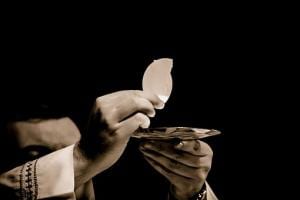
The sacraments are visible signs instituted by Christ that actually communicate the grace they signify. Baptism is not merely a symbolic washing. Through water and the Holy Spirit, a person is reborn in Christ. Likewise, the Eucharist is not merely an external representation of communion with Jesus. It is the sacrament in which Christ becomes truly present and gives himself to the faithful.
This does not mean that Christ is present in the Eucharist in the same manner that an ordinary physical object occupies space. The Church teaches that his presence is real and substantial, but sacramental. His body and blood are present under the appearances of bread and wine.
The distinction is important. When Catholics speak of the Real Presence, we are not claiming that the Eucharist becomes visibly identifiable human flesh under ordinary circumstances. Rather, through the power of Christ, the substance of bread and wine is changed into his body and blood while the appearances remain.
The Church would eventually articulate this mystery through the doctrine of transubstantiation, a term developed and refined centuries after the controversy at Corbie.
In this way, the ninth-century discussion contributed to a larger theological process. The Church did not invent a new Eucharistic faith, but gradually developed more precise language to explain the faith it had received.
The Danger of Separating the Material and Spiritual Worlds
The controversy between Paschasius and Ratramnus also provides an opportunity to examine a broader problem that continues to affect Christianity today. There is a temptation to separate the material world from the spiritual world so completely that the two seem unable to interact.
This tendency is especially problematic when discussing the sacraments.
Throughout Sacred Scripture, God uses material realities to accomplish his purposes. He forms Adam from the dust of the ground, speaks to Moses through a burning bush, commands the Israelites to mark their doorposts with the blood of the Passover lamb, and heals Naaman through washing in the Jordan River.
In the New Testament, this pattern continues. Christ heals the blind man using mud and water, touches the sick, and ultimately offers his own body upon the cross for the salvation of the world.
The Incarnation demonstrates that the material world is not an obstacle to divine grace. God can use his creation to communicate his presence and accomplish his will.
This sacramental worldview is fundamental to Catholic Christianity. The Church recognizes that God works through visible signs because human beings are both body and soul. We encounter the world through our senses, and God graciously meets us within that human experience.
A theology that reduces the sacraments to reminders or purely subjective expressions of faith risks diminishing this biblical understanding of God’s relationship with creation.
It would be historically inaccurate to blame Ratramnus for later philosophical movements such as humanism or materialism. Nevertheless, the questions raised by his writings provide an opportunity to reflect on the consequences of separating the spiritual and material dimensions of Christian worship.
The Catholic response is not to deny the importance of faith. Faith is essential for receiving the Eucharist fruitfully. Rather, the Church insists that the reality of Christ’s Eucharistic presence does not depend upon the personal belief of the individual receiving the sacrament.
Christ is truly present because of his promise and power, not because we make him present through our thoughts or feelings.
From the Ninth Century to the Doctrine of Transubstantiation
The discussion between Paschasius and Ratramnus did not immediately produce the precise theological definitions familiar to Catholics today. Instead, it became part of a much longer process of reflection upon the Eucharistic mystery.
In the eleventh century, another controversy emerged through the teachings of Berengar of Tours. His explanations of the Eucharist raised additional concerns about the relationship between sacramental signs and the reality of Christ’s body and blood.
These debates prompted theologians to clarify the Church’s understanding of Eucharistic presence. Over time, the language of substance and accidents became increasingly important in explaining how bread and wine could retain their sensory appearances while becoming the body and blood of Christ.
The Fourth Lateran Council in 1215 used the language of transubstantiation, and the Council of Trent later provided a more detailed explanation in response to the controversies of the Protestant Reformation.
The Catechism of the Catholic Church summarizes this teaching:
“By the consecration of the bread and wine there takes place a change of the whole substance of the bread into the substance of the body of Christ our Lord and of the whole substance of the wine into the substance of his blood” (CCC 1376).
This teaching preserves an essential truth that Paschasius sought to defend: the Eucharist is truly Jesus Christ.
The development of Eucharistic terminology should not be confused with the invention of Eucharistic doctrine. Christians believed in the reality of Christ’s Eucharistic presence long before the word transubstantiation became part of the Church’s theological vocabulary.
The terminology developed because the Church needed to explain more clearly what it had always professed in its worship and faith.
Why This Controversy Still Matters Today
It may be tempting to dismiss a theological disagreement between two ninth-century monks as something that has little relevance to modern Catholics. After all, more than a thousand years have passed since Paschasius and Ratramnus wrote their respective works.
However, the questions they explored remain remarkably relevant.
What do we believe happens during the consecration at Mass? Do we approach the Eucharist as an encounter with the living Christ, or has receiving Communion become something routine? Do we recognize that the sacraments are genuine encounters with God’s grace, or have we reduced them to religious ceremonies that simply remind us of spiritual truths?
These questions deserve serious consideration because our understanding of the Eucharist shapes the way we worship.
If the Eucharist is merely symbolic, then the Mass becomes primarily an act of remembrance. However, if the Eucharist is truly the body and blood of Christ, then every Mass brings us into sacramental communion with the sacrifice of Calvary and the risen Lord.
This is why the Catholic Church treats the Eucharist with such reverence. We genuflect before the tabernacle, adore Christ in the Blessed Sacrament, and prepare ourselves to receive Holy Communion worthily. These practices are not empty rituals. They flow from our conviction that Jesus Christ is truly present.
The Eucharist is also a call to transformation. Receiving Christ should change the way we live, treat others, forgive those who have wronged us, and respond to the needs of the poor. We cannot claim to be united with Christ in Holy Communion while refusing to allow his grace to transform our lives.
Paschasius understood this intimate connection between Eucharistic communion and Christian living. Christ gives himself to us so that we may live more fully in him.
Conclusion: The Eucharist Is an Encounter With the Living Christ
The first major medieval Eucharistic controversy reminds us that the Church has spent centuries contemplating the mystery of Christ’s presence in the Blessed Sacrament. Paschasius Radbertus and Ratramnus approached that mystery differently, and their writings contributed to the theological discussions that eventually produced more precise explanations of Eucharistic doctrine.
Yet the heart of the Catholic faith remains unchanged.
When we approach the altar and receive Holy Communion, we are not merely participating in a symbolic meal. We are receiving Jesus Christ, who gives himself completely for our salvation. The same Lord who walked the roads of Galilee, healed the sick, forgave sinners, died upon the cross, and rose triumphantly from the grave comes to us under the appearances of bread and wine.
There is something profoundly humbling about this reality. The Creator of the universe makes himself present in a manner that we can receive. He does so not because he needs anything from us, but because he desires communion with us.
The challenge for Catholics today is not simply to defend the doctrine of the Real Presence in theological discussions. It is to live as though we truly believe it.
The next time we approach the altar for Holy Communion, perhaps we should consider the words of Christ in John 6:57. We live because of him, and he gives himself to us so that his life may become the center of our own.
That is the beauty of the Eucharist. It is not merely something we believe. It is someone we encounter.
And that someone is Jesus Christ.
References
Catechism of the Catholic Church. (1997). §§ 1322–1419.
Council of Trent. (1551). Session XIII: Decree concerning the Most Holy Sacrament of the Eucharist.
Ignatius of Antioch. Letter to the Smyrnaeans, 6–7.
Justin Martyr. First Apology, 66.
Paschasius Radbertus. De corpore et sanguine Domini (On the Body and Blood of the Lord).
Pohle, J. (1911). St. Paschasius Radbertus. In The Catholic Encyclopedia (Vol. 11). Robert Appleton Company. https://www.newadvent.org/cathen/11518a.htm
Ratramnus of Corbie. De corpore et sanguine Domini (On the Body and Blood of the Lord).
Sacred Scripture: Matthew 26:26–28; John 1:14; John 6:51–58; 1 Corinthians 10:16–17; 1 Corinthians 11:23–29.
General Christian
Education and Religion
History and Religion
Previous Post

October 16, 2026
Archdiocese Hosts Military Marriage Retreat in Germany
Recent Comments
"Excellent presentation. I have found that what matters most is the "posture" of the heart ..."
"I agree with you 100%. The bishops have instructed everyone to receive on the hand ..."
"After seeing exactly how screwed up Christian Conservatives are, worshipping a man that is immorral. ..."
You Are With Jesus Or With ..."
"Jesus or Beelzebul? I'll take curtain three, thank you. I don't DO Fear religions."
You Are With Jesus Or With ..."
Browse Our Archives
Select a Category Uncategorized
Select a Month October 2026 September 2026 August 2026 July 2026 June 2026 May 2026 April 2026 March 2026 February 2026 January 2026 December 2025 November 2025 October 2025 September 2025 August 2025 July 2025 June 2025 May 2025 April 2025 March 2025 February 2025 January 2025 December 2024 November 2024 October 2024 September 2024 August 2024 July 2024 June 2024 May 2024 April 2024 March 2024 February 2024 January 2024 December 2023 November 2023 October 2023 September 2023 August 2023 May 2023 April 2023 March 2023 February 2023 January 2023 December 2022 November 2022 October 2022 September 2022 August 2022 July 2022 June 2022 May 2022 April 2022 March 2022 February 2022 January 2022 December 2021 November 2021 October 2021 March 2021 February 2021 January 2021 December 2020 November 2020 October 2020 September 2020 August 2020 July 2020 June 2020 May 2020 April 2020 March 2020 February 2020 January 2020
Follow Us!
TAKE THE
Religious Wisdom Quiz
What did David use to calm Saul when Saul was troubled by a harmful spirit?
Select your answer to see how you score.
Drum Harp Trumpet Flute
Related posts from The Pursuit of Holiness

Archdiocese Hosts Military Marriage Retreat in Germany

Ascension Releases New Edition of Dr. Edward Sri...

Archbishop Broglio Issues Statement on Execution Livestream
Ascension's New Catholic Bible for Readers with Dyslexia
TRENDING AT PATHEOS Catholic

Catholic Evangelization: Sharing Your Faith Every Day
Welcome back to the Graceful Awakening mini-series called, “From Faith to Mission.” ...

The Pillar of the Boatmen: the Ancient Monument...
The Pillar of the Boatmen is a Romano-Gaulish sculpture that dates from...

In one sense walking into Westminster Abbey is like walking down the...

'Super Scam Me' Exposes AI Jon Bon Jovi...
Leslie Pickett believed she was in a relationship with Jon Bon Jovi....

The Brazilian Remake of Kendricks' 'Flywheel' Opens in...
“Flywheel,” the story that launched the Kendrick Brothers’ filmmaking career is getting...

The Dangers of Gradual Accommodation (Winking at Sin)
Recently, the “law of gradualness” resurfaced during the opening of a weeklong,...
view all Catholic blogs
What Are Your Thoughts?leave a comment
Ad-Free & Subscriber Log-In Subscription Support
- About Us
- 2026 Calendar
- Videos
- Podcasts
- Library of World Religions
- Faith In Media Tracker
- Advertise With Us
- Write for Us
- Privacy Policy
- Terms of Service
- Do Not Sell My Data
- Contact Us
- Radiant Digital
- Manage Newsletter Subscriptions
- Unsubscribe From Notifications
- Sitemap
Copyright 2008-2026, Patheos. All rights reserved.
Subscription Support Ad-Free & Subscriber Log-In
Follow Patheos