
BuddhistCatholicContemplativeEvangelicalGeneral ChristianHinduJewishLatter-day SaintMuslimNew VisionsProgressive Christian
Beliefs
- Buddhist
- Catholic
- Contemplative
- Evangelical
- General Christian
- Hindu
- Jewish
- Latter-day Saint
- More Voices
- Muslim
- New Visions
- Pagan
- Progressive Christian
Topics
- Religion News
- Food and Religion
- Sports and Religion
- Religious Art
- Religious Music and Entertainment
- Religious Events
- History and Religion
- Style and Religion
- Politics and Religion
- Women in Religion
- Recreation Outdoors and Religion
- Business Finance and Religion
- Careers Workplace and Religion
- Education and Religion
- Family Parenting and Religion
- Health Fitness and Religion
- Home and Religion
- Relationships and Religion
- Technology and Religion
- Travel and Religion
Columnists
- Buddhist Columnists
- Business Finance and Religion Columnists
- Careers Workplace and Religion Columnists
- Catholic Columnists
- Contemplative Columnists
- Education and Religion Columnists
- Evangelists Columnists
- Family Parenting and Religion Columnists
- General Christian Columnists
- Health Fitness and Religion Columnists
- Hindu Columnists
- History and Religion Columnists
- Home and Religion Columnists
- Jewish Columnists
- More Voices Columnists
- Latter Day Columnists
- Muslim Columnists
- New Visions Columnists
- Nonreligious Columnists
- Pagan Columnists
- Politics and Religion Columnists
- Progressive Columnists
- Recreation Outdoors and Religion Columnists
- Relationships and Religion Columnists
- Religion News Columnists
- Religious Art Columnists
- Religious Events Columnists
- Religious Music and Entertainment Columnists
- Sports and Religion Columnists
- Style and Religion Columnists
- Technology and Religion Columnists
- Travel and Religion Columnists
- Women in Religion Columnists
Resource Library
- 2026 Calendar
- Library of World Religions
- The 100 Most Holy Places on Earth
- Patheos Answers
- Podcasts
- Videos
- Faith Leaders Database
- Anglican Episcopalian
- Bahai
- Baptist
- Buddhism
- Christianity
- Confucianism
- Eastern Orthodoxy
- Hinduism
- Holiness and Pentecostal
- ISKCON
- Islam
- Judaism
- Lutheran
- Methodist
- The Church of Jesus Christ of Latter-day Saints
- New Age
- Paganism
- Presbytarian and Reformed
- Protestantism
- Religion Behind the Scenes
- Roman Catholic
- Scientology
- Shia Islam
- Sikhism
- Sufism
- Sunni Islam
- Taoism
- Zen
- See all religions
Research Tools
 Ad-Free & Subscriber Log-In Subscription Support
Ad-Free & Subscriber Log-In Subscription Support
Follow Patheos 

- Trending:
- Forgiveness
- |
- Marriage
- |
- Consciousness
- |
- Death Penalty
- |
- Election
- |
- Halloween

- Home
- Catholic
- Education and Religion
- Sabellianism, Arianism, and the Need To Define The Trinity
Sabellianism, Arianism, and the Need To Define The Trinity
Last updated on: October 8, 2025 at 2:32 pm by William Hemsworth
Sabellianism, Arianism, and the Need To Define The Trinity 2025-10-08T14:32:06-07:00 William Hemsworth
Patheos Explore the world's faith through different perspectives on religion and spirituality! Patheos has the views of the prevalent religions and spiritualities of the world.
In the early centuries of the Church, many Christians wrestled with how to properly understand the divinity of Christ and, by extension, the mystery of the Holy Trinity. While the apostles and early Fathers affirmed the divine nature of the Son and the Holy Spirit, the Church had not yet issued formal dogmatic definitions. This left room for speculation and, unfortunately, the spread of various theological errors. Today, we have the benefit of centuries of reflection and the Church’s official teachings that clarify these mysteries. However, in the early Church, believers and theologians alike were navigating uncharted territory. The need to articulate clearly what had always been believed but not yet defined gave rise to some of the most important doctrinal developments in Christian history.
Among the early challenges to orthodox belief were the heresies of Monarchianism, Sabellianism, Subordinationism, and Arianism. Each of these errors, in different ways, distorted the relationship between the Father, the Son, and the Holy Spirit. Dynamic Monarchianism, for example, taught that the Father alone was truly God and that Christ was a mere man specially filled with divine power or presence—a sort of “adopted” Son (Preuss 126). This view denied Christ’s eternal divinity and reduced Him to a created being uniquely inspired by God rather than God Himself.
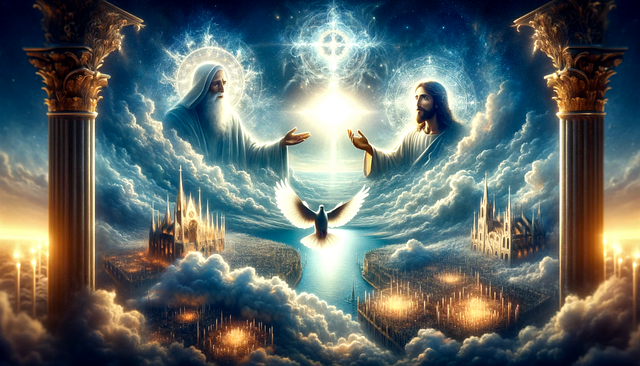
Patripassian Monarchianism, a related idea, attempted to safeguard Christ’s divinity but still failed to distinguish adequately between the divine persons. It taught that the Father Himself became incarnate and suffered on the Cross. This view, while affirming Christ’s divinity, blurred the personal distinctions within the Godhead and effectively made the Father and the Son the same person under different names. Sabellianism, also known as Modalism, developed this line of thinking further by teaching that God was one person who merely appeared or “manifested” Himself in three different modes—sometimes as Father, sometimes as Son, and sometimes as Holy Spirit (Garrigou-Lagrange, Ch. 5). In this framework, the three persons were not distinct at all but were simply different expressions of one divine person acting in different roles.
Arianism, on the other hand, took the opposite approach. Rather than collapsing the persons of the Trinity into one, Arius sharply divided them. He denied that the Son was co-eternal or consubstantial with the Father, claiming instead that the Son was a creation—albeit the highest of all created beings—and that there was a time when the Son did not exist. This view inevitably made Christ subordinate to the Father, both in nature and in dignity. The Holy Spirit, in Arian thought, was even further diminished, treated as a kind of divine energy or created force rather than a divine person. Because of these teachings, all these heresies in some way introduced subordinationism—lowering the divinity of the Son and the Spirit and undermining the fullness of the Godhead.
The implications of these errors were not merely academic. They struck at the heart of salvation itself. If Christ were not truly God, then His redemptive death and resurrection could not reconcile humanity to the Father. A created being, no matter how exalted, could not bridge the infinite gap between Creator and creature. The early Church recognized that such teachings threatened the very essence of Christian faith. The bishops, theologians, and faithful alike understood that to misunderstand who Christ is was to misunderstand the Gospel itself.
In response to these challenges, the Church, guided by the Holy Spirit, convened councils to clarify and define what had always been believed. The First Council of Nicaea in 325 AD was pivotal. There, the Church solemnly affirmed that the Son is “of one substance” (homoousios) with the Father—fully divine, eternally begotten, not made. This declaration refuted Arianism and laid the foundation for the Nicene Creed, which continues to serve as a cornerstone of Christian orthodoxy. Later councils, such as Constantinople (381), would further affirm the divinity of the Holy Spirit, completing the Church’s formal articulation of the doctrine of the Trinity.
The development of Trinitarian theology in the early centuries was not the invention of a new belief but the clarification of an eternal truth. Through prayer, debate, and divine guidance, the Church safeguarded the revelation of who God is: one divine essence in three distinct and coequal persons—Father, Son, and Holy Spirit.
Works Cited
Garrigou-Lagrange, Reginald. The Trinity and God the Creator. https://www.ewtn.com/library/THEOLOGY/TRINITY.HTM#05, accessed November 13, 2024.
Preuss, Arthur. The Divine Trinity. https://archive.org/details/divinetrinityad00pohlgoog, accessed November 12, 2024.
General Christian
Education and Religion
History and Religion
Previous Post
October 8, 2025
Sr. Michael Bochnowski Honored with Order of Joseph Award
Next Post
October 9, 2025 Bishop Caggianelli Leads Mass at Sea Services Pilgrimage
Recent Comments
"Excellent presentation. I have found that what matters most is the "posture" of the heart ..."
"I agree with you 100%. The bishops have instructed everyone to receive on the hand ..."
"After seeing exactly how screwed up Christian Conservatives are, worshipping a man that is immorral. ..."
You Are With Jesus Or With ..."
"Jesus or Beelzebul? I'll take curtain three, thank you. I don't DO Fear religions."
You Are With Jesus Or With ..."
Browse Our Archives
Select a Category Uncategorized
Select a Month October 2026 September 2026 August 2026 July 2026 June 2026 May 2026 April 2026 March 2026 February 2026 January 2026 December 2025 November 2025 October 2025 September 2025 August 2025 July 2025 June 2025 May 2025 April 2025 March 2025 February 2025 January 2025 December 2024 November 2024 October 2024 September 2024 August 2024 July 2024 June 2024 May 2024 April 2024 March 2024 February 2024 January 2024 December 2023 November 2023 October 2023 September 2023 August 2023 May 2023 April 2023 March 2023 February 2023 January 2023 December 2022 November 2022 October 2022 September 2022 August 2022 July 2022 June 2022 May 2022 April 2022 March 2022 February 2022 January 2022 December 2021 November 2021 October 2021 March 2021 February 2021 January 2021 December 2020 November 2020 October 2020 September 2020 August 2020 July 2020 June 2020 May 2020 April 2020 March 2020 February 2020 January 2020
Follow Us!
TAKE THE
Religious Wisdom Quiz
What is the meaning of "Golgotha," the place of Jesus' crucifixion?
Select your answer to see how you score.
Place of the Skull Place of Tears House of Sorrows Valley of Death
Related posts from The Pursuit of Holiness

The First Eucharistic Controversy: Christ’s Real Presence

Archdiocese Hosts Military Marriage Retreat in Germany

Ascension Releases New Edition of Dr. Edward Sri...

Archbishop Broglio Issues Statement on Execution Livestream
TRENDING AT PATHEOS Catholic

The Problem with False Prophets
Miller’s Station UMC| 10/18/26| Anchor Verse: Jeremiah 23: 1, 9-23 I...

Emotion in Early Christianity by Andrew Crislip
Andrew Crislip’s Emotion in Early Christianity examines an often overlooked dimension of...

16 Spiritual Touchstones for a More Grounded Life
After decades of spiritual study, here are 16 principles I try...

Catholic Evangelization: Sharing Your Faith Every Day
Welcome back to the Graceful Awakening mini-series called, “From Faith to Mission.” ...

The Pillar of the Boatmen: the Ancient Monument...
The Pillar of the Boatmen is a Romano-Gaulish sculpture that dates from...

In one sense walking into Westminster Abbey is like walking down the...
view all Catholic blogs
What Are Your Thoughts?leave a comment
Ad-Free & Subscriber Log-In Subscription Support
- About Us
- 2026 Calendar
- Videos
- Podcasts
- Library of World Religions
- Faith In Media Tracker
- Advertise With Us
- Write for Us
- Privacy Policy
- Terms of Service
- Do Not Sell My Data
- Contact Us
- Radiant Digital
- Manage Newsletter Subscriptions
- Unsubscribe From Notifications
- Sitemap
Copyright 2008-2026, Patheos. All rights reserved.
Subscription Support Ad-Free & Subscriber Log-In
Follow Patheos