
BuddhistCatholicContemplativeEvangelicalGeneral ChristianHinduJewishLatter-day SaintMuslimNew VisionsProgressive Christian
Beliefs
- Buddhist
- Catholic
- Contemplative
- Evangelical
- General Christian
- Hindu
- Jewish
- Latter-day Saint
- More Voices
- Muslim
- New Visions
- Pagan
- Progressive Christian
Topics
- Religion News
- Food and Religion
- Sports and Religion
- Religious Art
- Religious Music and Entertainment
- Religious Events
- History and Religion
- Style and Religion
- Politics and Religion
- Women in Religion
- Recreation Outdoors and Religion
- Business Finance and Religion
- Careers Workplace and Religion
- Education and Religion
- Family Parenting and Religion
- Health Fitness and Religion
- Home and Religion
- Relationships and Religion
- Technology and Religion
- Travel and Religion
Columnists
- Buddhist Columnists
- Business Finance and Religion Columnists
- Careers Workplace and Religion Columnists
- Catholic Columnists
- Contemplative Columnists
- Education and Religion Columnists
- Evangelists Columnists
- Family Parenting and Religion Columnists
- General Christian Columnists
- Health Fitness and Religion Columnists
- Hindu Columnists
- History and Religion Columnists
- Home and Religion Columnists
- Jewish Columnists
- More Voices Columnists
- Latter Day Columnists
- Muslim Columnists
- New Visions Columnists
- Nonreligious Columnists
- Pagan Columnists
- Politics and Religion Columnists
- Progressive Columnists
- Recreation Outdoors and Religion Columnists
- Relationships and Religion Columnists
- Religion News Columnists
- Religious Art Columnists
- Religious Events Columnists
- Religious Music and Entertainment Columnists
- Sports and Religion Columnists
- Style and Religion Columnists
- Technology and Religion Columnists
- Travel and Religion Columnists
- Women in Religion Columnists
Resource Library
- 2026 Calendar
- Library of World Religions
- The 100 Most Holy Places on Earth
- Patheos Answers
- Podcasts
- Videos
- Faith Leaders Database
- Anglican Episcopalian
- Bahai
- Baptist
- Buddhism
- Christianity
- Confucianism
- Eastern Orthodoxy
- Hinduism
- Holiness and Pentecostal
- ISKCON
- Islam
- Judaism
- Lutheran
- Methodist
- The Church of Jesus Christ of Latter-day Saints
- New Age
- Paganism
- Presbytarian and Reformed
- Protestantism
- Religion Behind the Scenes
- Roman Catholic
- Scientology
- Shia Islam
- Sikhism
- Sufism
- Sunni Islam
- Taoism
- Zen
- See all religions
Research Tools
 Ad-Free & Subscriber Log-In Subscription Support
Ad-Free & Subscriber Log-In Subscription Support
Follow Patheos 

- Trending:
- Forgiveness
- |
- Marriage
- |
- Consciousness
- |
- Death Penalty
- |
- Election
- |
- Halloween

- Home
- Catholic
- 1 John: A Historical Analysis
1 John: A Historical Analysis
Last updated on: March 6, 2022 at 3:59 pm by William Hemsworth
1 John: A Historical Analysis 2022-03-06T15:59:40-07:00 William Hemsworth
Patheos Explore the world's faith through different perspectives on religion and spirituality! Patheos has the views of the prevalent religions and spiritualities of the world.
One of the aspects of historical analysis is determining authorship. When it comes to authorship there are two predominant modes of thought. The first is that the author is the Apostle John, or John the son of Zebedee, as he is known in scripture. The other is that the author was part of the Johannine school of thought and a member of the Johannine community that wrote in the spirit of John. What we can do is compare the writing of the Gospel of John and the Johannine epistles to find some similarities. When these books are read the reader will notice much similarity in language, tone, and how the words are utilized. The similarities are so significant that there is an 86% match in how words are used.
1 John And The Early Church
The idea that John the Apostle is the author is one that went unchallenged until the twentieth century. The early tradition of the Christian church identifies John as the author. Theological heavyweights such as Irenaeus, Tertullian, and Dionysius of Alexandria say that the author John the Apostle of Christ. In his great work titled Against Heresies, Irenaeus says speaks of John testifying in his Epistle about the things he witnessed. The annotation of authorship from Dionysus is recorded by the great early church historian Eusebius. Tertullian has an interesting reason as to why John the Apostle is the author of 1 John. Though Tertullian gives many reasons, he explains that the knowledge of the humanity and divinity of Christ is expressed through what John saw in the transfiguration. These pieces of evidence are known as external evidence. They are called so because they occur outside of the epistle of 1 John. What does the internal evidence tell us about authorship?

Internal Evidence For Authorship
Internal evidence is evidence that we can see within the sacred text itself. 1 John is unique in that it does not follow the standard greeting formula that was common at the time. This lack of a standard greeting has led some to speculate that it is a sermon or homily. The author does not identify himself by name, but he is an individual as can bee seen from several references to himself in the singular form.
The author also writes with authority and is seen throughout the letter. This is a virtue of his apostolic authority. There is a chiastic pattern that is common between the Gospel of John and the epistles which would also link to John the Apostle. This is most attested to by 1:1 where the author claims to be an eyewitness.
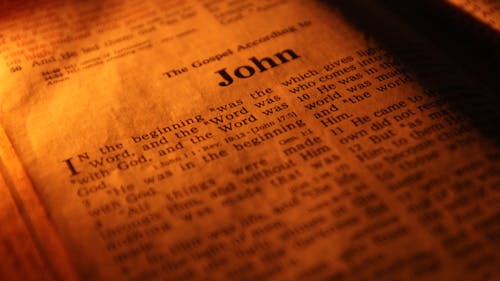
Why did John write 1 John? There is not one audience in mind as is seen with the Apostle Paul and Galatians, but it is meant for a group of churches who are being challenged in the same way. There is some speculation that the seven churches listed in Revelation were the intended audience, but evidence does not really support that hypothesis. The likely audiences were the churches located around Ephesus in Asia Minor.
Ephesus, in modern day Turkey, is where John resided towards the end of his life. It was the capital of Asia Minor, was a center of trade, and the Roman Proconsul and there is much evidence to place John there. Papias and Polycarp were the earliest to use the letter in their own writings. They were situated near Ephesus, and they were also disciples of the apostle. Early church tradition in the writing of Irenaeus, Justin Martyr, and Polycrates and also place the Apostle in Ephesus.
What Heresy Was Being Addressed In 1 John?
What John was addressing in the churches is another area of debate. There are three ideologies that are contenders for the heresy being described. One is a heresy known as cerinthianism. This ideology comes from a figure in the early church named Cerinthus and he is said to be taught by one of the disciples. Cerinthus denied some aspect of Christ’s flesh, particularly after the resurrection and he could have possible been an early proponent of adoptionism.
Another heresy that some say John was writing about was Gnosticism. We know from history that this movement was gaining substantial steam in Asia Minor. Gnosticism was able to cloche itself in the Christian message, so it was easy for someone with little knowledge to fall victim to it. It is an interesting belief system that essentially teaches that matter is evil and only those with the secret knowledge will be saved. Since all matter is evil there is no way that the incarnation is possible.
The third candidate for the opponents of John are what is known as Docetists. Some call them proto-Gnostics because some of their beliefs were made popular and spread by Gnostics. This group gets its name from the Greek word dokein which means “to appear” or “to seem”. In their view Christ only appeared to be human, but he really was not. Docetism is part of what would become Gnosticism and therefore the issue that John was addressing to his audience.
This historical analysis tells us who wrote 1 John, who the audience was, the opponents/occasion, and the general location. Understanding these things is essential to interpreting 1 John. John was an eyewitness to Jesus and walked, talked, and saw him die on the cross. He is giving eyewitness testimony to his humanity and his divinity. The letter was written to a group of churches in Asia Minor that were experiencing the challenge of Docetism. John wrote to reassure the church that the Jesus that he has preached to them, using his apostolic witness, is the true Jesus and therefore the true faith.
Interview About 1 John
I was recently interviewed by Gary Michuta on his Hands on Apologetics radio program that airs daily on Virgin Most Powerful Radio. Below is our discussion on 1 John.
Previous Post
March 5, 2022
The Book of Revelation and Overcoming
Next Post

March 7, 2022 The Importance of the Liturgy: An Interview With David L. Gray
Browse Our Archives
Select a Category Uncategorized
Select a Month October 2026 September 2026 August 2026 July 2026 June 2026 May 2026 April 2026 March 2026 February 2026 January 2026 December 2025 November 2025 October 2025 September 2025 August 2025 July 2025 June 2025 May 2025 April 2025 March 2025 February 2025 January 2025 December 2024 November 2024 October 2024 September 2024 August 2024 July 2024 June 2024 May 2024 April 2024 March 2024 February 2024 January 2024 December 2023 November 2023 October 2023 September 2023 August 2023 May 2023 April 2023 March 2023 February 2023 January 2023 December 2022 November 2022 October 2022 September 2022 August 2022 July 2022 June 2022 May 2022 April 2022 March 2022 February 2022 January 2022 December 2021 November 2021 October 2021 March 2021 February 2021 January 2021 December 2020 November 2020 October 2020 September 2020 August 2020 July 2020 June 2020 May 2020 April 2020 March 2020 February 2020 January 2020
Follow Us!
TAKE THE
Religious Wisdom Quiz
Who did God give the Ten Commandments to?
Select your answer to see how you score.
Abraham Moses Joshua Noah
Related posts from The Pursuit of Holiness

Archdiocese Hosts Military Marriage Retreat in Germany

Ascension Releases New Edition of Dr. Edward Sri...

Archbishop Broglio Issues Statement on Execution Livestream
Ascension's New Catholic Bible for Readers with Dyslexia
TRENDING AT PATHEOS Catholic

How to Make a Decision When You Can't...
Main point: It’s much more valuable to stay close to God so...

Archdiocese Hosts Military Marriage Retreat in Germany
RASTATT, Germany — The transient military lifestyle, with its frequent deployments and...

Nearly every morning, I make the drive to Detroit with my high-school-age...

The Real AI Story Is Adoption Without Trust
Artificial intelligence has crossed a political threshold. It is no longer a...

A new article, written by Jeff Lindsay and Gale L. Pooley,...

Swimfan: Forgotten Aughts Pleasures
This is a recovery effort. In 2002, My Big Fat Greek Wedding...
view all Catholic blogs
Ad-Free & Subscriber Log-In Subscription Support
- About Us
- 2026 Calendar
- Videos
- Podcasts
- Library of World Religions
- Faith In Media Tracker
- Advertise With Us
- Write for Us
- Privacy Policy
- Terms of Service
- Do Not Sell My Data
- Contact Us
- Radiant Digital
- Manage Newsletter Subscriptions
- Unsubscribe From Notifications
- Sitemap
Copyright 2008-2026, Patheos. All rights reserved.
Subscription Support Ad-Free & Subscriber Log-In
Follow Patheos