
BuddhistCatholicContemplativeEvangelicalGeneral ChristianHinduJewishLatter-day SaintMuslimNew VisionsProgressive Christian
Beliefs
- Buddhist
- Catholic
- Contemplative
- Evangelical
- General Christian
- Hindu
- Jewish
- Latter-day Saint
- More Voices
- Muslim
- New Visions
- Pagan
- Progressive Christian
Topics
- Religion News
- Food and Religion
- Sports and Religion
- Religious Art
- Religious Music and Entertainment
- Religious Events
- History and Religion
- Style and Religion
- Politics and Religion
- Women in Religion
- Recreation Outdoors and Religion
- Business Finance and Religion
- Careers Workplace and Religion
- Education and Religion
- Family Parenting and Religion
- Health Fitness and Religion
- Home and Religion
- Relationships and Religion
- Technology and Religion
- Travel and Religion
Columnists
- Buddhist Columnists
- Business Finance and Religion Columnists
- Careers Workplace and Religion Columnists
- Catholic Columnists
- Contemplative Columnists
- Education and Religion Columnists
- Evangelists Columnists
- Family Parenting and Religion Columnists
- General Christian Columnists
- Health Fitness and Religion Columnists
- Hindu Columnists
- History and Religion Columnists
- Home and Religion Columnists
- Jewish Columnists
- More Voices Columnists
- Latter Day Columnists
- Muslim Columnists
- New Visions Columnists
- Nonreligious Columnists
- Pagan Columnists
- Politics and Religion Columnists
- Progressive Columnists
- Recreation Outdoors and Religion Columnists
- Relationships and Religion Columnists
- Religion News Columnists
- Religious Art Columnists
- Religious Events Columnists
- Religious Music and Entertainment Columnists
- Sports and Religion Columnists
- Style and Religion Columnists
- Technology and Religion Columnists
- Travel and Religion Columnists
- Women in Religion Columnists
Resource Library
- 2026 Calendar
- Library of World Religions
- The 100 Most Holy Places on Earth
- Patheos Answers
- Podcasts
- Videos
- Faith Leaders Database
- Anglican Episcopalian
- Bahai
- Baptist
- Buddhism
- Christianity
- Confucianism
- Eastern Orthodoxy
- Hinduism
- Holiness and Pentecostal
- ISKCON
- Islam
- Judaism
- Lutheran
- Methodist
- The Church of Jesus Christ of Latter-day Saints
- New Age
- Paganism
- Presbytarian and Reformed
- Protestantism
- Religion Behind the Scenes
- Roman Catholic
- Scientology
- Shia Islam
- Sikhism
- Sufism
- Sunni Islam
- Taoism
- Zen
- See all religions
Research Tools
 Ad-Free & Subscriber Log-In Subscription Support
Ad-Free & Subscriber Log-In Subscription Support
Follow Patheos 

- Trending:
- Forgiveness
- |
- Marriage
- |
- Consciousness
- |
- Death Penalty
- |
- Election
- |
- Halloween

- Home
- Catholic
- Apostolic Succession And The Arian Controversy: Part 2
Apostolic Succession And The Arian Controversy: Part 2
Last updated on: September 21, 2020 at 1:06 pm by William Hemsworth
Apostolic Succession And The Arian Controversy: Part 2 2020-09-21T13:06:36-07:00 William Hemsworth
Patheos Explore the world's faith through different perspectives on religion and spirituality! Patheos has the views of the prevalent religions and spiritualities of the world.
Arianism, Church Fathers, And Apostolic Succession
The temptation when looking at the Arian controversy is to immediately look to the Council of Nicea. However there is much more to the church’s response. As any good Pastor would be, Bishop Alexander became concerned by the teaching of one of his priests.
This error has eternal consequences for those who became wooed by this new doctrine. Alexander admits that he initially ignored the false doctrines and hoped they would die out on their own. Plans changed when Bishop Eusebius of Nicomedia came to the aid of Arius. To This Alexander of Alexandria writes:
But seeing that Eusebius, now of Nicomedia, who thinks that the government of the Church rests with him, because retribution has not come upon him for his desertion of Berytus, when he had cast an eye of desire on the Church of the Nicomedians, begins to support these apostates, and has taken upon him to write letters everywhere in their behalf, if by any means he may draw in certain ignorant persons to this most base and antichristian heresy (Schaff, 69).
Apostolic Succession And Authority
Seeing that a fellow bishop is no longer teaching doctrine that is part of scripture or sacred tradition was very alarming. Alexander used his authority, received via Apostolic Succession, to try to correct the situation. Alexander of Alexandria called a local synod that formally condemned the teachings of Arius. Subsequently letters were sent to surrounding bishops to inform them of the synods conclusion (Ferguson, 192).
The way that Alexander pleaded his case against Arius was nothing short of brilliant. Arius said that Jesus could not be God because God is immutable. Alexander’s argument was polemical in nature, but very effective. He said that Arius denied the immutability of the Father by saying that he was not immutable until the son was created.
According to Alexander, “Now when Arius and his fellows made these assertions, and shamelessly avowed them, we being assembled with the Bishops of Egypt and Libya, nearly a hundred in number, anathematized both them and their followers” (Schaff, 70).

Apostolic Succession And Anathema
Over one hundred bishops exercised their authority, that they received by apostolic succession, to anathematize Arius and his followers. The allow a teaching that was contrary to that of the apostles was to risk the salvation of souls. The early fathers had no choice but the exercise their authority.
According to the synod there was one view of Christ which was handed down directly from the apostles. Sadly, this would not be the end of the heresy. Though the synod had a near unanimous ruling, the eastern bishops were split.
We look back on this event now and say that this was a serious situation. You would be correct. A schism this early into the Christian era could have been disastrous. Emperor Constantine heard of the controversy from his Bishop named Hosius.
Regarding this the ancient church historian Socrates Scholasticus writes, “To this end he sent a letter to Alexander and Arius by a trustworthy person named Hosius, who was bishop of Cordova in Spain, and whom the emperor greatly loved and held in the highest estimation” (Scholasticus, 17). Constantine needed Christianity to be unified in an already crumbling Roman empire.
The Calling Of Nicea
To maintain unity, the emperor called all the bishops in the empire for a council. This council would become known as the first ecumenical Council of Nicea. The council commenced in 325 and set a precedent for all other ecumenical councils.
This council was so important that all other councils would reference it as being so (Sanders, 18). The council was made of 318 bishops. The Holy Father was absent from the council, not because he was not invited, but because he was too elderly to make the trip.
In his place he sent two priests to be legates, and to act in his place and authority. Church Historian William Carroll writes,
“The recommendation for a general or ecumenical council . . . had probably already been made to Constantine by Ossius [aka Hosius], and most probably to Pope Silvester as well. Ossius presided over its deliberations; he probably, and two priests of Rome certainly, came as representatives of the Pope” (Carroll, 11).
St. Athanasius
Championing the orthodox cause at the council was St. Athanasius. Athanasius was a brilliant theologian who argued from scripture the case that Christ is eternal. He argued that terms in scripture such as “was handed over” do not imply that the Son was not divine (Norris, 95).
The Council fathers rallied behind St. Athanasius, as he was preaching the faith that had been handed on to them (Schroeder, 14). The great saint said many things, but one struck the heart of Arius’s argument.
Regarding the Logos Athanasius said,
“It is plain, therefore, to everyone that not knowing is proper to the flesh, whereas the Logos, insofar as he is the Logos, knows all things even before their origination” (Norris, 97). Only God knows all things before their origination. This was a statement of deity that had been passed on from the beginning of the church (Bokenkotter, 51).
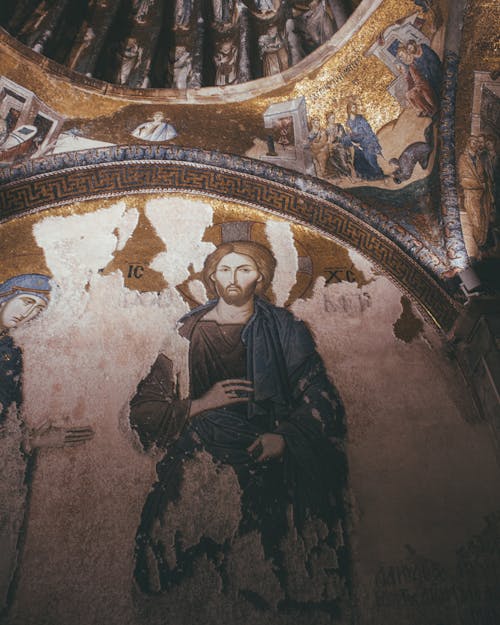
Homoosios And Apostolic Succession
Both sides of the controversy appealed to scripture. However the orthodox side coined the usage of a term that is not in scripture to describe Christ’s deity. This Greek work word is known as homoousios. The term means that the Son is of the same substance, or consubstantial, as the Father (Sanders, 18).
These are the same words we use at mass when we recite the Nicean creed. The teaching was passed on by valid apostolic succession. The irony is that while the bishops condemned Arianism, the term was a source of controversy.
The terminology and definitions were defined more narrowly in 381 at the Council of Constantinople thanks in part to the Cappadocian fathers. Regarding the definition St, Gregory of Nazianzus writes, “Because they are from him, though not after him. Being unoriginate necessarily implies being eternal, but being eternal does not entail being unoriginate” (Nazianzus, 71).
To review part one of this article you can review it here.
Stay tuned for part three.
Works Cited
Socrates Scholasticus. A History of the Church in Seven Books. London: Samuel Bagster and Sons, 1844. Print.
William Carroll. The Building of Christendom. Christendom College Press. Front Royal, VA: 1987. Print.
Schaff, Philip, and Henry Wace, eds. St. Athanasius: Select Works and Letters. Vol. 4. New York: Christian Literature Company, 1892. Print. A Select Library of the Nicene and Post-Nicene Fathers of the Christian Church, Second Series.
Schroeder, H. J. Disciplinary Decrees of the General Councils: Text, Translation, and Commentary. St. Louis, MO; London: B. Herder Book Co., 1937. Print.
Gregory of Nazianzus. On God and Christ. St. Vladimir’s Seminary Press. Crestwood, NY: 2002. Print.
Norris, Richard. The Christological Controversy. Fortress Press. Philadelphia, PA: 1980. Print
Fred Sanders & Klaus Issler. Jesus in Trinitarian Perspective. B&H Academic. Nashville, TN: 2007. Print.
Bokenkotter, Thomas. A Concise History of the Catholic Church. Image Books. New York, NY: 2004. Print.
Previous Post
September 18, 2020
Apostolic Succession And The Arian Controversy: Part1
Next Post
September 25, 2020 Apostolic Succession And The Arian Controversy: Part 3
Browse Our Archives
Select a Category Uncategorized
Select a Month October 2026 September 2026 August 2026 July 2026 June 2026 May 2026 April 2026 March 2026 February 2026 January 2026 December 2025 November 2025 October 2025 September 2025 August 2025 July 2025 June 2025 May 2025 April 2025 March 2025 February 2025 January 2025 December 2024 November 2024 October 2024 September 2024 August 2024 July 2024 June 2024 May 2024 April 2024 March 2024 February 2024 January 2024 December 2023 November 2023 October 2023 September 2023 August 2023 May 2023 April 2023 March 2023 February 2023 January 2023 December 2022 November 2022 October 2022 September 2022 August 2022 July 2022 June 2022 May 2022 April 2022 March 2022 February 2022 January 2022 December 2021 November 2021 October 2021 March 2021 February 2021 January 2021 December 2020 November 2020 October 2020 September 2020 August 2020 July 2020 June 2020 May 2020 April 2020 March 2020 February 2020 January 2020
Follow Us!
TAKE THE
Religious Wisdom Quiz
Who was Jochebed?
Select your answer to see how you score.
David's mother Jesus' mother Moses' mother Samuel's mother
Related posts from The Pursuit of Holiness

The First Eucharistic Controversy: Christ’s Real Presence

Archdiocese Hosts Military Marriage Retreat in Germany

Ascension Releases New Edition of Dr. Edward Sri...

Archbishop Broglio Issues Statement on Execution Livestream
TRENDING AT PATHEOS Catholic

Methodist Central Hall and Westminster Abbey
Situated on the same square is Methodist Central Hall and Westminster Abbey. ...

57th Dove Awards Honor Dolly Parton, Crown New...
On gospel music’s biggest night, the 57th annual GMA Dove Awards honored...

The First Eucharistic Controversy: Christ’s Real Presence
For Catholics, the Eucharist is the source and summit of the Christian...

What a Stop Sign Can Teach Us About...
How to Make a Decision When You Can't Hear God Main point:...

Archdiocese Hosts Military Marriage Retreat in Germany
RASTATT, Germany — The transient military lifestyle, with its frequent deployments and...

Nearly every morning, I make the drive to Detroit with my high-school-age...
view all Catholic blogs
Ad-Free & Subscriber Log-In Subscription Support
- About Us
- 2026 Calendar
- Videos
- Podcasts
- Library of World Religions
- Faith In Media Tracker
- Advertise With Us
- Write for Us
- Privacy Policy
- Terms of Service
- Do Not Sell My Data
- Contact Us
- Radiant Digital
- Manage Newsletter Subscriptions
- Unsubscribe From Notifications
- Sitemap
Copyright 2008-2026, Patheos. All rights reserved.
Subscription Support Ad-Free & Subscriber Log-In
Follow Patheos