
BuddhistCatholicContemplativeEvangelicalGeneral ChristianHinduJewishLatter-day SaintMuslimNew VisionsProgressive Christian
Beliefs
- Buddhist
- Catholic
- Contemplative
- Evangelical
- General Christian
- Hindu
- Jewish
- Latter-day Saint
- More Voices
- Muslim
- New Visions
- Pagan
- Progressive Christian
Topics
- Religion News
- Food and Religion
- Sports and Religion
- Religious Art
- Religious Music and Entertainment
- Religious Events
- History and Religion
- Style and Religion
- Politics and Religion
- Women in Religion
- Recreation Outdoors and Religion
- Business Finance and Religion
- Careers Workplace and Religion
- Education and Religion
- Family Parenting and Religion
- Health Fitness and Religion
- Home and Religion
- Relationships and Religion
- Technology and Religion
- Travel and Religion
Columnists
- Buddhist Columnists
- Business Finance and Religion Columnists
- Careers Workplace and Religion Columnists
- Catholic Columnists
- Contemplative Columnists
- Education and Religion Columnists
- Evangelists Columnists
- Family Parenting and Religion Columnists
- General Christian Columnists
- Health Fitness and Religion Columnists
- Hindu Columnists
- History and Religion Columnists
- Home and Religion Columnists
- Jewish Columnists
- More Voices Columnists
- Latter Day Columnists
- Muslim Columnists
- New Visions Columnists
- Nonreligious Columnists
- Pagan Columnists
- Politics and Religion Columnists
- Progressive Columnists
- Recreation Outdoors and Religion Columnists
- Relationships and Religion Columnists
- Religion News Columnists
- Religious Art Columnists
- Religious Events Columnists
- Religious Music and Entertainment Columnists
- Sports and Religion Columnists
- Style and Religion Columnists
- Technology and Religion Columnists
- Travel and Religion Columnists
- Women in Religion Columnists
Resource Library
- 2026 Calendar
- Library of World Religions
- The 100 Most Holy Places on Earth
- Patheos Answers
- Podcasts
- Videos
- Faith Leaders Database
- Anglican Episcopalian
- Bahai
- Baptist
- Buddhism
- Christianity
- Confucianism
- Eastern Orthodoxy
- Hinduism
- Holiness and Pentecostal
- ISKCON
- Islam
- Judaism
- Lutheran
- Methodist
- The Church of Jesus Christ of Latter-day Saints
- New Age
- Paganism
- Presbytarian and Reformed
- Protestantism
- Religion Behind the Scenes
- Roman Catholic
- Scientology
- Shia Islam
- Sikhism
- Sufism
- Sunni Islam
- Taoism
- Zen
- See all religions
Research Tools
 Ad-Free & Subscriber Log-In Subscription Support
Ad-Free & Subscriber Log-In Subscription Support
Follow Patheos 

- Trending:
- Forgiveness
- |
- Marriage
- |
- Consciousness
- |
- Death Penalty
- |
- Election
- |
- Halloween

- Home
- Catholic
- Biblical Evidence For The Eucharist
Biblical Evidence For The Eucharist
Last updated on: May 12, 2020 at 9:38 pm by William Hemsworth
Biblical Evidence For The Eucharist 2020-05-12T21:38:40-07:00 William Hemsworth
Patheos Explore the world's faith through different perspectives on religion and spirituality! Patheos has the views of the prevalent religions and spiritualities of the world.
Biblical Passages
Some claim that the doctrine of the Eucharist is not found in scripture, but this outlook is an indication of one reading the biblical text through a denominational lens. The last supper narratives all describe Jesus as saying “this is my body, this is my blood” in Matthew 26:17-30, Mark 14:12-25, Luke 22:7-20, and John 13:1-30.
St. Paul also writes about the body and blood of Christ in the breaking of bread in 1 Corinthians 10:16-17 and 1 Corinthians 11:23-29. Perhaps the strongest biblical evidence is from Christ himself in John 6:22-59 which is known as the bread of life discourse. In this discourse Christ loses follows because he is speaking literally about his body and blood.
Begins In The Old Testament
To understand these verses fully we must look at some Old Testament passages because these New Testament verses employ a theological term known as typology. Typology studies events and institution that foreshadow something greater that is to come. Regarding this Dr. Scott Hahn writes, “The basis of such study is the belief that God, who providentially shapes and determines the course of human events, infuses those events with a prophetic and theological significance” (Catholic Bible Dictionary page 929).
Understanding typology helps us understand salvation history as something fluid, and not as periods that are broken up independent of each other. God does not change, and the subtle clues that he gives us in the Old Testament find their final fulfillment in the pages of the New Testament.
With that said we see the beginnings of the Eucharist in the pages of the Old Testament, and there are two items that are significant for our purposes here. Those two things are the bread of the presence in the Temple and the manna in the desert.
Manna From Heaven
The story of the manna in the desert takes place in the book of Exodus. Moses, through the grace of God, led the children of Israel out of Egyptian bondage. Though they were in bondage in Egypt they ate well. They roamed through the desert and they began to complain about how much better off they were in Egypt. In Exodus 16:2 we read, “The whole congregation of the Israelites complained against Moses and Aaron in the wilderness” (NRSV).
They were understandably afraid and did not know where the next meal was coming from because it was always provided in Egypt. Moses took their concerns before the Lord and the Lord responds. The Lord says to Moses in Exodus 16:4, “I am going to rain bread from heaven for you, and each day the people shall go out and gather enough for that day. In that way I will test them, whether they will follow my instruction or not” (NRSV).
This miraculous bread was brought down from heaven every morning, and the Israelites were to pick as much as they needed for the day. This is a foreshadowing of what Christ says in the Bread of life discourse in John chapter 6. In that discourse Jesus says that he is the true manna that came down from Heaven.
The Bread Of Life
The bread of life discourse takes up most of John 6, but only a few verses will be covered so the relations between the manna and the Eucharist can be established. In John 6:32 Jesus tells the Jews that Moses was not the one that gave the bread from heaven, but the Father gives them “true bread” from heaven. Jesus is using present tense verbs, and not past tense as if he were simply discussing what Moses did.
The Jews long for the bread that Jesus describes, and he shifts the conversation from the manna that gave the Israelites life to the true bread. Jesus says in John 6:35, “I am the bread of life. Whoever comes to me will never be hungry, and whoever believes in me will never be thirsty” (NRSV). In John 6:41 the Jews are complaining to Jesus because he said that he is the bread of life. When Jesus is encountered the Jews could not understand that they would be feeding on the living God (Benedict XVI para 53).
Both John 6:41 and Exodus 16:2 state that he Jews started complaining. They both started complaining over something that they believed to be literal. The manna in the desert was a real event as was Jesus saying that his flesh must be eaten.

Jesus Ups The Ante
Though the Jews were complaining, just like the Israelites in the wilderness, he repeats himself. In John 6:51 Christ says, ” I am the living bread that came down from heaven. Whoever eats of this bread will live forever; and the bread that I will give for the life of the world is my flesh” (NRSV). It is interesting to note that the Jews not only complained but became indignant.
They asked among themselves How Christ could give his flesh to eat (John 6:52). This leads to a very important question that is at the heart of this research. If our Lord were speaking metaphorically why would the Jews take him literally? The question they asked among themselves is literal in nature.
Jesus understood their confusion and raised the ante again. In fact, with his next phrase he would erase all doubt and his audience would know exactly what he meant. In John 6:53 Jesus states, “Very truly, I tell you, unless you eat the flesh of the Son of Man and drink his blood, you have no life in you” (NRSV).
Pay Attention To The Greek
In this verse Jesus uses a different Greek verb for the word “eat”. The verb used by Christ is the Greek word trogo and it means “to gnaw, munch, crunch” (Thomas #5176). This word is never meant as a literary metaphor in the Greek language and is always used in a literal fashion. At this saying many of those who were following Jesus left.
They left because they knew what he meant, and that meaning was literal. He then turned to the twelve disciples in John 6:61 and asked if they were offended and wanted to leave. Many will say that Jesus also said that he was a door and a vine, and he did say those things.
However, he never willingly lost followers over those statements. The comparison between Exodus 16 and John 6 shows that manna was a prefiguration of the Eucharist. As Pope Emeritus Benedict XVI states, “The mystery of the Eucharist reveals the true manna, the true bread of heaven: it is God’s Logos made flesh, who gave himself up for us in the paschal mystery” (Verbum Domini para 54).
Bread Of The Presence
The bread of the presence is also a foreshadowing of the Eucharist in the Old Testament. According to Exodus 25:30 this bread was to be continually before the Lord. This bread stood as a reminder to al who saw it that God was continually present.
The bread was placed on a golden table outside of the Holy of Holies, and every Sabbath new bread would be placed, and priests would eat the old (Hahn 929). Four times per year, on major feast days, the bread of the presence was shown to the people to remind them that God was with them.
The bread of the presence reaches its fulfillment in Christ who institutes it in the Eucharistic celebration as it is Christ who sustains our spiritual life. The connection between the bread of the presence and is not lost on our Protestant brethren. Protestant biblical scholar Paul Karleen states, “The specially made bread that lay on an ornate table in the Holy Place in the Tabernacle; pictures Christ as the one who sustains (spiritual) life” (Karleen 359).
Twelve Tribe And The New Covenant
The bread consisted of twelve loaves for the twelve tribes of Israel. In the New Covenant Jesus has twelve disciples to represent the same. As the Priests in the Old Testament lifted the bread to show the people that God was with them, Jesus does the same at the last supper.
Using the principles of typology and what Jesus stated in John chapter 6 we see Jesus, in his role as high priest, offer himself to be eaten by his disciples. This is done every day in the celebration of the Eucharist at Holy Mass.
This far two Old Testament preludes to the Eucharist have been detailed, but what about the New Testament? For this we will look to the last supper narratives in the New Testament, but specifically the Gospel of Matthew. The sequence of events is familiar as Jesus takes the bread as says in Matthew 26:26 “Take, eat; this is my body” (NRSV).
The word “is” is a crucial component of the study of the Eucharist. The Greek word used is esti which is a third person singular verb which means “to be” (Thomas #1510). What is even more interesting, as far as this word is concerned, is its origins.
The word esti has its root in the present infinitive Greek verb einai “to be, to exist, to be present” (Thomas #1510). In Matthew 26:27 Jesus then states, “this is my blood of the covenant, which is poured out for many for the forgiveness of sins” (NRSV).
The Passover
A study of the Greek language is a good starting point, but it has a very real connection to Passover. The Gospels are clear, and state that the Jesus and the disciples gathered to celebrate the Passover. The Passover meal was done to remember the exodus event and was a sacrificial meal in its own right.
Prior to Passover a lamb would be slaughtered and the whole lamb had to be consumed. The Passover was a community feast and parallels the gathering that we see with Jesus and the disciples. During the meal the head of the table would make comments and was ritualistic in nature.
Jesus Goes Against The Script
There was a formula that was followed. Jesus did not follow the prescribed formula and said the words mentioned above in Matthew 26:26-27. He also commanded the disciples to follow his lead and to do this act in the future.
There are a couple other ways in the which last supper deviate from the traditional Passover meal. Conspicuous in its absence is the roasted lamb. This is important because Jesus took the place of the Passover lamb (Zizoulas 5).
When Christ said the words of institution the bread and wine that were present became his body which was the sacrifice of the New Covenant given for the sins of the world. Regarding the connection between the Passover and the Eucharist John Zizoulas writes, “To understand the remembrance in this way makes the Eucharist not only a re-presentation of the sacrifice and resurrection of Christ, but also a foretaste of the Kingdom to come” (Zizoulas 5).
WORKS CITED
Benedict XVI. Verbum Domini. Vatican City: Libreria Editrice Vaticana, 2010. Print.
Hahn, Scott, ed. Catholic Bible Dictionary 2009: n. pag. Print.
Karleen, Paul S. The Handbook to Bible Study: With a Guide to the Scofield Study System. New York: Oxford University Press, 1987. Print.
Thomas, Robert L. New American Standard Hebrew-Aramaic and Greek dictionaries: updated edition 1998: n. pag. Print.
Zizioulas, John D. The Eucharistic Communion and the World. Ed. Luke Ben Tallon. London; New York: T&T Clark, 2011. Print.
Images Courtesy of Pixabay
Previous Post
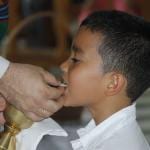
May 9, 2020
Eucharist: What Is It And Why Have We Taken It For Granted?
Next Post

May 17, 2020 End The Stigma: You Are Loved and Cherished
Browse Our Archives
Select a Category Uncategorized
Select a Month October 2026 September 2026 August 2026 July 2026 June 2026 May 2026 April 2026 March 2026 February 2026 January 2026 December 2025 November 2025 October 2025 September 2025 August 2025 July 2025 June 2025 May 2025 April 2025 March 2025 February 2025 January 2025 December 2024 November 2024 October 2024 September 2024 August 2024 July 2024 June 2024 May 2024 April 2024 March 2024 February 2024 January 2024 December 2023 November 2023 October 2023 September 2023 August 2023 May 2023 April 2023 March 2023 February 2023 January 2023 December 2022 November 2022 October 2022 September 2022 August 2022 July 2022 June 2022 May 2022 April 2022 March 2022 February 2022 January 2022 December 2021 November 2021 October 2021 March 2021 February 2021 January 2021 December 2020 November 2020 October 2020 September 2020 August 2020 July 2020 June 2020 May 2020 April 2020 March 2020 February 2020 January 2020
Follow Us!
TAKE THE
Religious Wisdom Quiz
Rejoice greatly, Daughter Zion! See, your king comes to you, righteous and victorious, yet humble and riding on what?
Select your answer to see how you score.
A white horse A donkey A camel A chariot
Related posts from The Pursuit of Holiness

Ascension Releases New Edition of Dr. Edward Sri...

Archbishop Broglio Issues Statement on Execution Livestream
Ascension's New Catholic Bible for Readers with Dyslexia
TRENDING AT PATHEOS Catholic

Swimfan: Forgotten Aughts Pleasures
This is a recovery effort. In 2002, My Big Fat Greek Wedding...

Top Three Anti-Catholic Lies About Catholicism
This is my initial transcript for the video, "THE 3 WORST...

Pope Leo Celebrates Mass for Nurses & Docs...
I don't have any idea how he did it, but Pope Leo...

The Sermon on the Mount, Part I: Matthew...
The Sermon on the Mount, Part I (Matthew 4:12-5:12) St. Matthew moves...

What's up from Crossway: Reviewing some of their latest A few weeks...

Janie Learns the Way of the Cross: A...
Teaching children about Jesus' Passion can be challenging. Many parents and educators...
view all Catholic blogs
Ad-Free & Subscriber Log-In Subscription Support
- About Us
- 2026 Calendar
- Videos
- Podcasts
- Library of World Religions
- Faith In Media Tracker
- Advertise With Us
- Write for Us
- Privacy Policy
- Terms of Service
- Do Not Sell My Data
- Contact Us
- Radiant Digital
- Manage Newsletter Subscriptions
- Unsubscribe From Notifications
- Sitemap
Copyright 2008-2026, Patheos. All rights reserved.
Subscription Support Ad-Free & Subscriber Log-In
Follow Patheos