
BuddhistCatholicContemplativeEvangelicalGeneral ChristianHinduJewishLatter-day SaintMuslimNew VisionsProgressive Christian
Beliefs
- Buddhist
- Catholic
- Contemplative
- Evangelical
- General Christian
- Hindu
- Jewish
- Latter-day Saint
- More Voices
- Muslim
- New Visions
- Pagan
- Progressive Christian
Topics
- Religion News
- Food and Religion
- Sports and Religion
- Religious Art
- Religious Music and Entertainment
- Religious Events
- History and Religion
- Style and Religion
- Politics and Religion
- Women in Religion
- Recreation Outdoors and Religion
- Business Finance and Religion
- Careers Workplace and Religion
- Education and Religion
- Family Parenting and Religion
- Health Fitness and Religion
- Home and Religion
- Relationships and Religion
- Technology and Religion
- Travel and Religion
Columnists
- Buddhist Columnists
- Business Finance and Religion Columnists
- Careers Workplace and Religion Columnists
- Catholic Columnists
- Contemplative Columnists
- Education and Religion Columnists
- Evangelists Columnists
- Family Parenting and Religion Columnists
- General Christian Columnists
- Health Fitness and Religion Columnists
- Hindu Columnists
- History and Religion Columnists
- Home and Religion Columnists
- Jewish Columnists
- More Voices Columnists
- Latter Day Columnists
- Muslim Columnists
- New Visions Columnists
- Nonreligious Columnists
- Pagan Columnists
- Politics and Religion Columnists
- Progressive Columnists
- Recreation Outdoors and Religion Columnists
- Relationships and Religion Columnists
- Religion News Columnists
- Religious Art Columnists
- Religious Events Columnists
- Religious Music and Entertainment Columnists
- Sports and Religion Columnists
- Style and Religion Columnists
- Technology and Religion Columnists
- Travel and Religion Columnists
- Women in Religion Columnists
Resource Library
- 2026 Calendar
- Library of World Religions
- The 100 Most Holy Places on Earth
- Patheos Answers
- Podcasts
- Videos
- Faith Leaders Database
- Anglican Episcopalian
- Bahai
- Baptist
- Buddhism
- Christianity
- Confucianism
- Eastern Orthodoxy
- Hinduism
- Holiness and Pentecostal
- ISKCON
- Islam
- Judaism
- Lutheran
- Methodist
- The Church of Jesus Christ of Latter-day Saints
- New Age
- Paganism
- Presbytarian and Reformed
- Protestantism
- Religion Behind the Scenes
- Roman Catholic
- Scientology
- Shia Islam
- Sikhism
- Sufism
- Sunni Islam
- Taoism
- Zen
- See all religions
Research Tools
 Ad-Free & Subscriber Log-In Subscription Support
Ad-Free & Subscriber Log-In Subscription Support
Follow Patheos 

- Trending:
- Forgiveness
- |
- Marriage
- |
- Consciousness
- |
- Death Penalty
- |
- Election
- |
- Halloween
 The Peripatetic Preacher
- Home
- Progressive Christian
- The Peripatetic Preacher. Church and State Once Again
The Peripatetic Preacher. Church and State Once Again
Last updated on: July 6, 2021 at 5:47 pm by John C Holbert
The Peripatetic Preacher. Church and State Once Again 2021-07-06T17:47:50-05:00 John C Holbert
Patheos Explore the world's faith through different perspectives on religion and spirituality! Patheos has the views of the prevalent religions and spiritualities of the world.
 I admit that this essay is a bit late. Our national holiday this year, July 4, fell on a Sunday. I had already written a response to the 2 Samuel text for that day, finding 2 Samuel 5, the tale about David’s capture of Jerusalem for his new capitol, oddly appropriate for our day of national celebration, with hot dogs and beer, or your beverage of choice, capped off with the bangs and bursts of fireworks. David’s strange and odious hatred of the blind and the lame in that story led me to reflect on the ways we US Americans have become so divided from one another, when the 4th has long been seen as the ultimate unifier of the nation. However, this year that famous quote from Frederick Douglas, the former slave turned US critic and conscience, reminded us that for African Americans, July 4 is really not their day of independence—for white folks, said Douglas, but for people like him, not so much. After the murder of George Floyd, among many other black persons, at the hands of legal authorities, Douglas’s words from a century and a half ago sound prescient still.
Just how are we Christians to worship on July 4th when so many of our fellow citizens are monumentally confused about the relationship between church and state? So many see absolutely no problem with an American flag in the sanctuary, see no problem when that flag is paraded up and down church aisles to the tones of “God Bless America” or “The Battle Hymn of the Republic,” belted out by an exuberant choir, sometimes robed in red, white, and blue. One church I served as an interim pastor used to bring the American flag down the center aisle while all sang the 4th verse of “America.” On the Sunday following 9/11, I preached in a church where nearly everyone was in uniform, military, Boy, Girl, and Cub Scout, and others I could not identify. Between the two morning services, someone had moved the American flag from its usual spot at the back of the chancel to within a few feet of the pulpit. I literally preached my second sermon in the shadow of the flag. I found the experience decidedly unnerving.
One of US America’s central ideas is that of the separation of church and state. As enunciated most crucially by Thomas Jefferson, who spoke of a “wall” between the two, a wall designed to prevent the state from becoming just a mouthpiece for the demands of one church or another. And by the same notion, the concept was to prevent the state from determining exactly what a church should say or do. Freedom of religion has led in US America to freedom from religion, which is a natural and important idea that should be celebrated. Yet in our day, the dividing wall has been lowered or breached in several instances, from Supreme Court rulings that smack of religious dogma (see the very narrow recent decision that allows Roman Catholic agencies to deny adoption rights to LGBTQI+ persons in Philadelphia, because they claim that particular “life style” is anathema to their long-held doctrines), to the supposed constitutional right for a public baker to refuse to bake a wedding cake for a same-sex couple, citing again their notion that their religious freedom is being infringed if they bake that cake. I suggest that Jefferson, himself a deeply non-sectarian “believer” would be appalled. That hallowed wall of separation has served us well, but in our fractious days the wall appears fragile at best, and flimsy at worst.
When we turn to the Bible for help here, we immediately realize a sharp distinction between the Bible’s world and our own; in that ancient world there was no separation of “church” and “state”. The state was supporter and advocate for the church (I use the word church very broadly of course), while the church was the supporter of the state. This reality is made crystal clear in a story I have discussed already several weeks ago, the tale when David brings the Ark of the Covenant into his new capitol city, Jerusalem. He performs that act for two fairly obvious reasons: first, he needs a unifying religious symbol to create a religious bond between the disparate tribes of Israel, particularly those tribes in the north of the land that had been loyal to the now-dead Saul, and what better than the mysterious Ark that had been ubiquitous in the wilderness wanderings of the people and in their early wars with numerous enemies upon their entry into the land of promise. Yet, over the past several years, the ancient chest, said to contain the Ten Commandments written by YHWH directly and brought down from Sinai by the fabled Moses, had lain fallow and nearly forgotten on a rural farm. The second reason that David chooses the Ark is its magic history, its wonderful power. Not many years earlier, after the Ark had been captured by the Philistines and had wreaked havoc on their corn god, Dagon, they had urgently sent it back to Israel. When it came back to the Israelites, some of them foolishly “looked into it,” and as a result thousands of people died that day. This magic box would be just the thing to bring to David renewed authority and an enhanced reputation as a very religious and Godly king.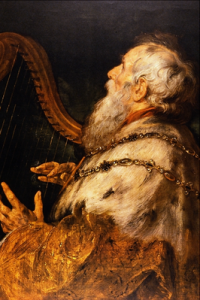
So, David decides to move the Ark from the farm to the city. Unfortunately for David, the Ark really does have mysterious power, and when one of the men assigned to lead the cart carrying the Ark reaches out a hand to steady it lest it fall on the road, YHWH immediately and suddenly kills that man. David’s reaction is interesting: “David was angry because YHWH had burst forth with an outburst upon Uzzah. David was afraid of YHWH, and said, ‘How can the Ark of YHWH come to me’” (2 Sam.6:8-9)? Note how David words his anger. His fury is because YHWH has gotten in the way of his plans for the Ark. David cares little for the death of Uzzah; his concern is that his plan has been thwarted. As a result, he handles the sacred box much more carefully the next time, taking it first to the farm of a foreign follower of the king to see whether or not YHWH’s anger remains or whether time will calm the God down. After three months, David determines that the prosperity of the chosen farmer has noticeably increased, hence the Ark may be safe once again for David’s purposes.
This time the king moves carefully and slowly, sacrificing numerous divine offerings along the path toward Jerusalem, while David himself, clad only in a very skimpy liturgical garment called an ephod, dances with great energy and abandon before the Ark as it makes its way up to the City of David. There can be no doubt that in this scene, church and state have been joined inexorably; David is priest and king all at once, and serves his people in both roles.
To use these tales as some sort of model for modern worship is to fall into a deadly trap. Our state, no matter how much the lines have been blurred, is not in any way the guarantor of any church and its beliefs and practices. The chief justice of the Supreme Court will never be seen dancing before the Constitution or the Declaration of Independence, announcing the religious imprimatur on either document. Yet, too often we confuse the object of our devotion by flying flags in our sanctuaries, by ruling in favor of sectarian beliefs, making them into national laws.
Our model should be the angry and crusty old Amos. When he comes to Bethel to preach in the 8th century BCE, he is confronted by the high priest of the day, Amaziah. The priest upbraids the prophet for disrupting the worship of the day by demanding that the people spend far less time worshipping than in serving the poor, widow, and orphans of the city. Amaziah is enraged. “You dare come into this holy place, this sanctuary of the king, this temple of the kingdom, and say such nonsense!” And of course right there Amaziah has put his well-shod foot right in it; the temple in Bethel is not the “temple of the king” but the temple of YHWH, or if it is not, it is no temple at all. Amos quickly corrects the holy man, indicating that his perception is completely wrong. Once the temple anywhere becomes a king’s temple, it can no longer be God’s temple. There is the full separation of church and state, and our own time must find a way to return to that condition if we are to comprehend the implications of Jefferson’s crucial distinction and separation of the two.
(Images from Wikimedia Commons)
Previous Post

June 29, 2021
The Peripatetic Preacher. Faith or Cynicism
Next Post
July 7, 2021 The Peripatetic Preacher. The Big Lie Lives
Browse Our Archives
Select a Category Uncategorized
Select a Month July 2021 June 2021 May 2021 April 2021 March 2021 February 2021 January 2021 December 2020 November 2020 October 2020 September 2020 August 2020 July 2020 June 2020 May 2020 April 2020 March 2020 February 2020 January 2020 December 2019 November 2019 October 2019 September 2019 August 2019 July 2019 June 2019 May 2019 April 2019 March 2019 February 2019 January 2019 December 2018 November 2018 October 2018 September 2018 August 2018 July 2018 June 2018 May 2018 April 2018 March 2018 February 2018 January 2018 December 2017 November 2017 October 2017 September 2017 August 2017 July 2017 June 2017 May 2017 April 2017 March 2017 February 2017 January 2017 December 2016 November 2016 October 2016 September 2016 August 2016 July 2016 June 2016 May 2016 April 2016
Follow Us!
TAKE THE
Religious Wisdom Quiz
What natural event accompanied God's descent on Sinai?
Select your answer to see how you score.
Thunder and lightning Earthquake Windstorm Drought
Related posts from The Peripatetic Preacher

The Peripatetic Preacher. Ordinary, Extraordinary Love
The Peripatetic Preacher Is There History in the...

The Peripatetic Preacher. Get the Shots Already!
The Peripatetic Preacher. In Solidarity with Creation
TRENDING AT PATHEOS Progressive Christian

Why Christians Have a Sacred Duty to Vote:...
The Bible offers strong support for the sacred duty to vote. Here...

What Being a Modern-Day Apostle Means to Me
In my last column, I discussed the ins and outs of modern-day...

Did Ancient China Once Worship the God of...
Across human history, a common thread weaves through the origins of the...

Love Your Neighbor – Including Earth-Kin: Lev. 19,...
God’s command to love your neighbor means acting in an ethical and...

Lead a Church Study of “Jesus and Lao...
Guest writer Jack Thomas (The Irreverent Reverend) reflects on leading his church...

Principles for Understanding the Apostolic Ministry Today
Whenever people discover that my formal ministry title is "apostle," as in...
view all Progressive Christian blogs
Ad-Free & Subscriber Log-In Subscription Support
- About Us
- 2026 Calendar
- Videos
- Podcasts
- Library of World Religions
- Faith In Media Tracker
- Advertise With Us
- Write for Us
- Privacy Policy
- Terms of Service
- Do Not Sell My Data
- Contact Us
- Radiant Digital
- Manage Newsletter Subscriptions
- Unsubscribe From Notifications
- Sitemap
Copyright 2008-2026, Patheos. All rights reserved.
Subscription Support Ad-Free & Subscriber Log-In
Follow Patheos