
BuddhistCatholicContemplativeEvangelicalGeneral ChristianHinduJewishLatter-day SaintMuslimNew VisionsProgressive Christian
Beliefs
- Buddhist
- Catholic
- Contemplative
- Evangelical
- General Christian
- Hindu
- Jewish
- Latter-day Saint
- More Voices
- Muslim
- New Visions
- Pagan
- Progressive Christian
Topics
- Religion News
- Food and Religion
- Sports and Religion
- Religious Art
- Religious Music and Entertainment
- Religious Events
- History and Religion
- Style and Religion
- Politics and Religion
- Women in Religion
- Recreation Outdoors and Religion
- Business Finance and Religion
- Careers Workplace and Religion
- Education and Religion
- Family Parenting and Religion
- Health Fitness and Religion
- Home and Religion
- Relationships and Religion
- Technology and Religion
- Travel and Religion
Columnists
- Buddhist Columnists
- Business Finance and Religion Columnists
- Careers Workplace and Religion Columnists
- Catholic Columnists
- Contemplative Columnists
- Education and Religion Columnists
- Evangelists Columnists
- Family Parenting and Religion Columnists
- General Christian Columnists
- Health Fitness and Religion Columnists
- Hindu Columnists
- History and Religion Columnists
- Home and Religion Columnists
- Jewish Columnists
- More Voices Columnists
- Latter Day Columnists
- Muslim Columnists
- New Visions Columnists
- Nonreligious Columnists
- Pagan Columnists
- Politics and Religion Columnists
- Progressive Columnists
- Recreation Outdoors and Religion Columnists
- Relationships and Religion Columnists
- Religion News Columnists
- Religious Art Columnists
- Religious Events Columnists
- Religious Music and Entertainment Columnists
- Sports and Religion Columnists
- Style and Religion Columnists
- Technology and Religion Columnists
- Travel and Religion Columnists
- Women in Religion Columnists
Resource Library
- 2026 Calendar
- Library of World Religions
- The 100 Most Holy Places on Earth
- Patheos Answers
- Podcasts
- Videos
- Faith Leaders Database
- Anglican Episcopalian
- Bahai
- Baptist
- Buddhism
- Christianity
- Confucianism
- Eastern Orthodoxy
- Hinduism
- Holiness and Pentecostal
- ISKCON
- Islam
- Judaism
- Lutheran
- Methodist
- The Church of Jesus Christ of Latter-day Saints
- New Age
- Paganism
- Presbytarian and Reformed
- Protestantism
- Religion Behind the Scenes
- Roman Catholic
- Scientology
- Shia Islam
- Sikhism
- Sufism
- Sunni Islam
- Taoism
- Zen
- See all religions
Research Tools
 Ad-Free & Subscriber Log-In Subscription Support
Ad-Free & Subscriber Log-In Subscription Support
Follow Patheos 

- Trending:
- Forgiveness
- |
- Marriage
- |
- Consciousness
- |
- Death Penalty
- |
- Election
- |
- Halloween
 The Pangea Blog
- Home
- Progressive Christian
- What happens to people who never hear about Jesus? (4 Views)
What happens to people who never hear about Jesus? (4 Views)
Last updated on: April 26, 2018 at 4:12 pm by Kurt Willems
What happens to people who never hear about Jesus? (4 Views) 2018-04-26T16:12:28-07:00 Kurt Willems
Patheos Explore the world's faith through different perspectives on religion and spirituality! Patheos has the views of the prevalent religions and spiritualities of the world.

Before getting to a guest post, which is written by Bonnie Kristian (author of A Flexible Faith: Rethinking What it Means to Follow Jesus Today), let me take this time to thank all of you who have taken the step forward to support my work (The Pangea Blog, Theology Curator, Rapture Drill, The Paulcast) via Patreon. Contributing as little as $3 per month makes a huge difference. Currently we have about 45 people supporting this work. It would be amazing to get this number up to over 100, so I can cover all the costs associated with maintaining my online ministry and cover some of the time I invest into this labor of love.
Thanks for all who are already patrons!
Also, don’t forget about my brand new podcast Rapture Drill: Reframing Revelation, the End Times, and Our Weird Obsession with the Apocalypse. We are now 5 episodes in!
And, on The Paulcast (podcast) this week I interview Lucy Peppiatt about Paul’s language regarding the man being the head of the woman (1 Cor.). This is one of the most challenging passages in the New Testament but one that doesn’t push against women in leadership in the church and home. Check it out!
Now, let’s get to our question: What happens to the people who never hear about Jesus?
Guest writer bio:
 Bonnie Kristian is a writer who lives in the Twin Cities. She is a graduate of Bethel Seminary, weekend editor at The Week, and a fellow at Defense Priorities. Bonnie is the author of A Flexible Faith: Rethinking What It Means to Follow Jesus Today*, from which portions of this article are adapted. Learn more and pre-order at* bonniekristian.com/book.
The following is written by Bonnie Kristian:
Even if every Christian in every church in every country throughout all of history spent every waking hour of every day on evangelism, some people would still fall through the cracks. Whether because of accidents of geography or miscommunication or other circumstances they can’t control, some people would still never hear about Jesus before they die.
What happens to them? Is it fair for God to treat people who have honestly never heard this stuff the same way he treats people who knowingly reject him? Is ignorance as bad as an intentional embrace of evil? Christians have historically answered these questions three ways, positing theories that are today called exclusivism, inclusivism, and postmortem evangelism. I’ll also cover a fourth theory called universalism, which has sometimes—but not universally, if you’ll pardon a bad pun—been labeled heresy.
Exclusivism
Exclusivism gets its name from the fact that it depicts salvation as an exclusive thing, only available to people who explicitly avail themselves of the offer of reconciliation Jesus extends. It’s not enough, exclusivists say, for someone ignorant of Jesus to respond in faith to what God reveals of himself in the beauty of nature or to the Holy Spirit’s speaking to their own hearts. Only those who are told the gospel message and consciously accept it can be saved.
This perspective is supported by Bible passages like John 14:6, which underscore Jesus’ role as the only way to God. “I am the way and the truth and the life,” Jesus says. “No one comes to the Father except through me.” The conclusion for exclusivists is that the unknown billions upon billions of people who never hear about Jesus are utterly without hope. They cannot be saved and must be damned after death.
Inclusivism
Inclusivism begins by recognizing the injustice of damning billions because of circumstances outside of their control but remains committed to Jesus as the one route to salvation. As C.S. Lewis expressed it, “the real God, of His infinite courtesy, readdresses the letters [to false gods] to Himself and they are dealt with like the rest of the mail.”
The central thing to understand about inclusivism is that it isn’t saying anyone can be saved without Jesus, just that some people are saved without hearing about Jesus. Inclusivism relies on Scripture passages like Paul’s sermon in Athens, Greece, recorded in Acts 17, where God is described as revealing himself to everyone in all times and all places, drawing any who will listen into loving relationship with him. That relationship is possible because of the saving work of Christ, but God doesn’t require us to know all the details of what Jesus did to be saved. Evangelism remains vital in this view, because it will always be more difficult to respond to God without hearing the gospel message.
Postmortem Evangelism
The way postmortem evangelism works is right there in the title: After death or perhaps at the moment of death (that’s the postmortem part), those who never hear about Jesus while alive will be given an opportunity to understand the work of Christ (there’s the evangelism) and be saved.
Postmortem evangelism rests on two primary arguments. First, the Bible says again and again that God wants everyone to be saved, and he may not make our physical death the cutoff for that to happen. Jesus’ resurrection is described as a defeat of death itself—a victory over the grave—so if God wants salvation to still be possible when we die, he could certainly do that.
The second argument is more an interaction with a smattering of strange verses in the New Testament that are difficult for the other perspectives to explain. The most important passage is in 1 Peter 3–4, which says that Jesus, after dying, “went and made proclamation to the imprisoned spirits” (3:19) and “the gospel was preached even to those who are now dead” (4:6). Many Christians, particularly in the early church, have understood these passages to literally mean that in between his death and resurrection, Jesus preached in hell. Some unknown number of souls embraced his message and followed him out, and God can now offer the same opportunity to those who die having never heard of Christ.
Universalism
A fourth way to answer what happens to people who never hear about Jesus is universalism: Eventually, everyone will be saved. To be clear, Christian universalism is not the same as pluralism, which denies that Christianity has any special grasp on truth or that Jesus is the only way to be right with God. A Christian universalist believes salvation is found only in Christ, but that eventually (perhaps after some period of punishment) salvation will be applied to every human who has ever lived.
Even with that distinction, universalism remains controversial. Whether this should be considered an option in orthodox Christianity is the subject of centuries of disagreement, and I have no illusions I can settle that question here. Instead, I’ll simply say that Christian universalism is often unfairly caricatured, and as a serious theological perspective it is more diverse and grounded in the Bible than many realize. It’s not a get-out-of-jail-free pass for Hitler. A thoughtful universalist can’t ignore what Scripture has to say about God’s justice and judgment on evil.
Discussion Questions
- Which view of the destiny of the unevangelized is most familiar to you? Which one(s) did your Sunday school teachers tell you?
- Which perspective do you find most appealing and why? Which do you find most convincing and why?
- Is the theory you find most appealing the same as the one you find most convincing? If not, what’s the difference?
- Only universalism escapes troubling questions about the fate of the mentally disabled as well as very young children who die before they are capable of understanding the gospel message. Many Christians—even exclusivists—have embraced “baby universalism,” which says people who die without the mental capacity for moral choice will not be subject to judgment. Does that work with the perspective you find most convincing? If yes, how? If no, how do you address this issue?
- What perspective we take on the fate of those who never hear about Jesus will deeply influence our theology of evangelism. After considering these options and your own perspective, has your view of your personal responsibility to share the good news changed?
Learn More
If you want to learn more about the destiny of the unevangelized, this reading list will help you get started. I’ll especially highlight Greg Boyd and Paul Eddy’s Across the Spectrum, which competently explains every perspective covered here except universalism. Gregory MacDonald’s The Evangelical Universalist is a compelling read that demolishes strawman versions of Christian universalism, while Four Views on Salvation in a Pluralistic World moves beyond the options mentioned in this chapter to include a sort of hopeful agnosticism about the fate of those who never hear about Christ.
- Augustine, “Sermo ad Caesariensis Ecclesiae Plebem” (“Address to the People of the Church at Caesarea”)
- Greg Boyd and Paul Eddy, Across the Spectrum: Understanding Issues in Evangelical Theology
- Clement of Alexandria, The Stromata
- Cyprian, Epistle 72
- Dante Alighieri, Inferno
- Irenaeus, Against Heresies
- Justin Martyr, The First and Second Apologies
- C. S. Lewis, The Problem of Pain
- Gregory MacDonald, The Evangelical Universalist
- Christopher W. Morgan and Robert A. Peterson (editors), Faith Comes by Hearing: A Response to Inclusivism
- Dennis L. Okholm and Timothy R. Phillips (editors), Four Views on Salvation in a Pluralistic World
- Origen, On First Principles
- Clark H. Pinnock, A Wideness in God’s Mercy: The Finality of Jesus Christ in a World of Religions
- John Sanders, No Other Name: An Investigation into the Destiny of the Unevangelized
- Daniel Strange, The Possibility of Salvation Among the Unevangelized: An Analysis of Inclusivism in Recent Evangelical Theology
- John Wesley, On Faith
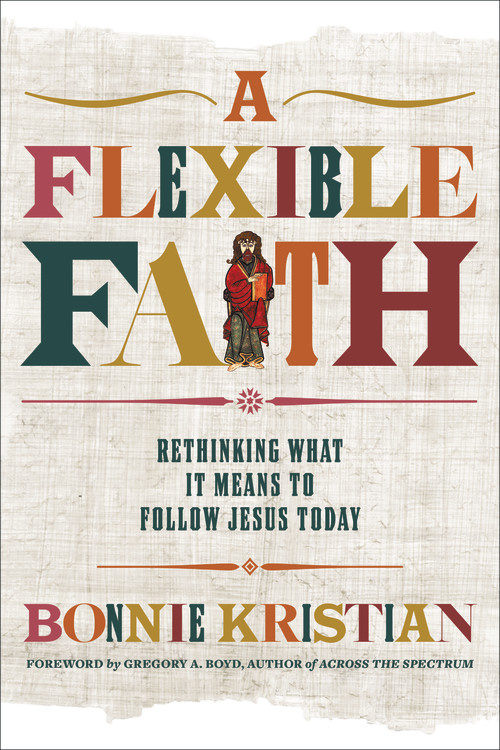 This article is adapted from the book, A Flexible Faith: Rethinking What It Means to Follow Jesus Today, by Bonnie Kristian. Copyright (c) Bonnie Kristian by Faithwords. Reprinted with permission of Hachette Book Group, New York, NY. All rights reserved.
Kurt, here. I hope this was helpful today! I highly recommend checking out Bonnie’s book, A Flexible Faith, which deals with numerous theological questions ranging from violence to hell to miracles to baptism to the end times. It will be released May 15th!
Previous Post

April 19, 2018
Cosmic Signs Don't Signal a Rapture (Another Prediction by David Meade)
Next Post

May 10, 2018 Talking to Kids about God & the Spirit (and Learning from Them Too)
Browse Our Archives
Select a Category (Series) All Out War-Spiritual Warfare (Series) Church Plant Journal (Series) Dear Reader... (Series) Earthquakes...Signs of the Times? (Series) Entering the... Conversation (Series) Evangelical Culture Myths (Series) Everything is Meaningless [Pete Enns] (Series) Evolving Evangelicalism (Series) Hell Yes. Hell No! Who Cares? (Series) Hidden Worldviews (Series) If Evolution is Right, what about Adam? (Series) in less than 300 words (Series) Jesus and Nationalism (Series) Liberating Women for Ministry? (Series) Life-Changing Books (Series) Markers of Church Plant Movement (Series) Nonviolence 101 (Series) Philemon - Reconciliation (Series) Quote to Ponder (Series) Red Letter Dialogues (Series) Resource of the Week (SERIES) Revelation Sermons (Series) Share Something Sundays (Series) Simplicity in the Burbs: $2 a day (Series) The Binding of God [Open Theism] (Series) The Creed: Anabaptist Reflections (Series) Values for Church Leadership (Series) Video to Ponder Anabaptism Animal Advocacy Books Church Ministry Church Planting Community Culture Eschatology Eucharist Evangelical Reject Evolution Fundamentalism Greek Greg Boyd Guest Contributors Hell Holy Spirit Israel/Palestine Kingdom of God Lent Missional N. T. Wright Nationalism New Creation Nonviolence Open Mic Open Theism Parenting Passover Paul Philemon Podcast Politics Restorative Justice Revelation (the book of) Rob Bell Ron Martoia Sermon Shane Claiborne Social Justice Speaking Engagement Spiritual Warfare Spirituality Temple Theology Tim Geddert Tribulation Uncategorized universalism Video Blog Women in Ministry Worship Music Youth Ministry
Select a Month August 2018 July 2018 June 2018 May 2018 April 2018 March 2018 February 2018 January 2018 December 2017 October 2017 July 2017 June 2017 May 2017 April 2017 December 2016 October 2016 August 2016 June 2016 May 2016 April 2016 March 2016 December 2015 November 2015 October 2015 September 2015 August 2015 June 2015 May 2015 April 2015 March 2015 February 2015 January 2015 December 2014 November 2014 October 2014 September 2014 August 2014 July 2014 June 2014 May 2014 April 2014 March 2014 February 2014 January 2014 December 2013 November 2013 October 2013 September 2013 August 2013 June 2013 May 2013 April 2013 March 2013 February 2013 January 2013 December 2012 November 2012 October 2012 September 2012 August 2012 July 2012 June 2012 May 2012 April 2012 March 2012 February 2012 January 2012 December 2011 November 2011 October 2011 September 2011 August 2011 July 2011 June 2011 May 2011 April 2011 March 2011 February 2011 January 2011 December 2010 November 2010 September 2010 August 2010 July 2010 June 2010 May 2010 April 2010 March 2010 February 2010 January 2010 October 2009 September 2009 August 2009 July 2009 June 2009 May 2009 April 2009 March 2009 February 2009 January 2009 December 2008 November 2008 October 2008 September 2008 August 2008 June 2008 May 2008 April 2008
Follow Us!
TAKE THE
Religious Wisdom Quiz
How many books is the Book of Psalms divided into?
Select your answer to see how you score.
Seven Ten Three Five
Support this
Column


Related posts from The Pangea Blog

What is the Kingdom of God? (with Frank...

Sunday is Not the Main Event: A Practice-Based...

10 Years Ago, I Embraced Nonviolence & Anabaptism

The Gospel is about a Person, not a...
TRENDING AT PATHEOS Progressive Christian

Why Christians Have a Sacred Duty to Vote:...
The Bible offers strong support for the sacred duty to vote. Here...

What Being a Modern-Day Apostle Means to Me
In my last column, I discussed the ins and outs of modern-day...

Did Ancient China Once Worship the God of...
Across human history, a common thread weaves through the origins of the...

Love Your Neighbor – Including Earth-Kin: Lev. 19,...
God’s command to love your neighbor means acting in an ethical and...

Lead a Church Study of “Jesus and Lao...
Guest writer Jack Thomas (The Irreverent Reverend) reflects on leading his church...

Principles for Understanding the Apostolic Ministry Today
Whenever people discover that my formal ministry title is "apostle," as in...
view all Progressive Christian blogs
Ad-Free & Subscriber Log-In Subscription Support
- About Us
- 2026 Calendar
- Videos
- Podcasts
- Library of World Religions
- Faith In Media Tracker
- Advertise With Us
- Write for Us
- Privacy Policy
- Terms of Service
- Do Not Sell My Data
- Contact Us
- Radiant Digital
- Manage Newsletter Subscriptions
- Unsubscribe From Notifications
- Sitemap
Copyright 2008-2026, Patheos. All rights reserved.
Subscription Support Ad-Free & Subscriber Log-In
Follow Patheos