
BuddhistCatholicContemplativeEvangelicalGeneral ChristianHinduJewishLatter-day SaintMuslimNew VisionsProgressive Christian
Beliefs
- Buddhist
- Catholic
- Contemplative
- Evangelical
- General Christian
- Hindu
- Jewish
- Latter-day Saint
- More Voices
- Muslim
- New Visions
- Pagan
- Progressive Christian
Topics
- Religion News
- Food and Religion
- Sports and Religion
- Religious Art
- Religious Music and Entertainment
- Religious Events
- History and Religion
- Style and Religion
- Politics and Religion
- Women in Religion
- Recreation Outdoors and Religion
- Business Finance and Religion
- Careers Workplace and Religion
- Education and Religion
- Family Parenting and Religion
- Health Fitness and Religion
- Home and Religion
- Relationships and Religion
- Technology and Religion
- Travel and Religion
Columnists
- Buddhist Columnists
- Business Finance and Religion Columnists
- Careers Workplace and Religion Columnists
- Catholic Columnists
- Contemplative Columnists
- Education and Religion Columnists
- Evangelists Columnists
- Family Parenting and Religion Columnists
- General Christian Columnists
- Health Fitness and Religion Columnists
- Hindu Columnists
- History and Religion Columnists
- Home and Religion Columnists
- Jewish Columnists
- More Voices Columnists
- Latter Day Columnists
- Muslim Columnists
- New Visions Columnists
- Nonreligious Columnists
- Pagan Columnists
- Politics and Religion Columnists
- Progressive Columnists
- Recreation Outdoors and Religion Columnists
- Relationships and Religion Columnists
- Religion News Columnists
- Religious Art Columnists
- Religious Events Columnists
- Religious Music and Entertainment Columnists
- Sports and Religion Columnists
- Style and Religion Columnists
- Technology and Religion Columnists
- Travel and Religion Columnists
- Women in Religion Columnists
Resource Library
- 2026 Calendar
- Library of World Religions
- The 100 Most Holy Places on Earth
- Patheos Answers
- Podcasts
- Videos
- Faith Leaders Database
- Anglican Episcopalian
- Bahai
- Baptist
- Buddhism
- Christianity
- Confucianism
- Eastern Orthodoxy
- Hinduism
- Holiness and Pentecostal
- ISKCON
- Islam
- Judaism
- Lutheran
- Methodist
- The Church of Jesus Christ of Latter-day Saints
- New Age
- Paganism
- Presbytarian and Reformed
- Protestantism
- Religion Behind the Scenes
- Roman Catholic
- Scientology
- Shia Islam
- Sikhism
- Sufism
- Sunni Islam
- Taoism
- Zen
- See all religions
Research Tools
 Ad-Free & Subscriber Log-In Subscription Support
Ad-Free & Subscriber Log-In Subscription Support
Follow Patheos 

- Trending:
- Forgiveness
- |
- Marriage
- |
- Consciousness
- |
- Death Penalty
- |
- Election
- |
- Halloween
 The Pangea Blog
- Home
- Progressive Christian
- Sunday is Not the Main Event: A Practice-Based Christianity (Aaron Niequist)
Sunday is Not the Main Event: A Practice-Based Christianity (Aaron Niequist)
Last updated on: August 7, 2018 at 10:06 am by Kurt Willems
Sunday is Not the Main Event: A Practice-Based Christianity (Aaron Niequist) 2018-08-07T10:06:33-07:00 Kurt Willems
Patheos Explore the world's faith through different perspectives on religion and spirituality! Patheos has the views of the prevalent religions and spiritualities of the world.
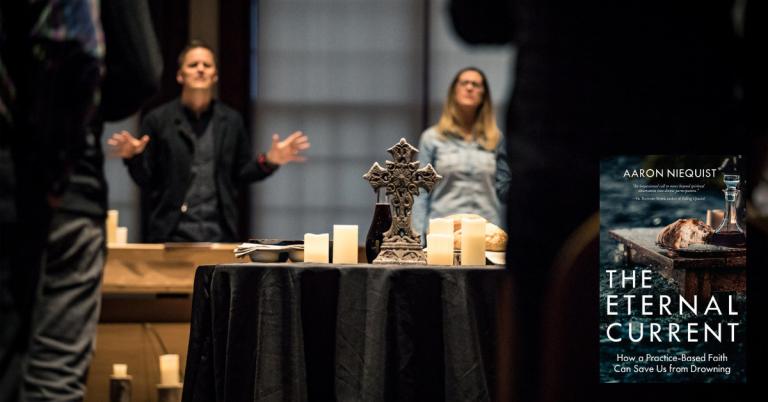
Kurt: Today I’m excited to share with you an excerpt from my friend Aaron Niequist’s brand new book: The Eternal Current: How a Practice-Based Faith Can Save Us from Drowning. I’ve been waiting a long time to get a copy in my hands. And let me tell you: this book will not disappoint.
In what follows, Aaron shares why Sunday gatherings for worship are not the main thing. It is a catalyst that propels Jesus-followers to practice the ways of Jesus throughout the week.
 And hear me: I am a huge advocate for the Sunday gathering. We’ve been doing this for 2,000 years and I don’t think we need to get rid of it.
However, I do think we need to consider if what we do during that hour and a half each week is equipping regular folks to practice their faith together in the day-to-day grind of life.
So, with that, here’s Aaron’s excellent reflection from the book:
Sunday Is Not the Main Event
A Practice-Based Life
The weekly gathering of the church is incredibly important for those who want to swim with God’s River. No one can do it alone, and something supernatural happens when the whole body is together. God is creating a people on earth, not a collection of spiritual individuals, and the church is eternally important.
On the other hand, attending a church service is not even close to being the most important aspect of a spiritual life. An overemphasis on the weekly Sunday-morning event can do a disservice to the people of God. Overvaluing what goes on in a church service can actually diminish the church universal, the body of Christ.
How Overvaluing Church Diminishes the Church
A church service takes up one or two hours of a week. There are 168 hours in a week, so life beyond a Sunday-morning church experience occupies the other 166 hours. Placing too much emphasis on a church service results, for many people, in de-emphasizing practice-based faith throughout the week. It’s as if the one or two hours devoted to religious duty on Sunday takes care of one’s devotion to God for the week. “Well, I got that taken care of until next Sunday.”
Overemphasizing what happens at church also tends to assign too much importance to professional church workers. They have a role to play, to be sure, but their primary job is to launch everyone else into the remaining 166 hours of the week. Too many Christians have assumed that God’s work on earth should be taken care of by the paid professionals, since they are the specialists in this field.
The church exists to equip the saints for ministry (see Ephesians 4:12). Ministry takes place primarily outside the walls of a church. Of the fifty-plus “one another” commands in the Scriptures, such as “Love one another” (John 13:34) and “Forgive one another” (Colossians 3:13), most can’t happen fully while sitting in a church service. This is one reason we believe that Sunday is not the main event; our actual life—Monday through Saturday—is the main event.
<<<As an aside: If you are interested in having me speak at your Christian conference, church, camp, or university–here’s where you can inquire.>>>
What does practice-based faith look like Monday through Saturday? How do we swim with the River of God in every area of life—family, work, and relationships with our neighbors? Let’s return to our central text:
Are you tired? Worn out? Burned out on religion? Come to me. Get away with me and you’ll recover your life. I’ll show you how to take a real rest. Walk with me and work with me—watch how I do it. Learn the unforced rhythms of grace. I won’t lay anything heavy or ill-fitting on you. Keep company with me and you’ll learn to live freely and lightly. (Matthew 11:28–30, msg)
When I first began to ponder this passage, the words recover and take a real rest captured my attention. I was weary, in part because I had been immersed in a form of Christianity that loaded more religious bricks onto my already-slumping shoulders. As a firstborn achiever, I carried them a long time, but my back was beginning to break. (It’s interesting that religion often puts bricks on people’s shoulders. The biblical story of the Exodus tells us that Pharaoh, not God, loaded people up with bricks. God rescued the people of Israel from the whole brick-building enterprise.) So reading these words of Christ felt healing, comforting, and deeply inviting. I could finally exhale in God’s presence.
However, as our community meditated on this text, we noticed that the invitation to rest accounted for only half of the invitation. Most of Jesus’s words call us to action: come, walk, work, watch, learn. At first this seemed contradictory. But as we sat with the text, we began to settle into the reality that rest and work are far from opposites. In this context, they are the same thing—two sides of the same coin.
The Dualism of Do Versus Done
The dualism of faith versus works has wreaked havoc in my spiritual life. Teachers from Sunday school, summer camp, and beyond proclaimed, over and over, “It’s not about what you do for God but what Jesus has done for you!” “There is nothing you could ever do to earn God’s favor or blessing.” Or as Martin Luther famously taught, salvation is by grace—plus nothing![i]
There is much to affirm in these proclamations. If we must earn God’s forgiveness and grace with our good actions, then we have no hope. God gives us grace because God is gracious, not because we deserve grace. This is a foundational reality at the heart of the good news.
But if I’m honest, these teachings often left me feeling paralyzed. I was so afraid of slipping into “works-based righteousness” and so convinced that my righteousness was dirty rags anyway (see Isaiah 64:6), that I felt handcuffed from participating in my own spiritual life. Thankfully, Jesus did not share this one-dimensional understanding of grace versus works. Notice the way he ended the Sermon on the Mount:
Everyone who hears these words of mine and puts them into practice is like a wise man who built his house on the rock. The rain came down, the streams rose, and the winds blew and beat against that house; yet it did not fall, because it had its foundation on the rock. But everyone who hears these words of mine and does not put them into practice is like a foolish man who built his house on sand. The rain came down, the streams rose, and the winds blew and beat against that and it fell with a great crash. (Matthew 7:24–27, emphasis added)
Jesus basically said, “In summary, do this. Whoever puts my teachings into practice will survive the storms of life.” He didn’t say, “Whoever believes that my words are true…” It is not just a matter of assenting to the rightness of certain teachings or affirming one’s belief in the correct doctrines. His final teaching was do this if you want to live. The invitation is participation.
Dallas Willard, a brilliant teacher on the kingdom and spiritual practice, said it this way:
You can be sure that if you do not act in an advised fashion consistently and resolutely you will not grow spiritually. We all know that Jesus said, (in John 15) “without me you can do nothing.” We need to add, “if you do nothing, it will be most assuredly without him.”
Of course we must be concerned about works righteousness. I talk a lot about the value of spiritual disciplines but also the danger of using them as if they help us earn our salvation. But it is crucial to realize that grace is not opposed to effort, but to earning. Earning is an attitude, effort is action. Without effort, we would be nowhere. When you read the New Testament you see how astonishingly energetic it is. Paul says, “take off the old self, put on the new.” There is no suggesting that this will be done for you.[ii]
We have been invited into the River by grace and grace alone. There’s nothing we can do to earn our way into the water. But the invitation is to swim, and that takes grace-empowered practice.
Practice-Based Living
What does this grace-empowered practice look like in our daily lives? Not every action is equally helpful, so how do we begin crafting a practice-based life, Monday through Sunday? I will offer (at least) four suggestions: we need a toolbox, a rule of life, a plan to help us throw off sin, and a commitment to engaging in messy, risky service. …
[For the rest of the chapter, pick up The Eternal Current: How a Practice-Based Fatih Can Save Us from Drowning by Aaron Niequist. Excerpted from THE ETERNAL CURRENT: HOW A PRACTICE-BASED FAITH CAN SAVE US FROM DROWNING by Aaron Niequist. Copyright © 2018 by Moped Media Company. Published by WaterBrook, an imprint of Penguin Random House LLC.]
 ***Aaron Niequist author of The Eternal Current, has served as a leader at some of the most influential churches in the country. He has created a series of liturgical recordings called A New Liturgy to help people create holy space wherever they find themselves. Visit aaronniequist.com.***
[i] To read the story of Martin Luther’s conversion to sola fide, see Roland H. Bainton, Here I Stand: A Life of Martin Luther (Nashville, TN: Abingdon, 2013), 50–51.
[ii] Dallas Willard, “Kingdom Living,” interview by Andy Peck, May 2002, www.dwillard.org/articles/printable.asp?artid=92.
Kurt: I hope this excerpt from Aaron encourages you to lean into the ways of Jesus. May we swim in the waters of God’s grace and abundance!
Previous Post

July 25, 2018
10 Years Ago, I Embraced Nonviolence & Anabaptism
Next Post

August 27, 2018 What is the Kingdom of God? (with Frank Viola)
Browse Our Archives
Select a Category (Series) All Out War-Spiritual Warfare (Series) Church Plant Journal (Series) Dear Reader... (Series) Earthquakes...Signs of the Times? (Series) Entering the... Conversation (Series) Evangelical Culture Myths (Series) Everything is Meaningless [Pete Enns] (Series) Evolving Evangelicalism (Series) Hell Yes. Hell No! Who Cares? (Series) Hidden Worldviews (Series) If Evolution is Right, what about Adam? (Series) in less than 300 words (Series) Jesus and Nationalism (Series) Liberating Women for Ministry? (Series) Life-Changing Books (Series) Markers of Church Plant Movement (Series) Nonviolence 101 (Series) Philemon - Reconciliation (Series) Quote to Ponder (Series) Red Letter Dialogues (Series) Resource of the Week (SERIES) Revelation Sermons (Series) Share Something Sundays (Series) Simplicity in the Burbs: $2 a day (Series) The Binding of God [Open Theism] (Series) The Creed: Anabaptist Reflections (Series) Values for Church Leadership (Series) Video to Ponder Anabaptism Animal Advocacy Books Church Ministry Church Planting Community Culture Eschatology Eucharist Evangelical Reject Evolution Fundamentalism Greek Greg Boyd Guest Contributors Hell Holy Spirit Israel/Palestine Kingdom of God Lent Missional N. T. Wright Nationalism New Creation Nonviolence Open Mic Open Theism Parenting Passover Paul Philemon Podcast Politics Restorative Justice Revelation (the book of) Rob Bell Ron Martoia Sermon Shane Claiborne Social Justice Speaking Engagement Spiritual Warfare Spirituality Temple Theology Tim Geddert Tribulation Uncategorized universalism Video Blog Women in Ministry Worship Music Youth Ministry
Select a Month August 2018 July 2018 June 2018 May 2018 April 2018 March 2018 February 2018 January 2018 December 2017 October 2017 July 2017 June 2017 May 2017 April 2017 December 2016 October 2016 August 2016 June 2016 May 2016 April 2016 March 2016 December 2015 November 2015 October 2015 September 2015 August 2015 June 2015 May 2015 April 2015 March 2015 February 2015 January 2015 December 2014 November 2014 October 2014 September 2014 August 2014 July 2014 June 2014 May 2014 April 2014 March 2014 February 2014 January 2014 December 2013 November 2013 October 2013 September 2013 August 2013 June 2013 May 2013 April 2013 March 2013 February 2013 January 2013 December 2012 November 2012 October 2012 September 2012 August 2012 July 2012 June 2012 May 2012 April 2012 March 2012 February 2012 January 2012 December 2011 November 2011 October 2011 September 2011 August 2011 July 2011 June 2011 May 2011 April 2011 March 2011 February 2011 January 2011 December 2010 November 2010 September 2010 August 2010 July 2010 June 2010 May 2010 April 2010 March 2010 February 2010 January 2010 October 2009 September 2009 August 2009 July 2009 June 2009 May 2009 April 2009 March 2009 February 2009 January 2009 December 2008 November 2008 October 2008 September 2008 August 2008 June 2008 May 2008 April 2008
Follow Us!
TAKE THE
Religious Wisdom Quiz
Who prophesied swords would be beaten into plowshares?
Select your answer to see how you score.
Joel Daniel Hosea Micah
Support this
Column


Related posts from The Pangea Blog

What is the Kingdom of God? (with Frank...

10 Years Ago, I Embraced Nonviolence & Anabaptism

The Gospel is about a Person, not a...

Does God plan everything that happens? (4 Views)
TRENDING AT PATHEOS Progressive Christian

What Being a Modern-Day Apostle Means to Me
In my last column, I discussed the ins and outs of modern-day...

Did Ancient China Once Worship the God of...
Across human history, a common thread weaves through the origins of the...

Love Your Neighbor – Including Earth-Kin: Lev. 19,...
God’s command to love your neighbor means acting in an ethical and...

Lead a Church Study of “Jesus and Lao...
Guest writer Jack Thomas (The Irreverent Reverend) reflects on leading his church...

Pastoral Wisdom for Responding to Sermon Pushback
Getting sermon pushback on your social justice sermon? Learn practical, Proverbs-based strategies...

Principles for Understanding the Apostolic Ministry Today
Whenever people discover that my formal ministry title is "apostle," as in...
view all Progressive Christian blogs
Ad-Free & Subscriber Log-In Subscription Support
- About Us
- 2026 Calendar
- Videos
- Podcasts
- Library of World Religions
- Faith In Media Tracker
- Advertise With Us
- Write for Us
- Privacy Policy
- Terms of Service
- Do Not Sell My Data
- Contact Us
- Radiant Digital
- Manage Newsletter Subscriptions
- Unsubscribe From Notifications
- Sitemap
Copyright 2008-2026, Patheos. All rights reserved.
Subscription Support Ad-Free & Subscriber Log-In
Follow Patheos