
BuddhistCatholicContemplativeEvangelicalGeneral ChristianHinduJewishLatter-day SaintMuslimNew VisionsProgressive Christian
Beliefs
- Buddhist
- Catholic
- Contemplative
- Evangelical
- General Christian
- Hindu
- Jewish
- Latter-day Saint
- More Voices
- Muslim
- New Visions
- Pagan
- Progressive Christian
Topics
- Religion News
- Food and Religion
- Sports and Religion
- Religious Art
- Religious Music and Entertainment
- Religious Events
- History and Religion
- Style and Religion
- Politics and Religion
- Women in Religion
- Recreation Outdoors and Religion
- Business Finance and Religion
- Careers Workplace and Religion
- Education and Religion
- Family Parenting and Religion
- Health Fitness and Religion
- Home and Religion
- Relationships and Religion
- Technology and Religion
- Travel and Religion
Columnists
- Buddhist Columnists
- Business Finance and Religion Columnists
- Careers Workplace and Religion Columnists
- Catholic Columnists
- Contemplative Columnists
- Education and Religion Columnists
- Evangelists Columnists
- Family Parenting and Religion Columnists
- General Christian Columnists
- Health Fitness and Religion Columnists
- Hindu Columnists
- History and Religion Columnists
- Home and Religion Columnists
- Jewish Columnists
- More Voices Columnists
- Latter Day Columnists
- Muslim Columnists
- New Visions Columnists
- Nonreligious Columnists
- Pagan Columnists
- Politics and Religion Columnists
- Progressive Columnists
- Recreation Outdoors and Religion Columnists
- Relationships and Religion Columnists
- Religion News Columnists
- Religious Art Columnists
- Religious Events Columnists
- Religious Music and Entertainment Columnists
- Sports and Religion Columnists
- Style and Religion Columnists
- Technology and Religion Columnists
- Travel and Religion Columnists
- Women in Religion Columnists
Resource Library
- 2026 Calendar
- Library of World Religions
- The 100 Most Holy Places on Earth
- Patheos Answers
- Podcasts
- Videos
- Faith Leaders Database
- Anglican Episcopalian
- Bahai
- Baptist
- Buddhism
- Christianity
- Confucianism
- Eastern Orthodoxy
- Hinduism
- Holiness and Pentecostal
- ISKCON
- Islam
- Judaism
- Lutheran
- Methodist
- The Church of Jesus Christ of Latter-day Saints
- New Age
- Paganism
- Presbytarian and Reformed
- Protestantism
- Religion Behind the Scenes
- Roman Catholic
- Scientology
- Shia Islam
- Sikhism
- Sufism
- Sunni Islam
- Taoism
- Zen
- See all religions
Research Tools
 Ad-Free & Subscriber Log-In Subscription Support
Ad-Free & Subscriber Log-In Subscription Support
Follow Patheos 

- Trending:
- Forgiveness
- |
- Marriage
- |
- Consciousness
- |
- Death Penalty
- |
- Election
- |
- Halloween
 The Pangea Blog
- Home
- Progressive Christian
- God for Guns: A Christian Response to Yet Another School Shooting
God for Guns: A Christian Response to Yet Another School Shooting
Last updated on: February 26, 2018 at 5:29 am by Kurt Willems
God for Guns: A Christian Response to Yet Another School Shooting 2018-02-25T19:32:31-08:00 Kurt Willems
Patheos Explore the world's faith through different perspectives on religion and spirituality! Patheos has the views of the prevalent religions and spiritualities of the world.
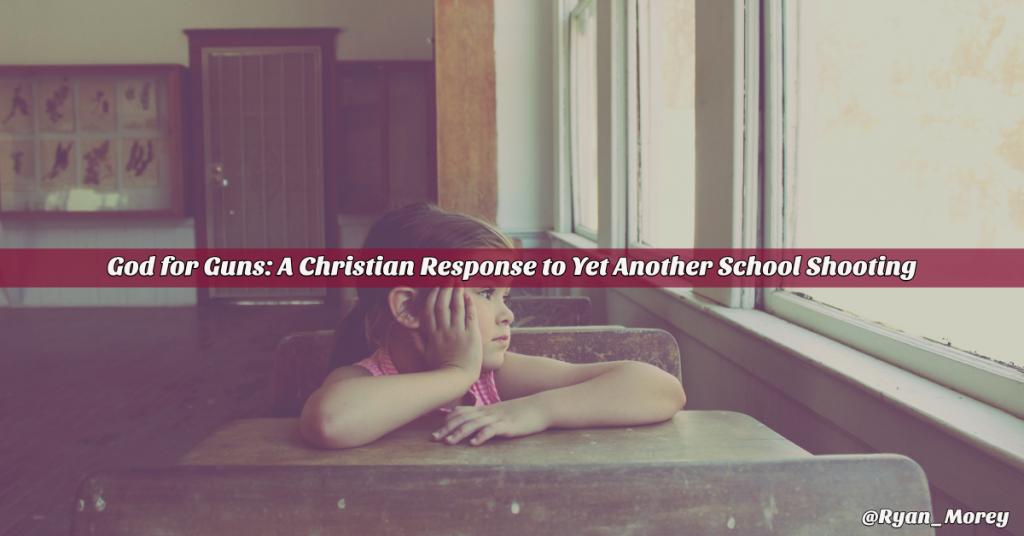
A Note from Kurt Willems about this guest post:
This is a guest post from my friend Ryan Morey. He’s my ‘in-the-flesh’ / hangs-in-my-small-group kind of friend. He is also a great thinker and writer. Here’s his mini-bio:
Ryan Morey (lives near Seattle, Wa.) teaches in the Monroe School District. He’s a lover of Jesus, the PNW sunshine and many nerdy pursuits. Find Ryan online: Twitter.

It happens every time there is a mass shooting and they seem to be happening with greater and greater frequency. Every single time there is the same loop, the same cycle of very emotional responses to the violence. There is the lament; someone changes their online profile image to one of solidarity, “thoughts and prayers” are delivered and the blood even has time to seep into the earth there is the cry to not politicize these deaths. There is the paranoid cry for protecting the Second Amendment rights and the guns attached to them.
In America we love our guns.
Really one could say, we don’t love them, we worship them. This is very clear from the numbers. For instance, for every 100 people, there are 88 guns within the United States. (Mccarthy, Beckett, & Glenza, 2017) It is estimated there are about 265 million guns in U.S. citizen hands. These numbers might seem outlandish, but this is largely because roughly half of these guns are owned by a mere 3 percent of the population. (Jervis, 2016)
The problem still persists, and if the students from Parkland, Florida are any indication, it’s not going to be something we can ignore any longer. Because of this those who want to hold onto their automatic and semi-automatic weapons and make no changes to the difficulty of acquiring them have to find ways to protect these children without removing those guns. The ideas most often touted are either arming teachers or hiring and arming veterans as a deterrent to these active shooters. However, since most of these shooters are counting on assisted suicide, I don’t see this as a deterrent.
The Good Guy with a Gun Myth
This is all dependent on what has been called the “Good Guy with a Gun Myth”, the idea that the only way to stop a bad man with a gun is a good guy with a gun. There really doesn’t seem to be that much evidence to demonstrate this overall. One instance touted by those who support this myth of course is the church shooting in Texas that occurred November 12, 2017. In this instance a gunman, after the shooter had already finished killing his targets at the church and was fleeing, shot the shooter wounding him. Of course, this did not prevent the slaughter at all and only wounded the shooter so that he was still able to get into his car and flee. He eventually did die in his vehicle after being chased into the next county and crashing it.
In addition, at the Parkland, Florida school shooting, there was a “good guy with a gun” there, a sheriff who didn’t even attempt to enter the building. Our love of guns has so completely captivated our imagination that we all think of ourselves as Clint Eastwood, armed and ready to save the day, when the reality is we are more likely to shoot ourselves than “the bad guys.”

In all of this I am more concerned about what this says about our culture, and especially Christian culture. I say this because many of those who cling more tightly to their weapons at times like this are Christians who would label themselves as conservatives. These people of course will defend their rights to “bear arms” as part of their heritage as Americans, as this seems promised under the Second Amendment. Of course, I have never actually met one who also claims to be part of a well-regulated state militia, which was the grounds for the Second Amendment in the first place. Beyond this however, I think we get a peek at the larger and deeper issue. What this reveals is an issue of trust, and what we trust is what we ultimately worship.
Some people trust in chariots, others in horses; but we praise the Lord’s name. Psalm 20:7
Here the Psalmist is offering up two ways of being in the world, but to get to them we have to understand a little bit about the place of horses and chariots in the Ancient world. This after all predates the Colosseum and the chariot races of Greco-Roman culture. Chariots were implements of war and violence that were of course led by horses. We might today say that some trust in tanks and others in rifles, but we praise the Lord. The Psalmist is making the case first of all, that whatever we trust in is what we worship. Secondly, I think he wants to say that you cannot trust in weapons of violence as well as God.
Subverting Violence in a Violent book
It would be easy to be confused by this since so much of the Old Testament is stories of violence, but if you look closer, so often they subvert the common ideas of violence. The future king David accepts the challenge of Goliath and so King Saul gets David his armor and his sword. Israel at this time, didn’t really have swords because they hadn’t mastered working with iron yet. So, they actually had to buy them from the Philistines. This is why Saul had to arm David with his own sword and armor, not a lot of others could afford that stuff. Yet the armor doesn’t fit and both it and the sword are too heavy so David goes out with just a slingshot and the clothes he came from Bethlehem in. Then he actually manages to defeat the armored giant Goliath with his sling and his trust in God.
God downsized Gideon’s army multiple times before battle. The walls of Jericho fell because of horn blasts. All of this subverts the ideas that if you want to beat an enemy you have to meet their violence with an equal violence. All of this subverts the trust in the sword. It subverts the way of living that depends on anything other than God for protection.
When Jesus told Peter that if you “live by the sword, you die by the sword” he was not simply trying to get Peter to stop fighting the Romans, he was talking about ways of living or being in the world. If violence and the sword, or a gun is what you depend on when it gets scary, that will be what takes you out. Some trust in swords and others in guns, but we will praise the name of the Lord.
But what if…?
Of course, whenever you talk about this sort of issue, you inevitably run into the big “what if” worst case scenario questions. I’d like to suggest first of all, that we don’t know. I don’t know. You don’t know. If what we have learned from the good guy with a gun myth if anything is that we really do not know how we will react in situations. All I can say is that I hope to have instilled in myself the kind of character Hugh Deweber has.
Pastor Deweber
Hugh Deweber was the pastor at the church where I grew up. He was a tall man, with white hair, a pug, and the warmest smile. He lived sacrificially in many ways the entire time he was pastor there. The lessons I have learned from him will continue to shape me in many ways. I do think none will shape me more than this one.
One evening, while he and his wife were home we awoke to a noise. He got out of bed and walked out of his room and into the living room. There he was confronted by a man with a gun. I suppose you could call him a bad guy with a gun, but I don’t think that is how Hugh saw him. I think what he saw was a lonely, broken child who didn’t know how much his Father loved him. He saw a prodigal whose Father wanted him to come home.
Hugh spoke to him in a way that was not harsh or confrontational, but loving. He honored that broken man’s humanity by seeing in him not the enemy, but a brother. He did what Jesus said to do to this man with a gun and loved his enemy. At the end of it the man saw himself the way Hugh saw him. At the end of it that man entrusted himself to Jesus and not to his guns. At the end of it they both walked away whole and loved, perhaps in ways they had never known before.

I don’t know the rest of the story for that man with a gun. I do know that I want my story to be like Hugh’s. I want to look into the face of my enemy and see my brother.
God for guns
Right now, this nation’s love of its weapons has become idolatrous. You can see it by how easily we are willing to sacrifice our children on the altar of the Second Amendment. We have exchanged God for guns. This is especially sad within the church. Many in the church have reinvented God’s image into a god who is for guns. This could not be further from the image of God Jesus. Jesus is perfectly revealed on the cross forgiving those who are crucifying him. God is love and this is how we know what love looks like.
“This is love: it is not that we loved God but that he loved us and sent his Son as the sacrifice that deals with our sins.
Dear friends, if God loved us this way, we also ought to love each other.” 1 John 4:10,11
I am a teacher, and I am a Christian. If our government wants to force me to carry a gun, they can call me a conscientious objector. Some trust in horses and others in chariots, I will praise the Lord. I will not live by the sword, but I will trust in God. I will love my neighbor–even my enemies.
References
Jervis, R. (2016, September 22). 3% of Americans own half the country’s 265 million guns. Retrieved from USA Today: https://www.usatoday.com/story/news/2016/09/22/study-guns-owners-violence/90858752/
Mccarthy, T., Beckett, L., & Glenza, J. (2017, October 3). America’s passion for guns: ownership and violence by the numbers. Retrieved from The Guardian: https://www.theguardian.com/us-news/2017/oct/02/us-gun-control-ownership-violence-statistics
Previous Post

February 8, 2018
Shame Disrupts Shalom: Voices that Pull Us Away from God and Others
Next Post

March 8, 2018 Name Change Myth: Saul Never Became Paul
Browse Our Archives
Select a Category (Series) All Out War-Spiritual Warfare (Series) Church Plant Journal (Series) Dear Reader... (Series) Earthquakes...Signs of the Times? (Series) Entering the... Conversation (Series) Evangelical Culture Myths (Series) Everything is Meaningless [Pete Enns] (Series) Evolving Evangelicalism (Series) Hell Yes. Hell No! Who Cares? (Series) Hidden Worldviews (Series) If Evolution is Right, what about Adam? (Series) in less than 300 words (Series) Jesus and Nationalism (Series) Liberating Women for Ministry? (Series) Life-Changing Books (Series) Markers of Church Plant Movement (Series) Nonviolence 101 (Series) Philemon - Reconciliation (Series) Quote to Ponder (Series) Red Letter Dialogues (Series) Resource of the Week (SERIES) Revelation Sermons (Series) Share Something Sundays (Series) Simplicity in the Burbs: $2 a day (Series) The Binding of God [Open Theism] (Series) The Creed: Anabaptist Reflections (Series) Values for Church Leadership (Series) Video to Ponder Anabaptism Animal Advocacy Books Church Ministry Church Planting Community Culture Eschatology Eucharist Evangelical Reject Evolution Fundamentalism Greek Greg Boyd Guest Contributors Hell Holy Spirit Israel/Palestine Kingdom of God Lent Missional N. T. Wright Nationalism New Creation Nonviolence Open Mic Open Theism Parenting Passover Paul Philemon Podcast Politics Restorative Justice Revelation (the book of) Rob Bell Ron Martoia Sermon Shane Claiborne Social Justice Speaking Engagement Spiritual Warfare Spirituality Temple Theology Tim Geddert Tribulation Uncategorized universalism Video Blog Women in Ministry Worship Music Youth Ministry
Select a Month August 2018 July 2018 June 2018 May 2018 April 2018 March 2018 February 2018 January 2018 December 2017 October 2017 July 2017 June 2017 May 2017 April 2017 December 2016 October 2016 August 2016 June 2016 May 2016 April 2016 March 2016 December 2015 November 2015 October 2015 September 2015 August 2015 June 2015 May 2015 April 2015 March 2015 February 2015 January 2015 December 2014 November 2014 October 2014 September 2014 August 2014 July 2014 June 2014 May 2014 April 2014 March 2014 February 2014 January 2014 December 2013 November 2013 October 2013 September 2013 August 2013 June 2013 May 2013 April 2013 March 2013 February 2013 January 2013 December 2012 November 2012 October 2012 September 2012 August 2012 July 2012 June 2012 May 2012 April 2012 March 2012 February 2012 January 2012 December 2011 November 2011 October 2011 September 2011 August 2011 July 2011 June 2011 May 2011 April 2011 March 2011 February 2011 January 2011 December 2010 November 2010 September 2010 August 2010 July 2010 June 2010 May 2010 April 2010 March 2010 February 2010 January 2010 October 2009 September 2009 August 2009 July 2009 June 2009 May 2009 April 2009 March 2009 February 2009 January 2009 December 2008 November 2008 October 2008 September 2008 August 2008 June 2008 May 2008 April 2008
Follow Us!
TAKE THE
Religious Wisdom Quiz
What did Jesus use to heal a blind man in John 9?
Select your answer to see how you score.
His robe Mud and saliva A fig leaf Olive oil
Support this
Column


Related posts from The Pangea Blog

What is the Kingdom of God? (with Frank...

Sunday is Not the Main Event: A Practice-Based...

10 Years Ago, I Embraced Nonviolence & Anabaptism

Romans 13 Doesn't Give Government an Ethical Blank...
TRENDING AT PATHEOS Progressive Christian

What Being a Modern-Day Apostle Means to Me
In my last column, I discussed the ins and outs of modern-day...

Did Ancient China Once Worship the God of...
Across human history, a common thread weaves through the origins of the...

Love Your Neighbor – Including Earth-Kin: Lev. 19,...
God’s command to love your neighbor means acting in an ethical and...

Lead a Church Study of “Jesus and Lao...
Guest writer Jack Thomas (The Irreverent Reverend) reflects on leading his church...

Pastoral Wisdom for Responding to Sermon Pushback
Getting sermon pushback on your social justice sermon? Learn practical, Proverbs-based strategies...

Principles for Understanding the Apostolic Ministry Today
Whenever people discover that my formal ministry title is "apostle," as in...
view all Progressive Christian blogs
Ad-Free & Subscriber Log-In Subscription Support
- About Us
- 2026 Calendar
- Videos
- Podcasts
- Library of World Religions
- Faith In Media Tracker
- Advertise With Us
- Write for Us
- Privacy Policy
- Terms of Service
- Do Not Sell My Data
- Contact Us
- Radiant Digital
- Manage Newsletter Subscriptions
- Unsubscribe From Notifications
- Sitemap
Copyright 2008-2026, Patheos. All rights reserved.
Subscription Support Ad-Free & Subscriber Log-In
Follow Patheos