
BuddhistCatholicContemplativeEvangelicalGeneral ChristianHinduJewishLatter-day SaintMuslimNew VisionsProgressive Christian
Beliefs
- Buddhist
- Catholic
- Contemplative
- Evangelical
- General Christian
- Hindu
- Jewish
- Latter-day Saint
- More Voices
- Muslim
- New Visions
- Pagan
- Progressive Christian
Topics
- Religion News
- Food and Religion
- Sports and Religion
- Religious Art
- Religious Music and Entertainment
- Religious Events
- History and Religion
- Style and Religion
- Politics and Religion
- Women in Religion
- Recreation Outdoors and Religion
- Business Finance and Religion
- Careers Workplace and Religion
- Education and Religion
- Family Parenting and Religion
- Health Fitness and Religion
- Home and Religion
- Relationships and Religion
- Technology and Religion
- Travel and Religion
Columnists
- Buddhist Columnists
- Business Finance and Religion Columnists
- Careers Workplace and Religion Columnists
- Catholic Columnists
- Contemplative Columnists
- Education and Religion Columnists
- Evangelists Columnists
- Family Parenting and Religion Columnists
- General Christian Columnists
- Health Fitness and Religion Columnists
- Hindu Columnists
- History and Religion Columnists
- Home and Religion Columnists
- Jewish Columnists
- More Voices Columnists
- Latter Day Columnists
- Muslim Columnists
- New Visions Columnists
- Nonreligious Columnists
- Pagan Columnists
- Politics and Religion Columnists
- Progressive Columnists
- Recreation Outdoors and Religion Columnists
- Relationships and Religion Columnists
- Religion News Columnists
- Religious Art Columnists
- Religious Events Columnists
- Religious Music and Entertainment Columnists
- Sports and Religion Columnists
- Style and Religion Columnists
- Technology and Religion Columnists
- Travel and Religion Columnists
- Women in Religion Columnists
Resource Library
- 2026 Calendar
- Library of World Religions
- The 100 Most Holy Places on Earth
- Patheos Answers
- Podcasts
- Videos
- Faith Leaders Database
- Anglican Episcopalian
- Bahai
- Baptist
- Buddhism
- Christianity
- Confucianism
- Eastern Orthodoxy
- Hinduism
- Holiness and Pentecostal
- ISKCON
- Islam
- Judaism
- Lutheran
- Methodist
- The Church of Jesus Christ of Latter-day Saints
- New Age
- Paganism
- Presbytarian and Reformed
- Protestantism
- Religion Behind the Scenes
- Roman Catholic
- Scientology
- Shia Islam
- Sikhism
- Sufism
- Sunni Islam
- Taoism
- Zen
- See all religions
Research Tools
 Ad-Free & Subscriber Log-In Subscription Support
Ad-Free & Subscriber Log-In Subscription Support
Follow Patheos 

- Trending:
- Forgiveness
- |
- Marriage
- |
- Consciousness
- |
- Death Penalty
- |
- Election
- |
- Halloween
 The Pangea Blog
- Home
- Progressive Christian
- Jesus Never Said: “God Helps Those Who Help Themselves”
Jesus Never Said: “God Helps Those Who Help Themselves”
Last updated on: July 21, 2017 at 9:16 am by Kurt Willems
Jesus Never Said: “God Helps Those Who Help Themselves” 2017-07-21T09:16:41-07:00 Kurt Willems
Patheos Explore the world's faith through different perspectives on religion and spirituality! Patheos has the views of the prevalent religions and spiritualities of the world.
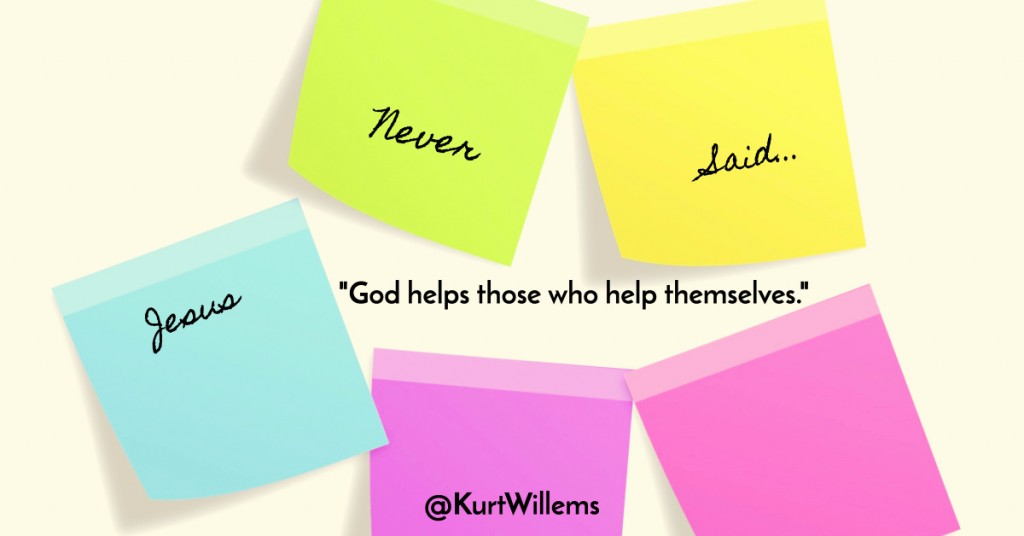
Perhaps you’ve heard the catchphrase: “God helps those who help themselves.”
It might have come up at a dinner table during the election.
In our day, this phrase comes up in political banter more than any other place.
One side claims that Jesus gives everyone a fair go at life, so all you have to do is work hard to succeed. At one level I agree: we should strive to be personally responsible where we can be.
The other side appeals to all of the passages about feeding the hungry, and says that this phrase certainly doesn’t mean that we leave people to their own difficult circumstances.
(For my friends who aren’t American, this probably doesn’t apply, but feel free to chuckle at us from a distance ;-))
Where both sides are often wrong, I think at least, is in the assumption that this is even a helpful or “Christian” saying at all.
It’s not.
Sadly, one stat I came across from the 90s (so old, admittedly) states that about 68% of US Christians believed that “The Bible teaches that God helps those who helps themselves” is true. The number was higher for Americans in general.
Not only is this slogan unhelpful but it is not in the Bible at all.
It’s nowhere to be found.
It has its origins about 400 years prior to Jesus in Aesop’s Fables, in the story of Hercules and the Wagoner.
The wagoner’s heavy load leads him to distress because he gets stuck in the mud.
If you’ve ever been stuck in the mud (don’t read ‘stick in the mud’ although maybe this is true at times too for some of us :-)), you know that things can get really bad really fast.
So the wagoner cries out to Hercules for help. The demigod Hercules (Heracles to the Greeks) replies:
“Get up and put your shoulder to the wheel. The gods help them that help themselves.”
Where does this infamous one liner come from: not Jesus, nor the Scriptures.
It comes from Greco-Roman myth.
Nothing about it is Jewish or Christian.
But after Benjamin Franklin used this slogan in his publication of Poor Richard’s Almanac, it has become part of the American ethos ever since.
Thus, many people believe it to be in the Bible or based on something from the Bible.
I’d argue, it is actually anti-Bible.
Here’s why.
This idea can easily lead to a poor assumption: my actions determine my access.
Let me say that again.
The false idea that “God helps them who help themselves” leads to the false narrative that our actions determine our access to God.
Nothing could be further from the truth!
Rather, our access to God (relationally, experiencially, etc.) can and should determine our actions (rooted in God-like love and empathy toward others).
Accessing God is so different for those of us to see Jesus revealed in the New Testament. The gates are as wide as we let them be! God wants nothing more than to be accessible to all.
This is why, in the Scriptures, the initiative for all that is good always starts and ends with God, not us.
God always takes initiative. Whether it is calling Abram to be the father of a people who would partner with God to undo the evil of Genesis 3-11, or forsaking the glories of the heavenly realm of reality to become human in Jesus of Nazareth: God is the intiator.
God doesn’t wait around hoping we will take the first move to ‘help ourselves.’
God is already acting in the world to our good end.
Everything that is good, starts and ends in God. Our cooperation flow from our access and experience of God, not to earn access to God.
Add to this that “God helps those who help themselves” is the language of privilege.
If God is into impartiality, then this slogan is junk already.
God is so impartial that Jesus says that we are to love even enemies! God sees our enemies as people to be loved! God sends rain on both the righteous and the unrighteous (see Matthew 5.44-45).
God isn’t partial to those who pick themselves up by the bootstraps to “help themselves” first. Neither should we adopt this posture!
God’s love extends father than our logic or cliches will ever know!
When we are tempted to grab for quick answers and slogans that will reinforce our particular positions on an issue, we need to ask: Does this look like the God who looks like Jesus?
In this case, the slogan doesn’t pan out.
In fact, there was once a man who was pretty well off in life who approached Jesus (see Mark 10.17-22).
He wanted to know what he needed to do to inherit the life of the Kingdom that Jesus came to proclaim.
The conversation first turned to the 10 Commandments.
Sure Jesus: I’ve never stolen anything. I never killed another person. I tell the truth about others. I’m good to my parents.
Of course, Jesus is glad to hear that this wealthy young man lived out the Torah commands so well.
But even in appealing to the commandments first, we see that this person had the wrong narrative:
For him, it seems, his actions (what he had accomplished) should lead to greater access (an inheritance in God’s kingdom).
Jesus tells him to sell all his stuff (because it is getting in the way of truly seeing how wide the access point really is!) and to follow him (the embodiment of “access”).
Basically, it’s like Jesus is saying: Come and see just how wide and beautiful the access to God really is… follow me to it… that’s how you will see the kingdom for what it truly is. It is all grace. You are in unless you opt out.
Sadly, this young man can’t do it. He gives us an example of someone who at some level believed that “God helps those who help themselves.” He was mistaken.
He had all the money he would ever need. He had all of the rules followed.
But he lacked one thing: expereincing the gift of recklessly following Jesus into the deep love of God that opens our eyes to others around us.
May you experience a God who’s access is wide.
May you experience others as God does, objects of love, before they do anything to “help themselves.”
And may you see that empathy for others and reliance on God is born out of a life surrendered to the love of God!
***Some of the historical insights come from Adam Hamilton in Half-Truths.
Previous Post

June 28, 2017
The "Christian" Politics of Stone Throwing
Next Post

July 18, 2017 Sometimes Reading the Bible Literally Is Literally Wrong
Browse Our Archives
Select a Category (Series) All Out War-Spiritual Warfare (Series) Church Plant Journal (Series) Dear Reader... (Series) Earthquakes...Signs of the Times? (Series) Entering the... Conversation (Series) Evangelical Culture Myths (Series) Everything is Meaningless [Pete Enns] (Series) Evolving Evangelicalism (Series) Hell Yes. Hell No! Who Cares? (Series) Hidden Worldviews (Series) If Evolution is Right, what about Adam? (Series) in less than 300 words (Series) Jesus and Nationalism (Series) Liberating Women for Ministry? (Series) Life-Changing Books (Series) Markers of Church Plant Movement (Series) Nonviolence 101 (Series) Philemon - Reconciliation (Series) Quote to Ponder (Series) Red Letter Dialogues (Series) Resource of the Week (SERIES) Revelation Sermons (Series) Share Something Sundays (Series) Simplicity in the Burbs: $2 a day (Series) The Binding of God [Open Theism] (Series) The Creed: Anabaptist Reflections (Series) Values for Church Leadership (Series) Video to Ponder Anabaptism Animal Advocacy Books Church Ministry Church Planting Community Culture Eschatology Eucharist Evangelical Reject Evolution Fundamentalism Greek Greg Boyd Guest Contributors Hell Holy Spirit Israel/Palestine Kingdom of God Lent Missional N. T. Wright Nationalism New Creation Nonviolence Open Mic Open Theism Parenting Passover Paul Philemon Podcast Politics Restorative Justice Revelation (the book of) Rob Bell Ron Martoia Sermon Shane Claiborne Social Justice Speaking Engagement Spiritual Warfare Spirituality Temple Theology Tim Geddert Tribulation Uncategorized universalism Video Blog Women in Ministry Worship Music Youth Ministry
Select a Month August 2018 July 2018 June 2018 May 2018 April 2018 March 2018 February 2018 January 2018 December 2017 October 2017 July 2017 June 2017 May 2017 April 2017 December 2016 October 2016 August 2016 June 2016 May 2016 April 2016 March 2016 December 2015 November 2015 October 2015 September 2015 August 2015 June 2015 May 2015 April 2015 March 2015 February 2015 January 2015 December 2014 November 2014 October 2014 September 2014 August 2014 July 2014 June 2014 May 2014 April 2014 March 2014 February 2014 January 2014 December 2013 November 2013 October 2013 September 2013 August 2013 June 2013 May 2013 April 2013 March 2013 February 2013 January 2013 December 2012 November 2012 October 2012 September 2012 August 2012 July 2012 June 2012 May 2012 April 2012 March 2012 February 2012 January 2012 December 2011 November 2011 October 2011 September 2011 August 2011 July 2011 June 2011 May 2011 April 2011 March 2011 February 2011 January 2011 December 2010 November 2010 September 2010 August 2010 July 2010 June 2010 May 2010 April 2010 March 2010 February 2010 January 2010 October 2009 September 2009 August 2009 July 2009 June 2009 May 2009 April 2009 March 2009 February 2009 January 2009 December 2008 November 2008 October 2008 September 2008 August 2008 June 2008 May 2008 April 2008
Follow Us!
TAKE THE
Religious Wisdom Quiz
Who was the prophet after Moses?
Select your answer to see how you score.
Samuel Elijah Joshua Isaiah
Support this
Column


Related posts from The Pangea Blog

Sunday is Not the Main Event: A Practice-Based...

The Gospel is about a Person, not a...

Romans 13 Doesn't Give Government an Ethical Blank...
Love is the Only Way: Why I Loved...
TRENDING AT PATHEOS Progressive Christian

What Being a Modern-Day Apostle Means to Me
In my last column, I discussed the ins and outs of modern-day...

Did Ancient China Once Worship the God of...
Across human history, a common thread weaves through the origins of the...

Love Your Neighbor – Including Earth-Kin: Lev. 19,...
God’s command to love your neighbor means acting in an ethical and...

Lead a Church Study of “Jesus and Lao...
Guest writer Jack Thomas (The Irreverent Reverend) reflects on leading his church...

Pastoral Wisdom for Responding to Sermon Pushback
Getting sermon pushback on your social justice sermon? Learn practical, Proverbs-based strategies...

Principles for Understanding the Apostolic Ministry Today
Whenever people discover that my formal ministry title is "apostle," as in...
view all Progressive Christian blogs
Ad-Free & Subscriber Log-In Subscription Support
- About Us
- 2026 Calendar
- Videos
- Podcasts
- Library of World Religions
- Faith In Media Tracker
- Advertise With Us
- Write for Us
- Privacy Policy
- Terms of Service
- Do Not Sell My Data
- Contact Us
- Radiant Digital
- Manage Newsletter Subscriptions
- Unsubscribe From Notifications
- Sitemap
Copyright 2008-2026, Patheos. All rights reserved.
Subscription Support Ad-Free & Subscriber Log-In
Follow Patheos