
BuddhistCatholicContemplativeEvangelicalGeneral ChristianHinduJewishLatter-day SaintMuslimNew VisionsProgressive Christian
Beliefs
- Buddhist
- Catholic
- Contemplative
- Evangelical
- General Christian
- Hindu
- Jewish
- Latter-day Saint
- More Voices
- Muslim
- New Visions
- Pagan
- Progressive Christian
Topics
- Religion News
- Food and Religion
- Sports and Religion
- Religious Art
- Religious Music and Entertainment
- Religious Events
- History and Religion
- Style and Religion
- Politics and Religion
- Women in Religion
- Recreation Outdoors and Religion
- Business Finance and Religion
- Careers Workplace and Religion
- Education and Religion
- Family Parenting and Religion
- Health Fitness and Religion
- Home and Religion
- Relationships and Religion
- Technology and Religion
- Travel and Religion
Columnists
- Buddhist Columnists
- Business Finance and Religion Columnists
- Careers Workplace and Religion Columnists
- Catholic Columnists
- Contemplative Columnists
- Education and Religion Columnists
- Evangelists Columnists
- Family Parenting and Religion Columnists
- General Christian Columnists
- Health Fitness and Religion Columnists
- Hindu Columnists
- History and Religion Columnists
- Home and Religion Columnists
- Jewish Columnists
- More Voices Columnists
- Latter Day Columnists
- Muslim Columnists
- New Visions Columnists
- Nonreligious Columnists
- Pagan Columnists
- Politics and Religion Columnists
- Progressive Columnists
- Recreation Outdoors and Religion Columnists
- Relationships and Religion Columnists
- Religion News Columnists
- Religious Art Columnists
- Religious Events Columnists
- Religious Music and Entertainment Columnists
- Sports and Religion Columnists
- Style and Religion Columnists
- Technology and Religion Columnists
- Travel and Religion Columnists
- Women in Religion Columnists
Resource Library
- 2026 Calendar
- Library of World Religions
- The 100 Most Holy Places on Earth
- Patheos Answers
- Podcasts
- Videos
- Faith Leaders Database
- Anglican Episcopalian
- Bahai
- Baptist
- Buddhism
- Christianity
- Confucianism
- Eastern Orthodoxy
- Hinduism
- Holiness and Pentecostal
- ISKCON
- Islam
- Judaism
- Lutheran
- Methodist
- The Church of Jesus Christ of Latter-day Saints
- New Age
- Paganism
- Presbytarian and Reformed
- Protestantism
- Religion Behind the Scenes
- Roman Catholic
- Scientology
- Shia Islam
- Sikhism
- Sufism
- Sunni Islam
- Taoism
- Zen
- See all religions
Research Tools
 Ad-Free & Subscriber Log-In Subscription Support
Ad-Free & Subscriber Log-In Subscription Support
Follow Patheos 

- Trending:
- Forgiveness
- |
- Marriage
- |
- Consciousness
- |
- Death Penalty
- |
- Election
- |
- Halloween
 The Pangea Blog
- Home
- Progressive Christian
- Paul’s “Problem” with Torah: Why Evangelicalism’s Law vs Grace Preaching Needs to be Reconsidered
Paul’s “Problem” with Torah: Why Evangelicalism’s Law vs Grace Preaching Needs to be Reconsidered
Last updated on: December 7, 2015 at 6:00 am by Kurt Willems
Paul’s “Problem” with Torah: Why Evangelicalism’s Law vs Grace Preaching Needs to be Reconsidered 2015-12-06T21:45:48-08:00 Kurt Willems
Patheos Explore the world's faith through different perspectives on religion and spirituality! Patheos has the views of the prevalent religions and spiritualities of the world.
Paul had a problem with the Torah.[1] There is no denying this fact.
The nature of the problem, however, is certainly up for debate.
Growing up as a child of evangelicalism, the problem was often framed in binaries: law vs. grace or religion vs. grace or works vs. faith or flesh vs. Spirit or slavery vs. freedom. All of these dualities get at the same thing: the old Hebrew covenant was needed, but only so that at the fullness of time God could establish a new covenant that trumped the archaic (but temporarily needed) legalism of the Torah.
Pastors that I greatly admire picked up on this tradition of reading Paul (often applying it to the Jesus of the Gospels). From this viewpoint, the Apostle to the Gentiles (Paul) was a spiritually motivated iconoclast within Judaism who favored a life of obedient freedom in Christ and “law of love” over the religious checklists of the Pharisees and Sadducees. The foundational question in many churches is: What do I have to do to know I’m ‘right with God?’ The answer: Nothing! Grace is opposed to works. God loves people just as they are. Works/deeds are the outflow of a life rooted in grace, but not the requirement for receiving it.
Although I now disagree with this reading of Paul, I don’t fault well-meaning pastors who preach his letters in this way. In fact, it may be what some people need to get out of a cycle of damaging spiritual self-talk that measures one’s worth by how “good” a person is instead from a posture of inherent human worth. To believe that the Divine is on your side—before doing anything at all—this is truly good news. Much of this preaching from the boomer generation comes as a response to the mantra of many of their parents and grandparents (that now has mostly become a joke, even to aged folks): “Don’t smoke, drink or chew or go with girls who do.” Many boomers and gen X-ers were appropriately responding to legalism within evangelical Christian culture with the categories available for them: law vs. grace.
The Problem with Evangelicalism’s Problem with Torah
Reading Paul as resisting legalism has come under serious scrutiny in the scholarship of the late twentieth century up until now. For what would become broadly known as the “New Perspective on Paul,”[2] the Apostle wasn’t responding to legalism. In fact, the practices of Judaean persons weren’t aimed at making sure someone was “right with God” at all—at least not in the salvific sense that is assumed by most Christians. Rather, Judaean practice was about responding to the grace of God who had allowed the Judaean people to be elected into the covenant, with a symbolic entrance point being circumcision. In other words, Judaeans weren’t attempting to “stay saved” or “earn salvation” by living perfectly under the law. They were “in” from birth. Their response to God’s grace—what we might call “covenantal faithfulness”—was to live in accordance to Torah. Torah helped them maintain right-standing with God in light of grace, not to earn and re-earn it through ritualistic practices. Thus, Paul can say things like “no one is justified before God by the law” (Gal. 3.11, NRSV) because even Judaeans aren’t/weren’t justified (made right) by following the law (Torah). They were justified by God’s covenantal faithfulness, the grace of God to them, which was lived out through Torah.
For New Perspective scholars, then, the problem that Paul had with Torah isn’t legalism in any sense, but rather that it (from this view) serves a boundary-marking function of exclusion.[3] The law’s practices (including the entry point of circumcision for males) are the very things that separate Jew from Gentile. Now that Christ has died for all and removed these distinctions (see Galatians 3.28), the law isn’t needed (insofar that it promotes ethnocentrism) as it has been redefined around the Messiah, community, and the Spirit.
So what we then deduce from this approach is that Torah observance for ‘messianic’ Jews like Paul became increasingly negative in their rhetoric about the law while also acknowledging that it had a good purpose. Different scholars approach these benefits/negatives of the law in various ways, which are too numerous to explore in this brief essay. Suffice it to say that the New Perspective started an important conversation about the nature of Judaean religious practices shifting the problem Paul had with Torah from legalism to ethnocentrism. But perhaps they didn’t go far enough to really deal with the dualisms of law vs. grace.
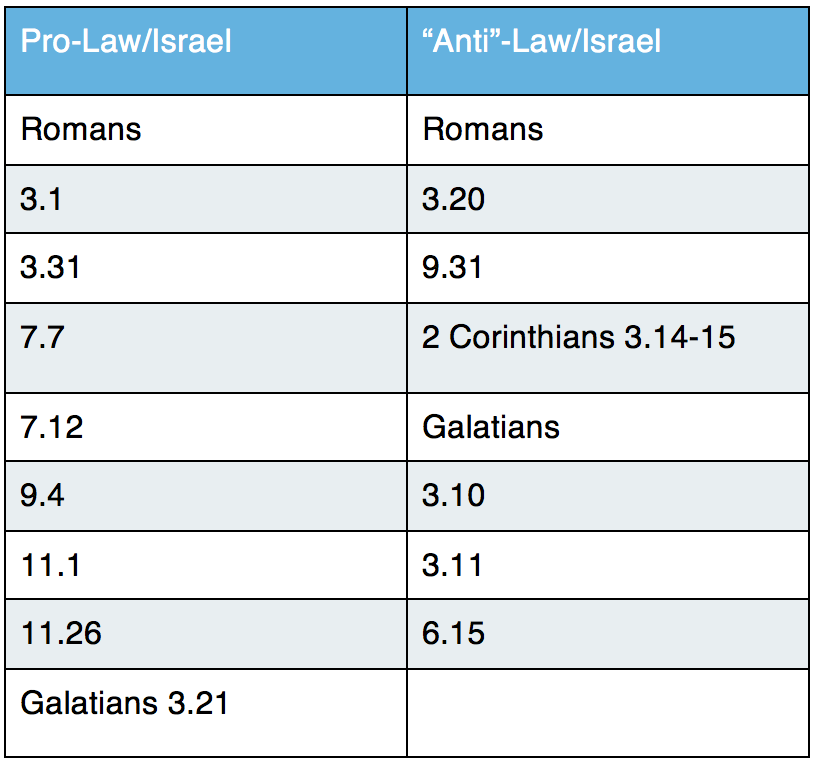
Is Paul’s real concern with boundary-keeping and ethnocentrism? Certainly Paul would be upset if these sorts of things were found within his communities. Even today, we can imagine shifting the old law vs. grace preaching to boundary-making and determining (perhaps even legalistically) who’s in and who’s out. Paul would likely not want to play such “religious” games. However, his view of the law is so positive at times that we have to wonder if there is a better way to think about his approach to the Torah. Consider the chart with various examples of how Paul seems to speak out of both sides of his mouth. No wonder Paul’s understanding of the Torah is so difficult to grasp!
Paul’s Problem with Torah is for those Outside of Torah
In order to believe that Paul becomes increasingly anti-Torah, at least in the sense that its season of relevance has passed because of Jesus’ new covenant inaugurated through resurrection, one must assume that everything Paul says about the law is directed (unless clearly specified) at a mixed audience of Judaeans and gentiles (really, gentiles should be translated as “the nations” but we will go with the conventional use for now). Circumcision is bad for everyone, in other words, as an obvious example. Or to make it even more relevant to real life: If Paul were married and had a male son, would he have circumcised his child in light of the gospel of Jesus?
Until recently I would have answered that question with an adamant “no.” Paul certainly believed that these boundary-making practices were put to death in the tomb with Jesus. However, I’m now quite comfortable believing that Paul would have had his theoretical son circumcised. I can’t see any better way to read Paul’s dialectic around the Torah than to come to the conclusion that he believed that Judaeans ought to remain in covenant relationship with God through the means they always have and that the negative rhetoric about the law are aimed exclusively at gentiles. As John Gager wrote:
Any statement that begins with the words, ‘How could a Jew like Paul say X, Y, Z about the law,’ must be regarded as misguided. In all likelihood Paul, the apostle to the Gentiles, is not speaking about the law as it relates to Israel but only about the law and Gentile members of the Jesus-movement.[4]
What I’m claiming, then, is that Paul does in fact have a real problem with Torah—for the gentiles only. The peoples from the nations do not have to become Judaeans in the formal sense, through circumcision and being absorbed into the Judaean ethnos (identity). They only need to trust in the faithfulness of Christ that he acted on behalf of the gentiles to bring them in just as they are: as gentiles (see 1 Corinthians 7.17-20 for an example of this logic).
In this way, they are to be gathered as distinct peoples to the worship of Israel’s God—an expectation that Paul clearly has inherited from the prophets (see Isaiah 2.2; 45) and his understanding of the covenant with Abraham that his decedents were blessed to become a blessing to every family on earth (Genesis 12.1-3; Galatians 3.1-9). Paul’s gospel was that active Torah observant Judaeans were seeing the launch of the end of days as the nations/gentiles gathered to worship Israel’s God, and thus, through Jesus’ faithfulness a Judaean plus Gentile covenantal community was now possible. Paul wants Jews, even messianic Jews, to remain faithful to Torah. He wants gentiles to remain gentiles, while at the same time refusing to worship pagan gods of the empire (Galatians 4.8-11).[5]
Issues that Need Further Examination
This approach to Paul’s “problem” with the Torah raises many important questions. Briefly, I will make some initial comments about these questions, recognizing that more space will be needed to truly flesh them out.
Does Paul, then, have a two covenant model? Yes, sort of. This comes through in Romans 8-11, specifically through Paul’s need to address the arrogance of non-Judaean Jesus followers who seem to think they have the advantage now in God’s plan. Paul’s response to them is that in the end “all Israel will be saved” even if for now, they have been hardened to the Jesus message. There is one covenant it seems with two tracks. These tracks will eventually meet at the end of the age when Christ is revealed as the world’s true Lord, of both Jews and gentiles.
Then, is Jesus the Messiah for Israel or is he only significant for the gentiles? This is a question that requires pages of examination. For now, I do think that Jesus is important beyond simply being the means through which the nations are grafted into the covenant. Why else would Peter, for instance, be called the apostle to the Jews? I suspect that there is more significance than merely announcing the end of the age has arrived. For instance, Paul’s emphasis on life in the Spirit of God/Christ (i.e. Romans 8, Galatians 5) seems to be something that only those who have trusted in Christ’s faithfulness get to experience.
So the Spiritual Temple language in Paul is only for the gentiles and Jesus-believing Jews? Yes, that is my opinion. This image comes up in 1 Corinthians 3 and 6, for instance, and seems to be directed at a gentile audience who do not participate in the physical temple worship in Jerusalem. They, through the mystical presence of Christ’s spirit are a spiritual temple (which would include Jesus-believing Jews). God’s experiential presence seems to have moved beyond the walls of the temple into the life of the community. However, nothing indicates that God’s experiential presence has left the building (temple) either. These are two different ways to encounter Israel’s God, but trusting in Jesus seems to have as an advantage the presence of the Spirit. Jesus believing Judaean worshipers presumably have the best of both worlds.
The Ongoing Problem of Torah Doesn’t have to be a Problem
Clearly, the way we speak of Paul and the law has ramifications for how faith communities live. Although pastors may have good motives to remove shame and guilt induced by legalism, the unintended ramification may be a distorted view of Judaism. Our rhetoric has built walls between Christians and Jews that a more nuanced approach might dismantle. The stones from that wall of hostility would be better repurposed as the building blocks of a bridge. This reconsideration of evangelicalism’s approach to Paul may lead to some beautiful new possibilities.
And the old problem of legalism and boundary-keeping, if these aren’t problems Paul is addressing then perhaps they aren’t our problems after all. Perhaps the solution for evangelical preachers might be found in reclaiming a unique trust in a God of love who through the faithfulness of Jesus has an open door policy to everyone: failures and all.
—————————————-
[1] From here on out, unless otherwise noted, I will use “Torah” and “law” as synonyms.
[2] Typically, this scholastic movement is considered to have its origin in the work of E.P. Sanders. Those who followed his lead often site that they agree with him on the basic nature of Judaism in the second temple period, but that he struggled to build a stable bridge to apply these insights to Paul’s gospel.
[3] This is especially evident, with different nuances, in N.T. Wright and James Dunn.
[4]. John G. Gager, Reinventing Paul (New York: Oxford University Press, 2000),44.
[5] Here, it is important to note that the calendar in question in Galatians 4 is the imperial calendar, not the Judaean one. See Mark D. Nanos, “A Jewish View,” in Four Views on the Apostle Paul, ed. Michael F. Bird (Grand Rapids, MI: Zondervan, 2012), 184-186, n. 20.
======================================================
 THIS WEEK ON THE SERMON PODCAST: In this first message of Subverting the Christmas Empire, Kurt dives head first into the Gospel/Good News of Caesar Augustus. This is the dominating story that Jesus is born into and yet somehow upstages. The story that places power and the gods in the center is subverted by a story that seeks its influence from the margins of Bethlehem. We American Christians have a lot to learn about Kingdom influence, especially during the holiday season: iTunes, Feed.

Next Post

March 28, 2016 Introducing: The Paulcast Podcast & Easy Book Giveaway (Books about Paul)
Browse Our Archives
Select a Category (Series) All Out War-Spiritual Warfare (Series) Church Plant Journal (Series) Dear Reader... (Series) Earthquakes...Signs of the Times? (Series) Entering the... Conversation (Series) Evangelical Culture Myths (Series) Everything is Meaningless [Pete Enns] (Series) Evolving Evangelicalism (Series) Hell Yes. Hell No! Who Cares? (Series) Hidden Worldviews (Series) If Evolution is Right, what about Adam? (Series) in less than 300 words (Series) Jesus and Nationalism (Series) Liberating Women for Ministry? (Series) Life-Changing Books (Series) Markers of Church Plant Movement (Series) Nonviolence 101 (Series) Philemon - Reconciliation (Series) Quote to Ponder (Series) Red Letter Dialogues (Series) Resource of the Week (SERIES) Revelation Sermons (Series) Share Something Sundays (Series) Simplicity in the Burbs: $2 a day (Series) The Binding of God [Open Theism] (Series) The Creed: Anabaptist Reflections (Series) Values for Church Leadership (Series) Video to Ponder Anabaptism Animal Advocacy Books Church Ministry Church Planting Community Culture Eschatology Eucharist Evangelical Reject Evolution Fundamentalism Greek Greg Boyd Guest Contributors Hell Holy Spirit Israel/Palestine Kingdom of God Lent Missional N. T. Wright Nationalism New Creation Nonviolence Open Mic Open Theism Parenting Passover Paul Philemon Podcast Politics Restorative Justice Revelation (the book of) Rob Bell Ron Martoia Sermon Shane Claiborne Social Justice Speaking Engagement Spiritual Warfare Spirituality Temple Theology Tim Geddert Tribulation Uncategorized universalism Video Blog Women in Ministry Worship Music Youth Ministry
Select a Month August 2018 July 2018 June 2018 May 2018 April 2018 March 2018 February 2018 January 2018 December 2017 October 2017 July 2017 June 2017 May 2017 April 2017 December 2016 October 2016 August 2016 June 2016 May 2016 April 2016 March 2016 December 2015 November 2015 October 2015 September 2015 August 2015 June 2015 May 2015 April 2015 March 2015 February 2015 January 2015 December 2014 November 2014 October 2014 September 2014 August 2014 July 2014 June 2014 May 2014 April 2014 March 2014 February 2014 January 2014 December 2013 November 2013 October 2013 September 2013 August 2013 June 2013 May 2013 April 2013 March 2013 February 2013 January 2013 December 2012 November 2012 October 2012 September 2012 August 2012 July 2012 June 2012 May 2012 April 2012 March 2012 February 2012 January 2012 December 2011 November 2011 October 2011 September 2011 August 2011 July 2011 June 2011 May 2011 April 2011 March 2011 February 2011 January 2011 December 2010 November 2010 September 2010 August 2010 July 2010 June 2010 May 2010 April 2010 March 2010 February 2010 January 2010 October 2009 September 2009 August 2009 July 2009 June 2009 May 2009 April 2009 March 2009 February 2009 January 2009 December 2008 November 2008 October 2008 September 2008 August 2008 June 2008 May 2008 April 2008
Follow Us!
TAKE THE
Religious Wisdom Quiz
What was the primary water source in Jerusalem?
Select your answer to see how you score.
River Well Spring Rain collection
Support this
Column


Related posts from The Pangea Blog

What is the Kingdom of God? (with Frank...

Sunday is Not the Main Event: A Practice-Based...

10 Years Ago, I Embraced Nonviolence & Anabaptism

Romans 13 Doesn't Give Government an Ethical Blank...
TRENDING AT PATHEOS Progressive Christian

What Being a Modern-Day Apostle Means to Me
In my last column, I discussed the ins and outs of modern-day...

Did Ancient China Once Worship the God of...
Across human history, a common thread weaves through the origins of the...

Love Your Neighbor – Including Earth-Kin: Lev. 19,...
God’s command to love your neighbor means acting in an ethical and...

Lead a Church Study of “Jesus and Lao...
Guest writer Jack Thomas (The Irreverent Reverend) reflects on leading his church...

Pastoral Wisdom for Responding to Sermon Pushback
Getting sermon pushback on your social justice sermon? Learn practical, Proverbs-based strategies...

Principles for Understanding the Apostolic Ministry Today
Whenever people discover that my formal ministry title is "apostle," as in...
view all Progressive Christian blogs
Ad-Free & Subscriber Log-In Subscription Support
- About Us
- 2026 Calendar
- Videos
- Podcasts
- Library of World Religions
- Faith In Media Tracker
- Advertise With Us
- Write for Us
- Privacy Policy
- Terms of Service
- Do Not Sell My Data
- Contact Us
- Radiant Digital
- Manage Newsletter Subscriptions
- Unsubscribe From Notifications
- Sitemap
Copyright 2008-2026, Patheos. All rights reserved.
Subscription Support Ad-Free & Subscriber Log-In
Follow Patheos