
BuddhistCatholicContemplativeEvangelicalGeneral ChristianHinduJewishLatter-day SaintMuslimNew VisionsProgressive Christian
Beliefs
- Buddhist
- Catholic
- Contemplative
- Evangelical
- General Christian
- Hindu
- Jewish
- Latter-day Saint
- More Voices
- Muslim
- New Visions
- Pagan
- Progressive Christian
Topics
- Religion News
- Food and Religion
- Sports and Religion
- Religious Art
- Religious Music and Entertainment
- Religious Events
- History and Religion
- Style and Religion
- Politics and Religion
- Women in Religion
- Recreation Outdoors and Religion
- Business Finance and Religion
- Careers Workplace and Religion
- Education and Religion
- Family Parenting and Religion
- Health Fitness and Religion
- Home and Religion
- Relationships and Religion
- Technology and Religion
- Travel and Religion
Columnists
- Buddhist Columnists
- Business Finance and Religion Columnists
- Careers Workplace and Religion Columnists
- Catholic Columnists
- Contemplative Columnists
- Education and Religion Columnists
- Evangelists Columnists
- Family Parenting and Religion Columnists
- General Christian Columnists
- Health Fitness and Religion Columnists
- Hindu Columnists
- History and Religion Columnists
- Home and Religion Columnists
- Jewish Columnists
- More Voices Columnists
- Latter Day Columnists
- Muslim Columnists
- New Visions Columnists
- Nonreligious Columnists
- Pagan Columnists
- Politics and Religion Columnists
- Progressive Columnists
- Recreation Outdoors and Religion Columnists
- Relationships and Religion Columnists
- Religion News Columnists
- Religious Art Columnists
- Religious Events Columnists
- Religious Music and Entertainment Columnists
- Sports and Religion Columnists
- Style and Religion Columnists
- Technology and Religion Columnists
- Travel and Religion Columnists
- Women in Religion Columnists
Resource Library
- 2026 Calendar
- Library of World Religions
- The 100 Most Holy Places on Earth
- Patheos Answers
- Podcasts
- Videos
- Faith Leaders Database
- Anglican Episcopalian
- Bahai
- Baptist
- Buddhism
- Christianity
- Confucianism
- Eastern Orthodoxy
- Hinduism
- Holiness and Pentecostal
- ISKCON
- Islam
- Judaism
- Lutheran
- Methodist
- The Church of Jesus Christ of Latter-day Saints
- New Age
- Paganism
- Presbytarian and Reformed
- Protestantism
- Religion Behind the Scenes
- Roman Catholic
- Scientology
- Shia Islam
- Sikhism
- Sufism
- Sunni Islam
- Taoism
- Zen
- See all religions
Research Tools
 Ad-Free & Subscriber Log-In Subscription Support
Ad-Free & Subscriber Log-In Subscription Support
Follow Patheos 

- Trending:
- Forgiveness
- |
- Marriage
- |
- Consciousness
- |
- Death Penalty
- |
- Election
- |
- Halloween
 The Pangea Blog
- Home
- Progressive Christian
- Many American Christians Would Call for the Execution of St. Paul #KellyonMyMind
Many American Christians Would Call for the Execution of St. Paul #KellyonMyMind
Last updated on: October 2, 2015 at 4:24 pm by Kurt Willems
Many American Christians Would Call for the Execution of St. Paul #KellyonMyMind 2015-10-02T16:24:14-07:00 Kurt Willems
Patheos Explore the world's faith through different perspectives on religion and spirituality! Patheos has the views of the prevalent religions and spiritualities of the world.

Photo Credit: http://www.kellyonmymind.com/
Last night hit our country hard. Millions of people followed, with interest, the case of Kelly Gissendaner. Sadly she was executed late yesterday evening after countless pleas from people around the world, including the Pope, to spare her life. The retribution machine won.
Kelly
Kelly is a woman, who in 1997, conspired with her then boyfriend to murder her husband. The killer-boyfriend received life in prison (the actual hands who did the killing) and Kelly received the death penalty as the conspirator. Apparently the idea is just as bad as the act – or in this case, judged as worse. She conspired about murder, the murder was carried out, and she received the death penalty.
In death row, it is well documented (here, here, here, and especially here) that Kelly went through a radical personal transformation. Regretting all she had done, she came to know a God of forgiveness and mercy as she set her gaze on Jesus Christ. This led to many things, including joining a virtual seminary program:
In 2011, Gissendaner graduated from the Certificate for Theological Studies program at Lee Arrendale State Prison, a yearlong academic program started in 2009. The program is sponsored in part by Candler School of Theology and was founded by Candler’s Associate Professor of Christian Ethics Elizabeth M. Bounds and alumna Susan Bishop.
“This is a good illustration of an extraordinarily talented woman who sank into a very dark place and did some really horrible things. But it is just as poignant an illustration of God’s redemptive work in the world,” Love said.
Indeed the change in her life was evident. One of her professors and friends called her a true example of a “new creation.” She even became pen-pals with famed theologian Jurgan Moltmann. He visited her in prison when he was on a visiting lectureship in the United States. By all accounts, Kelly had truly changed.
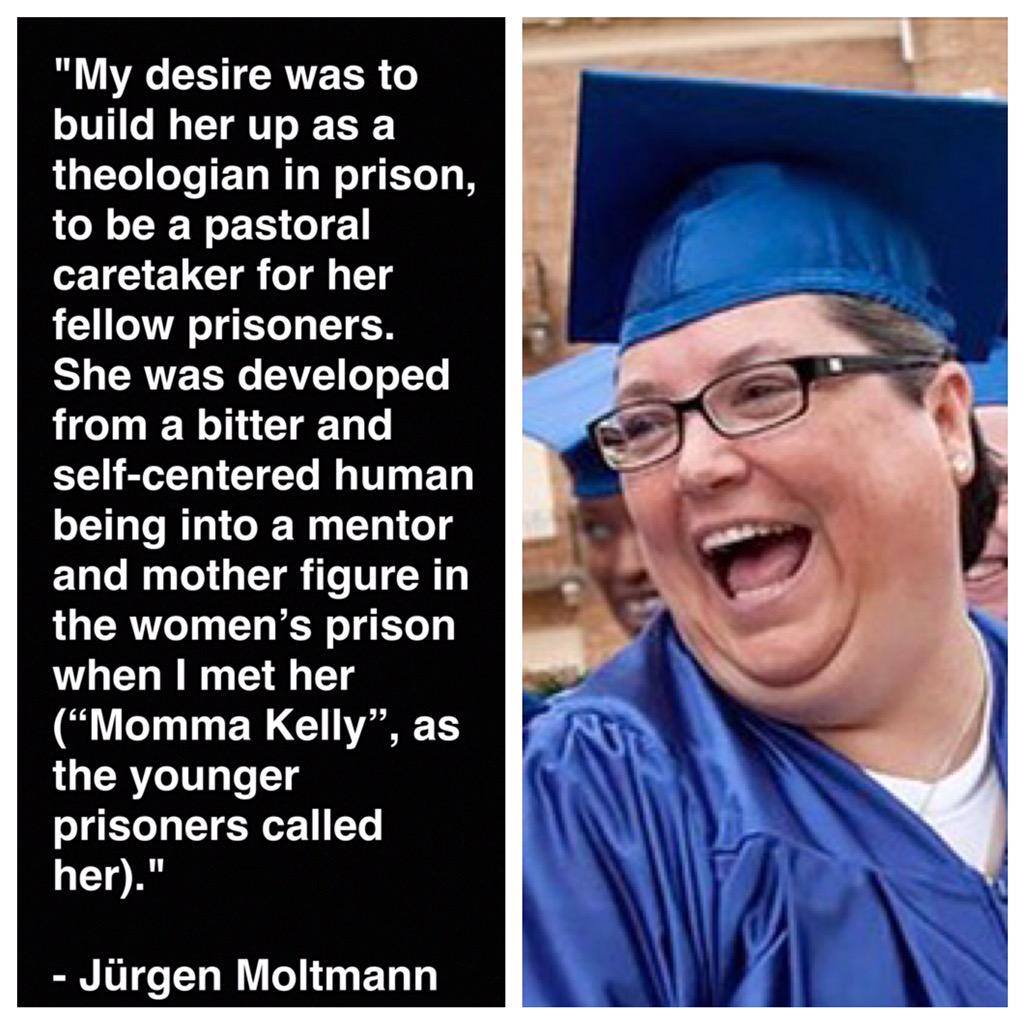
If it isn’t enough to hear from seminary professors and Christian leaders, perhaps the fact that her own children and several inmates have also born witness to the beautiful image bearer of God she had become will help. This video from Amnesty International tells powerful stories about her loving presence in prison.
And here’s one telling about how her children forgave the conspirator to murder their father:
All of this tells us that Kelly Gissendaner was transformed by God’s love. She was a positive presence in the dark world of the prison system. She became an apostle (in the loose sense of a “sent one”) to incarcerated women and she had in her backstory the desire to see her husband killed.
Paul
Interestingly, the key figure in the early Christian story, after the resurrection of Jesus, is another Apostle (in a more technical sense): Paul. St. Paul has a similar backstory to Kelly. The Acts of the Apostles* shares a telling narrative in the following way:
At this, they shrieked and covered their ears. Together, they charged at him, threw him out of the city, and began to stone him. The witnesses placed their coats in the care of a young man named Saul. As they battered him with stones, Stephen prayed, “Lord Jesus, accept my life!” Falling to his knees, he shouted, “Lord, don’t hold this sin against them!” Then he died. Saul was in full agreement with Stephen’s murder. (Acts of the Apostles 7.57 – 8.1, CEB)
Saul, who would become known as Paul, continued to spew “out murderous threats against the Lord’s disciples” (Acts of the Apostles 9.1). After adopting the way of Jesus as in continuity with his Judean Phariseeism (note: Paul never rejected his Torah following ways, but simply added Jesus as the incarnation of Israel’s God to his perspective.), he would reflect on his own violent past by saying:
You heard about my previous life in Judaism, how severely I harassed God’s church and tried to destroy it. I advanced in Judaism beyond many of my peers, because I was much more militant about the traditions of my ancestors. But God had set me apart from birth and called me through his grace. He was pleased to reveal his Son to me, so that I might preach about him to the Gentiles. I didn’t immediately consult with any human being… They only heard a report about me: “The man who used to harass us now preaches the faith that he once tried to destroy.” So they were glorifying God because of me. (Galatians 1.13-16, 23-24, CEB)
Paul, a conspirator for the destruction of innocent human lives, a man with zealous murder in his background, was transformed by the renewing love of God as revealed in his calling into the Jesus movement. This fact has been celebrated in the church for 2,000 years! Thank God for the way that Paul was changed from a murderer to an Apostle (“sent one”) to the outsiders of Judean faith: the gentiles (which simply means, the “nations”).
Kelly and Paul
In no way do I want to create a one-for-one correlation between St. Paul and Kelly Gissendaner. Paul’s violence was religiously motivated (always evil in light of Christ) and Kelly’s was motivated by other things. But, the fact is that they do have one thing in common: they both conspired to commit unthinkable murders and they both found the light of God which changed them into dramatically loving people. Certainly they were embedded within a highly different context with very different “rules.” Even so, at the end of the day we must admit that murder is the destruction of innocent life. Both of them share a guilty verdict.
We should, if we are Christians, weep over all victims from both narratives. Nothing about life-change minimizes the unjust evil of murder committed against the emerging Jesus movement in the first century or a husband and father in the 20th century. But transformation should at least cause us to question our assumptions about the near unilateral support of popular evangelicalism and the death penalty. Even many Roman Catholics support the death penalty, when it is against church teaching and the very words of the Pope. Something tied to a Western/American worldview has crept into the way we think about Christian ethics: retribution.
Just Rewards?
No one in the American church has ever said that Paul should have received his just reward: execution. He would later be executed, but not for the murder of early Jewish Christians, but for preaching an alternative worldview in confrontation of the Roman Imperial machine.
Rome crucified Jesus. Jesus exposed the folly of crucifixion by destroying the last enemy, death, but walking out of a tomb on that first Easter morning. Paul’s gospel directly upset the gospel of the Empire. If tradition is correct, this led to his death in the early 60s CE.
Even so, Paul’s past does beg the question: How would Christians today reason about Paul’s fate? Does life-change free him from the need to be killed: a life for a life? Although this is hypothetical, it seems that when a person on death row is transformed by the love of God, the typical response from many American Christians goes something like this:
That person murdered so and so. They deserve to die. Since the days of Noah, such people are supposed to be killed to protect the innocent. And great! That person, if their conversion is sincere, will die and go to heaven. But they must face the consequences for what they have done. God would see it fit to have them executed. We shouldn’t speak out against that.
But, what if execution of any kind is always wrong? The hypothetical “just reward” for Paul should be the same, at least from our perspective, as it is for anyone who has been transformed after evildoing. Kelly and Paul deserve the same. Yet, so do the other people on death row. So do all perpetrators who never feel remorse. They all deserve the same fate: dignity. Not a free pass, but the recognition that they never become less than human, thus are never forced to forfeit their humanity in death.
Retribution Isn’t Christian
We live in society obsessed with retribution. When a woman deserved to die due to the law of the land, Jesus stopped it by helping the men with stones realize that they had no right to throw them (John 8). In our system, metaphorical stones are thrown as if they are going to some how make society safer and bring healing to the victim’s loved ones. Both of these assumptions are false, and have been demonstrated as false for years now. Yet, retribution continues to get the final word. And many Christians applaud this as “justice.”
The trajectory of Scripture points us toward an alternative vision: restorative justice.** Things that have been fractured can be mended, at least in part. Every human life is precious according to this vision. Mercy trumps retribution 77 times over (Matthew 18). Love and innate human dignity trump labels and wrongdoings. Restoration, not destruction, is the will of God wherever possible.
Certainly consequences are important. Jails exist and rightfully so. They protect people from other people who choose to do wrong. They perhaps could also do much more to be spaces of rehab, but that is beside our focus for now. The point, however, is that destroying a life to demonstrate that it is wrong to destroy a life is simply giving into the cycle of retribution.
As followers of the way of Jesus, we can be reminded that he chose (amongst other things) to put his own body in the violent wake of the system of retribution: a Roman cross. Not to justify this method of torture and death, but to expose its folly and to absorb the sting of death for all humanity. And lest we forget, to conquer death through resurrection.
If we believe that Kelly, although changed, got her just reward, then perhaps we ought to have wished that upon St. Paul as well. No matter how evil the act, no human deserves to be killed, especially when they are no longer roaming free. No Christian should justify such killing as just. Instead, we should weep over all lives lost and promote a better way forward. Our attitude toward the death of another must change. This isn’t about mere politics, but about the ethics of Jesus.
Kelly did not receive what is “just,” she received vengeance. May her story inspire us to look deep into our hearts to recognize the innate value and dignity that even the worst of humanity deserves. May we become a people who look like Jesus, who offer mercy before judgment, and who carry our own cross as we place our lives in the wake of the retribution cycle of empire.
Until the day of resurrection, rest in peace Kelly, good and faithful servant of Christ.

Ann Borden, Emory Photo Video. Kelly Gissendaner is a graduate of the Certificate in Theological Studies. Graduation at Lee Arrendale State Prison, Alto, GA, 2011.
————————————————————————————–
* I realize that Acts is a dramatic narrative and isn’t “history” in the sense that a modern textbook might be, although I remain unconvinced that it has no historical value. I still believe it to be a reliable source of what basically happened during the early years of the Jesus movement.
** Anticipating the comments a bit, I realize that Romans 13 often is used to “support” the death penalty. A few thoughts. First, nothing about the passage is an endorsement on governmental policy. Paul simply names the system as it was and warns the church at Rome to beware of the consequences. The passage is about the current state of affairs, from Paul’s view, not an endorsement of the death penalty. Second, it doesn’t offer us a way to engage political theory. Paul has zero influence on the government of the Romans. He knows this. But he also knows that they must live in such a way as to not get put on their radar screen for risk of persecution. Third, the “sword” and the “church” in the passage are radically separate groups. The “sword” stuff is not the stuff that the “church” does. Fourth, go back and read Romans 12 and listen to the echoes of the Sermon on the Mount to inform your understanding of chapter 13 a bit. Here’s my take on the passage in light of nonviolence. One need not be a pacifist to name the immorality of the death penalty.
Previous Post

September 28, 2015
We Just Launched a Portable Church
Next Post

October 19, 2015 A Video that Perfectly Illustrates How Egocentric Humankind has Become
Browse Our Archives
Select a Category (Series) All Out War-Spiritual Warfare (Series) Church Plant Journal (Series) Dear Reader... (Series) Earthquakes...Signs of the Times? (Series) Entering the... Conversation (Series) Evangelical Culture Myths (Series) Everything is Meaningless [Pete Enns] (Series) Evolving Evangelicalism (Series) Hell Yes. Hell No! Who Cares? (Series) Hidden Worldviews (Series) If Evolution is Right, what about Adam? (Series) in less than 300 words (Series) Jesus and Nationalism (Series) Liberating Women for Ministry? (Series) Life-Changing Books (Series) Markers of Church Plant Movement (Series) Nonviolence 101 (Series) Philemon - Reconciliation (Series) Quote to Ponder (Series) Red Letter Dialogues (Series) Resource of the Week (SERIES) Revelation Sermons (Series) Share Something Sundays (Series) Simplicity in the Burbs: $2 a day (Series) The Binding of God [Open Theism] (Series) The Creed: Anabaptist Reflections (Series) Values for Church Leadership (Series) Video to Ponder Anabaptism Animal Advocacy Books Church Ministry Church Planting Community Culture Eschatology Eucharist Evangelical Reject Evolution Fundamentalism Greek Greg Boyd Guest Contributors Hell Holy Spirit Israel/Palestine Kingdom of God Lent Missional N. T. Wright Nationalism New Creation Nonviolence Open Mic Open Theism Parenting Passover Paul Philemon Podcast Politics Restorative Justice Revelation (the book of) Rob Bell Ron Martoia Sermon Shane Claiborne Social Justice Speaking Engagement Spiritual Warfare Spirituality Temple Theology Tim Geddert Tribulation Uncategorized universalism Video Blog Women in Ministry Worship Music Youth Ministry
Select a Month August 2018 July 2018 June 2018 May 2018 April 2018 March 2018 February 2018 January 2018 December 2017 October 2017 July 2017 June 2017 May 2017 April 2017 December 2016 October 2016 August 2016 June 2016 May 2016 April 2016 March 2016 December 2015 November 2015 October 2015 September 2015 August 2015 June 2015 May 2015 April 2015 March 2015 February 2015 January 2015 December 2014 November 2014 October 2014 September 2014 August 2014 July 2014 June 2014 May 2014 April 2014 March 2014 February 2014 January 2014 December 2013 November 2013 October 2013 September 2013 August 2013 June 2013 May 2013 April 2013 March 2013 February 2013 January 2013 December 2012 November 2012 October 2012 September 2012 August 2012 July 2012 June 2012 May 2012 April 2012 March 2012 February 2012 January 2012 December 2011 November 2011 October 2011 September 2011 August 2011 July 2011 June 2011 May 2011 April 2011 March 2011 February 2011 January 2011 December 2010 November 2010 September 2010 August 2010 July 2010 June 2010 May 2010 April 2010 March 2010 February 2010 January 2010 October 2009 September 2009 August 2009 July 2009 June 2009 May 2009 April 2009 March 2009 February 2009 January 2009 December 2008 November 2008 October 2008 September 2008 August 2008 June 2008 May 2008 April 2008
Follow Us!
TAKE THE
Religious Wisdom Quiz
A hand wrote on the palace wall during a feast, and I interpreted the message: numbered, weighed, divided. What were these three Aramaic words?
Select your answer to see how you score.
Holy, Holy, Holy Ichabod, Ebenezer, Beulah Babylon, Media, Persia Mene, Mene, Tekel, Parsin
Support this
Column


Related posts from The Pangea Blog

What is the Kingdom of God? (with Frank...

10 Years Ago, I Embraced Nonviolence & Anabaptism

Romans 13 Doesn't Give Government an Ethical Blank...

Does God plan everything that happens? (4 Views)
TRENDING AT PATHEOS Progressive Christian

What Being a Modern-Day Apostle Means to Me
In my last column, I discussed the ins and outs of modern-day...

Did Ancient China Once Worship the God of...
Across human history, a common thread weaves through the origins of the...

Love Your Neighbor – Including Earth-Kin: Lev. 19,...
God’s command to love your neighbor means acting in an ethical and...

Lead a Church Study of “Jesus and Lao...
Guest writer Jack Thomas (The Irreverent Reverend) reflects on leading his church...

Pastoral Wisdom for Responding to Sermon Pushback
Getting sermon pushback on your social justice sermon? Learn practical, Proverbs-based strategies...

Principles for Understanding the Apostolic Ministry Today
Whenever people discover that my formal ministry title is "apostle," as in...
view all Progressive Christian blogs
Ad-Free & Subscriber Log-In Subscription Support
- About Us
- 2026 Calendar
- Videos
- Podcasts
- Library of World Religions
- Faith In Media Tracker
- Advertise With Us
- Write for Us
- Privacy Policy
- Terms of Service
- Do Not Sell My Data
- Contact Us
- Radiant Digital
- Manage Newsletter Subscriptions
- Unsubscribe From Notifications
- Sitemap
Copyright 2008-2026, Patheos. All rights reserved.
Subscription Support Ad-Free & Subscriber Log-In
Follow Patheos