
BuddhistCatholicContemplativeEvangelicalGeneral ChristianHinduJewishLatter-day SaintMuslimNew VisionsProgressive Christian
Beliefs
- Buddhist
- Catholic
- Contemplative
- Evangelical
- General Christian
- Hindu
- Jewish
- Latter-day Saint
- More Voices
- Muslim
- New Visions
- Pagan
- Progressive Christian
Topics
- Religion News
- Food and Religion
- Sports and Religion
- Religious Art
- Religious Music and Entertainment
- Religious Events
- History and Religion
- Style and Religion
- Politics and Religion
- Women in Religion
- Recreation Outdoors and Religion
- Business Finance and Religion
- Careers Workplace and Religion
- Education and Religion
- Family Parenting and Religion
- Health Fitness and Religion
- Home and Religion
- Relationships and Religion
- Technology and Religion
- Travel and Religion
Columnists
- Buddhist Columnists
- Business Finance and Religion Columnists
- Careers Workplace and Religion Columnists
- Catholic Columnists
- Contemplative Columnists
- Education and Religion Columnists
- Evangelists Columnists
- Family Parenting and Religion Columnists
- General Christian Columnists
- Health Fitness and Religion Columnists
- Hindu Columnists
- History and Religion Columnists
- Home and Religion Columnists
- Jewish Columnists
- More Voices Columnists
- Latter Day Columnists
- Muslim Columnists
- New Visions Columnists
- Nonreligious Columnists
- Pagan Columnists
- Politics and Religion Columnists
- Progressive Columnists
- Recreation Outdoors and Religion Columnists
- Relationships and Religion Columnists
- Religion News Columnists
- Religious Art Columnists
- Religious Events Columnists
- Religious Music and Entertainment Columnists
- Sports and Religion Columnists
- Style and Religion Columnists
- Technology and Religion Columnists
- Travel and Religion Columnists
- Women in Religion Columnists
Resource Library
- 2026 Calendar
- Library of World Religions
- The 100 Most Holy Places on Earth
- Patheos Answers
- Podcasts
- Videos
- Faith Leaders Database
- Anglican Episcopalian
- Bahai
- Baptist
- Buddhism
- Christianity
- Confucianism
- Eastern Orthodoxy
- Hinduism
- Holiness and Pentecostal
- ISKCON
- Islam
- Judaism
- Lutheran
- Methodist
- The Church of Jesus Christ of Latter-day Saints
- New Age
- Paganism
- Presbytarian and Reformed
- Protestantism
- Religion Behind the Scenes
- Roman Catholic
- Scientology
- Shia Islam
- Sikhism
- Sufism
- Sunni Islam
- Taoism
- Zen
- See all religions
Research Tools
 Ad-Free & Subscriber Log-In Subscription Support
Ad-Free & Subscriber Log-In Subscription Support
Follow Patheos 

- Trending:
- Forgiveness
- |
- Marriage
- |
- Consciousness
- |
- Death Penalty
- |
- Election
- |
- Halloween
 The Pangea Blog
- Home
- Progressive Christian
- Politicized Christology in Christianized Politics: “Constantinianism” of “Right” and “Left”
Politicized Christology in Christianized Politics: “Constantinianism” of “Right” and “Left”
Last updated on: March 17, 2015 at 6:00 am by Kurt Willems
Politicized Christology in Christianized Politics: “Constantinianism” of “Right” and “Left” 2015-03-14T12:41:03-07:00 Kurt Willems
Patheos Explore the world's faith through different perspectives on religion and spirituality! Patheos has the views of the prevalent religions and spiritualities of the world.
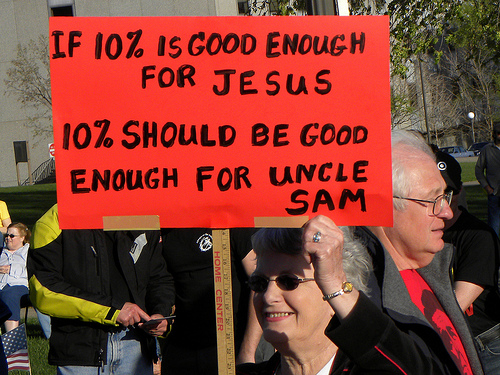
Flickr: CreativeCommons 2.0
This is a guest post to get us thinking about political discourse as Christians. Thanks to Darrin W. Snyder Belousek for this great guest submission!
————————————
In a recent essay at The Week, Damon Linker responds to several writers in First Things who lament the triumph of “secular liberalism” and the demise of “civic Christianity” in American politics, evidenced acutely by the (anticipated) victory of same-sex marriage in the arena of constitutional law at the Supreme Court. Linker writes:
“I’d like to suggest that they should get over it — that, rightly understood, Christianity can be most fully itself when it relinquishes political and cultural rule, when it ceases to identify itself so closely with any particular political order…
“It is a perennial Christian temptation — one growing out of that most distinctively Christian doctrine, the bodily incarnation of God — to sanctify (and to see God embodied in) the political order that prevails at any given moment of history.”
I agree with the overall trajectory and tenor of Linker’s argument—not because I am a theological liberal who is skeptical of the church’s ethical teaching, but precisely because I am an orthodox confessing Christian. The quest to see Christ embodied in a particular political order, which has been dubbed “Constantinianism” by theologians, should be seen as a distortion of Christianity.
That said, I think Linker’s analysis does not go deep enough. He writes:
“Whether in the Middle Ages or the contemporary United States, it is a betrayal of Christian ideals to give in to the incarnational temptation. In mistaking one particular political community for the city of God that always lies beyond any earthly city, it makes eventual disappointment inevitable.”
Linker’s critique, which echoes Augustine, is correct as far as it goes. His Augustinian critique, however, needs to be supplemented with (if you will) an Ephesian and Athanasian critique. Yielding to the “incarnational temptation” gives way not only to political disappointment but also to ecclesiological corruption, soteriological deviance, missiological confusion, and, ultimately, Christological error.
First, Constantinianism points toward a corrupted form of the church: if Christ can be embodied in a particular political order, then the politeia (political community) can supplant the ekklesia (church community) as the unique sacrament in and through which the soma Christou (body of Christ) is fully present in history (cf. Ephesians 1).
Second, Constantinianism suggests a deviant doctrine of salvation: if Christ can be embodied in a particular political order, then we can make salvation for ourselves through works by the accomplishments of our activism or by identifying with our causes rather than receive salvation from God through faith by the grace and peace of the cross (cf. Ephesians 2).
Third, Constantinianism leads to a confused mode of mission: if Christ can be embodied in a particular political order, then the church can fulfill its commission to make known “the wisdom of God” by promoting our “agenda for America” rather than proclaiming “the mystery of Christ” revealed through the gospel (cf. Ephesians 3).
Ultimately, Constantinianism requires an erroneous doctrine of Christ. In the 4th C. Christological debate surrounding the Council of Nicaea, it was not the “high” Christology of Athanasius (the Son is eternally begotten of the Father and so ontologically equal with the Father and ontologically superior to all creation) but rather the “low” Christology of Arius (the Son is the firstborn of creatures and thus ontologically equal to creation and ontologically subordinate to the Father) that was amenable to Constantinianism (the sanctification of the imperial order a la Eusebius).
If, on the one hand, Christ is “begotten not made” and so has eternal supremacy over all creation (per the Nicene Creed), then Christ as Lord stands in judgment over every political order such that no political order within creation can ever claim to instantiate the reign of Christ. Every political order within creation necessarily falls short of Christ’s reign precisely because Christ, though incarnate, is no mere creature—and thus no mere creature, not even the highest of the “rulers and authorities,” can ever share the place of Christ as Lord of all. Thus, the “high” Christology of the Nicene Creed is actually anti-Constantinian at the same time as it is anti-Arian.
If, on the other hand, we seek to merge the rule of Caesar with the reign of Christ and so sanctify the rule of Caesar as the will of God (per Constantinianism), because we cannot credibly elevate Caesar to the status of Christ (“begotten”), then we must demote Christ to the status of Caesar (“made”). Thus, the Constantinian project requires that we make Christ a creature elevated by God to first status in creation under God, parallel to Caesar a creature elevated by God to second status in creation under Christ, so that we can then link the throne of Caesar with the throne of Christ. That is, Constantinian politics requires an Arian Christology.
The irony here is that conservative Christians who would otherwise insist on maintaining doctrinal orthodoxy, by desiring to see Christ embodied in American politics might actually be (unintentionally) tinkering with a new-age variant of ancient heresy.
An even bigger irony, in my view, is that I see much the same coming from American Christians on the political left, including some “social action” Evangelicals and “peace-and-justice” Anabaptists, many of whom see themselves as opposing the “theocratic” tendencies of the Christian “right.” Many on the Christian “left” seek to directly translate (their interpretation of) the gospel into progressive policies and thereby effectively reduce Jesus to liberal ideals (“tolerance,” “inclusion,” etc.). Accordingly, we often hear from the Christian “left” claims of this form: “Jesus was for <fill in liberal ideal>, therefore we should support <fill in progressive policy>.” Consequently, when the Christian “left” is faced with skepticism from other Christians, we often hear responses to this effect: “If you don’t support policy X, then you are not a true follower of Jesus.
The Christian “right” and the Christian “left” of American politics are BOTH susceptible to variants of Constantinianism, whenever either implicitly identifies the success of its political agenda with the furtherance of Christ’s reign. In doing so, each in its own way reduces Christ to a particular set of political norms and thus each in its own way is a variant of Arian Christology. The common implication of both “right” and “left” variants of Constantinianism is that, because Christ is reduced to a particular set of political norms, Christ no longer has eternal supremacy over every political order and thus cannot stand in judgment over those particular norms. Having reduced Christ to politics, many American Christians on the political left cannot imagine Christ standing in judgment over its vision of “social progress” the same as many American Christians on the political right cannot imagine Christ standing in judgment over its vision of “American power.” To put it succinctly: Christ the Lord is reduced to Christ the partisan.
Orthodox Christianity rejects every politicized Christology that would demote Christ from Lord over every political order into a partisan of this or that set of political norms. Christians, as “Christ-like ones,” should take a critical stance toward every political order, especially if it claims to be “Christian.”
So, if you cannot imagine Jesus passing judgment on your favored political agenda (whether of the “right” or of the “left”), then you just might be a new-age Arian after all.
—————————————————————————
Darrin W. Snyder Belousek teaches philosophy and religion at Ohio Northern University and is the author most recently of The Road That I Must Walk: A Disciple’s Journey (Cascade Books 2014).
Previous Post

March 16, 2015
Rethinking Hell Conference at Fuller Seminary
Browse Our Archives
Select a Category (Series) All Out War-Spiritual Warfare (Series) Church Plant Journal (Series) Dear Reader... (Series) Earthquakes...Signs of the Times? (Series) Entering the... Conversation (Series) Evangelical Culture Myths (Series) Everything is Meaningless [Pete Enns] (Series) Evolving Evangelicalism (Series) Hell Yes. Hell No! Who Cares? (Series) Hidden Worldviews (Series) If Evolution is Right, what about Adam? (Series) in less than 300 words (Series) Jesus and Nationalism (Series) Liberating Women for Ministry? (Series) Life-Changing Books (Series) Markers of Church Plant Movement (Series) Nonviolence 101 (Series) Philemon - Reconciliation (Series) Quote to Ponder (Series) Red Letter Dialogues (Series) Resource of the Week (SERIES) Revelation Sermons (Series) Share Something Sundays (Series) Simplicity in the Burbs: $2 a day (Series) The Binding of God [Open Theism] (Series) The Creed: Anabaptist Reflections (Series) Values for Church Leadership (Series) Video to Ponder Anabaptism Animal Advocacy Books Church Ministry Church Planting Community Culture Eschatology Eucharist Evangelical Reject Evolution Fundamentalism Greek Greg Boyd Guest Contributors Hell Holy Spirit Israel/Palestine Kingdom of God Lent Missional N. T. Wright Nationalism New Creation Nonviolence Open Mic Open Theism Parenting Passover Paul Philemon Podcast Politics Restorative Justice Revelation (the book of) Rob Bell Ron Martoia Sermon Shane Claiborne Social Justice Speaking Engagement Spiritual Warfare Spirituality Temple Theology Tim Geddert Tribulation Uncategorized universalism Video Blog Women in Ministry Worship Music Youth Ministry
Select a Month August 2018 July 2018 June 2018 May 2018 April 2018 March 2018 February 2018 January 2018 December 2017 October 2017 July 2017 June 2017 May 2017 April 2017 December 2016 October 2016 August 2016 June 2016 May 2016 April 2016 March 2016 December 2015 November 2015 October 2015 September 2015 August 2015 June 2015 May 2015 April 2015 March 2015 February 2015 January 2015 December 2014 November 2014 October 2014 September 2014 August 2014 July 2014 June 2014 May 2014 April 2014 March 2014 February 2014 January 2014 December 2013 November 2013 October 2013 September 2013 August 2013 June 2013 May 2013 April 2013 March 2013 February 2013 January 2013 December 2012 November 2012 October 2012 September 2012 August 2012 July 2012 June 2012 May 2012 April 2012 March 2012 February 2012 January 2012 December 2011 November 2011 October 2011 September 2011 August 2011 July 2011 June 2011 May 2011 April 2011 March 2011 February 2011 January 2011 December 2010 November 2010 September 2010 August 2010 July 2010 June 2010 May 2010 April 2010 March 2010 February 2010 January 2010 October 2009 September 2009 August 2009 July 2009 June 2009 May 2009 April 2009 March 2009 February 2009 January 2009 December 2008 November 2008 October 2008 September 2008 August 2008 June 2008 May 2008 April 2008
Follow Us!
TAKE THE
Religious Wisdom Quiz
What nation captured Jerusalem and took Daniel captive?
Select your answer to see how you score.
Egypt Assyria Babylonia Persia
Support this
Column


Related posts from The Pangea Blog

What is the Kingdom of God? (with Frank...

10 Years Ago, I Embraced Nonviolence & Anabaptism

God for Guns: A Christian Response to Yet...
Jesus' Radical Kingdom Reformation within Judaism (and some...
TRENDING AT PATHEOS Progressive Christian

What Being a Modern-Day Apostle Means to Me
In my last column, I discussed the ins and outs of modern-day...

Did Ancient China Once Worship the God of...
Across human history, a common thread weaves through the origins of the...

Love Your Neighbor – Including Earth-Kin: Lev. 19,...
God’s command to love your neighbor means acting in an ethical and...

Lead a Church Study of “Jesus and Lao...
Guest writer Jack Thomas (The Irreverent Reverend) reflects on leading his church...

Pastoral Wisdom for Responding to Sermon Pushback
Getting sermon pushback on your social justice sermon? Learn practical, Proverbs-based strategies...

Principles for Understanding the Apostolic Ministry Today
Whenever people discover that my formal ministry title is "apostle," as in...
view all Progressive Christian blogs
Ad-Free & Subscriber Log-In Subscription Support
- About Us
- 2026 Calendar
- Videos
- Podcasts
- Library of World Religions
- Faith In Media Tracker
- Advertise With Us
- Write for Us
- Privacy Policy
- Terms of Service
- Do Not Sell My Data
- Contact Us
- Radiant Digital
- Manage Newsletter Subscriptions
- Unsubscribe From Notifications
- Sitemap
Copyright 2008-2026, Patheos. All rights reserved.
Subscription Support Ad-Free & Subscriber Log-In
Follow Patheos