
BuddhistCatholicContemplativeEvangelicalGeneral ChristianHinduJewishLatter-day SaintMuslimNew VisionsProgressive Christian
Beliefs
- Buddhist
- Catholic
- Contemplative
- Evangelical
- General Christian
- Hindu
- Jewish
- Latter-day Saint
- More Voices
- Muslim
- New Visions
- Pagan
- Progressive Christian
Topics
- Religion News
- Food and Religion
- Sports and Religion
- Religious Art
- Religious Music and Entertainment
- Religious Events
- History and Religion
- Style and Religion
- Politics and Religion
- Women in Religion
- Recreation Outdoors and Religion
- Business Finance and Religion
- Careers Workplace and Religion
- Education and Religion
- Family Parenting and Religion
- Health Fitness and Religion
- Home and Religion
- Relationships and Religion
- Technology and Religion
- Travel and Religion
Columnists
- Buddhist Columnists
- Business Finance and Religion Columnists
- Careers Workplace and Religion Columnists
- Catholic Columnists
- Contemplative Columnists
- Education and Religion Columnists
- Evangelists Columnists
- Family Parenting and Religion Columnists
- General Christian Columnists
- Health Fitness and Religion Columnists
- Hindu Columnists
- History and Religion Columnists
- Home and Religion Columnists
- Jewish Columnists
- More Voices Columnists
- Latter Day Columnists
- Muslim Columnists
- New Visions Columnists
- Nonreligious Columnists
- Pagan Columnists
- Politics and Religion Columnists
- Progressive Columnists
- Recreation Outdoors and Religion Columnists
- Relationships and Religion Columnists
- Religion News Columnists
- Religious Art Columnists
- Religious Events Columnists
- Religious Music and Entertainment Columnists
- Sports and Religion Columnists
- Style and Religion Columnists
- Technology and Religion Columnists
- Travel and Religion Columnists
- Women in Religion Columnists
Resource Library
- 2026 Calendar
- Library of World Religions
- The 100 Most Holy Places on Earth
- Patheos Answers
- Podcasts
- Videos
- Faith Leaders Database
- Anglican Episcopalian
- Bahai
- Baptist
- Buddhism
- Christianity
- Confucianism
- Eastern Orthodoxy
- Hinduism
- Holiness and Pentecostal
- ISKCON
- Islam
- Judaism
- Lutheran
- Methodist
- The Church of Jesus Christ of Latter-day Saints
- New Age
- Paganism
- Presbytarian and Reformed
- Protestantism
- Religion Behind the Scenes
- Roman Catholic
- Scientology
- Shia Islam
- Sikhism
- Sufism
- Sunni Islam
- Taoism
- Zen
- See all religions
Research Tools
 Ad-Free & Subscriber Log-In Subscription Support
Ad-Free & Subscriber Log-In Subscription Support
Follow Patheos 

- Trending:
- Forgiveness
- |
- Marriage
- |
- Consciousness
- |
- Death Penalty
- |
- Election
- |
- Halloween
 The Pangea Blog
- Home
- Progressive Christian
- We Refuse to be Enemies: The Next Dr. King or Gandhi lives in Palestine
We Refuse to be Enemies: The Next Dr. King or Gandhi lives in Palestine
Last updated on: May 6, 2014 at 5:27 pm by Kurt Willems
We Refuse to be Enemies: The Next Dr. King or Gandhi lives in Palestine 2014-05-06T17:27:45-07:00 Kurt Willems
Patheos Explore the world's faith through different perspectives on religion and spirituality! Patheos has the views of the prevalent religions and spiritualities of the world.
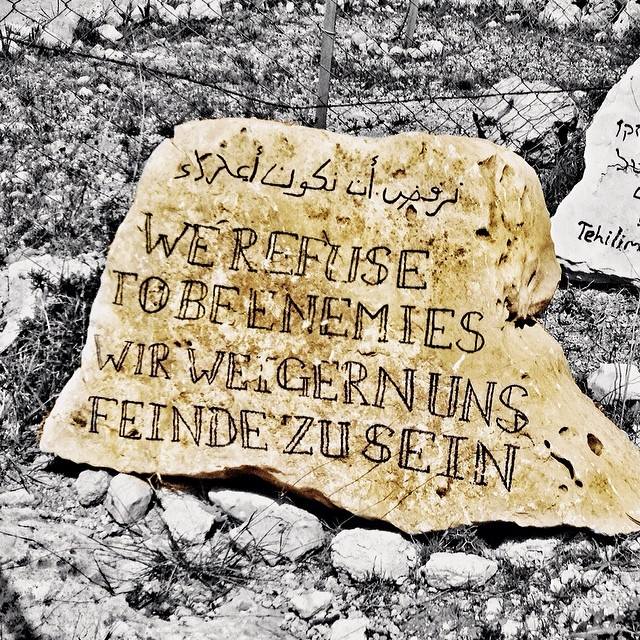
Over the past couple of months I’ve occasionally posted my reflections from an experience I had with The Global Immersion Project. If you want to read other reflections, check out: “A Land Without a People for a People without a Land?” or “The Art of Resistance: Bansky, Memory, & Hope.” I should simply add that TGIP continues to make an impact on my life, both my personal reflections and my guidance of our new church. In fact, I hope to take another trip with TGIP in the near-future. This trip would primarily be for leaders within my faith community, but would involve a few others as well. All of that to say: if you want to visit the Holy Land and if you want training in active peacemaking – TGIP is THE organization to go with!
————————————————————————————-
The next Dr. King or Gandhi lives in Palestine.
One of the peacemakers that we got to know on our trip to Israel/Palestine was Daoud Nasser. His family has owned the same hill in the West Bank since 1916! In fact, this is the last Palestinian owned hill – anywhere. They have the ownership papers to prove it, traced back all the way to the Ottoman Empire. As a result, they have been in court with Israel since 1991. Through seasons of persecution: military vehicles coming on the property bearing a threatening presence, Israeli settlers coming with guns and acting out in violence, olive trees being torn down, being unable to get building permits and running water, and more – they have maintained this slogan:
We refuse to be enemies.
-Tent of Nations
They are, in a beautiful sense, what Jesus was getting at when he talked about “a city on a hill” by refusing hatred and instead choosing to “love [their] enemies.” With this beautiful gift of the hill, they house an organization called Tent of Nations. Among several ministries, Tent of Nations teaches about peacemaking, hosts creative camps for children, cultivates the land through eco-friendly means, and develops methods for harnessing power and water since the government refuses to give them access to such necessities. On top of this, when they are persecuted they choose to go through the legal system – tilted against them – to humbly expose injustice while loving their oppressors! They model something that Jesus clearly taught in the Sermon on the Mount: that enemy love is central to the message of the Kingdom of God. For Daoud and his family, how they react to persecution reflects the God that they serve. The Sermon on the Mount is a source for funding their imagination.
Options for Responding to Oppression
In Matthew 5, Jesus declares that the peacemakers are “blessed” (fortunate or happy). Later in verse 38 we are given the Hebrew Bible command “eye for eye, and tooth for tooth.” It is commonly noted that such a law was a preventative measure to ensure that punishment was proportional to the crime, and no more.[1] “Where the Torah restricts retaliation, Jesus forbids it all together.”[2] This is clear by his exhortation that disciples are called to “not resist an evil person.” Is Jesus saying that one must not resist at all?
For Palestinian people, they have had several responses to the situation under the Israeli Occupation. One option is to embrace that the only hope left is violence. But, as I’ve heard Daoud say in person: “Violence only creates more violence.” The second group chooses a posture of victimhood. They see no options beyond their despair and are rendered passive. The third group, many of whom are part of the Christian minority, find ways to leave the country so that they have a chance at a better life. But, in leaving, they escape a situation that might be made better by their presence. This is where Daoud and his family come in. Inspired by Jesus and the early church, and secondarily by Dr. Martin Luther King Jr. and Gandhi, they are choosing a path that cuts through passivity and violence: nonviolent resistance. This is, from what I can tell, the New Testament model of resisting injustice, occupation (lest we forget that Israel was also Occupied in Jesus’ day by an oppressor), and violence.
It is interesting to note that the Ancient Greek (the language the New Testament was originally written in) word for not resisting is: ἀντιστῆναι (antistēnai). The way that this word is translated in Matthew 5.39 (“Do not resist an evildoer”) gives the impression that any form of resistance is unacceptable. If this is indeed the case, then nonresistance is the more faithful term to describe the New Testament position against violence. But, Jesus chose a specific word that has a deeper meaning than is often attributed to it. Walter Wink helpfully points out that “antistēnai… means to resist violently, to revolt or rebel, to engage in an armed insurrection.”[3] So, to be clear, Jesus is using a word that means resisting through violent means and negating it! This differs from a passive posture but simultaneously forbids using dehumanizing violence.
Support for this translation is not unwarranted as antistēnai is the word repeatedly used in the Greek version of the Hebrew Bible as “warfare” and is also used in Ephesians 6.13 in the context of active military imagery.[4] In the famous “armor of God” passage the rhetoric clearly indicates an offensive military-like “stand” that is able to both pursue and undo the works of the powers of evil.[5] Wink’s argument is further affirmed by N.T. Wright who translates verse 39 in the following way: “But I say to you: don’t use violence to resist evil!”[6] Jesus “is telling us to transcend both passivity and violence by finding a third way, one that is at once assertive yet nonviolent.”[7] Daoud and the Tent of Nations exemplify this approach!
Jesus invites his followers to choose nonviolence in a world of violence. This may seem irrational for some, but it is one of the central aspects of what it means to be a disciple. He takes it further than nonviolent resistance when he also invites us to “love your enemies” or as Tent of Nations says: “We refuse to be enemies.” Peace means that we become a people who love everyone, even the people we might be inclined to hate. Tent of Nations models this for the world to see. They are a “city on a hill” that “cannot be hidden” (Matt. 5.14) – which is especially true now when 50,000 Israeli settlers surround them.
Peacemaking: From Abstract Controversy to Concrete Realism
For us (or at least me) in the USA, the concept of enemies is often hard to grasp. We may spend our time arguing about whether or not Jesus actually taught absolute nonviolence or if it was some sort of “ideal” versus the “real.” It gets even more complex as we start our conversations from the worst case scenarios (What about a rapist attacking your wife? What about Hitler?) and then work our way up toward the biblical text rather than starting with Jesus’ own words and letting that inform our normative understanding of his teaching. Even more, when we don’t deal with real flesh and blood enemies on a daily basis it’s easy to leave these difficult conversations in the clouds of theory.
For Daoud Nasser, this isn’t an option. For him, choosing the nonviolent resistance model of Jesus and loving his enemies is a concrete practice.This, of course begs a question: What if we simply started experimenting with peacemaking (or perhaps an easier word to grasp that isn’t so controversial theologically is reconciliation) in our neighborhoods and cities? I think this is one thing that Daoud’s example invites us into, and this is certainly what I learned during my total time with The Global Immersion Project (I’ll say more about this in later posts). Perhaps how this Palestinian Gandhi or Dr. King beckons us to respond is by choosing to see how we can be agents of reconciliation in tangible ways. This starts by seeing that conflict is all around us and by believing that a better way is possible – for the Palestinian people and for us, wherever we live.
The next Dr. King or Gandhi lives in Palestine, but what if the next Dr. King/Gandhi also lives in your neighborhood? Perhaps it will also be you.
Two Videos to Check Out:
The Tent of Nations from Christ at the Checkpoint on Vimeo.
Love Your Enemies from The Austin Stone on Vimeo.
[1] Richard B. Hays, The Moral Vision of the New Testament: Community, Cross, New Creation: A Contemporary Introduction to New Testament Ethics (San Francisco: HarperSanFrancisco, 1996), 324.
[2] Ibid., 325.
[3] Walter Wink, The Powers That Be: Theology for a New Millennium (New York: Doubleday, 1998), 100.
[4] Ibid.
[5] Thomas Yoder-Neufeld, Ephesians, Believers Church Bible Commentary (Scottdale, PA: Herald Press, 2002), 294-95.
[6] Tom Wright, Matthew for Everyone, 1 (Louisville, KY: Westminster John Knox Press, 2004), 49.
[7] Wink, The Powers That Be: Theology for a New Millennium, 101.
Previous Post

May 6, 2014
5 Church-Types to Probably NOT Avoid, but Embrace
Next Post

May 8, 2014 When you are Pissed Off, Put that Energy Elsewhere
Browse Our Archives
Select a Category (Series) All Out War-Spiritual Warfare (Series) Church Plant Journal (Series) Dear Reader... (Series) Earthquakes...Signs of the Times? (Series) Entering the... Conversation (Series) Evangelical Culture Myths (Series) Everything is Meaningless [Pete Enns] (Series) Evolving Evangelicalism (Series) Hell Yes. Hell No! Who Cares? (Series) Hidden Worldviews (Series) If Evolution is Right, what about Adam? (Series) in less than 300 words (Series) Jesus and Nationalism (Series) Liberating Women for Ministry? (Series) Life-Changing Books (Series) Markers of Church Plant Movement (Series) Nonviolence 101 (Series) Philemon - Reconciliation (Series) Quote to Ponder (Series) Red Letter Dialogues (Series) Resource of the Week (SERIES) Revelation Sermons (Series) Share Something Sundays (Series) Simplicity in the Burbs: $2 a day (Series) The Binding of God [Open Theism] (Series) The Creed: Anabaptist Reflections (Series) Values for Church Leadership (Series) Video to Ponder Anabaptism Animal Advocacy Books Church Ministry Church Planting Community Culture Eschatology Eucharist Evangelical Reject Evolution Fundamentalism Greek Greg Boyd Guest Contributors Hell Holy Spirit Israel/Palestine Kingdom of God Lent Missional N. T. Wright Nationalism New Creation Nonviolence Open Mic Open Theism Parenting Passover Paul Philemon Podcast Politics Restorative Justice Revelation (the book of) Rob Bell Ron Martoia Sermon Shane Claiborne Social Justice Speaking Engagement Spiritual Warfare Spirituality Temple Theology Tim Geddert Tribulation Uncategorized universalism Video Blog Women in Ministry Worship Music Youth Ministry
Select a Month August 2018 July 2018 June 2018 May 2018 April 2018 March 2018 February 2018 January 2018 December 2017 October 2017 July 2017 June 2017 May 2017 April 2017 December 2016 October 2016 August 2016 June 2016 May 2016 April 2016 March 2016 December 2015 November 2015 October 2015 September 2015 August 2015 June 2015 May 2015 April 2015 March 2015 February 2015 January 2015 December 2014 November 2014 October 2014 September 2014 August 2014 July 2014 June 2014 May 2014 April 2014 March 2014 February 2014 January 2014 December 2013 November 2013 October 2013 September 2013 August 2013 June 2013 May 2013 April 2013 March 2013 February 2013 January 2013 December 2012 November 2012 October 2012 September 2012 August 2012 July 2012 June 2012 May 2012 April 2012 March 2012 February 2012 January 2012 December 2011 November 2011 October 2011 September 2011 August 2011 July 2011 June 2011 May 2011 April 2011 March 2011 February 2011 January 2011 December 2010 November 2010 September 2010 August 2010 July 2010 June 2010 May 2010 April 2010 March 2010 February 2010 January 2010 October 2009 September 2009 August 2009 July 2009 June 2009 May 2009 April 2009 March 2009 February 2009 January 2009 December 2008 November 2008 October 2008 September 2008 August 2008 June 2008 May 2008 April 2008
Follow Us!
TAKE THE
Religious Wisdom Quiz
Who prophesied about the birth of Jesus in the Old Testament?
Select your answer to see how you score.
Jeremiah Ezekiel Isaiah Daniel
Support this
Column


Related posts from The Pangea Blog

10 Years Ago, I Embraced Nonviolence & Anabaptism

God for Guns: A Christian Response to Yet...
Jesus' Radical Kingdom Reformation within Judaism (and some...

Value All Human Life: From the Womb to...
TRENDING AT PATHEOS Progressive Christian

Why Christians Have a Sacred Duty to Vote:...
The Bible offers strong support for the sacred duty to vote. Here...

What Being a Modern-Day Apostle Means to Me
In my last column, I discussed the ins and outs of modern-day...

Did Ancient China Once Worship the God of...
Across human history, a common thread weaves through the origins of the...

Love Your Neighbor – Including Earth-Kin: Lev. 19,...
God’s command to love your neighbor means acting in an ethical and...

Lead a Church Study of “Jesus and Lao...
Guest writer Jack Thomas (The Irreverent Reverend) reflects on leading his church...

Principles for Understanding the Apostolic Ministry Today
Whenever people discover that my formal ministry title is "apostle," as in...
view all Progressive Christian blogs
Ad-Free & Subscriber Log-In Subscription Support
- About Us
- 2026 Calendar
- Videos
- Podcasts
- Library of World Religions
- Faith In Media Tracker
- Advertise With Us
- Write for Us
- Privacy Policy
- Terms of Service
- Do Not Sell My Data
- Contact Us
- Radiant Digital
- Manage Newsletter Subscriptions
- Unsubscribe From Notifications
- Sitemap
Copyright 2008-2026, Patheos. All rights reserved.
Subscription Support Ad-Free & Subscriber Log-In
Follow Patheos