
BuddhistCatholicContemplativeEvangelicalGeneral ChristianHinduJewishLatter-day SaintMuslimNew VisionsProgressive Christian
Beliefs
- Buddhist
- Catholic
- Contemplative
- Evangelical
- General Christian
- Hindu
- Jewish
- Latter-day Saint
- More Voices
- Muslim
- New Visions
- Pagan
- Progressive Christian
Topics
- Religion News
- Food and Religion
- Sports and Religion
- Religious Art
- Religious Music and Entertainment
- Religious Events
- History and Religion
- Style and Religion
- Politics and Religion
- Women in Religion
- Recreation Outdoors and Religion
- Business Finance and Religion
- Careers Workplace and Religion
- Education and Religion
- Family Parenting and Religion
- Health Fitness and Religion
- Home and Religion
- Relationships and Religion
- Technology and Religion
- Travel and Religion
Columnists
- Buddhist Columnists
- Business Finance and Religion Columnists
- Careers Workplace and Religion Columnists
- Catholic Columnists
- Contemplative Columnists
- Education and Religion Columnists
- Evangelists Columnists
- Family Parenting and Religion Columnists
- General Christian Columnists
- Health Fitness and Religion Columnists
- Hindu Columnists
- History and Religion Columnists
- Home and Religion Columnists
- Jewish Columnists
- More Voices Columnists
- Latter Day Columnists
- Muslim Columnists
- New Visions Columnists
- Nonreligious Columnists
- Pagan Columnists
- Politics and Religion Columnists
- Progressive Columnists
- Recreation Outdoors and Religion Columnists
- Relationships and Religion Columnists
- Religion News Columnists
- Religious Art Columnists
- Religious Events Columnists
- Religious Music and Entertainment Columnists
- Sports and Religion Columnists
- Style and Religion Columnists
- Technology and Religion Columnists
- Travel and Religion Columnists
- Women in Religion Columnists
Resource Library
- 2026 Calendar
- Library of World Religions
- The 100 Most Holy Places on Earth
- Patheos Answers
- Podcasts
- Videos
- Faith Leaders Database
- Anglican Episcopalian
- Bahai
- Baptist
- Buddhism
- Christianity
- Confucianism
- Eastern Orthodoxy
- Hinduism
- Holiness and Pentecostal
- ISKCON
- Islam
- Judaism
- Lutheran
- Methodist
- The Church of Jesus Christ of Latter-day Saints
- New Age
- Paganism
- Presbytarian and Reformed
- Protestantism
- Religion Behind the Scenes
- Roman Catholic
- Scientology
- Shia Islam
- Sikhism
- Sufism
- Sunni Islam
- Taoism
- Zen
- See all religions
Research Tools
 Ad-Free & Subscriber Log-In Subscription Support
Ad-Free & Subscriber Log-In Subscription Support
Follow Patheos 

- Trending:
- Forgiveness
- |
- Marriage
- |
- Consciousness
- |
- Death Penalty
- |
- Election
- |
- Halloween
 The Pangea Blog
- Home
- Progressive Christian
- Being “confident enough” to follow Jesus: apologetics, doubt, and the idol of certainty
Being “confident enough” to follow Jesus: apologetics, doubt, and the idol of certainty
Last updated on: November 21, 2013 at 9:15 pm by Kurt Willems
Being “confident enough” to follow Jesus: apologetics, doubt, and the idol of certainty 2013-11-21T21:15:47-08:00 Kurt Willems
Patheos Explore the world's faith through different perspectives on religion and spirituality! Patheos has the views of the prevalent religions and spiritualities of the world.
Editor’s Note: This post is part of our “Life-changing Books” series; I chose not to use that in the title of this particular reflection. Also, I hope I can remind you of our great NT Wright Logos book giveaway (we are giving away a collection of 36 books!). Enter here!
——————————————————–
As a young college student I remember when I figured out that with just a few crafty arguments, one could demonstrate the divinity of Jesus by proving the resurrection of Jesus as a historical fact. The Case for Christ and various other influences, at the time, had me convinced that only a fool says in his/her heart ‘there is no God.’ Apologetics (the study and defense of the Christian faith) created a foundation for my relationship with God – an unbreakable one.
Over time, as I evolved along my own spiritual journey, apologetics gradually seemed less relevant (at least in the conservative/classical sense). I became and remain convinced that the greatest apologetic isn’t found in logic/reason/argumentation, but rather in narrative. The intersection between God’s story and our human story yields what many would call a relational apologetic. This approach, subjective as it is, seems to offer the most compelling evidence of God: a God who is manifest through our image-bearing. With that said, I do believe that apologetics has its place, for without logic our experiences easily dissolve into mere fantasy. Logic, when it is not the “foundation,” comes alongside relationality to offer resources for us who experience the elusive presence of the Divine.
The logic of classical evangelical/fundamentalist apologetics wanted the Bible to be the “foundation,” especially its verbal and plenary (inerrant) inspiration [if you don’t know those words, they’re not worth learning ;-)]. Those of us who find ourselves in post-conservative/emerging/semi-progressive/Anabaptist circles prefer to make that foundation the person of Jesus Christ. The way in which the Bible is (or isn’t) inspired by the Holy Spirit, then, is a secondary concern. This may seem like a bit of a leap (as the Bible is the primary source for understanding who Jesus is), but let’s be honest – that is exactly what faith is – a leap.
When our foundation is no longer a book, but rather a person, it’s natural for doubt to seep into the crevasses of our lives. We can dissect a book and give ourselves the feeling of complete assurance; we can’t do this with a person – let alone a person that we can’t see. Faith inevitably brings doubt.
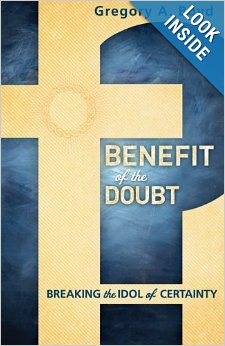
Greg Boyd, in what I believe to be one of his most important books, invites followers of Jesus to embrace doubt. Benefit of the Doubt: Breaking the Idol of Certainty is, in fact, a critique of faith systems that foster the need for certainty. He believes that such approaches (which he calls “certainty-seeking faith”) unknowingly (innocently) creates an idol out of apologetics and the inspiration of Scripture. We don’t worship the Bible and the mode in which the Holy Spirit inspired the writers, rather we worship a person: Jesus of Nazareth. We don’t need to have all of the questions answered that a 2000+ year old collection of books leaves us with, but only need to be “confident enough.” Many of the issues that trip people up on the faith/doubt journey such as the historicity of the Flood or the age of the earth ought not to deter us from taking the leap to follow Jesus. Greg states:
…the thing that God most wants Scripture to do—point to the cross—leads me to expect it to reflect some limitations, imperfections and faults rather than to feel the need to defend it against these things…. So long as we can trust that God uses these narratives [biblical stories] to point us to Christ and to help us cultivate a relationship with Christ, it seems to me that how we resolve these [apologetics] issues, or even if we were to remain undecided about these issues, is completely inconsequential (185).
Although I will not have enough space to explicate each wonderful theme in Greg’s book, I hope to give you a glimpse into one of the central arguments. To move this post in that direction, here is one of many quotes that stood out to me as I read:
One of the most unfortunate consequences of certainty-seeking faith is that, because it rewards people for feeling certain they’re right and discourages people from questioning their perspectives, it conditions people to insist that their maps are the territory. People who embrace this kind of faith will be more inclined to assume that their interpretation of a biblical verse is the meaning of the verse itself. So to disagree with their interpretation is to disagree with the verse itself. In fact, the mind-set that this model of faith produces inclines people to forget they’re interpreting at all. As an angry man told me in a theological dispute some years ago, “I don’t interpret the Bible. I just read it!” (149).
This view of the Bible relates closely with people who have a “house of cards” sort of “certainty-seeking faith.” In a house of cards, if one card falls out of place, the whole structure falls down. This is how many certainty-seekers have set up their spiritual lives. These beliefs create a structure and if one belief is threatened then the whole reality of Christ is threatened. Rather, Greg believes that our foundation or center ought to be the historical person of Jesus Christ (who abides with us through the Holy Spirit).
For those who want more than a mere subjective faith, he suggests that the historical person of Jesus might just help us to be “confident enough” to follow Jesus. We don’t need the Bible to be the center/foundation, but can reframe the Bible’s place within our faith-doubt schema. He states:
The all-important center of the Christian faith is not anything we believe; it’s the person of Jesus Christ, with whom we are invited to have a life-giving relationship… I began to realize that I didn’t need to rely on the Bible as the inspired Word of God in order to enter into this relationship with Christ. Rather than believing in Jesus because I believe the Bible to be the inspired Word of God, as evangelicals typically do, I came to believe the Bible was the inspired Word of God because I first believe in Jesus. This is how I now encourage people to structure their faith, for I have found it to be a much surer intellectual foundation for my faith than the conviction that Scripture is the Word of God (158).
The question then becomes: How do we come to believe that Jesus is historically who the Bible basically claims him to be without our first assumption being that the Bible is inspired? Greg points to four areas for his own conviction, which he claims to hold apart from the divine inspiration of Scripture.
First, he notes that there are philosophical reasons to trust Christ is the incarnation of a God love versus competing narratives.
Second, he admits that some of his reasoning is existential. The God portrayed in the Bible “‘rings true’ with the deepest part of my being… [as] the greatest myth ever told” (160).
Third, some of Greg’s reasons are spiritual. The ways in which Christ has engaged in Greg’s life on a personal level are undeniable for his own life story and make it difficult to deny that Christ is real.
With that said, Greg attributes what he calls “the most compelling and most objective reasons (ibid)” for following Jesus to historical arguments. It is in the combination of these four categories, but especially the fourth, that Greg finds enough confidence to believe Jesus is who the disciples claimed he was/is. Historically, Greg offers a brief (yet compelling) vision of why it isn’t intellectually dishonest to see the testimony of the early church as basically reliable (space doesn’t permit me to expound it here, but read through 160-166 for the details). He adds:
…we don’t need to insist that their presentation is historically accurate on every point or that it is entirely devoid of legendary accretion. We need only accept that their testimony is generally reliable. If, generally speaking, Jesus lived the way they said he lived, made the claims and performed the miracles they said he performed, and died on a cross and then appeared to them, as they claimed, we can understand why they would have said these things about him, why they would have put their lives at risk by proclaiming their message about him, and why they would have allowed their Jewish faith to be overturned by treating this man as God (161).
What Greg has essentially done is taken a relational apologetic and given it intellectually honest reinforcement. This approach doesn’t deny the need for careful study but also doesn’t fall into the fallacy of certainty-seeking faith which assumes that the Bible is a perfect book (as its foundational presupposition). Therefore, when we wrestle with the many intellectual difficulties of the Scriptures (not to mention the experienced world that often seems void of God’s love), we can be “confident enough” that the Jesus we experience is the same Jesus that the early church proclaimed to be God. This is not to run away from doubt, but to have the courage to take steps forward with Christ with doubt as the very means through which faith is fostered. In this way, faith and doubt can be graceful dance partners.
I highly recommend Benefit of the Doubt. It conveys what it means to follow Jesus, in the midst of doubt, more effectively than any book I have ever read. More could be said about Greg’s insights that are not mentioned in this 1600 word reflection, but to get those, you are going need to be “confident enough” to pick up this book and read it!
Previous Post

November 16, 2013
"Batkid" - Best Make a Wish Foundation Moment, ever!
Next Post
November 19, 2013 Life-Changing Books: Surprised by Hope
Browse Our Archives
Select a Category (Series) All Out War-Spiritual Warfare (Series) Church Plant Journal (Series) Dear Reader... (Series) Earthquakes...Signs of the Times? (Series) Entering the... Conversation (Series) Evangelical Culture Myths (Series) Everything is Meaningless [Pete Enns] (Series) Evolving Evangelicalism (Series) Hell Yes. Hell No! Who Cares? (Series) Hidden Worldviews (Series) If Evolution is Right, what about Adam? (Series) in less than 300 words (Series) Jesus and Nationalism (Series) Liberating Women for Ministry? (Series) Life-Changing Books (Series) Markers of Church Plant Movement (Series) Nonviolence 101 (Series) Philemon - Reconciliation (Series) Quote to Ponder (Series) Red Letter Dialogues (Series) Resource of the Week (SERIES) Revelation Sermons (Series) Share Something Sundays (Series) Simplicity in the Burbs: $2 a day (Series) The Binding of God [Open Theism] (Series) The Creed: Anabaptist Reflections (Series) Values for Church Leadership (Series) Video to Ponder Anabaptism Animal Advocacy Books Church Ministry Church Planting Community Culture Eschatology Eucharist Evangelical Reject Evolution Fundamentalism Greek Greg Boyd Guest Contributors Hell Holy Spirit Israel/Palestine Kingdom of God Lent Missional N. T. Wright Nationalism New Creation Nonviolence Open Mic Open Theism Parenting Passover Paul Philemon Podcast Politics Restorative Justice Revelation (the book of) Rob Bell Ron Martoia Sermon Shane Claiborne Social Justice Speaking Engagement Spiritual Warfare Spirituality Temple Theology Tim Geddert Tribulation Uncategorized universalism Video Blog Women in Ministry Worship Music Youth Ministry
Select a Month August 2018 July 2018 June 2018 May 2018 April 2018 March 2018 February 2018 January 2018 December 2017 October 2017 July 2017 June 2017 May 2017 April 2017 December 2016 October 2016 August 2016 June 2016 May 2016 April 2016 March 2016 December 2015 November 2015 October 2015 September 2015 August 2015 June 2015 May 2015 April 2015 March 2015 February 2015 January 2015 December 2014 November 2014 October 2014 September 2014 August 2014 July 2014 June 2014 May 2014 April 2014 March 2014 February 2014 January 2014 December 2013 November 2013 October 2013 September 2013 August 2013 June 2013 May 2013 April 2013 March 2013 February 2013 January 2013 December 2012 November 2012 October 2012 September 2012 August 2012 July 2012 June 2012 May 2012 April 2012 March 2012 February 2012 January 2012 December 2011 November 2011 October 2011 September 2011 August 2011 July 2011 June 2011 May 2011 April 2011 March 2011 February 2011 January 2011 December 2010 November 2010 September 2010 August 2010 July 2010 June 2010 May 2010 April 2010 March 2010 February 2010 January 2010 October 2009 September 2009 August 2009 July 2009 June 2009 May 2009 April 2009 March 2009 February 2009 January 2009 December 2008 November 2008 October 2008 September 2008 August 2008 June 2008 May 2008 April 2008
Follow Us!
TAKE THE
Religious Wisdom Quiz
Who dreamed of a ladder reaching to heaven?
Select your answer to see how you score.
Joseph Simeon Isaac Jacob
Support this
Column


Related posts from The Pangea Blog

Sunday is Not the Main Event: A Practice-Based...

10 Years Ago, I Embraced Nonviolence & Anabaptism

The Gospel is about a Person, not a...
Love is the Only Way: Why I Loved...
TRENDING AT PATHEOS Progressive Christian

What Being a Modern-Day Apostle Means to Me
In my last column, I discussed the ins and outs of modern-day...

Did Ancient China Once Worship the God of...
Across human history, a common thread weaves through the origins of the...

Love Your Neighbor – Including Earth-Kin: Lev. 19,...
God’s command to love your neighbor means acting in an ethical and...

Lead a Church Study of “Jesus and Lao...
Guest writer Jack Thomas (The Irreverent Reverend) reflects on leading his church...

Pastoral Wisdom for Responding to Sermon Pushback
Getting sermon pushback on your social justice sermon? Learn practical, Proverbs-based strategies...

Principles for Understanding the Apostolic Ministry Today
Whenever people discover that my formal ministry title is "apostle," as in...
view all Progressive Christian blogs
Ad-Free & Subscriber Log-In Subscription Support
- About Us
- 2026 Calendar
- Videos
- Podcasts
- Library of World Religions
- Faith In Media Tracker
- Advertise With Us
- Write for Us
- Privacy Policy
- Terms of Service
- Do Not Sell My Data
- Contact Us
- Radiant Digital
- Manage Newsletter Subscriptions
- Unsubscribe From Notifications
- Sitemap
Copyright 2008-2026, Patheos. All rights reserved.
Subscription Support Ad-Free & Subscriber Log-In
Follow Patheos