
BuddhistCatholicContemplativeEvangelicalGeneral ChristianHinduJewishLatter-day SaintMuslimNew VisionsProgressive Christian
Beliefs
- Buddhist
- Catholic
- Contemplative
- Evangelical
- General Christian
- Hindu
- Jewish
- Latter-day Saint
- More Voices
- Muslim
- New Visions
- Pagan
- Progressive Christian
Topics
- Religion News
- Food and Religion
- Sports and Religion
- Religious Art
- Religious Music and Entertainment
- Religious Events
- History and Religion
- Style and Religion
- Politics and Religion
- Women in Religion
- Recreation Outdoors and Religion
- Business Finance and Religion
- Careers Workplace and Religion
- Education and Religion
- Family Parenting and Religion
- Health Fitness and Religion
- Home and Religion
- Relationships and Religion
- Technology and Religion
- Travel and Religion
Columnists
- Buddhist Columnists
- Business Finance and Religion Columnists
- Careers Workplace and Religion Columnists
- Catholic Columnists
- Contemplative Columnists
- Education and Religion Columnists
- Evangelists Columnists
- Family Parenting and Religion Columnists
- General Christian Columnists
- Health Fitness and Religion Columnists
- Hindu Columnists
- History and Religion Columnists
- Home and Religion Columnists
- Jewish Columnists
- More Voices Columnists
- Latter Day Columnists
- Muslim Columnists
- New Visions Columnists
- Nonreligious Columnists
- Pagan Columnists
- Politics and Religion Columnists
- Progressive Columnists
- Recreation Outdoors and Religion Columnists
- Relationships and Religion Columnists
- Religion News Columnists
- Religious Art Columnists
- Religious Events Columnists
- Religious Music and Entertainment Columnists
- Sports and Religion Columnists
- Style and Religion Columnists
- Technology and Religion Columnists
- Travel and Religion Columnists
- Women in Religion Columnists
Resource Library
- 2026 Calendar
- Library of World Religions
- The 100 Most Holy Places on Earth
- Patheos Answers
- Podcasts
- Videos
- Faith Leaders Database
- Anglican Episcopalian
- Bahai
- Baptist
- Buddhism
- Christianity
- Confucianism
- Eastern Orthodoxy
- Hinduism
- Holiness and Pentecostal
- ISKCON
- Islam
- Judaism
- Lutheran
- Methodist
- The Church of Jesus Christ of Latter-day Saints
- New Age
- Paganism
- Presbytarian and Reformed
- Protestantism
- Religion Behind the Scenes
- Roman Catholic
- Scientology
- Shia Islam
- Sikhism
- Sufism
- Sunni Islam
- Taoism
- Zen
- See all religions
Research Tools
 Ad-Free & Subscriber Log-In Subscription Support
Ad-Free & Subscriber Log-In Subscription Support
Follow Patheos 

- Trending:
- Forgiveness
- |
- Marriage
- |
- Consciousness
- |
- Death Penalty
- |
- Election
- |
- Halloween
 The Pangea Blog
- Home
- Progressive Christian
- North Korea may bomb the hell out of us and blow us to smithereens, yet we will cling to the instability of hope
North Korea may bomb the hell out of us and blow us to smithereens, yet we will cling to the instability of hope
Last updated on: April 16, 2013 at 8:27 am by Kurt Willems
North Korea may bomb the hell out of us and blow us to smithereens, yet we will cling to the instability of hope 2013-04-16T08:27:52-07:00 Kurt Willems
Patheos Explore the world's faith through different perspectives on religion and spirituality! Patheos has the views of the prevalent religions and spiritualities of the world.
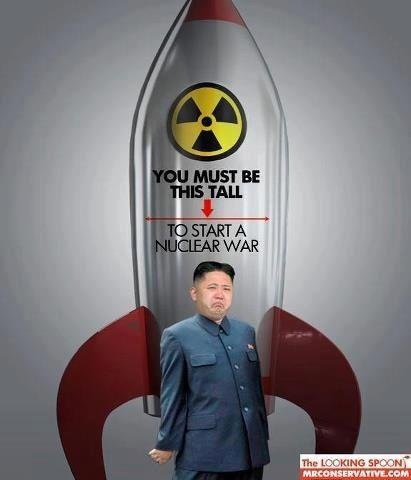
If this image is not to be shared, please feel free to contact me and I will take it down.
***I wrote this article prior to the events in Boston, otherwise my title would have been a bit more sensitive. My prayers go out to the victims and their families.
At the moment, I have the unfortunate luck to commute about an hour to and from work every day. Don’t get me wrong, I love my current job and realize I’m blessed to have it, but the drive can be a bit of a downer. Although there is one positive – radio time! Yep, listening to NPR or Macklemore and Ryan Lewis’ The Heist keeps me driving without too much boredom.
The news operates in cycles. Sometimes the big story is about a cruise ship that lost power and caused Americans to “suffer” at sea for a few days (tell that to the kid in Africa with a bloated belly). Other times the stories engage in the next impending political crisis that will ruin everything in America if it is not resolved. But then, every once in a while, stories emerge that make us come together for a time, like the tragedy at New Town.
Another story, not nearly as emotionally loaded at this point, but that nonetheless captures our imagination concerns nuclear war.
North Korea’s, Kim Jong Un, continues to make boisterous claims about warring on the United States and our national allies. In one sense, this is the type of story that the media loves because it guarantees that listeners will go out of their way to tune in.
Instability Today?
Whether or not this story is being blown out of proportion by the media, the thought of missiles or nukes being pointed toward the West coast causes us to reflect on the question: What if? Our fears in the nineties versus our fears today escalate more quickly in this post 9-11 world. We are not invincible. The old myth of “progress” deconstructed as the twin towers crumbled before our very eyes. Nothing is outside of the realm of possibility. Our small piece of reality might be bombed to hell at any moment and there is nothing that we could do about it. Existence is unstable.
Although we realize that our way of life is both unsustainable and insecure, we often choose to cling to the hope that either “God’s will is God’s will” or that the U.S. military is stronger than North Korea’s military.
Hope Today?
If we want to gloss over this issue, perhaps the bumper-sticker approach to life is the key. One way to remain hopeful is to ignore the reality of our daily instability by trusting in sloganeering:
“Ignorance is bliss”
“In case of rapture, this car will be unmanned” (which is often connected with the belief that if America is about to be destroyed, God will rescue the church from such doom via holy evacuation)
“Jesus is all we need”
“It’s all part of God’s sovereign plan”
“Let go and let God”
“Bomb ‘em all and let God sort ‘em out” (okay, this last one is too much of a stretch)
Of course we also might place our hope in the sophisticated United States military. I certainly did for most of my life. During the debates about reducing our debts and balancing our national budget, isn’t it interesting how the idea of reducing spending to the U.S. military is quickly taken off the table by both sides of the aisle? Ironically, a significant portion of the national debt can be attributed to excessive militarism. Our default settings as a culture tells us that the Armed Forces need our taxes so that they can preserve our way of life. “Peace through strength” is good for us all, or so many believe.
In church of our youth, we glorified the Armed Forces and took deep pride whenever the flag salute was proclaimed. These things served as liturgy for even my non-liturgical low-church evangelical roots. If you don’t believe me, just attend the average church with an AWANA program for kids. Each week they pledge their allegiance to the flag. All of this reminds us that we often put our hope in bombs, the very thing that causes our instability. Church ministries often reinforce this idea. Our bombs are bigger and more sophisticated than their bombs so we don’t have much to fear… Besides God will guide our guided missiles toward evildoers ‘over-there.’
My experience is that Christians are really good at appealing to sloganeering to bring about a false sense that things are “fine.” When these slogans stop working, many church going folks appeal to God’s country – America – as being safe as long as our military is strong. Sometimes slogans and theistic militarism combine creatively, like one bumper sticker I saw recently: “God bless our troops… Especially our snipers.” Too often, the Christian hope is co-opted by the hope of Caesar (more about that in a moment).

Instability Then?
During the time of Jesus, tensions for those living in Israel continued to escalate. Since the days of the Babylonian Exile and subsequent return, Israel hadn’t returned to its former glory. Moments looked positive for a brief time, but the next invading empire soon overshadowed these hopes.
By the time of Jesus, the Greco-Roman Empire had conquered his homeland. Julius Caesar and the Senate installed Herod as king. It would take Herod three years to finally gain all control over the still hostile Jews, but he would in due course keep a firm rule over the whole region. He eventually became one of Augustus’ favorite military leaders, and was admired by the new emperor because of his immense development program.
Not only did Herod expand the Temple in Jerusalem to be more grandiose and stylistically Hellenistic-Roman, but he also imposed a sacrifice that the priests would give on behalf of Rome and the emperor. Additionally, Herod had whole cities named to give reverence to Caesar as well as imperial temples and fortresses to reinforce Roman control. The great building campaigns were not possible without taxing the peoples of Galilee, Samaria, and Judea greatly; leaving the majority of Jesus’ contemporaries in poverty.
As you can easily imagine, various sects rose up amongst the Jews who chose a particular posture as a response: compromised to gain favor with the Romans (Sadducees), blamed subjugation on the “sinful” common people (Pharisees), or secretly plotted violent revolution (Zealots). Jesus enters the scene and criticizes all of these groups. Ultimately, Jesus declares the Temple system (which had sold out to the elite and made a pretty penny for Rome) as void.
In Mark 13 Jesus claims that the Temple will be destroyed within one generation of his hearers (nope, this passage is not primarily about the “End Times). The center of their universe – Jerusalem – and the center of the city – the Temple – would all be demolished. The initial conversation between Jesus and his disciples makes this clear:
As Jesus left the temple, one of his disciples said to him, “Teacher, look! What awesome stones and buildings!”
Jesus responded, “Do you see these enormous buildings? Not even one stone will be left upon another. All will be demolished.”
Jesus was sitting on the Mount of Olives across from the temple. Peter, James, John, and Andrew asked him privately, “Tell us, when will these things happen? What sign will show that all these things are about to come to an end?” (Mark 13.1-4, CEB).
Jesus then goes on to explain that the worst catastrophe imaginable will take place within “this generation.” The rest of Mark 13, and parallels, expresses that the whole City will be proverbially “blown to smithereens.”
Hope Then?
For those who lived in Jerusalem during the first century, hope was elusive. After the death and resurrection of the Lord Jesus, tensions in Israel continued to escalate. Three options for responding to this situation (to put it simply) revealed the “signs of the times.” First, the people could embrace their overlord Caesar and his “good news” to be the “savior” of all the peoples of the earth by bringing peace, justice, and hope to all under the banner of “Pax Romana” (Peace of Rome). That may sound familiar if you replace emperor worship with the co-opting ideals of “God bless America.” The second option was to take up arms and put hope in the nationalistic god of Israel and fight the Romans for their freedom. Finally, a third option, take Jesus’ words seriously about the coming doom of the City (along with the fact that he proclaimed an alternative peaceable Kingdom).
The Romans did eventually destroy the Temple in Jerusalem. Jesus’ words as they are recorded in Mark’s gospel actually came to fulfillment approximately 40 years after they would have been spoken. Ancient historian, Flavius Josephus provided a thorough account of the events leading up to the Jewish war and the eventual destruction of the Temple and city of Jerusalem. The Jewish Zealots mobilized to revolt and killed a Roman garrison. This led Emperor Nero to commission Vespasian and his son Titus, to end the uprising that had taken place with the rebels. This would not be an easy task. From 66 until 70 AD, war would ensue. For four years, the city of Jerusalem and the surrounding area, was plagued by a war that the Zealots considered to be religious in nature.
Jerusalem was completely under Roman control by September 7, 70 AD. Not only were the Romans successful, but they laid the city bare, destroying both the city and its Temple. Where did this leave the compromisers? They were likely shown mercy. Where did this leave the Zealots? Murdered and buried outside of the City, probably burned up in a place Jesus referred to as “Gehenna.”
And as for the Christians, well, let’s assume that they took Jesus’ prophetic words seriously. They were the only group that truly knew hope in this scenario. This hope, the hope of an eventual resurrection and the “renewal of all things,” fueled them to love their neighbors in spite the instability. They put their hope, neither in Jewish nationalism nor in allegiance to Caesar; their hope was in a Kingdom that transcends borders, even those of Jerusalem. By this time, of course, the people of God included non-Jews from throughout the known world as well, so they all had to discern how to live out the Kingdom hope in their own contexts.
The Instability of Hope: Living the Already/Not Yet Way of Jesus
We followers of Jesus in the empire of America have a choice. We can put our trust in empty sloganeering. We can trust in the horses and chariots of the military. Or, we can place our lives in the midst of reality, the unstable yet sure hope we have in Christ Jesus.
Just as the Jews (and early Christians) experienced instability in the conditions created by the Romans during Jesus’ ministry (and the 40-ish years after), we see signs of the times in news headlines every day. North Korea might just bomb the hell out of us one day, but the question we must ask is: In what shall we hope in the midst of instability? Perhaps a basic starting point is to simply take Jesus’ teaching on worry to heart, that we should not worry about tomorrow for today has enough troubles of its own.
In the midst of an unstable global political climate, perhaps there is more we can do. Many people are talking about the “what ifs” of North Korea, so what if we saw this as an opportunity to embody hope for people in the midst of instability?
Christians have a hope that started on the first Easter morning when Jesus walked out of a tomb and that ends in the renewed heavens and earth. Living between the resurrection and the New Creation has always involved dynamic tension in the midst of instability. Hope and instability go together at any time or place in history, be it 70 AD, 1776, or 2013. This is the nature of the already/not yet Kingdom of God.
If it is not North Korea, another threat will always loom its ugly head as long as the powers of evil are running the show. Yet in the midst of this all, unstable times are a gift that reminds us that ultimately King Jesus is in charge of this moment of historical chaos and in every moment leading to his return. We remind our world of this every time we choose to live as though God’s renewed world, our ultimate hope, has already begun. We don’t rely on cheap slogans. Our hope isn’t in the largest military in the world. Our hope isn’t that North Korea will be overthrown. No, our hope is that the world isn’t always going to be like this. The stability of New Creation will come, and in fact, it is already here.
———————————————————————————————————————————-
For the historical facts see my two papers:
Signs of the Times: A study of Mark 13
Behind Luke’s Gospel: The Roman Empire during the time of Jesus


Browse Our Archives
Select a Category (Series) All Out War-Spiritual Warfare (Series) Church Plant Journal (Series) Dear Reader... (Series) Earthquakes...Signs of the Times? (Series) Entering the... Conversation (Series) Evangelical Culture Myths (Series) Everything is Meaningless [Pete Enns] (Series) Evolving Evangelicalism (Series) Hell Yes. Hell No! Who Cares? (Series) Hidden Worldviews (Series) If Evolution is Right, what about Adam? (Series) in less than 300 words (Series) Jesus and Nationalism (Series) Liberating Women for Ministry? (Series) Life-Changing Books (Series) Markers of Church Plant Movement (Series) Nonviolence 101 (Series) Philemon - Reconciliation (Series) Quote to Ponder (Series) Red Letter Dialogues (Series) Resource of the Week (SERIES) Revelation Sermons (Series) Share Something Sundays (Series) Simplicity in the Burbs: $2 a day (Series) The Binding of God [Open Theism] (Series) The Creed: Anabaptist Reflections (Series) Values for Church Leadership (Series) Video to Ponder Anabaptism Animal Advocacy Books Church Ministry Church Planting Community Culture Eschatology Eucharist Evangelical Reject Evolution Fundamentalism Greek Greg Boyd Guest Contributors Hell Holy Spirit Israel/Palestine Kingdom of God Lent Missional N. T. Wright Nationalism New Creation Nonviolence Open Mic Open Theism Parenting Passover Paul Philemon Podcast Politics Restorative Justice Revelation (the book of) Rob Bell Ron Martoia Sermon Shane Claiborne Social Justice Speaking Engagement Spiritual Warfare Spirituality Temple Theology Tim Geddert Tribulation Uncategorized universalism Video Blog Women in Ministry Worship Music Youth Ministry
Select a Month August 2018 July 2018 June 2018 May 2018 April 2018 March 2018 February 2018 January 2018 December 2017 October 2017 July 2017 June 2017 May 2017 April 2017 December 2016 October 2016 August 2016 June 2016 May 2016 April 2016 March 2016 December 2015 November 2015 October 2015 September 2015 August 2015 June 2015 May 2015 April 2015 March 2015 February 2015 January 2015 December 2014 November 2014 October 2014 September 2014 August 2014 July 2014 June 2014 May 2014 April 2014 March 2014 February 2014 January 2014 December 2013 November 2013 October 2013 September 2013 August 2013 June 2013 May 2013 April 2013 March 2013 February 2013 January 2013 December 2012 November 2012 October 2012 September 2012 August 2012 July 2012 June 2012 May 2012 April 2012 March 2012 February 2012 January 2012 December 2011 November 2011 October 2011 September 2011 August 2011 July 2011 June 2011 May 2011 April 2011 March 2011 February 2011 January 2011 December 2010 November 2010 September 2010 August 2010 July 2010 June 2010 May 2010 April 2010 March 2010 February 2010 January 2010 October 2009 September 2009 August 2009 July 2009 June 2009 May 2009 April 2009 March 2009 February 2009 January 2009 December 2008 November 2008 October 2008 September 2008 August 2008 June 2008 May 2008 April 2008
Follow Us!
TAKE THE
Religious Wisdom Quiz
What were the names of Eli's two corrupt sons?
Select your answer to see how you score.
Jonathan and Saul David and Nathan Abinadab and Shammah Hophni and Phinehas
Support this
Column


Related posts from The Pangea Blog

What is the Kingdom of God? (with Frank...

Sunday is Not the Main Event: A Practice-Based...

10 Years Ago, I Embraced Nonviolence & Anabaptism

Romans 13 Doesn't Give Government an Ethical Blank...
TRENDING AT PATHEOS Progressive Christian

What Being a Modern-Day Apostle Means to Me
In my last column, I discussed the ins and outs of modern-day...

Did Ancient China Once Worship the God of...
Across human history, a common thread weaves through the origins of the...

Love Your Neighbor – Including Earth-Kin: Lev. 19,...
God’s command to love your neighbor means acting in an ethical and...

Lead a Church Study of “Jesus and Lao...
Guest writer Jack Thomas (The Irreverent Reverend) reflects on leading his church...

Pastoral Wisdom for Responding to Sermon Pushback
Getting sermon pushback on your social justice sermon? Learn practical, Proverbs-based strategies...

Principles for Understanding the Apostolic Ministry Today
Whenever people discover that my formal ministry title is "apostle," as in...
view all Progressive Christian blogs
Ad-Free & Subscriber Log-In Subscription Support
- About Us
- 2026 Calendar
- Videos
- Podcasts
- Library of World Religions
- Faith In Media Tracker
- Advertise With Us
- Write for Us
- Privacy Policy
- Terms of Service
- Do Not Sell My Data
- Contact Us
- Radiant Digital
- Manage Newsletter Subscriptions
- Unsubscribe From Notifications
- Sitemap
Copyright 2008-2026, Patheos. All rights reserved.
Subscription Support Ad-Free & Subscriber Log-In
Follow Patheos