
BuddhistCatholicContemplativeEvangelicalGeneral ChristianHinduJewishLatter-day SaintMuslimNew VisionsProgressive Christian
Beliefs
- Buddhist
- Catholic
- Contemplative
- Evangelical
- General Christian
- Hindu
- Jewish
- Latter-day Saint
- More Voices
- Muslim
- New Visions
- Pagan
- Progressive Christian
Topics
- Religion News
- Food and Religion
- Sports and Religion
- Religious Art
- Religious Music and Entertainment
- Religious Events
- History and Religion
- Style and Religion
- Politics and Religion
- Women in Religion
- Recreation Outdoors and Religion
- Business Finance and Religion
- Careers Workplace and Religion
- Education and Religion
- Family Parenting and Religion
- Health Fitness and Religion
- Home and Religion
- Relationships and Religion
- Technology and Religion
- Travel and Religion
Columnists
- Buddhist Columnists
- Business Finance and Religion Columnists
- Careers Workplace and Religion Columnists
- Catholic Columnists
- Contemplative Columnists
- Education and Religion Columnists
- Evangelists Columnists
- Family Parenting and Religion Columnists
- General Christian Columnists
- Health Fitness and Religion Columnists
- Hindu Columnists
- History and Religion Columnists
- Home and Religion Columnists
- Jewish Columnists
- More Voices Columnists
- Latter Day Columnists
- Muslim Columnists
- New Visions Columnists
- Nonreligious Columnists
- Pagan Columnists
- Politics and Religion Columnists
- Progressive Columnists
- Recreation Outdoors and Religion Columnists
- Relationships and Religion Columnists
- Religion News Columnists
- Religious Art Columnists
- Religious Events Columnists
- Religious Music and Entertainment Columnists
- Sports and Religion Columnists
- Style and Religion Columnists
- Technology and Religion Columnists
- Travel and Religion Columnists
- Women in Religion Columnists
Resource Library
- 2026 Calendar
- Library of World Religions
- The 100 Most Holy Places on Earth
- Patheos Answers
- Podcasts
- Videos
- Faith Leaders Database
- Anglican Episcopalian
- Bahai
- Baptist
- Buddhism
- Christianity
- Confucianism
- Eastern Orthodoxy
- Hinduism
- Holiness and Pentecostal
- ISKCON
- Islam
- Judaism
- Lutheran
- Methodist
- The Church of Jesus Christ of Latter-day Saints
- New Age
- Paganism
- Presbytarian and Reformed
- Protestantism
- Religion Behind the Scenes
- Roman Catholic
- Scientology
- Shia Islam
- Sikhism
- Sufism
- Sunni Islam
- Taoism
- Zen
- See all religions
Research Tools
 Ad-Free & Subscriber Log-In Subscription Support
Ad-Free & Subscriber Log-In Subscription Support
Follow Patheos 

- Trending:
- Forgiveness
- |
- Marriage
- |
- Consciousness
- |
- Death Penalty
- |
- Election
- |
- Halloween
 The Pangea Blog
- Home
- Progressive Christian
- What can we learn from the early church? – Living like the first Christians
What can we learn from the early church? – Living like the first Christians
Last updated on: November 19, 2012 at 6:00 am by Kurt Willems
What can we learn from the early church? – Living like the first Christians 2012-11-18T21:26:40-08:00 Kurt Willems
Patheos Explore the world's faith through different perspectives on religion and spirituality! Patheos has the views of the prevalent religions and spiritualities of the world.

Dr. Charles (Chuck) Gutenson is a church consultant and former Chief Operating Officer of Sojourners and has served as a COO in the for profit sector as well. He previously served 10 years at Asbury Seminary in Kentucky, most recently as the professor of Theology and Philosophy. He received an M.Div. from Asbury in 1995 and a PhD in Philosophical Theology from Southern Methodist University in 2000. A member of the International Society of Theta Phi, an honor society for theological students, scholars in the field of religion and outstanding religious leaders. Chuck is the author of six books (one forthcoming) and numerous articles on a variety of theological and philosophical articles. Check out his new book: The Right Church: Live Like the First Christians.
————————————————————————————————-
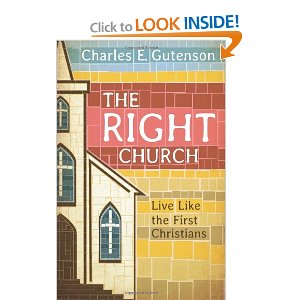 The Right Church seems like a presumptuous name for a book. Care to explain the title and tell us a little about the project behind the book?
That’s a very good question, and I have to admit that it really is something of a misnomer. If I had it to do again, I think I would have used only the subtitle with a question mark: Live Like the First Christians? Because, the goal of the project is not to say “Here is how the early church saw things, and therefore we should see them that way, too.” Instead, it is to invite the reader for a short tour through the world of the early church—a world that is, in many ways, very different than our own. At the same time, though, it is the world of our earliest spiritual parents, if you will. In taking time to see how these early Christians understood the call of Christ and how they tried to live it out in their own lives, I am convinced that there are deep riches that we can appropriate for our own lives of faith. So, as I say in the introduction, the main goal of the book is to spur us to ask the question: what can I learn from the earliest centuries of the church that can empower the church today to be more faithfully obedient to God’s intentions for us.
A popular theme on this blog is nonviolence. What did the early church writers have to say on the issues related to violence and war?
There can be no question but that Christians of the earliest period were overwhelmingly pacifist. I would say, until the year 200 pacifism was the norm for Christians. That began to change slightly from 200 to the Constantinian Edict in 313. Tertullian (160-225) was very strong in arguing that Christians could not participate in war, and he went so far as to say that those who were already soldiers must quit the military when they became followers of Jesus. There are cases during this early period where Christians chose to be martyred rather than to serve in the military. So, the period prior to 200 was clearly one that embraced pacifism as the norm, and that pretty much continued until after the year 300.
During the period prior to Constantine, the church suffered ten separate persecutions, periods where Christians were killed simply for being Christians. So, when Constantine offered to make Christianity, in essence, the official religion of the empire, we might understand how appealing that would have been, a chance finally to escape persecution at the hands of the empire. As a consequence, the church embraced the empire and it’s resistance to participation in war soon had fallen by the wayside. What we have to ask ourselves today is whether that transition was a healthy one, a move to become participants in empire, or whether it was fundamentally a mistake. The answer one gives to that goes a large way in determining how one sees pacifism today. I have my own views, of course, though for the sake of the book, I tend more to leave those to the side.
Sometimes modern day Christians assume that early church leaders were more or less on the same page on issues that we now consider controversial. Is there any truth to this assumption, or does a wider range of opinions exists in the early years of the church?
No, the early church would challenge many of the things that we take utterly for granted today. For example, we’ve just discussed how the early church saw war. I suspect that contemporary Christians largely assume that most embraced something like just war theory, and they are often shocked to see that pacifism was the norm in the early period. Another example is the way we 21st century Christians think about freedom. Most often, in our culture today, we take the term “freedom” to be synonymous with the liberty to do as you please. However, as I show, during the early church, they were much more likely to think of freedom as the freedom from sin. There is the paradoxical notion that as one becomes “freer,” the range of choices one has is actually smaller. Why? Because in being freed from our sins, we become much less likely to choose sinful behaviors. One more example, today we tend to take our responsibilities to use our possessions for the care of the poor and marginalized very much less seriously than the early church. Rather than seeing “our stuff” as ours, it was not unusual to find the early church preachers reminding the well-to-do of the obligations that attend wealth. For example, John Chrysostom once commented, “That spare coat you have in your closet, you stole that from the poor.” How shocking is that to us today?
It seems that the issues Christians are talking about have not changed much in 2000 years. In your research and writing for The Right Church, did you find anything that surprised you?
Actually, I think what has surprised me most, over the years of teaching and covering some of these different themes, is how interested and receptive students have been to hear these challenging words of the early church fathers and mothers. As you can see, many of their ways of seeing the world run counter to and challenge our own, but I often find that students are suspicious that the call of Christ on our lives is more radical than we often want to admit. When they hear the challenging words of the fathers, they seem very much open to considering what they have to say. It is rewarding to see such openness to the radical call of Christ on our lives.
You assert in the intro of The Right Church that you are primarily interested in church renewal. How does a project that recounts the views of a bunch of dead guys who often did not get along help the church today?
Ah, yes, the “old dead guys” question :-). To say that the church is in decline in the West would be almost cliché at this point. The number of folks who self-identify as Christian has been in decline for 60 years, at least. So, what do we do about that? What I am suggesting in The Right Church is that one of the things that we need to be done is once again to return to the rich resources that are ours in the broader Christian tradition, particularly, in this book, the ones that come to use through the words and wisdom of the earliest centuries of our history. Will everything turn out to be useful? Probably not. Will we simply be able to import their words into our own time? Sometimes yes, sometimes no. But, we do need to hear what they say to us. And, after hearing what they have to say, we need to consider carefully how their wisdom might influence how we live the life of faith today. I have invested a good deal of time and energy in the belief that we have much to learn from them and that our own challenges to renew the church will benefit from the time we take to spend with the early church.
Previous Post

November 6, 2012
The todays and tomorrows of this election - a reflection
Next Post
November 19, 2012 Shane Claiborne talks about "spiritual economics"
Browse Our Archives
Select a Category (Series) All Out War-Spiritual Warfare (Series) Church Plant Journal (Series) Dear Reader... (Series) Earthquakes...Signs of the Times? (Series) Entering the... Conversation (Series) Evangelical Culture Myths (Series) Everything is Meaningless [Pete Enns] (Series) Evolving Evangelicalism (Series) Hell Yes. Hell No! Who Cares? (Series) Hidden Worldviews (Series) If Evolution is Right, what about Adam? (Series) in less than 300 words (Series) Jesus and Nationalism (Series) Liberating Women for Ministry? (Series) Life-Changing Books (Series) Markers of Church Plant Movement (Series) Nonviolence 101 (Series) Philemon - Reconciliation (Series) Quote to Ponder (Series) Red Letter Dialogues (Series) Resource of the Week (SERIES) Revelation Sermons (Series) Share Something Sundays (Series) Simplicity in the Burbs: $2 a day (Series) The Binding of God [Open Theism] (Series) The Creed: Anabaptist Reflections (Series) Values for Church Leadership (Series) Video to Ponder Anabaptism Animal Advocacy Books Church Ministry Church Planting Community Culture Eschatology Eucharist Evangelical Reject Evolution Fundamentalism Greek Greg Boyd Guest Contributors Hell Holy Spirit Israel/Palestine Kingdom of God Lent Missional N. T. Wright Nationalism New Creation Nonviolence Open Mic Open Theism Parenting Passover Paul Philemon Podcast Politics Restorative Justice Revelation (the book of) Rob Bell Ron Martoia Sermon Shane Claiborne Social Justice Speaking Engagement Spiritual Warfare Spirituality Temple Theology Tim Geddert Tribulation Uncategorized universalism Video Blog Women in Ministry Worship Music Youth Ministry
Select a Month August 2018 July 2018 June 2018 May 2018 April 2018 March 2018 February 2018 January 2018 December 2017 October 2017 July 2017 June 2017 May 2017 April 2017 December 2016 October 2016 August 2016 June 2016 May 2016 April 2016 March 2016 December 2015 November 2015 October 2015 September 2015 August 2015 June 2015 May 2015 April 2015 March 2015 February 2015 January 2015 December 2014 November 2014 October 2014 September 2014 August 2014 July 2014 June 2014 May 2014 April 2014 March 2014 February 2014 January 2014 December 2013 November 2013 October 2013 September 2013 August 2013 June 2013 May 2013 April 2013 March 2013 February 2013 January 2013 December 2012 November 2012 October 2012 September 2012 August 2012 July 2012 June 2012 May 2012 April 2012 March 2012 February 2012 January 2012 December 2011 November 2011 October 2011 September 2011 August 2011 July 2011 June 2011 May 2011 April 2011 March 2011 February 2011 January 2011 December 2010 November 2010 September 2010 August 2010 July 2010 June 2010 May 2010 April 2010 March 2010 February 2010 January 2010 October 2009 September 2009 August 2009 July 2009 June 2009 May 2009 April 2009 March 2009 February 2009 January 2009 December 2008 November 2008 October 2008 September 2008 August 2008 June 2008 May 2008 April 2008
Follow Us!
TAKE THE
Religious Wisdom Quiz
Which ancient city is famous for its towers and the confusion of languages?
Select your answer to see how you score.
Babylon Sodom Babel Nineveh
Support this
Column


Related posts from The Pangea Blog

10 Years Ago, I Embraced Nonviolence & Anabaptism
God for Guns: A Christian Response to Yet...
Jesus' Radical Kingdom Reformation within Judaism (and some...

Value All Human Life: From the Womb to...
TRENDING AT PATHEOS Progressive Christian

What Being a Modern-Day Apostle Means to Me
In my last column, I discussed the ins and outs of modern-day...

Did Ancient China Once Worship the God of...
Across human history, a common thread weaves through the origins of the...

Love Your Neighbor – Including Earth-Kin: Lev. 19,...
God’s command to love your neighbor means acting in an ethical and...

Lead a Church Study of “Jesus and Lao...
Guest writer Jack Thomas (The Irreverent Reverend) reflects on leading his church...

Pastoral Wisdom for Responding to Sermon Pushback
Getting sermon pushback on your social justice sermon? Learn practical, Proverbs-based strategies...

Principles for Understanding the Apostolic Ministry Today
Whenever people discover that my formal ministry title is "apostle," as in...
view all Progressive Christian blogs
Ad-Free & Subscriber Log-In Subscription Support
- About Us
- 2026 Calendar
- Videos
- Podcasts
- Library of World Religions
- Faith In Media Tracker
- Advertise With Us
- Write for Us
- Privacy Policy
- Terms of Service
- Do Not Sell My Data
- Contact Us
- Radiant Digital
- Manage Newsletter Subscriptions
- Unsubscribe From Notifications
- Sitemap
Copyright 2008-2026, Patheos. All rights reserved.
Subscription Support Ad-Free & Subscriber Log-In
Follow Patheos