
BuddhistCatholicContemplativeEvangelicalGeneral ChristianHinduJewishLatter-day SaintMuslimNew VisionsProgressive Christian
Beliefs
- Buddhist
- Catholic
- Contemplative
- Evangelical
- General Christian
- Hindu
- Jewish
- Latter-day Saint
- More Voices
- Muslim
- New Visions
- Pagan
- Progressive Christian
Topics
- Religion News
- Food and Religion
- Sports and Religion
- Religious Art
- Religious Music and Entertainment
- Religious Events
- History and Religion
- Style and Religion
- Politics and Religion
- Women in Religion
- Recreation Outdoors and Religion
- Business Finance and Religion
- Careers Workplace and Religion
- Education and Religion
- Family Parenting and Religion
- Health Fitness and Religion
- Home and Religion
- Relationships and Religion
- Technology and Religion
- Travel and Religion
Columnists
- Buddhist Columnists
- Business Finance and Religion Columnists
- Careers Workplace and Religion Columnists
- Catholic Columnists
- Contemplative Columnists
- Education and Religion Columnists
- Evangelists Columnists
- Family Parenting and Religion Columnists
- General Christian Columnists
- Health Fitness and Religion Columnists
- Hindu Columnists
- History and Religion Columnists
- Home and Religion Columnists
- Jewish Columnists
- More Voices Columnists
- Latter Day Columnists
- Muslim Columnists
- New Visions Columnists
- Nonreligious Columnists
- Pagan Columnists
- Politics and Religion Columnists
- Progressive Columnists
- Recreation Outdoors and Religion Columnists
- Relationships and Religion Columnists
- Religion News Columnists
- Religious Art Columnists
- Religious Events Columnists
- Religious Music and Entertainment Columnists
- Sports and Religion Columnists
- Style and Religion Columnists
- Technology and Religion Columnists
- Travel and Religion Columnists
- Women in Religion Columnists
Resource Library
- 2026 Calendar
- Library of World Religions
- The 100 Most Holy Places on Earth
- Patheos Answers
- Podcasts
- Videos
- Faith Leaders Database
- Anglican Episcopalian
- Bahai
- Baptist
- Buddhism
- Christianity
- Confucianism
- Eastern Orthodoxy
- Hinduism
- Holiness and Pentecostal
- ISKCON
- Islam
- Judaism
- Lutheran
- Methodist
- The Church of Jesus Christ of Latter-day Saints
- New Age
- Paganism
- Presbytarian and Reformed
- Protestantism
- Religion Behind the Scenes
- Roman Catholic
- Scientology
- Shia Islam
- Sikhism
- Sufism
- Sunni Islam
- Taoism
- Zen
- See all religions
Research Tools
 Ad-Free & Subscriber Log-In Subscription Support
Ad-Free & Subscriber Log-In Subscription Support
Follow Patheos 

- Trending:
- Forgiveness
- |
- Marriage
- |
- Consciousness
- |
- Death Penalty
- |
- Election
- |
- Halloween
 The Pangea Blog
- Home
- Progressive Christian
- Evolving Evangelicalism (part 6): Creation “Out of Something” Not “Nothing”
Evolving Evangelicalism (part 6): Creation “Out of Something” Not “Nothing”
Last updated on: May 15, 2012 at 6:00 am by Kurt Willems
Evolving Evangelicalism (part 6): Creation “Out of Something” Not “Nothing” 2012-05-14T23:53:15-07:00 Kurt Willems
Patheos Explore the world's faith through different perspectives on religion and spirituality! Patheos has the views of the prevalent religions and spiritualities of the world.
The following series is based on my senior paper for Seminary. You may remember a video where I invited people to contribute their stories to help make my case. For the next couple weeks, I’ve decided to share my findings with you all. There will be a “thesis/problem” section, a “biblical theology” section, and an “application” section. I hope you will read along and share this with others! You can read the rest of the series here.
—————————————————————————————
Chaos, Creation, and the Beginning
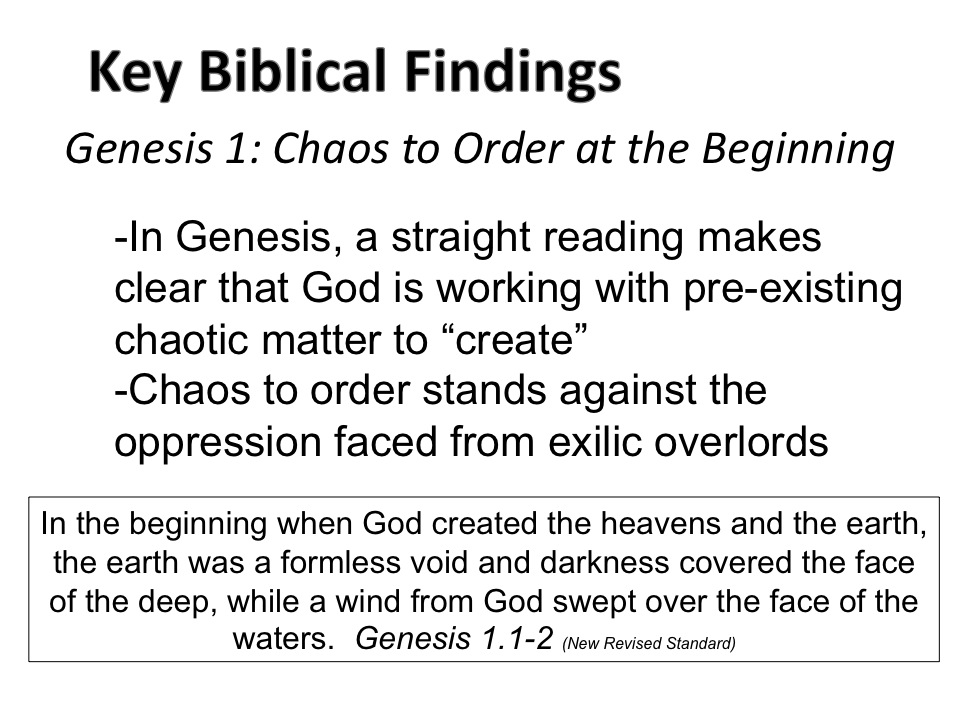
Verse two contains a counter-intuitive claim: God created by bringing order to pre-existing chaos. According to the NIV, the world was “formless and empty” at creation. This description should not be confused with physical nothingness, but “refers to the earth as ‘void/empty’ in the sense of something desolate and unproductive.”[1] The historical despair of Israel being expelled from their land parallels the chaos that must again be tamed by God. Only a fresh creative act enables the restoration of the people of God. For Israel in exile, they appealed to the ultimate beginning of the world, from chaos to order, as a way of speaking to the need for stability in the midst of disarray.
For many evangelicals, the phrase “In the beginning God created…” does not evoke the contextual reality of exile experienced by the ancient people of God. Instead this verse regularly leads to a disregard for evolution. Some might say: If God created “in the beginning,” what else is there to discuss? I say, there is much to discuss! To start, we must discern the beginning to which the writer is referring. For much of Christian history, the church assumed an original beginning and an ex nihilo (out of nothing) creation.
One helpful perspective is that the opening phrase, specifically the word beginning (Re’shiyth), “does not refer to the absolute beginning of all things, but to the beginning of ordered creation.”[2] The chapter communicates “a relative beginning” after the pre-Genesis world of chaos.[3] This is radically different from the gap theory (the view that there is a significant time-lapse between Genesis 1.1 and 1.2). There is no gap in this text; rather pre-historic matter or chaos is assumed preexist at creation. More will be discussed on that point in a moment.
Evangelical scholar John Walton provides a related, but slightly nuanced, perspective. Walton persuasively demonstrates that the word “beginning” is used to introduce “a period in time, rather than a point in time.”[4] Therefore, it is evident that, “verse 1 serves as a literary introduction to the rest of the chapter.”[5] Throughout the rest of Genesis is a phrase: “this is the account of,” which introduces the eleven sections of the book that follow, beginning with verse 2.4. Therefore, verse 1.1 uses beginning to introduce the initial period outlined in the whole of the book of Genesis. The following eleven sections are also introduced by the above phrase. Consider Walton’s proposed translation of the first verse in the Bible: “In the initial period, God created by assigning functions throughout the heavens and the earth, and this is how he did it.”[6]
Functional Ontology
The above translation assumes God created by assigning functions. Bara’, the word English Bibles translate “created,” only refers to God’s own activity in the Old Testament. Up until the time just prior to Jesus (2 Maccabees 7.28), bara’ never implied a creation out of nothing. Rather, it was understood as the bringing of order to the world.[7] One source argues for the traditional meaning of the word arguing that its “primary emphasis… is on the newness of the created object.” However, Laird-Harris concedes that such a “concept is not necessarily inherent within the meaning of the word.”[8] We might avoid the tendency to hold onto the ex nihilo perspective if we scrutinize our presuppositions as moderns compared to that of the Ancient Near East. Bara’ occurs 50 times in the Hebrew Bible and never refers to “physical manufacturing” but rather to “assigning roles” or functions in various contexts.[9]
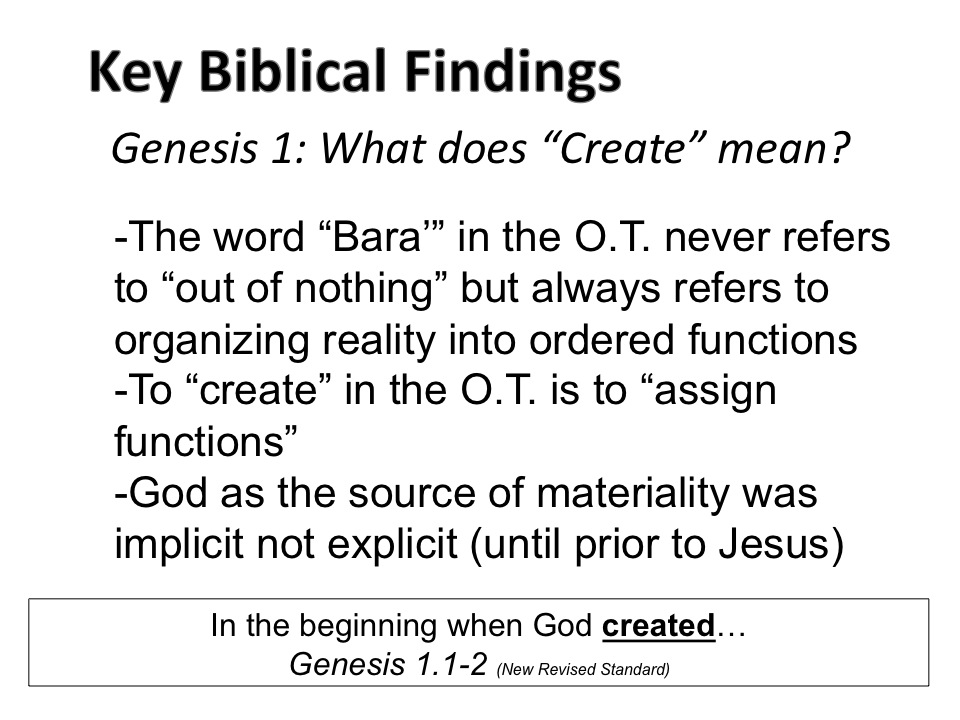
This assigning of functions out of pre-existing chaos, again, demonstrates God’s all-powerfulness in direct confrontation to the gods of Mesopotamia.[10] This should not be taken to say that God is not also the source of materiality; this particular text does not attempt to make the same point that moderns often do in interpretations. Exilic Jews certainly would have affirmed God as the source of material origins, but their questions focused on the functional realities of the cosmos. Eventually, the New Testament states that God created out of nothing (Rom. 4.17, Heb. 11.3), but that was a relatively new claim.[11] The Old Testament never makes this claim.
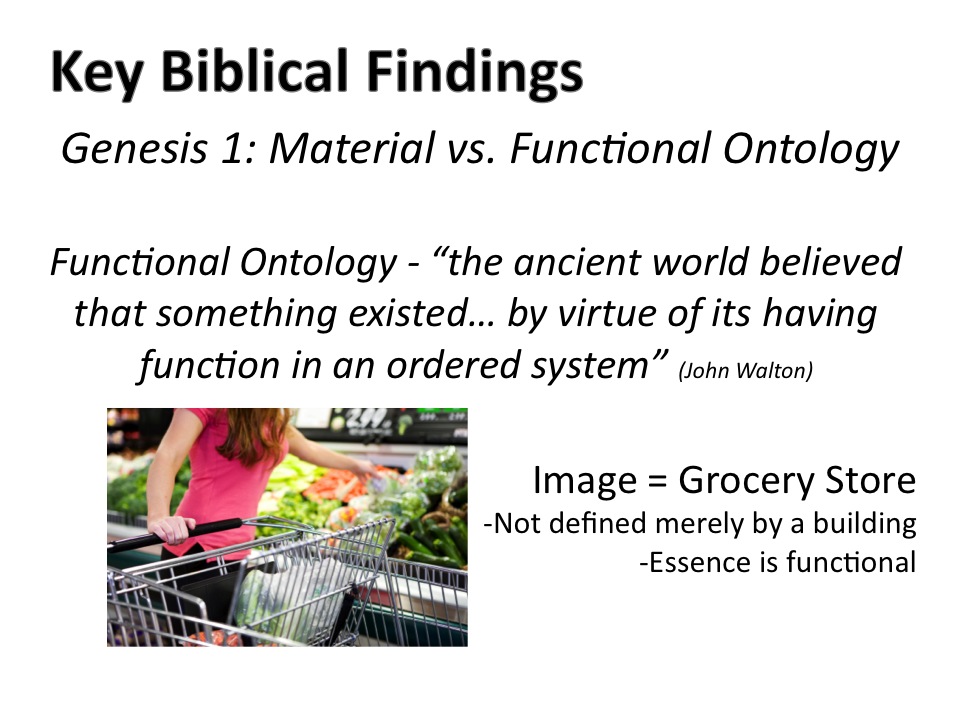
Moderns hold to a view of existence called material ontology,[12] “the belief that something exists by virtue of its physical properties and its ability to be experienced by the senses.”[13] In contrast, ancients held to what is called functional ontology, “the ancient world believed that something existed… by virtue of its having function in an ordered system.”[14]
Imagine that a grocery store is going to be constructed down the street from your home. Perhaps you notice a foundation being laid or the walls going up. Later, you see a sign on the building that says “Whole Foods.” Is this now a grocery store or simply a building? It does not function as a grocery store, so perhaps at this point, it is merely an empty building with the potential to become something more useful. It will finally become a grocery store when the employees are in place to make the building function so that it is stocked with food and ready for customers. This sort of ordering is comparable to a functional view of reality. Walton explains:
In this sort of functional ontology, the sun does not exist by virtue of its material properties, or even by its function as a burning ball of gas. Rather it exists by virtue of the role that it has in its sphere of existence, particularly in the way that it functions for humankind and human society… In a functional ontology, to bring something into existence would require giving it a function or a role in an ordered system, rather than giving it material properties. Consequently, something could be manufactured physically but still not “exist” if it has not become functional.[15]
Genesis 1 is not concerned with material origins, but with functional origins. Genesis 1 is about God taking unorganized preexistent materials (which also originated in God) and organizing them into their various functions.[16]
[1]. Fretheim, The New Interpreter’s Bible: A Commentary in Twelve Volumes – Volume I, 342.
[2]. Fretheim, The New Interpreter’s Bible: A Commentary in Twelve Volumes – Volume I, 342.
[3]. Waltke, Genesis: A Commentary, 58-59 and n. 12.
[4]. Walton, The Lost World of Genesis One: Ancient Cosmology and the Origins Debate, 45.
[5]. Ibid.
[6]. Ibid., 46.
[7]. Theodore Hiebert, “Create, To,” in The New Interpreter’s Dictionary of the Bible: A-C, ed. Katharine Doob Sakenfeld (Nashville, TN: Abingdon Press, 2006-2009), 1:779-80.
[8]. R. Laird Harris et al., eds., “278,” in Theological Wordbook of the Old Testament (Chicago: Moody Press, 1980), 1:127.
[9]. John H. Walton, “Creation,” in Dictionary of the Old Testament: Pentateuch, ed. David Baker and T. Desmond Alexander (Downers Grove: InterVarsity Press, 2003), 161.
[10]. Ibid., 163.
[11]. Brueggemann, Genesis, 29.
[12]. Ontology is a particular theory about the nature of being or the kinds of things that have existence. Merriam-Webster, I. (2003). Merriam-Webster’s collegiate dictionary. (Eleventh ed.). Springfield, Mass.: Merriam-Webster, Inc.
[13]. Walton, The Lost World of Genesis One: Ancient Cosmology and the Origins Debate, 24.
[14]. Ibid., 26.
[15]. Ibid.
[16]. Ibid., 45.
(Series) Evolving Evangelicalism
Previous Post

May 14, 2012
What I said in my graduation speech to fellow seminarians
Next Post
May 15, 2012 The Nine Circles Of Hell, As Depicted In LEGO
Browse Our Archives
Select a Category (Series) All Out War-Spiritual Warfare (Series) Church Plant Journal (Series) Dear Reader... (Series) Earthquakes...Signs of the Times? (Series) Entering the... Conversation (Series) Evangelical Culture Myths (Series) Everything is Meaningless [Pete Enns] (Series) Evolving Evangelicalism (Series) Hell Yes. Hell No! Who Cares? (Series) Hidden Worldviews (Series) If Evolution is Right, what about Adam? (Series) in less than 300 words (Series) Jesus and Nationalism (Series) Liberating Women for Ministry? (Series) Life-Changing Books (Series) Markers of Church Plant Movement (Series) Nonviolence 101 (Series) Philemon - Reconciliation (Series) Quote to Ponder (Series) Red Letter Dialogues (Series) Resource of the Week (SERIES) Revelation Sermons (Series) Share Something Sundays (Series) Simplicity in the Burbs: $2 a day (Series) The Binding of God [Open Theism] (Series) The Creed: Anabaptist Reflections (Series) Values for Church Leadership (Series) Video to Ponder Anabaptism Animal Advocacy Books Church Ministry Church Planting Community Culture Eschatology Eucharist Evangelical Reject Evolution Fundamentalism Greek Greg Boyd Guest Contributors Hell Holy Spirit Israel/Palestine Kingdom of God Lent Missional N. T. Wright Nationalism New Creation Nonviolence Open Mic Open Theism Parenting Passover Paul Philemon Podcast Politics Restorative Justice Revelation (the book of) Rob Bell Ron Martoia Sermon Shane Claiborne Social Justice Speaking Engagement Spiritual Warfare Spirituality Temple Theology Tim Geddert Tribulation Uncategorized universalism Video Blog Women in Ministry Worship Music Youth Ministry
Select a Month August 2018 July 2018 June 2018 May 2018 April 2018 March 2018 February 2018 January 2018 December 2017 October 2017 July 2017 June 2017 May 2017 April 2017 December 2016 October 2016 August 2016 June 2016 May 2016 April 2016 March 2016 December 2015 November 2015 October 2015 September 2015 August 2015 June 2015 May 2015 April 2015 March 2015 February 2015 January 2015 December 2014 November 2014 October 2014 September 2014 August 2014 July 2014 June 2014 May 2014 April 2014 March 2014 February 2014 January 2014 December 2013 November 2013 October 2013 September 2013 August 2013 June 2013 May 2013 April 2013 March 2013 February 2013 January 2013 December 2012 November 2012 October 2012 September 2012 August 2012 July 2012 June 2012 May 2012 April 2012 March 2012 February 2012 January 2012 December 2011 November 2011 October 2011 September 2011 August 2011 July 2011 June 2011 May 2011 April 2011 March 2011 February 2011 January 2011 December 2010 November 2010 September 2010 August 2010 July 2010 June 2010 May 2010 April 2010 March 2010 February 2010 January 2010 October 2009 September 2009 August 2009 July 2009 June 2009 May 2009 April 2009 March 2009 February 2009 January 2009 December 2008 November 2008 October 2008 September 2008 August 2008 June 2008 May 2008 April 2008
Follow Us!
TAKE THE
Religious Wisdom Quiz
What food did God provide for Israel in the wilderness?
Select your answer to see how you score.
Fish Bread Manna Milk
Support this
Column


Related posts from The Pangea Blog

What is the Kingdom of God? (with Frank...

Sunday is Not the Main Event: A Practice-Based...

10 Years Ago, I Embraced Nonviolence & Anabaptism

Romans 13 Doesn't Give Government an Ethical Blank...
TRENDING AT PATHEOS Progressive Christian

Why Christians Have a Sacred Duty to Vote:...
The Bible offers strong support for the sacred duty to vote. Here...

What Being a Modern-Day Apostle Means to Me
In my last column, I discussed the ins and outs of modern-day...

Did Ancient China Once Worship the God of...
Across human history, a common thread weaves through the origins of the...

Love Your Neighbor – Including Earth-Kin: Lev. 19,...
God’s command to love your neighbor means acting in an ethical and...

Lead a Church Study of “Jesus and Lao...
Guest writer Jack Thomas (The Irreverent Reverend) reflects on leading his church...

Principles for Understanding the Apostolic Ministry Today
Whenever people discover that my formal ministry title is "apostle," as in...
view all Progressive Christian blogs
Ad-Free & Subscriber Log-In Subscription Support
- About Us
- 2026 Calendar
- Videos
- Podcasts
- Library of World Religions
- Faith In Media Tracker
- Advertise With Us
- Write for Us
- Privacy Policy
- Terms of Service
- Do Not Sell My Data
- Contact Us
- Radiant Digital
- Manage Newsletter Subscriptions
- Unsubscribe From Notifications
- Sitemap
Copyright 2008-2026, Patheos. All rights reserved.
Subscription Support Ad-Free & Subscriber Log-In
Follow Patheos