
BuddhistCatholicContemplativeEvangelicalGeneral ChristianHinduJewishLatter-day SaintMuslimNew VisionsProgressive Christian
Beliefs
- Buddhist
- Catholic
- Contemplative
- Evangelical
- General Christian
- Hindu
- Jewish
- Latter-day Saint
- More Voices
- Muslim
- New Visions
- Pagan
- Progressive Christian
Topics
- Religion News
- Food and Religion
- Sports and Religion
- Religious Art
- Religious Music and Entertainment
- Religious Events
- History and Religion
- Style and Religion
- Politics and Religion
- Women in Religion
- Recreation Outdoors and Religion
- Business Finance and Religion
- Careers Workplace and Religion
- Education and Religion
- Family Parenting and Religion
- Health Fitness and Religion
- Home and Religion
- Relationships and Religion
- Technology and Religion
- Travel and Religion
Columnists
- Buddhist Columnists
- Business Finance and Religion Columnists
- Careers Workplace and Religion Columnists
- Catholic Columnists
- Contemplative Columnists
- Education and Religion Columnists
- Evangelists Columnists
- Family Parenting and Religion Columnists
- General Christian Columnists
- Health Fitness and Religion Columnists
- Hindu Columnists
- History and Religion Columnists
- Home and Religion Columnists
- Jewish Columnists
- More Voices Columnists
- Latter Day Columnists
- Muslim Columnists
- New Visions Columnists
- Nonreligious Columnists
- Pagan Columnists
- Politics and Religion Columnists
- Progressive Columnists
- Recreation Outdoors and Religion Columnists
- Relationships and Religion Columnists
- Religion News Columnists
- Religious Art Columnists
- Religious Events Columnists
- Religious Music and Entertainment Columnists
- Sports and Religion Columnists
- Style and Religion Columnists
- Technology and Religion Columnists
- Travel and Religion Columnists
- Women in Religion Columnists
Resource Library
- 2026 Calendar
- Library of World Religions
- The 100 Most Holy Places on Earth
- Patheos Answers
- Podcasts
- Videos
- Faith Leaders Database
- Anglican Episcopalian
- Bahai
- Baptist
- Buddhism
- Christianity
- Confucianism
- Eastern Orthodoxy
- Hinduism
- Holiness and Pentecostal
- ISKCON
- Islam
- Judaism
- Lutheran
- Methodist
- The Church of Jesus Christ of Latter-day Saints
- New Age
- Paganism
- Presbytarian and Reformed
- Protestantism
- Religion Behind the Scenes
- Roman Catholic
- Scientology
- Shia Islam
- Sikhism
- Sufism
- Sunni Islam
- Taoism
- Zen
- See all religions
Research Tools
 Ad-Free & Subscriber Log-In Subscription Support
Ad-Free & Subscriber Log-In Subscription Support
Follow Patheos 

- Trending:
- Forgiveness
- |
- Marriage
- |
- Consciousness
- |
- Death Penalty
- |
- Election
- |
- Halloween
 The Pangea Blog
- Home
- Progressive Christian
- Evolving Evangelicalism (part 5): Genesis 1 Confronts Empire!
Evolving Evangelicalism (part 5): Genesis 1 Confronts Empire!
Last updated on: May 14, 2012 at 6:00 am by Kurt Willems
Evolving Evangelicalism (part 5): Genesis 1 Confronts Empire! 2012-05-13T22:26:20-07:00 Kurt Willems
Patheos Explore the world's faith through different perspectives on religion and spirituality! Patheos has the views of the prevalent religions and spiritualities of the world.
The following series is based on my senior paper for Seminary. You may remember a video where I invited people to contribute their stories to help make my case. For the next couple weeks, I’ve decided to share my findings with you all. There will be a “thesis/problem” section, a “biblical theology” section, and an “application” section. I hope you will read along and share this with others! You can read the rest of the series here.
—————————————————————————————
Evolving Evangelicalism: Inviting Church Leaders to Refine their Approach to Scripture and Origins (part 5)
Occasion for Writing Genesis 1
In order to understand the author’s intent in Genesis 1, examining the original historical context will prove helpful. Although well-meaning evangelical apologists have written much to the contrary,[1] the entire book of Genesis did not come into its final form until the post-exilic age.[2] Genesis 1, the first creation narrative, is the relatively newer text (composed by the Priestly redactor [“P”]) addressing issues arising from the exilic / post-exilic period, and Genesis 2-3, the second creation narrative, finds its roots well before the exile (“J” source). For “P,” one purpose was to address the despair of God’s people who were divided, pillaged, and forced out of their land. The text provides a reflection on God as the creative organizer of the cosmos within a historically disorienting set of circumstances.
The two creation accounts ought to be read as two distinct stories.[3] These texts with “different origins and transmission histories” were intentionally “brought together in a coherent way by a redactor” to complementarily “provide the canonical picture of creation.”[4]
Polemical Nature of the Text
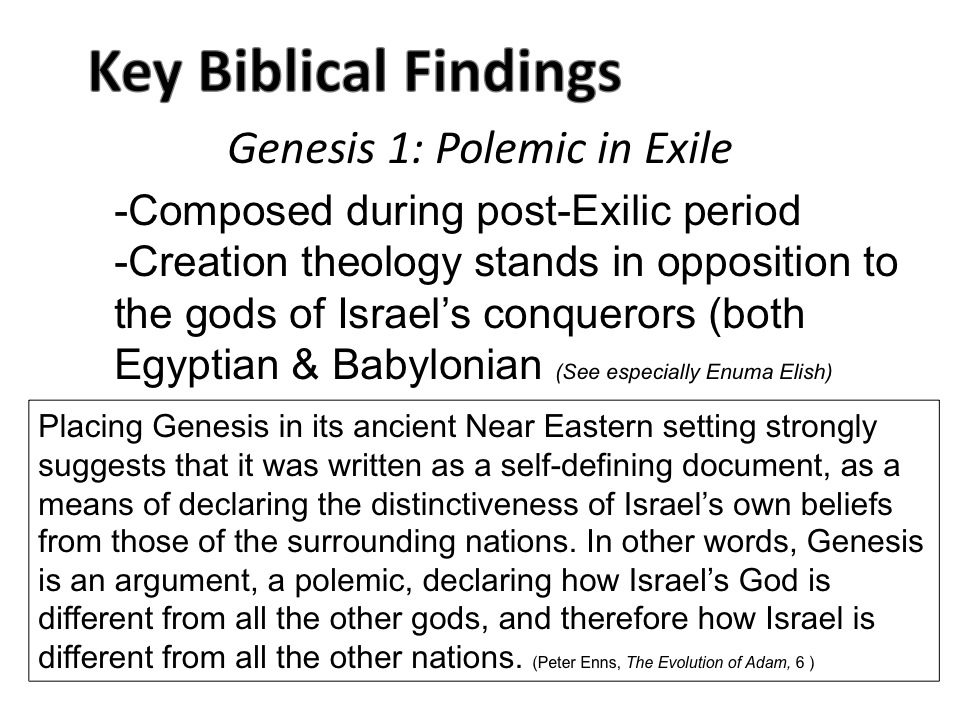
Genesis 1 functions as a polemic against the gods of Israel’s exilic conquerors. To accomplish this end, the liturgy utilizes older narratives about the creation of the cosmos from Israel’s neighbors. Elements of Egyptian and Mesopotamian stories find their way into the biblical text, but are deliberately subverted.[5] Genesis 1 provides a central interpretive concern, from which the creation theology finds its proper rooting. In order to make meaning out of their experiences with God in the midst of exile, Genesis 1 refutes the theology of 6th century Babylon by reminding Israel that God alone brings life and order to humanity and the earth.[6] Peter Enns states this well:
Placing Genesis in its ancient Near Eastern setting strongly suggests that it was written as a self-defining document, as a means of declaring the distinctiveness of Israel’s own beliefs from those of the surrounding nations. In other words, Genesis is an argument, a polemic, declaring how Israel’s God is different from all the other gods, and therefore how Israel is different from all the other nations.[7]
God’s Liberating Image
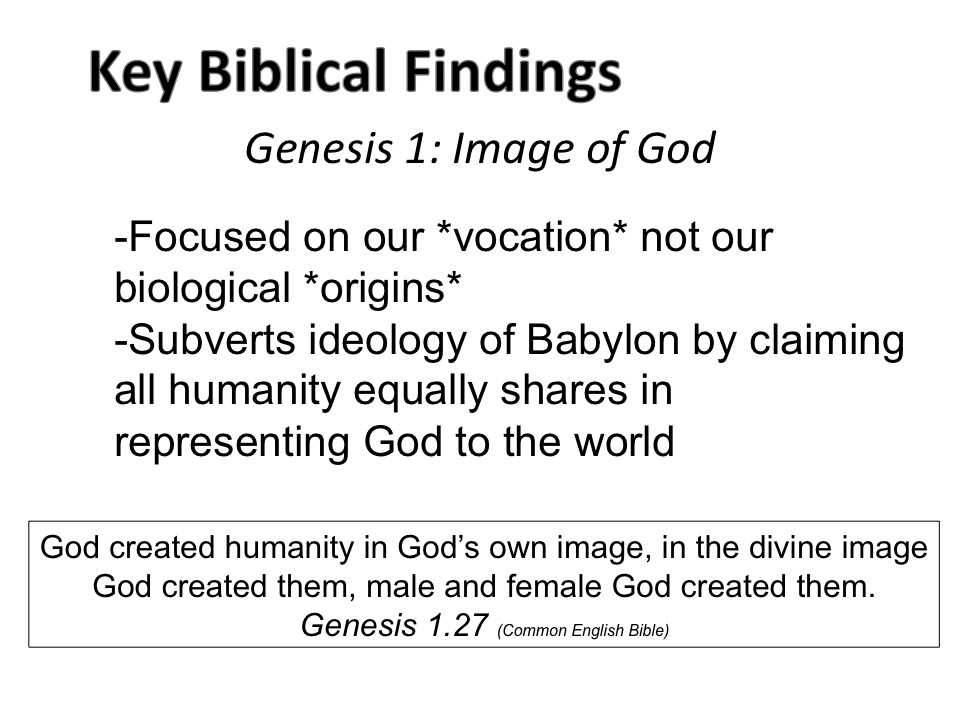
The climax of Genesis 1, seen here, concerns humanity: “So God created human beings in his own image, in the image of God he created them…” (Genesis 1.27). Many conflicts regarding biological evolution stem from this passage, because the common assumption is that humankind is unique. This is true, but our uniqueness is in our vocation, not in our biological origins. To make this point, it will be helpful to consider this verse in the context of the ancient world.
In the context of the passage, Brueggemann states: “It is now generally agreed that the image of God reflected in the human persons is after the manner of a king who establishes statues of himself to assert his sovereign rule where the king himself cannot be present.”[8] Placing tangible physical images in regions where the ruler could not be present served to remind the subjects of the identity of their ruler.
A key difference in Genesis is that the kingly language does not refer to iron-fisted dominance. Rather, this is a subversion of Mesopotamian ideology. J. Richard Middleton writes, “But whereas power in the Babylonian and Assyrian empires was concentrated in the hands of a few, power in Genesis 1 is diffused or shared.”[9] In God’s economy, humanity is “called to a fundamental mutuality in a shared task,”[10] involving the stewarding of God’s creation project. Therefore, the “image of God” ultimately describes the egalitarian role of imaging God to all the earth, and as such, endows all humankind with intrinsic value, thus liberating humanity from the oppressive values of empire.[11]
Chaos and Enuma Elish
Of the texts that Genesis 1 appropriates and subverts, Enuma Elish stands out as a key to comparison (which dates back at least to the 7th century BCE [pre-exile], but may have traditions reaching back to the 3rd millennium BCE). Enuma Elish makes us acutely aware of the theology of Babylonian peoples during the exilic period, which Israel’s creation theology intentionally countered.[12] Enuma Elish tells the story of the victorious god Marduk, who during a cosmic battle kills his great-great-grandmother, the goddess Tiamot. Then, Marduk separates her dead body into two pieces; one half becomes the heavens and the other half forms the earth.
There is a rhetorical connection between Genesis 1 and this Babylonian epic. Where Tiamot personifies chaos that must be tamed (through violence), Israelite theology deliberately depersonalizes chaos as “the deep” (Hebraic “tehom” with linguistic ties to the word Tiamot). God alone tames the dark chaos without the use of violence,[13] and is too powerful to consider a conflict with lesser deities from surrounding pagan nations.[14]
[1]. See: Josh McDowell, The New Evidence That Demands a Verdict, rev., updated, and expanded ed. (Nashville: Thomas Nelson, 1999), ch. 13-21. He argues for the Mosaic authorship of the whole Pentateuch.
[2]. Brueggemann, Genesis, 16.
[3]. Ibid., 14.
[4]. Fretheim, The New Interpreter’s Bible: A Commentary in Twelve Volumes – Volume I, 340.
[5]. Brueggemann, Genesis, 24.
[6]. Ibid., 25.
[7]. Peter Enns, The Evolution of Adam: What the Bible Does and Doesn’t Say about Human Origins (Grand Rapids, MI: Brazos Press, 2012), 6.
[8]. Brueggemann, Genesis, 32.
[9]. J. Richard Middleton, The Liberating Image: The Imago Dei in Genesis 1 (Grand Rapids: Brazos Press, 2005), 204.
[10]. Ibid., 205.
[11]. Ibid., 204-5.
[12]. Conceptual similarities between the two stories include: darkness and chaos precede creation, light exists prior to the sun, depiction of a method for keeping the waters separated above the earth, a sequence of creation days followed by rest, and connections to temples (a point that will be explored below).
[13]. Enns, The Evolution of Adam: What the Bible Does and Doesn’t Say about Human Origins, 38-41.
[14]. Raymond Van Leeuwen, “1343,” in New International Dictionary of Old Testament Theology & Exegesis, ed. Willem A. VanGemeren (Grand Rapids: Zondervan Pub. House, 1997), 729.
(Series) Evolving Evangelicalism
Previous Post

May 13, 2012
Evolution, Mom's with 3 Arms, and Church Signs
Next Post
May 14, 2012 What I said in my graduation speech to fellow seminarians
Browse Our Archives
Select a Category (Series) All Out War-Spiritual Warfare (Series) Church Plant Journal (Series) Dear Reader... (Series) Earthquakes...Signs of the Times? (Series) Entering the... Conversation (Series) Evangelical Culture Myths (Series) Everything is Meaningless [Pete Enns] (Series) Evolving Evangelicalism (Series) Hell Yes. Hell No! Who Cares? (Series) Hidden Worldviews (Series) If Evolution is Right, what about Adam? (Series) in less than 300 words (Series) Jesus and Nationalism (Series) Liberating Women for Ministry? (Series) Life-Changing Books (Series) Markers of Church Plant Movement (Series) Nonviolence 101 (Series) Philemon - Reconciliation (Series) Quote to Ponder (Series) Red Letter Dialogues (Series) Resource of the Week (SERIES) Revelation Sermons (Series) Share Something Sundays (Series) Simplicity in the Burbs: $2 a day (Series) The Binding of God [Open Theism] (Series) The Creed: Anabaptist Reflections (Series) Values for Church Leadership (Series) Video to Ponder Anabaptism Animal Advocacy Books Church Ministry Church Planting Community Culture Eschatology Eucharist Evangelical Reject Evolution Fundamentalism Greek Greg Boyd Guest Contributors Hell Holy Spirit Israel/Palestine Kingdom of God Lent Missional N. T. Wright Nationalism New Creation Nonviolence Open Mic Open Theism Parenting Passover Paul Philemon Podcast Politics Restorative Justice Revelation (the book of) Rob Bell Ron Martoia Sermon Shane Claiborne Social Justice Speaking Engagement Spiritual Warfare Spirituality Temple Theology Tim Geddert Tribulation Uncategorized universalism Video Blog Women in Ministry Worship Music Youth Ministry
Select a Month August 2018 July 2018 June 2018 May 2018 April 2018 March 2018 February 2018 January 2018 December 2017 October 2017 July 2017 June 2017 May 2017 April 2017 December 2016 October 2016 August 2016 June 2016 May 2016 April 2016 March 2016 December 2015 November 2015 October 2015 September 2015 August 2015 June 2015 May 2015 April 2015 March 2015 February 2015 January 2015 December 2014 November 2014 October 2014 September 2014 August 2014 July 2014 June 2014 May 2014 April 2014 March 2014 February 2014 January 2014 December 2013 November 2013 October 2013 September 2013 August 2013 June 2013 May 2013 April 2013 March 2013 February 2013 January 2013 December 2012 November 2012 October 2012 September 2012 August 2012 July 2012 June 2012 May 2012 April 2012 March 2012 February 2012 January 2012 December 2011 November 2011 October 2011 September 2011 August 2011 July 2011 June 2011 May 2011 April 2011 March 2011 February 2011 January 2011 December 2010 November 2010 September 2010 August 2010 July 2010 June 2010 May 2010 April 2010 March 2010 February 2010 January 2010 October 2009 September 2009 August 2009 July 2009 June 2009 May 2009 April 2009 March 2009 February 2009 January 2009 December 2008 November 2008 October 2008 September 2008 August 2008 June 2008 May 2008 April 2008
Follow Us!
TAKE THE
Religious Wisdom Quiz
Who saw a vision of wheels within wheels by the Kebar River?
Select your answer to see how you score.
Ezekiel Jonah Daniel Micah
Support this
Column


Related posts from The Pangea Blog

What is the Kingdom of God? (with Frank...

Sunday is Not the Main Event: A Practice-Based...

10 Years Ago, I Embraced Nonviolence & Anabaptism

Romans 13 Doesn't Give Government an Ethical Blank...
TRENDING AT PATHEOS Progressive Christian

What Being a Modern-Day Apostle Means to Me
In my last column, I discussed the ins and outs of modern-day...

Did Ancient China Once Worship the God of...
Across human history, a common thread weaves through the origins of the...

Love Your Neighbor – Including Earth-Kin: Lev. 19,...
God’s command to love your neighbor means acting in an ethical and...

Lead a Church Study of “Jesus and Lao...
Guest writer Jack Thomas (The Irreverent Reverend) reflects on leading his church...

Pastoral Wisdom for Responding to Sermon Pushback
Getting sermon pushback on your social justice sermon? Learn practical, Proverbs-based strategies...

Principles for Understanding the Apostolic Ministry Today
Whenever people discover that my formal ministry title is "apostle," as in...
view all Progressive Christian blogs
Ad-Free & Subscriber Log-In Subscription Support
- About Us
- 2026 Calendar
- Videos
- Podcasts
- Library of World Religions
- Faith In Media Tracker
- Advertise With Us
- Write for Us
- Privacy Policy
- Terms of Service
- Do Not Sell My Data
- Contact Us
- Radiant Digital
- Manage Newsletter Subscriptions
- Unsubscribe From Notifications
- Sitemap
Copyright 2008-2026, Patheos. All rights reserved.
Subscription Support Ad-Free & Subscriber Log-In
Follow Patheos