
BuddhistCatholicContemplativeEvangelicalGeneral ChristianHinduJewishLatter-day SaintMuslimNew VisionsProgressive Christian
Beliefs
- Buddhist
- Catholic
- Contemplative
- Evangelical
- General Christian
- Hindu
- Jewish
- Latter-day Saint
- More Voices
- Muslim
- New Visions
- Pagan
- Progressive Christian
Topics
- Religion News
- Food and Religion
- Sports and Religion
- Religious Art
- Religious Music and Entertainment
- Religious Events
- History and Religion
- Style and Religion
- Politics and Religion
- Women in Religion
- Recreation Outdoors and Religion
- Business Finance and Religion
- Careers Workplace and Religion
- Education and Religion
- Family Parenting and Religion
- Health Fitness and Religion
- Home and Religion
- Relationships and Religion
- Technology and Religion
- Travel and Religion
Columnists
- Buddhist Columnists
- Business Finance and Religion Columnists
- Careers Workplace and Religion Columnists
- Catholic Columnists
- Contemplative Columnists
- Education and Religion Columnists
- Evangelists Columnists
- Family Parenting and Religion Columnists
- General Christian Columnists
- Health Fitness and Religion Columnists
- Hindu Columnists
- History and Religion Columnists
- Home and Religion Columnists
- Jewish Columnists
- More Voices Columnists
- Latter Day Columnists
- Muslim Columnists
- New Visions Columnists
- Nonreligious Columnists
- Pagan Columnists
- Politics and Religion Columnists
- Progressive Columnists
- Recreation Outdoors and Religion Columnists
- Relationships and Religion Columnists
- Religion News Columnists
- Religious Art Columnists
- Religious Events Columnists
- Religious Music and Entertainment Columnists
- Sports and Religion Columnists
- Style and Religion Columnists
- Technology and Religion Columnists
- Travel and Religion Columnists
- Women in Religion Columnists
Resource Library
- 2026 Calendar
- Library of World Religions
- The 100 Most Holy Places on Earth
- Patheos Answers
- Podcasts
- Videos
- Faith Leaders Database
- Anglican Episcopalian
- Bahai
- Baptist
- Buddhism
- Christianity
- Confucianism
- Eastern Orthodoxy
- Hinduism
- Holiness and Pentecostal
- ISKCON
- Islam
- Judaism
- Lutheran
- Methodist
- The Church of Jesus Christ of Latter-day Saints
- New Age
- Paganism
- Presbytarian and Reformed
- Protestantism
- Religion Behind the Scenes
- Roman Catholic
- Scientology
- Shia Islam
- Sikhism
- Sufism
- Sunni Islam
- Taoism
- Zen
- See all religions
Research Tools
 Ad-Free & Subscriber Log-In Subscription Support
Ad-Free & Subscriber Log-In Subscription Support
Follow Patheos 

- Trending:
- Forgiveness
- |
- Marriage
- |
- Consciousness
- |
- Death Penalty
- |
- Election
- |
- Halloween
 The Pangea Blog
- Home
- Progressive Christian
- Evolving Evangelicalism (part 4): Genesis 1 is MORE than poetry
Evolving Evangelicalism (part 4): Genesis 1 is MORE than poetry
Last updated on: May 11, 2012 at 6:00 am by Kurt Willems
Evolving Evangelicalism (part 4): Genesis 1 is MORE than poetry 2012-05-10T22:48:57-07:00 Kurt Willems
Patheos Explore the world's faith through different perspectives on religion and spirituality! Patheos has the views of the prevalent religions and spiritualities of the world.
The following series is based on my senior paper for Seminary. You may remember a video where I invited people to contribute their stories to help make my case. For the next couple weeks, I’ve decided to share my findings with you all. There will be a “thesis/problem” section, a “biblical theology” section, and an “application” section. I hope you will read along and share this with others! You can read the rest of the series here.
—————————————————————————————
Evolving Evangelicalism: Inviting Church Leaders to Refine their Approach to Scripture and Origins (part 4)
BIBLICAL THEOLOGY
Scientific developments, particularly within the study of biological evolution, create an opportunity to dig deeper into the biblical text. In doing so, we will not seek to redefine Scripture to accommodate for science, but rather will be interested in the task of refining our interpretations with the utmost regard for biblical authority. We will begin by exploring one of the most beautiful, Holy Spirit-inspired passages in all of the biblical narrative: Genesis 1. We will then investigate Adam and Eve’s historicity. The following interpretation, while incomplete, provides a model for maintaining the biblical authority of the book of Scripture while also maintaining an open posture toward modern views about the book of nature.
Genesis 1 and Creation
In the beginning… there was conflict. The chaotic waters of the deep in verse 2 remind us of our cultural quarrels generating from interpretations of Genesis 1. The following approach attempts to demonstrate that this passage is not describing how the world was made, but instead declares who organized the world to function with purpose.
The Structure and Style of Genesis 1
Many interpreters of Genesis 1[1] appeal to the text as a work of poetry. The way poetry usually functions is to point to larger ideas, not to convey a literal lists of facts. In this case, some say that if the first chapter of Scripture is indeed poetic, then it demonstrates that: God created; humans bear the image of God; and God intimately loves what God made and declares all creation “very good.”
It is evident that the writer of Genesis 1 chose stylistic prose. However, the pericope uses a sequential future verb form throughout, which is the typical marker of an Old Testament narrative text.[2] Therefore, it uses a unique form that Walter Brueggemann calls “poetic narrative.”[3] This passage was probably utilized as a liturgy of Israel,[4] evidenced by its “doxological character,”[5] which may explain why the text is both poetic and narrative in form.
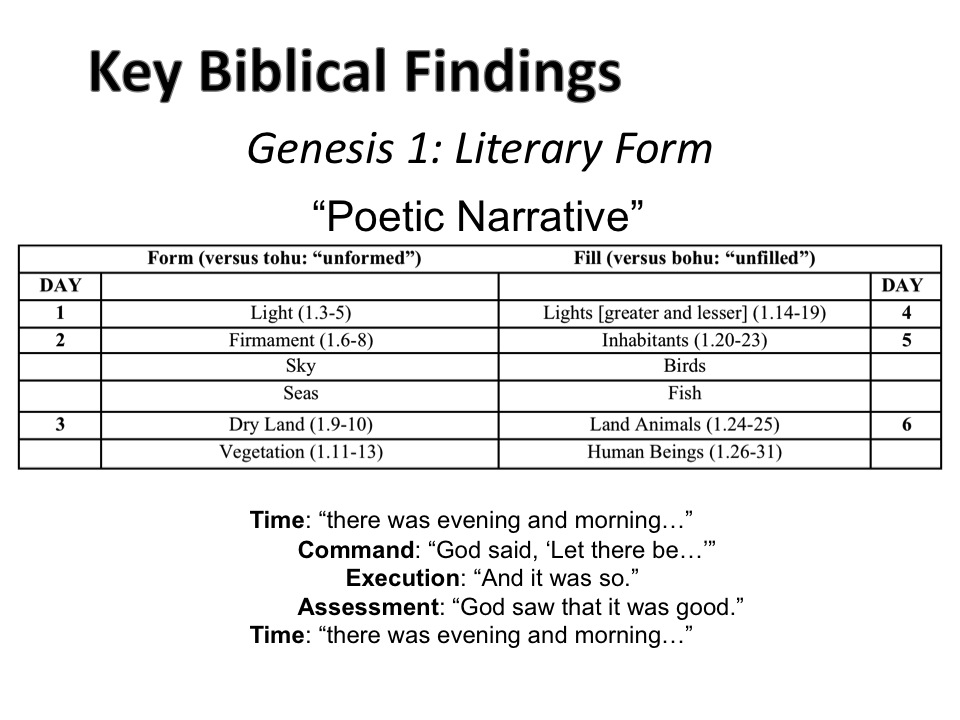
The following outline demonstrates the poetic stylizing of Genesis 1:[6]
Form (versus tohu: “unformed”) ———- Fill (versus bohu: “unfilled”) DAY DAY 1 Light (1.3-5) Lights [greater and lesser] (1.14-19) 4 2 Firmament (1.6-8) Inhabitants (1.20-23) 5 Sky Birds Seas Fish 3 Dry Land (1.9-10) Land Animals (1.24-25) 6 Vegetation (1.11-13) Human Beings (1.26-31)
It becomes obvious that the various days of creation parallel each other. Day 1 goes with day 4, 2 with 5, and 3 with 6. For this reason, many people who challenge the 7-day perspective ask how 24-hour days were marked when the sun was not created until day 4. That is one of many benefits to paying close attention to form.
The “poetic narrative” also demonstrates another pattern:
Time: “there was evening and morning…”
Command: “God said, ‘Let there be…’”
Execution: “And it was so.”
Assessment: “God saw that it was good.”
Time: “there was evening and morning…”
Both the framework of the days and the patterns of the command-execution sequences exhibit the passage’s literary intentionality.[7] Genesis 1 as “poetic narrative” (or liturgy) demonstrates that it was written with intent, not merely as a list of literal descriptions about how the world came into existence.
Yet, we must also recognize the temptation to dismiss this passage as only poetic. Many who claim a form of theistic evolution are content to stop there. Such an interpretive approach irresponsibly neglects the need for further theological inquiry, based on genre related issues. Knowing that Genesis 1 is both narrative and poetry invites careful interpreters to discover the various nuances of meaning beyond the broad truths that God created and humankind was made uniquely in God’s image. Integrity to the complex literary form (not to mention biblical authority) pushes us to think more deeply about the theological purposes and authorial intent of the first chapter of the Bible.
[1]. Genesis 1 in this paper actually refers to the textual unit of Genesis 1.1-2.3.
[2]. Prior to taking Hebrew in seminary, I took for granted that this text was purely poetry.
[3]. Walter Brueggemann, Genesis, Interpretation: a Bible Commentary for Teaching and Preaching (Atlanta: John Knox Press, 1982), 22.
[4]. John H. Walton, The Lost World of Genesis One: Ancient Cosmology and the Origins Debate (Downers Grove: IVP Academic, 2009), 91.
[5]. Terrence E. Fretheim, The New Interpreter’s Bible: A Commentary in Twelve Volumes – Volume I, Genesis (Nashville: Abingdon Press, 1994), 341.
[6]. Bruce K. Waltke, Genesis: A Commentary (Grand Rapids, Mich.: Zondervan, 2001), 57.
[7]. Brueggemann, Genesis, 30.
(Series) Evolving Evangelicalism
Previous Post

May 10, 2012
I’m Done Dating Jesus Online
Next Post
May 11, 2012 Post-Liberal and Emergent Christians Cartoon (video - random and funny)
Browse Our Archives
Select a Category (Series) All Out War-Spiritual Warfare (Series) Church Plant Journal (Series) Dear Reader... (Series) Earthquakes...Signs of the Times? (Series) Entering the... Conversation (Series) Evangelical Culture Myths (Series) Everything is Meaningless [Pete Enns] (Series) Evolving Evangelicalism (Series) Hell Yes. Hell No! Who Cares? (Series) Hidden Worldviews (Series) If Evolution is Right, what about Adam? (Series) in less than 300 words (Series) Jesus and Nationalism (Series) Liberating Women for Ministry? (Series) Life-Changing Books (Series) Markers of Church Plant Movement (Series) Nonviolence 101 (Series) Philemon - Reconciliation (Series) Quote to Ponder (Series) Red Letter Dialogues (Series) Resource of the Week (SERIES) Revelation Sermons (Series) Share Something Sundays (Series) Simplicity in the Burbs: $2 a day (Series) The Binding of God [Open Theism] (Series) The Creed: Anabaptist Reflections (Series) Values for Church Leadership (Series) Video to Ponder Anabaptism Animal Advocacy Books Church Ministry Church Planting Community Culture Eschatology Eucharist Evangelical Reject Evolution Fundamentalism Greek Greg Boyd Guest Contributors Hell Holy Spirit Israel/Palestine Kingdom of God Lent Missional N. T. Wright Nationalism New Creation Nonviolence Open Mic Open Theism Parenting Passover Paul Philemon Podcast Politics Restorative Justice Revelation (the book of) Rob Bell Ron Martoia Sermon Shane Claiborne Social Justice Speaking Engagement Spiritual Warfare Spirituality Temple Theology Tim Geddert Tribulation Uncategorized universalism Video Blog Women in Ministry Worship Music Youth Ministry
Select a Month August 2018 July 2018 June 2018 May 2018 April 2018 March 2018 February 2018 January 2018 December 2017 October 2017 July 2017 June 2017 May 2017 April 2017 December 2016 October 2016 August 2016 June 2016 May 2016 April 2016 March 2016 December 2015 November 2015 October 2015 September 2015 August 2015 June 2015 May 2015 April 2015 March 2015 February 2015 January 2015 December 2014 November 2014 October 2014 September 2014 August 2014 July 2014 June 2014 May 2014 April 2014 March 2014 February 2014 January 2014 December 2013 November 2013 October 2013 September 2013 August 2013 June 2013 May 2013 April 2013 March 2013 February 2013 January 2013 December 2012 November 2012 October 2012 September 2012 August 2012 July 2012 June 2012 May 2012 April 2012 March 2012 February 2012 January 2012 December 2011 November 2011 October 2011 September 2011 August 2011 July 2011 June 2011 May 2011 April 2011 March 2011 February 2011 January 2011 December 2010 November 2010 September 2010 August 2010 July 2010 June 2010 May 2010 April 2010 March 2010 February 2010 January 2010 October 2009 September 2009 August 2009 July 2009 June 2009 May 2009 April 2009 March 2009 February 2009 January 2009 December 2008 November 2008 October 2008 September 2008 August 2008 June 2008 May 2008 April 2008
Follow Us!
TAKE THE
Religious Wisdom Quiz
Why did God reject Saul as king?
Select your answer to see how you score.
He was tricked by David He was too old He disobeyed God He lost in battle
Support this
Column


Related posts from The Pangea Blog

What is the Kingdom of God? (with Frank...

Sunday is Not the Main Event: A Practice-Based...

10 Years Ago, I Embraced Nonviolence & Anabaptism

Romans 13 Doesn't Give Government an Ethical Blank...
TRENDING AT PATHEOS Progressive Christian

What Being a Modern-Day Apostle Means to Me
In my last column, I discussed the ins and outs of modern-day...

Did Ancient China Once Worship the God of...
Across human history, a common thread weaves through the origins of the...

Love Your Neighbor – Including Earth-Kin: Lev. 19,...
God’s command to love your neighbor means acting in an ethical and...

Lead a Church Study of “Jesus and Lao...
Guest writer Jack Thomas (The Irreverent Reverend) reflects on leading his church...

Pastoral Wisdom for Responding to Sermon Pushback
Getting sermon pushback on your social justice sermon? Learn practical, Proverbs-based strategies...

Principles for Understanding the Apostolic Ministry Today
Whenever people discover that my formal ministry title is "apostle," as in...
view all Progressive Christian blogs
Ad-Free & Subscriber Log-In Subscription Support
- About Us
- 2026 Calendar
- Videos
- Podcasts
- Library of World Religions
- Faith In Media Tracker
- Advertise With Us
- Write for Us
- Privacy Policy
- Terms of Service
- Do Not Sell My Data
- Contact Us
- Radiant Digital
- Manage Newsletter Subscriptions
- Unsubscribe From Notifications
- Sitemap
Copyright 2008-2026, Patheos. All rights reserved.
Subscription Support Ad-Free & Subscriber Log-In
Follow Patheos