
BuddhistCatholicContemplativeEvangelicalGeneral ChristianHinduJewishLatter-day SaintMuslimNew VisionsProgressive Christian
Beliefs
- Buddhist
- Catholic
- Contemplative
- Evangelical
- General Christian
- Hindu
- Jewish
- Latter-day Saint
- More Voices
- Muslim
- New Visions
- Pagan
- Progressive Christian
Topics
- Religion News
- Food and Religion
- Sports and Religion
- Religious Art
- Religious Music and Entertainment
- Religious Events
- History and Religion
- Style and Religion
- Politics and Religion
- Women in Religion
- Recreation Outdoors and Religion
- Business Finance and Religion
- Careers Workplace and Religion
- Education and Religion
- Family Parenting and Religion
- Health Fitness and Religion
- Home and Religion
- Relationships and Religion
- Technology and Religion
- Travel and Religion
Columnists
- Buddhist Columnists
- Business Finance and Religion Columnists
- Careers Workplace and Religion Columnists
- Catholic Columnists
- Contemplative Columnists
- Education and Religion Columnists
- Evangelists Columnists
- Family Parenting and Religion Columnists
- General Christian Columnists
- Health Fitness and Religion Columnists
- Hindu Columnists
- History and Religion Columnists
- Home and Religion Columnists
- Jewish Columnists
- More Voices Columnists
- Latter Day Columnists
- Muslim Columnists
- New Visions Columnists
- Nonreligious Columnists
- Pagan Columnists
- Politics and Religion Columnists
- Progressive Columnists
- Recreation Outdoors and Religion Columnists
- Relationships and Religion Columnists
- Religion News Columnists
- Religious Art Columnists
- Religious Events Columnists
- Religious Music and Entertainment Columnists
- Sports and Religion Columnists
- Style and Religion Columnists
- Technology and Religion Columnists
- Travel and Religion Columnists
- Women in Religion Columnists
Resource Library
- 2026 Calendar
- Library of World Religions
- The 100 Most Holy Places on Earth
- Patheos Answers
- Podcasts
- Videos
- Faith Leaders Database
- Anglican Episcopalian
- Bahai
- Baptist
- Buddhism
- Christianity
- Confucianism
- Eastern Orthodoxy
- Hinduism
- Holiness and Pentecostal
- ISKCON
- Islam
- Judaism
- Lutheran
- Methodist
- The Church of Jesus Christ of Latter-day Saints
- New Age
- Paganism
- Presbytarian and Reformed
- Protestantism
- Religion Behind the Scenes
- Roman Catholic
- Scientology
- Shia Islam
- Sikhism
- Sufism
- Sunni Islam
- Taoism
- Zen
- See all religions
Research Tools
 Ad-Free & Subscriber Log-In Subscription Support
Follow Patheos 

- Trending:
- Advent
- |
- Forgiveness
- |
- Thanksgiving
- |
- Election
- |
- Seasonal Holidays
- |
- Marriage
 The Pangea Blog
- Home
- Progressive Christian
- “Everything is MEANINGLESS!” Interview with Pete Enns on Ecclesiastes (2 of 3)
“Everything is MEANINGLESS!” Interview with Pete Enns on Ecclesiastes (2 of 3)
Last updated on: September 28, 2011 at 5:00 am by Kurt Willems
“Everything is MEANINGLESS!” Interview with Pete Enns on Ecclesiastes (2 of 3) 2011-09-27T23:15:25-07:00 Kurt Willems
Patheos Explore the world's faith through different perspectives on religion and spirituality! Patheos has the views of the prevalent religions and spiritualities of the world.

© 2010 Jim LePage. All rights reserved. Used by Permission | Click image to purchase various images based on Biblical books!
Below is an interview between myself and OT Scholar Pete Enns. He is one of the foremost thinkers on critical scholarship and evangelical faith. You can read his thoughts on Ecclesiastes below, which in my opinion is one of the most confusing books in the bible. You can read the other parts of the series here….
————————————
How does all of this fit with the rest of the Bible? Isn’t Ecclesiastes way out of sync with the life of faith Scripture holds out for us?
Ecclesiastes lets us in on the dark side of faith, something every Christians experiences sooner later. I would say that Ecclesiastes is in conversation with Israel’s religious tradition.
The baseline Old Testament teaching (let’s call it) is that God rewards Israel when faithful and punishes when disobedient. This theology is behind the Pentateuch, many of the prophets, and Proverbs. Psalm 1 is a good summary of that idea. What Ecclesiastes shares with Job and many of the lament psalms is a critique of that baseline teaching.
In their own way, each of these says, “Life is not the way God promised it would be, with blessings to the righteous and curses to the wicked. The opposite is true uncomfortably often. What is the world is God doing? What is he waiting for?”
Parts of the Bible challenge other parts?
Yes. These challenging voices say, “Uh. Excuse me. If God is God, and he says he will reward the faithful and punish the wicked, how come I keep seeing the exact opposite? Why can’t God just make the system—his own system!!—work all the time? I get the principle, but it’s not reliable, which means God is not reliable—and which means I am having a faith crisis.”
The book of Job engages that complaint by saying, “God is God. Don’t question him. He knows what he’s doing.” The lament psalms resolve this complaint in worship and by encouraging patience. Ecclesiastes resolves it by leaving the tension in a state of paradox. The book does not solve anything; it gives readers the resolve to keep going.
Once you decide to keep going in the faith journey in the face of apparently incontrovertible evidence to the contrary, you have won. That mindset is where Ecclesiastes takes us.
Doesn’t the New Testament fix Qohelet’s problem? How seriously can we take Qohelet’s extreme view in light of the Gospel?
It is a mistake to think of Ecclesiastes as a book that shows what happens to you if you stop trusting Jesus. It is a book that explores unflinchingly an inevitable dimension of the faith journey—doubt, even anger toward God. Only people of faith experience Qohelet’s despair; only those of deep faith struggle with their faith this deeply.
Most Christians I know have felt as despondent as Qohelet does—at least those who keep their eyes open and try to life a faithful life. I know I certainly have.
When we feel as if God is truly nowhere to be found, we are in good company. This sense of utter alienation from God is not absent from the New Testament. In fact, it is modeled for us in Jesus’ sense of God-abandonment in the garden and on the cross. Jesus did not just “feel” alone—he was alone. Part of following Christ, of being “in Christ” as Paul puts it, is participating in that same type of suffering—a point Paul famously makes in Phil 3:10, that believers “participate” in Christ’s sufferings.
We need to learn to expect our own “Qohelet moments” in life.
Struggling with faith is a common, universal, Christian phenomenon. So maybe Qohelet’s words are not that far from our own experience.
Exactly. Anyone who has been a Christian for more than 45 minutes knows something of the disconnect between how things are and what they ought to be.
A lost chapter of church history, especially for many Protestants, is the experience spiritual depression by such mystic figures as John of the Cross and Teresa of Avila. The “dark night of the soul” is that sense of utter spiritual darkness where one has no foothold, no foundation for faith, no sense of spiritual orientation. The familiar trappings are gone.
When God feels absent or non-existent, he does not come to the rescue like a helicopter parent. He leaves you in that pitch-black spiritual cave until every last bit of ego-driven “control” of your spiritual life is exposed for the sham that it is. He allows the “god” of our own imaginations to fade away so that he can begin the deeper process of forming us into spiritual begins who are content to trust rather than control.
Paradoxically, when God seems non-existent, it is then that he may actually be most at work. A Christian theology that learns to accept the dark night will be able to give thanks to God in any and all circumstances.
So, yeah, there is quite a bit in Ecclesiastes that intersects with the Gospel. Knowing Jesus doesn’t keep us from these experiences of alienation from God. They may actually bring us closer toward these experiences. That is all part of the Christian package—suffering conforms us to Christ’s image.
———————————————————–
Peter Enns (PhD, Harvard University) is senior fellow of biblical studies for The BioLogos Foundation, an organization founded by Francis Collins that explores, promotes, and celebrates the integration of science and Christian faith. From his office in Philadelphia, Pennsylvania, he writes a regular column for The BioLogos Forum blog Science and the Sacred. Enns has taught at Eastern University, Fuller Theological Seminary, and Westminster Theological Seminary and is the author or editor of several books, including Inspiration and Incarnation: Evangelicals and the Problem of the Old Testament and two forthcoming books –Ecclesiastes (Two Horizons Old Testament Commentary) and Evolution of Adam, The: What the Bible Does and Doesn’t Say about Human Origins.
You can order Pete’s commentary for “pre-order” by clicking the image below:
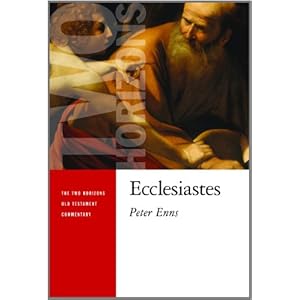
(Series) Everything is Meaningless [Pete Enns]

Browse Our Archives
Select a Category (Series) All Out War-Spiritual Warfare (Series) Church Plant Journal (Series) Dear Reader... (Series) Earthquakes...Signs of the Times? (Series) Entering the... Conversation (Series) Evangelical Culture Myths (Series) Everything is Meaningless [Pete Enns] (Series) Evolving Evangelicalism (Series) Hell Yes. Hell No! Who Cares? (Series) Hidden Worldviews (Series) If Evolution is Right, what about Adam? (Series) in less than 300 words (Series) Jesus and Nationalism (Series) Liberating Women for Ministry? (Series) Life-Changing Books (Series) Markers of Church Plant Movement (Series) Nonviolence 101 (Series) Philemon - Reconciliation (Series) Quote to Ponder (Series) Red Letter Dialogues (Series) Resource of the Week (SERIES) Revelation Sermons (Series) Share Something Sundays (Series) Simplicity in the Burbs: $2 a day (Series) The Binding of God [Open Theism] (Series) The Creed: Anabaptist Reflections (Series) Values for Church Leadership (Series) Video to Ponder Anabaptism Animal Advocacy Books Church Ministry Church Planting Community Culture Eschatology Eucharist Evangelical Reject Evolution Fundamentalism Greek Greg Boyd Guest Contributors Hell Holy Spirit Israel/Palestine Kingdom of God Lent Missional N. T. Wright Nationalism New Creation Nonviolence Open Mic Open Theism Parenting Passover Paul Philemon Podcast Politics Restorative Justice Revelation (the book of) Rob Bell Ron Martoia Sermon Shane Claiborne Social Justice Speaking Engagement Spiritual Warfare Spirituality Temple Theology Tim Geddert Tribulation Uncategorized universalism Video Blog Women in Ministry Worship Music Youth Ministry
Select a Month August 2018 July 2018 June 2018 May 2018 April 2018 March 2018 February 2018 January 2018 December 2017 October 2017 July 2017 June 2017 May 2017 April 2017 December 2016 October 2016 August 2016 June 2016 May 2016 April 2016 March 2016 December 2015 November 2015 October 2015 September 2015 August 2015 June 2015 May 2015 April 2015 March 2015 February 2015 January 2015 December 2014 November 2014 October 2014 September 2014 August 2014 July 2014 June 2014 May 2014 April 2014 March 2014 February 2014 January 2014 December 2013 November 2013 October 2013 September 2013 August 2013 June 2013 May 2013 April 2013 March 2013 February 2013 January 2013 December 2012 November 2012 October 2012 September 2012 August 2012 July 2012 June 2012 May 2012 April 2012 March 2012 February 2012 January 2012 December 2011 November 2011 October 2011 September 2011 August 2011 July 2011 June 2011 May 2011 April 2011 March 2011 February 2011 January 2011 December 2010 November 2010 September 2010 August 2010 July 2010 June 2010 May 2010 April 2010 March 2010 February 2010 January 2010 October 2009 September 2009 August 2009 July 2009 June 2009 May 2009 April 2009 March 2009 February 2009 January 2009 December 2008 November 2008 October 2008 September 2008 August 2008 June 2008 May 2008 April 2008
Follow Us!
TAKE THE
Religious Wisdom Quiz
Which sea did Moses part during the Exodus?
Select your answer to see how you score.
Red Sea Sea of Galilee Dead Sea Mediterranean Sea
Support this
Column


Related posts from The Pangea Blog
What is the Kingdom of God? (with Frank...
10 Years Ago, I Embraced Nonviolence & Anabaptism
The Gospel is about a Person, not a...

Romans 13 Doesn't Give Government an Ethical Blank...
TRENDING AT PATHEOS Progressive Christian

Personal Devotion After Deconstruction
It’s pretty standard for progressive believers to reject aspects of their religious...

The Secret behind A Charlie Brown Thanksgiving
Where Franklin Sat at Charlie Brown's Thanksgiving Table Sparky was sticking to...

Bridging the Gap Between God and Man
From Far Off to the Ultimate Embrace “God is a Spirit: and...

Let Matthew 25 Guide You to a Greater...
With the crisp feel of fall in the air, our minds quickly...

Can a Chatbot Touch Your Soul?
Can a chatbot offer genuine spiritual counsel? One conversation brought me to...

Religion and Politics: How Should We Then Live?
Two cultural axioms get repeated in polite company. Don't mix religion and...
view all Progressive Christian blogs
Ad-Free & Subscriber Log-In Subscription Support
- About Us
- 2026 Calendar
- Videos
- Podcasts
- Library of World Religions
- Faith In Media Tracker
- Advertise With Us
- Write for Us
- Privacy Policy
- Terms of Service
- Do Not Sell My Data
- Contact Us
- Radiant Digital
- Manage Newsletter Subscriptions
- Unsubscribe From Notifications
- Sitemap
Copyright 2008-2026, Patheos, part of the Radiant Digital network of media brands. All rights reserved.
Subscription Support Ad-Free & Subscriber Log-In
Follow Patheos