
BuddhistCatholicContemplativeEvangelicalGeneral ChristianHinduJewishLatter-day SaintMuslimNew VisionsProgressive Christian
Beliefs
- Buddhist
- Catholic
- Contemplative
- Evangelical
- General Christian
- Hindu
- Jewish
- Latter-day Saint
- More Voices
- Muslim
- New Visions
- Pagan
- Progressive Christian
Topics
- Religion News
- Food and Religion
- Sports and Religion
- Religious Art
- Religious Music and Entertainment
- Religious Events
- History and Religion
- Style and Religion
- Politics and Religion
- Women in Religion
- Recreation Outdoors and Religion
- Business Finance and Religion
- Careers Workplace and Religion
- Education and Religion
- Family Parenting and Religion
- Health Fitness and Religion
- Home and Religion
- Relationships and Religion
- Technology and Religion
- Travel and Religion
Columnists
- Buddhist Columnists
- Business Finance and Religion Columnists
- Careers Workplace and Religion Columnists
- Catholic Columnists
- Contemplative Columnists
- Education and Religion Columnists
- Evangelists Columnists
- Family Parenting and Religion Columnists
- General Christian Columnists
- Health Fitness and Religion Columnists
- Hindu Columnists
- History and Religion Columnists
- Home and Religion Columnists
- Jewish Columnists
- More Voices Columnists
- Latter Day Columnists
- Muslim Columnists
- New Visions Columnists
- Nonreligious Columnists
- Pagan Columnists
- Politics and Religion Columnists
- Progressive Columnists
- Recreation Outdoors and Religion Columnists
- Relationships and Religion Columnists
- Religion News Columnists
- Religious Art Columnists
- Religious Events Columnists
- Religious Music and Entertainment Columnists
- Sports and Religion Columnists
- Style and Religion Columnists
- Technology and Religion Columnists
- Travel and Religion Columnists
- Women in Religion Columnists
Resource Library
- 2026 Calendar
- Library of World Religions
- The 100 Most Holy Places on Earth
- Patheos Answers
- Podcasts
- Videos
- Faith Leaders Database
- Anglican Episcopalian
- Bahai
- Baptist
- Buddhism
- Christianity
- Confucianism
- Eastern Orthodoxy
- Hinduism
- Holiness and Pentecostal
- ISKCON
- Islam
- Judaism
- Lutheran
- Methodist
- The Church of Jesus Christ of Latter-day Saints
- New Age
- Paganism
- Presbytarian and Reformed
- Protestantism
- Religion Behind the Scenes
- Roman Catholic
- Scientology
- Shia Islam
- Sikhism
- Sufism
- Sunni Islam
- Taoism
- Zen
- See all religions
Research Tools
 Ad-Free & Subscriber Log-In Subscription Support
Ad-Free & Subscriber Log-In Subscription Support
Follow Patheos 

- Trending:
- Forgiveness
- |
- Marriage
- |
- Consciousness
- |
- Death Penalty
- |
- Election
- |
- Halloween
 The Other Side of the Hedge
- Home
- Pagan
- Animism and the Power of Waterfalls
Animism and the Power of Waterfalls
Last updated on: February 2, 2019 at 10:30 am by Christopher Drysdale
Animism and the Power of Waterfalls 2019-02-02T10:30:36-08:00 Christopher Drysdale
Patheos Explore the world's faith through different perspectives on religion and spirituality! Patheos has the views of the prevalent religions and spiritualities of the world.
Waterfalls are places of spiritual power. On some level, most people can sense this to be true. Maybe we cannot express exactly that uplifting feeling inside. Maybe we just rush on to the next thing. But for those of us who stay and really feel, waterfalls provide not just a sense of wonder, but a way to expand our own spirits.
For the animist, given to direct perception of the spiritual world just beyond our everyday sight, waterfalls provide both personal proof and further opportunity to sense the the world of the spirit. After all, animism is not about belief so much as experience.
It is a truism of the animist world that liminality brings a glimpse of what lies beyond the everyday. This, then, would help explain why waterfalls have such awesome power.
Land of Fire and Ice
Truth be told, Iceland has become a trendy tourist destination over the past few years. Its geothermal vents and ocean currents keep it far warmer than you would think, at least along its shores.
On the 2018 spring solstice, my wife and I headed over to Iceland. After a couple of trying years, it was time for a break.(1) Now, we are not the kind of couple that sits on a beach and drinks margaritas. As soon as I was cleared to travel, it was time for a long delayed pilgrimage to the land of of fire and ice.
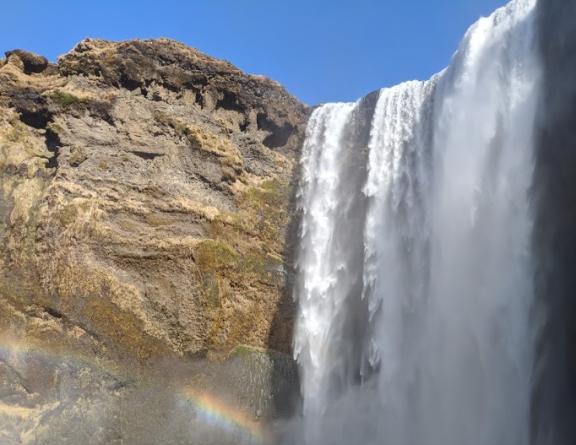
Plunge of Skógafoss – ©2018 Polly Peterson, used with permission
Rising out of the North Atlantic, Iceland is a volcanic island. And yet, significant portions of the landmass are covered with glaciers. Iceland is a powerful place of extremes.
And though the population is by and large Lutheran, the lack of population density outside of the capital city combines with the heavy extremes of the environment to provide a crack through to the spirit world.(2)
Fire and ice, water and land, high and low, even history and modernity all come together in this land. While I am sure the locals are all used to the thrumming power of their home and hardly think a thing of it, the shift from the blandness of suburban America to this land of extremes was as subtle as a slap in the face.
Skógafoss
Along the southern coast of Iceland, following the ridge that separates the highlands from the coastal lowlands, you can find one unbelievable waterfall after another. The melt-water from the glacial center of the island descends from the highlands down to the fertile band along the shore.
Once upon a time the river Skóga fell directly into the ocean. Now the waterfall, Skógafoss**(3),** which is two hundred feel high and over sixty feet wide, feeds the lowlands. And when the sun is right, it generates powerful rainbows.
I noticed a funny thing, there. We could blame it on the madness of tourists, but I think there was more to it.
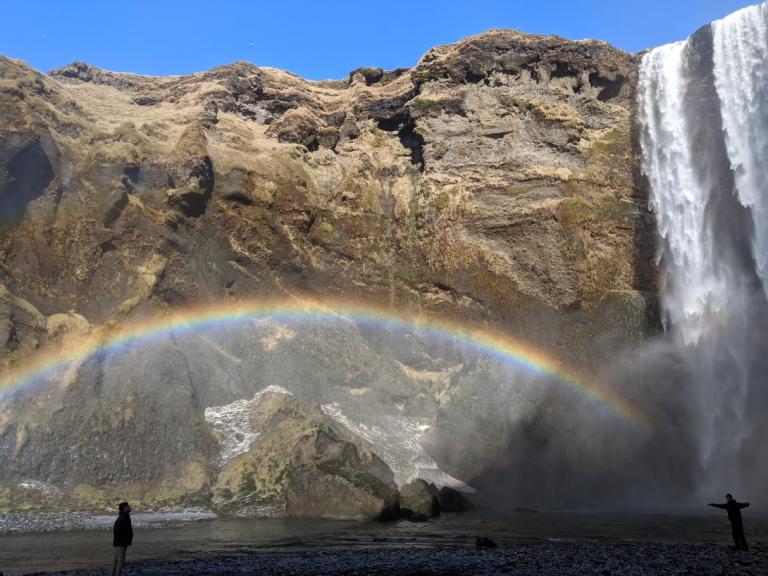
Skógafoss, a Waterfall on the Skoga River – ©2018 Polly Peterson, used with permission
For those who dare to come close to the bottom of Skógafoss, a curious thing happens. Just about every person I saw who came near to the spray lifted and extended his or her arms out to the side, making the body as large as it can be.
It was not just one person, either. As I stood and watched for at least a quarter of an hour, just about everyone who came into the direct area of the plunge pool did the same thing. And, of course, I did too. I did not mean to, but it was pure instinct and beyond my rational control
Expanding the Spirit
When a bunch of people all do the same irrational thing, it might just have some deeper meaning. All of us standing there by the plunge pool of this spectacular waterfall were doing something more than trying to look cool.
Rather, we were expanding our bodies to follow our expanding spirits. It is hard to explain, but waterfalls can act as bridges between the worlds of the physical body and the spirit.
Most of the time, people walk around with their spirits more or less tucked away. Sure, the spiritually inclined might expand them a bit more, but on a daily basis, most do not.
There are two times that we truly expand our spirits. The first is a reaction to mortal danger. The second is when we encounter spiritual forces far greater than us.
Letting Go
When we are placed in mortal danger, our spirits unwrap and open up. This is a spiritual mechanism that is similar to the biological adrenaline reaction. We reach out on all levels, as best we can, sensing for trouble and a pathway out of it.
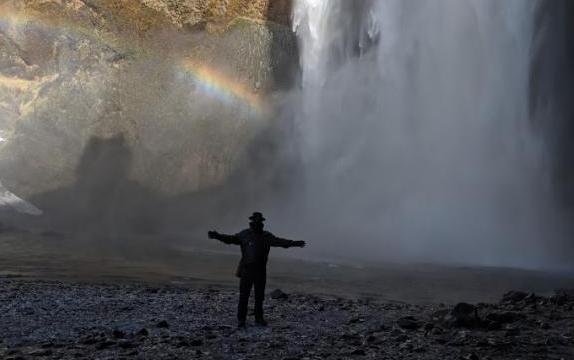
Plunge pool of Skógafoss – ©2018 Polly Peterson, used with permission
You have probably heard about the “my life flashed before my eyes” experience that people have when facing death. This is caused by the unwrapping of the spirit.
As we go about our lives, there are many things to which we cling. Constantly, we try to force the world to be what we want it to be. But when we come face to face with an existential threat, we shed all that and prepare to act.
But all the attachments, ideas, and meanings we drop do not just disappear. Instead, they all flash through our awareness in a single rush. Letting go of everything unnecessary is what causes that momentary reverie.
This is how we experience the rallying of the spirit. Perception becomes instantly clear. We know without knowing how we know. As our awareness expands, things simply “become” what they already were.
Encountering Power
The other time our spirits expand is when we are exposed to something that is way more spiritually potent than we are. In an environment brimming with power, we absorb some of it ourselves.
Our spirits naturally seek equilibrium with our environment. But such experiences are not once-and-done. Real change in our perception of the world requires repetition and practice.
There are many ways to seek out such experiences. It could be argued that this is the whole point of religion. But for good old-fashioned, natural, non-denominational opportunities, nothing beats standing near (or even under) a waterfall.
Whereas facing our deaths can effect radical change, the technique is hardly safe. And regular exposure to powerful forces, such as deities, comes with its own risks and costs.
Compared to such practices, slow and steady exposure to natural wonder is relatively safe and effective. And if we are patient, we can experience that same “letting go” without risk to life and limb.(4)
(1) If you would like the name of my awesome travel agent, please reach out to me. My email address is on my About page.
(2) Perhaps for this reason, the country sports well over one percent what I would call Pagan religionists. While that might not sound like much, if the United States has the same level of penetration it would work out to well over five million Pagans.
I am of the opinion that Pagan populations are not a cause of spiritual “awakeness” so much as one of the symptoms of it. A land that lends itself to spiritual awareness is going to have more spiritual practitioners on the whole. Paganism is just one expression of that.
(3) -foss is the suffix in Icelandic meaning “waterfall.”
(4) This is a bit of a nuanced idea, but keep in mind that it does not matter how much spiritual power there is in an environment. What matters is the distance between states. It is the change between states that generates shifts in awareness.
Previous Post

January 12, 2019
A Deep Dive on Divination
Next Post

February 9, 2019 What Is the Emerald Tablet?
Browse Our Archives
Select a Category Columns History Holidays Politics Ritual and Practice The Other Side of the Hedge Theology, Ethics, Philosophy
Select a Month June 2019 May 2019 April 2019 March 2019 February 2019 January 2019 December 2018 November 2018 October 2018 September 2018 August 2018 July 2018 June 2018 May 2018 April 2018 March 2018 February 2018 January 2018 November 2017 October 2017 September 2017 August 2017 July 2017 June 2017 May 2017 April 2017 March 2017 February 2017 January 2016 December 2015 November 2015 October 2015 September 2015
TAKE THE
Religious Wisdom Quiz
True or False: 3 John commends Diotrephes for his hospitality and love for the brethren.
Select your answer to see how you score.
TRUE FALSE
Related posts from The Other Side of the Hedge




TRENDING AT PATHEOS Pagan

When we talk about Greek religion, we often begin with the dodekatheion—the...

I was recently chatting with someone on Instagram. She asked me what...

While there are many people who share their results, the end of...

On July 23, I saw Christopher Nolan's The Odyssey which is Homer’s...

As I write this two big events have just finished up. One...

Restoring the Watershed of Divine Love
Perhaps cooperation is not something we manufacture through legislation, ideology, or moral...
view all Pagan blogs
Ad-Free & Subscriber Log-In Subscription Support
- About Us
- 2026 Calendar
- Videos
- Podcasts
- Library of World Religions
- Faith In Media Tracker
- Advertise With Us
- Write for Us
- Privacy Policy
- Terms of Service
- Do Not Sell My Data
- Contact Us
- Radiant Digital
- Manage Newsletter Subscriptions
- Unsubscribe From Notifications
- Sitemap
Copyright 2008-2026, Patheos. All rights reserved.
Subscription Support Ad-Free & Subscriber Log-In
Follow Patheos