
BuddhistCatholicContemplativeEvangelicalGeneral ChristianHinduJewishLatter-day SaintMuslimNew VisionsProgressive Christian
Beliefs
- Buddhist
- Catholic
- Contemplative
- Evangelical
- General Christian
- Hindu
- Jewish
- Latter-day Saint
- More Voices
- Muslim
- New Visions
- Pagan
- Progressive Christian
Topics
- Religion News
- Food and Religion
- Sports and Religion
- Religious Art
- Religious Music and Entertainment
- Religious Events
- History and Religion
- Style and Religion
- Politics and Religion
- Women in Religion
- Recreation Outdoors and Religion
- Business Finance and Religion
- Careers Workplace and Religion
- Education and Religion
- Family Parenting and Religion
- Health Fitness and Religion
- Home and Religion
- Relationships and Religion
- Technology and Religion
- Travel and Religion
Columnists
- Buddhist Columnists
- Business Finance and Religion Columnists
- Careers Workplace and Religion Columnists
- Catholic Columnists
- Contemplative Columnists
- Education and Religion Columnists
- Evangelists Columnists
- Family Parenting and Religion Columnists
- General Christian Columnists
- Health Fitness and Religion Columnists
- Hindu Columnists
- History and Religion Columnists
- Home and Religion Columnists
- Jewish Columnists
- More Voices Columnists
- Latter Day Columnists
- Muslim Columnists
- New Visions Columnists
- Nonreligious Columnists
- Pagan Columnists
- Politics and Religion Columnists
- Progressive Columnists
- Recreation Outdoors and Religion Columnists
- Relationships and Religion Columnists
- Religion News Columnists
- Religious Art Columnists
- Religious Events Columnists
- Religious Music and Entertainment Columnists
- Sports and Religion Columnists
- Style and Religion Columnists
- Technology and Religion Columnists
- Travel and Religion Columnists
- Women in Religion Columnists
Resource Library
- 2026 Calendar
- Library of World Religions
- The 100 Most Holy Places on Earth
- Patheos Answers
- Podcasts
- Videos
- Faith Leaders Database
- Anglican Episcopalian
- Bahai
- Baptist
- Buddhism
- Christianity
- Confucianism
- Eastern Orthodoxy
- Hinduism
- Holiness and Pentecostal
- ISKCON
- Islam
- Judaism
- Lutheran
- Methodist
- The Church of Jesus Christ of Latter-day Saints
- New Age
- Paganism
- Presbytarian and Reformed
- Protestantism
- Religion Behind the Scenes
- Roman Catholic
- Scientology
- Shia Islam
- Sikhism
- Sufism
- Sunni Islam
- Taoism
- Zen
- See all religions
Research Tools
 Ad-Free & Subscriber Log-In Subscription Support
Ad-Free & Subscriber Log-In Subscription Support
Follow Patheos 

- Trending:
- Forgiveness
- |
- Marriage
- |
- Consciousness
- |
- Death Penalty
- |
- Election
- |
- Halloween
 The Other Side of the Hedge
- Home
- Pagan
- On Developing Skill in Magic
On Developing Skill in Magic
Last updated on: December 2, 2018 at 11:04 am by Christopher Drysdale
On Developing Skill in Magic 2018-12-02T11:04:10-08:00 Christopher Drysdale
Patheos Explore the world's faith through different perspectives on religion and spirituality! Patheos has the views of the prevalent religions and spiritualities of the world.
Every skill is used to transform the world. From carpentry to medicine to law, skill is the way we take knowledge and apply it into the world to create change. In this respect, the skills of magic are no different.
People who do not study magic tend to either place it on a pedestal or cast it in a ditch. They hold that either magic can accomplish anything or nothing.
Even when we first start to learn magic, we tend to fall into one of these camps. Magic either needs to prove nothing to us, or everything.
We all start from where we are, and if you have been raised in Western culture like me, people generally either believe that the spiritual is everything, or the spiritual is nothing.
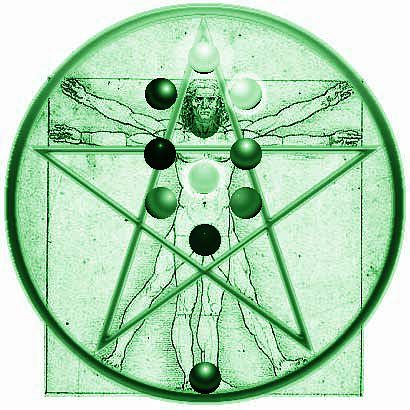
Public domain, via Wikimedia Commons
Magic can accomplish many things, but not anything. And like every other skill, magic depends on native talent, developed skill, and available resources.
We all have only the talents we have, and resources vary by context. But skill is something we can develop.
Knowledge, Action, and Skill
Knowing happens in our minds, and action happens in the world. It is only by integrating the two that we can develop skill and depth. As an example, let’s look at the Lesser Banishing Ritual of the Pentagram (LBRP).
In a physical sense, the LBRP is a series of sounds and movements. It is no more magical than dance or conversation.
In the everyday mind, the ritual’s sounds and movements are intentionally and heavily symbolic. And while we can read about their meaning all day, it is only by taking action that we can use those symbols. We have to do the work.
Magically, the LBRP is a small representative of an entirely new world, and diligent practice will give access to that world. Imagine it as a map that links what we think with what we do.
There is nothing inherently powerful about the Lesser Banishing Ritual of the Pentagram. What makes it special is that the path has been traveled so many times in the past.
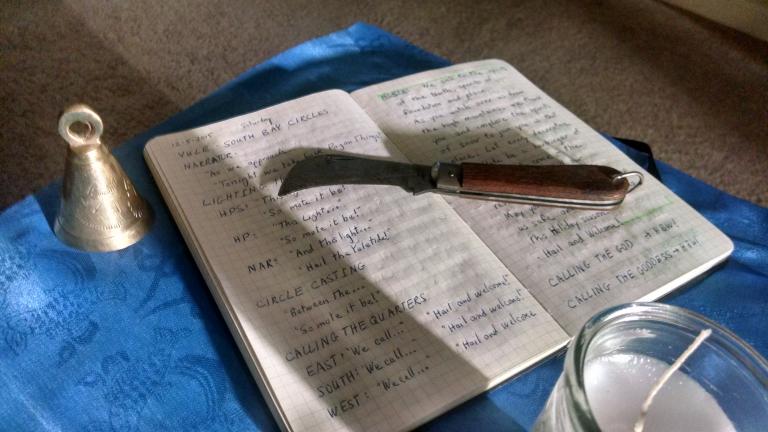
Boline on Book, ©2017 by author
The good news is that this well-traveled path is unlikely to accidentally land you somewhere you are not prepared to go. There are places inside of us that are stupidly dangerous, and it makes no sense to court that danger until we are ready.
The larger lesson here is that knowledge and action are not opposites; they are necessary and interrelated parts of the same process. Skill is the ability to transition back and forth between the two. The more skill we develop, the more smooth and seamless the transition.
We do not learn skills passively. Skills are not simply read in books or poured into us by teachers. They are cultivated inside of us through our own work. Knowledge is necessary, but it is only the first step – the seed of the skill.
Growing in Skill
The practice of magic is much like anything else. Knowledge, by itself, is never enough, and knowing is only the first step to building skill. Learning is not a matter of absorbing information, but instead a cycle of growth.
Learning, then, is not only about accepting information. Knowledge must then be applied, implemented, and finally integrated. And we complete this cycle, not once, but over and over. Each time we circle around, we go back and start again, developing deeper skill.
The longer I spend studying the world, the more I come to understand that the underlying patterns of things are guided by the same fundamental principles. When trees pass through seasons, they gain new layers each year. In the same way, skills grow inside of us.

Ancient Tree in a Fortress Wall, Namsan ©2009 Polly Peterson, used with permission
Like trees, skills require a proper environment to flourish. More, we must pay attention to the seasons, the phases of learning. And we need to exert patience. Like trees, no magic that is worthwhile grows overnight.
The Environment of Learning
The learning environment is not only about the state of things outside of us. While we might find silence and a lack of distractions useful in studying, that is because these things are necessary for us to create the right internal state.
And there is more to our internal state, when it comes to learning, than plain old focus. Paying attention is only the beginning.
In order to cultivate any skill, we need to be ready to change. And when it comes to magic, this is even more true.
Everyday people find education hard, and magic impossible. This is because they spend every waking hour doing their best to control and guide their own paths through life.
And while that seems laudable, we are often like children trying to plan our whole lives at age four. In the beginning, we cannot even imagine what is possible, or warn ourselves away from what is not.
An Alchemist in His Laboratory, via Wikimedia Commons
Learning means letting go of our death-grip on what we already know. Until we do that, we can never see the world around us on its own terms. “Engaging with the material” sounds nice, but especially when it comes to magic, often what it is really about is letting the deeper nature of things engage with us.
In order to learn a skill, we need to make ourselves more receptive. There are two ways to do this. We either need to cultivate humility inside of ourselves, or we need to be clearly and definitely motivated by something we value outside of us.
In other words, to allow anything into our lives, we either need lower ourselves or raise up the other thing. Either way, the natural flow brings it to us. Attempting to drag what we want into our lives by main force is a losing game.
ProTip: The virtues of humility and respect go hand in hand with learning. We have been taught, by the stories of our culture, only to respect naked power and cold, hard cash. We are a land of utilitarians who say that “time is money” and “knowledge is power” — as if time and knowledge were not worthwhile on their own. Time is all we truly have, and knowledge is the beginning of skill.
The Dangers of Cultivating Magical Skill
When it comes to learning magic, not just as an idea but as an actual practice, it matters how we cultivate our skills. Yes, we learn from our mistakes. But that does not mean that we should make mistakes willy-nilly.
Magical mistakes can be costly. The best way to learn to avoid overly-specific and controlling love spells is to try a few. (Go ahead. Really. I’ll bring the popcorn for me and a handkerchief for you.)
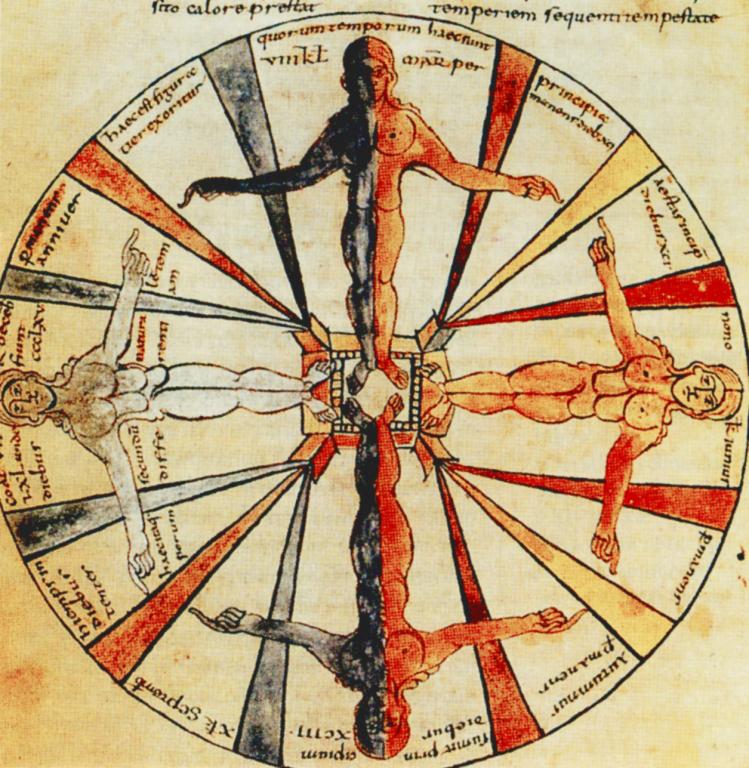
Isidore of Seville’s De natura rerum, via Wikimedia Commons
In the same way, full-on magic to win the lottery will have more effect on your life than your bank account. Poorly-designed magic, built without understanding, is the stuff of nightmares and lingering damage.
With that in mind, magic can be a useful skill and there are reasonable(-ish) ways to go about learning it. But when it comes to practicing magic, we need to keep a few things in mind.
It would be unfair to say that everything we already know about learning is wrong. We learn and develop skills every day, and in many ways, magic is just another skill.
But just because we manage to muddle through the process, that does not mean we understand it well. We might drive to and from work every day, but we are still not ready for the Indianapolis 500.
But, much like learning to drive, developing magical skills is risky business. Performing magic is at least as powerful as driving a car, and just as dangerous. With that in mind, it is important to learn how to learn magic so that we can limit our mistakes to the necessary ones.
A big difference between driving a car and performing magic is that most driving involves following well-laid paths. The dangers mostly come from other people.
The West has few well-laid magical paths, and they may not go where you need to go. In learning magic, we tend to spend an inordinate amount of time metaphorically off-roading as we develop our skills. Beyond the basics, we are often on our own and learning by trial and error.
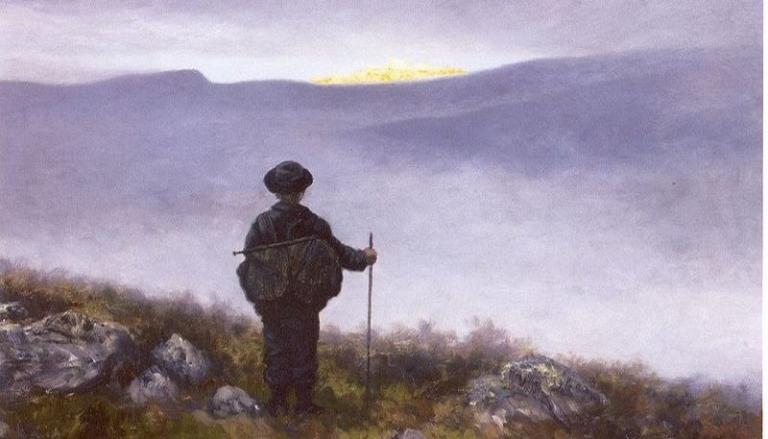
“Soria Moria” by Theodor Kittelsen. From WikiMedia.
Developing any skill is a challenge; developing one as far-reaching as magic is especially difficult. Most skills that we learn, from programming to cooking, take place in a cultural context. That is, they work because we all live in a constructed world that rests atop the geography of the real.
Magic is a skill that allows us to penetrate from the known to the real. That is its charm and its power. It is also its challenge.
For most of us, the “learning” we have done in our lives was modeled by people who do not understand natural rhythms. So, the way we have learned to learn will not work with magic. As we learn to interact with a larger, deeper universe, we have to understand not just the everyday world but the patterns that underlie it.
Yes, that is a lot to take into consideration. But a deeper understanding of nature, both internal and external, can show us better how to learn magic without something blowing up in our faces.
The Seasons of Learning
Because the skills of magic are not built, but grown organically from the interaction of knowledge and action, they follow the same natural path as all other things. With that in mind, we can talk about the four seasons of learning a skill.
Spring
First is spring. Here, we study, learning the language of the thing we want to do. This is the phase where we are most receptive, accepting information from the outside.
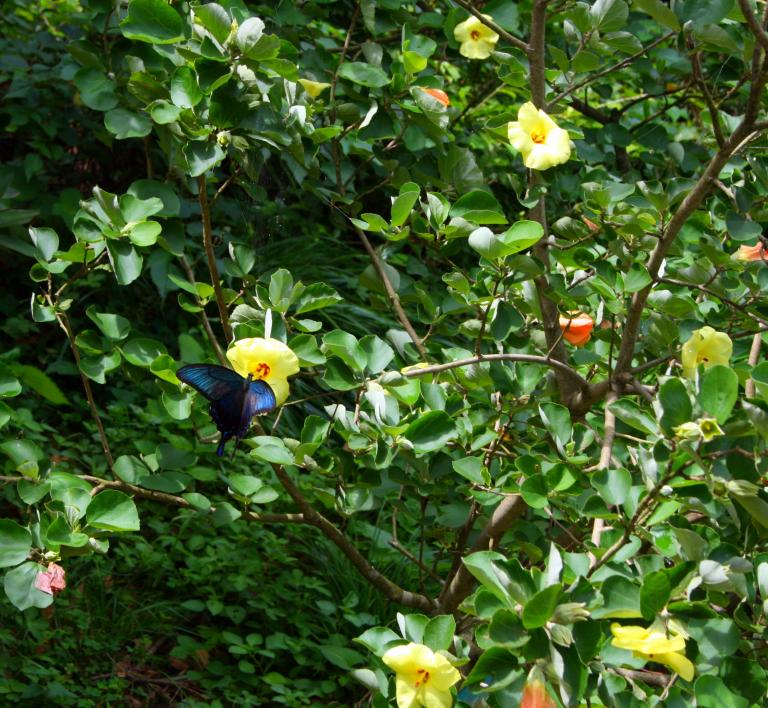
Blue Butterfly, Seongsan Sunrise Peak ©2010 Polly Peterson, used with permission
For example, to use the perennial example of the LBRP, this is the part of the process where we read about the history of the ritual, learn the meaning of the words, and the basis of the various symbols. But in learning a magical tradition, this same pattern holds.
In this phase, we have never actually done the ritual, or magic, itself. We have no experience, just concepts.
Summer
After spring come summer. This is where we apply what we have learned. Thoughts transition into action. But, if we are smart, we practice in a controlled environment. This is where we take up the ritual knife, wand, or other tool and act!
We start by fumbling through the ritual for the first time. We know the words, but they do not come unthinkingly to our lips. Here, the ritual itself is an act we perform.
But, for the first time, we have real experience of what the ritual means. From the land of the mind, we have moved to the body.
Autumn
After we have grown the skill inside ourselves, it is time to implement it. What we learn must be trained it in the real world. This is the autumn, where we harvest what we need and shed what we do not.
This is when magic becomes truly useful. It is the phase of the spirit, and during this time, it is likely that tests and challenges will “magically” appear before you.
Here, your training expands from mind and body to spirit. As this happens, your spirit will bring you face to face with what you need to overcome. Remember that in the world of the spirit there are no accidents.
Winter
Winter is the season that everyone wants to leave out. After a cycle of growth, there is a necessary time of quiescence. This is the “plateau” of training, where it seems like no progress is being made.
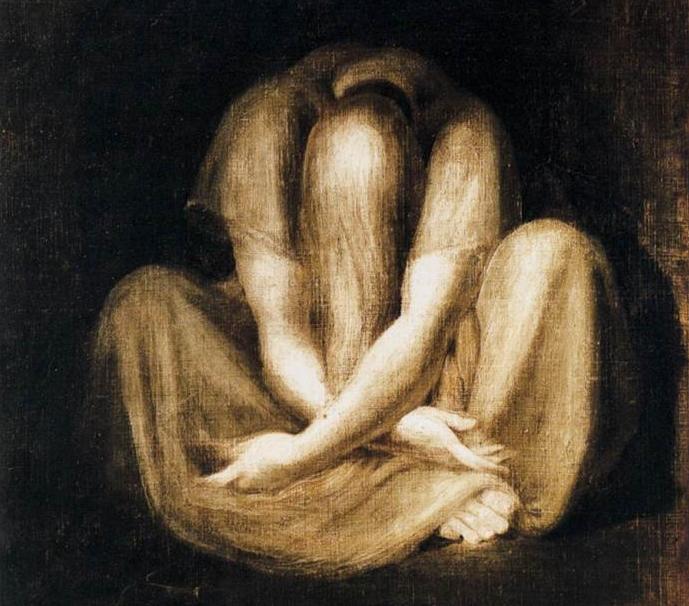
Silence. Henry Fuseli, via Wikimedia Commons
This phase is why it is a terrible idea to do a ritual a hundred times in a row to learn it. Such an approach will not create any depth, compared to a hundred times on a hundred different days.
This season is the season of the soul. It is where we integrate what we have learned into the deepest parts of ourselves. Until we have done this, we cannot continue the cycle.
Skill, Depth, and Expansion
Developing skill is both recursive and cyclical. Each step can be broken down into further steps. By the very nature of things, each phase is made of four phases, and that in turn is made of four phases, and on and on. But also, each cycle of phases is followed by another cycle. Each year, the seeds and planted and the harvest is taken. But there will come the next year, and the cycle continues.
Within this pattern, there is space for both infinite depth and infinite expansion. For a practical example, infinite depth would mean practicing the same spell over and over, always developing facility and deeper application. Infinite expansion means developing new spells out of the seeds of that one spell, expanding the purpose and utility.
To be sure, depth and expansion is not an either/or option. Too much expansion without depth creates flimsy practice. Too much depth without expansion promotes inflexibility. It is better to take advantage of both properties to create skills (and a self!) that are strong, yet flexible.
Season
Phase
Action Spring
Study
Accepting new knowledge Summer
Practice
Applying what we have learned Autumn
Train
Implementing the new skills in real life Winter
Rest
Integrating the new growth
Previous Post

November 17, 2018
A Deep Dive on Thanksgiving
Next Post

December 15, 2018 Habit, Freedom, and Daily Practice
Browse Our Archives
Select a Category Columns History Holidays Politics Ritual and Practice The Other Side of the Hedge Theology, Ethics, Philosophy
Select a Month June 2019 May 2019 April 2019 March 2019 February 2019 January 2019 December 2018 November 2018 October 2018 September 2018 August 2018 July 2018 June 2018 May 2018 April 2018 March 2018 February 2018 January 2018 November 2017 October 2017 September 2017 August 2017 July 2017 June 2017 May 2017 April 2017 March 2017 February 2017 January 2016 December 2015 November 2015 October 2015 September 2015
TAKE THE
Religious Wisdom Quiz
What metaphor does Paul use in Galatians to describe the law's role before Christ came?
Select your answer to see how you score.
A father A shepherd A guardian A judge
Related posts from The Other Side of the Hedge




TRENDING AT PATHEOS Pagan

I was recently chatting with someone on Instagram. She asked me what...

While there are many people who share their results, the end of...

On July 23, I saw Christopher Nolan's The Odyssey which is Homer’s...

As I write this two big events have just finished up. One...

Restoring the Watershed of Divine Love
Perhaps cooperation is not something we manufacture through legislation, ideology, or moral...

Many UUs don’t pray because of bad experiences in a previous religion,...
view all Pagan blogs
Ad-Free & Subscriber Log-In Subscription Support
- About Us
- 2026 Calendar
- Videos
- Podcasts
- Library of World Religions
- Faith In Media Tracker
- Advertise With Us
- Write for Us
- Privacy Policy
- Terms of Service
- Do Not Sell My Data
- Contact Us
- Radiant Digital
- Manage Newsletter Subscriptions
- Unsubscribe From Notifications
- Sitemap
Copyright 2008-2026, Patheos. All rights reserved.
Subscription Support Ad-Free & Subscriber Log-In
Follow Patheos