
BuddhistCatholicContemplativeEvangelicalGeneral ChristianHinduJewishLatter-day SaintMuslimNew VisionsProgressive Christian
Beliefs
- Buddhist
- Catholic
- Contemplative
- Evangelical
- General Christian
- Hindu
- Jewish
- Latter-day Saint
- More Voices
- Muslim
- New Visions
- Pagan
- Progressive Christian
Topics
- Religion News
- Food and Religion
- Sports and Religion
- Religious Art
- Religious Music and Entertainment
- Religious Events
- History and Religion
- Style and Religion
- Politics and Religion
- Women in Religion
- Recreation Outdoors and Religion
- Business Finance and Religion
- Careers Workplace and Religion
- Education and Religion
- Family Parenting and Religion
- Health Fitness and Religion
- Home and Religion
- Relationships and Religion
- Technology and Religion
- Travel and Religion
Columnists
- Buddhist Columnists
- Business Finance and Religion Columnists
- Careers Workplace and Religion Columnists
- Catholic Columnists
- Contemplative Columnists
- Education and Religion Columnists
- Evangelists Columnists
- Family Parenting and Religion Columnists
- General Christian Columnists
- Health Fitness and Religion Columnists
- Hindu Columnists
- History and Religion Columnists
- Home and Religion Columnists
- Jewish Columnists
- More Voices Columnists
- Latter Day Columnists
- Muslim Columnists
- New Visions Columnists
- Nonreligious Columnists
- Pagan Columnists
- Politics and Religion Columnists
- Progressive Columnists
- Recreation Outdoors and Religion Columnists
- Relationships and Religion Columnists
- Religion News Columnists
- Religious Art Columnists
- Religious Events Columnists
- Religious Music and Entertainment Columnists
- Sports and Religion Columnists
- Style and Religion Columnists
- Technology and Religion Columnists
- Travel and Religion Columnists
- Women in Religion Columnists
Resource Library
- 2026 Calendar
- Library of World Religions
- The 100 Most Holy Places on Earth
- Patheos Answers
- Podcasts
- Videos
- Faith Leaders Database
- Anglican Episcopalian
- Bahai
- Baptist
- Buddhism
- Christianity
- Confucianism
- Eastern Orthodoxy
- Hinduism
- Holiness and Pentecostal
- ISKCON
- Islam
- Judaism
- Lutheran
- Methodist
- The Church of Jesus Christ of Latter-day Saints
- New Age
- Paganism
- Presbytarian and Reformed
- Protestantism
- Religion Behind the Scenes
- Roman Catholic
- Scientology
- Shia Islam
- Sikhism
- Sufism
- Sunni Islam
- Taoism
- Zen
- See all religions
Research Tools
 Ad-Free & Subscriber Log-In Subscription Support
Ad-Free & Subscriber Log-In Subscription Support
Follow Patheos 

- Trending:
- Forgiveness
- |
- Marriage
- |
- Consciousness
- |
- Death Penalty
- |
- Election
- |
- Halloween
 The Other Side of the Hedge
- Home
- Pagan
- Habit, Freedom, and Daily Practice
Habit, Freedom, and Daily Practice
Last updated on: April 28, 2019 at 8:56 am by Christopher Drysdale
Habit, Freedom, and Daily Practice 2019-04-28T08:56:43-07:00 Christopher Drysdale
Patheos Explore the world's faith through different perspectives on religion and spirituality! Patheos has the views of the prevalent religions and spiritualities of the world.
We are all creatures of habit. In fact, on most days, habit controls most of the things we do. But rather than tear against it in a quest for some sense of freedom, we can reshape those same chains into our tools of escape. This can be accomplished through daily practice.
People come to the Path of Transformation to change their lives. The Path is not solely about magic, or communion with the gods, or direct experience of the spiritual side of life. It contains all of these things because it is the path to freeing ourselves.
Transformation is broader than simply changing our lives. The goal is not to transform your life, but to become one who can transform. When we have become who and what we really are, then we can turn ourselves to anything we desire.(1)
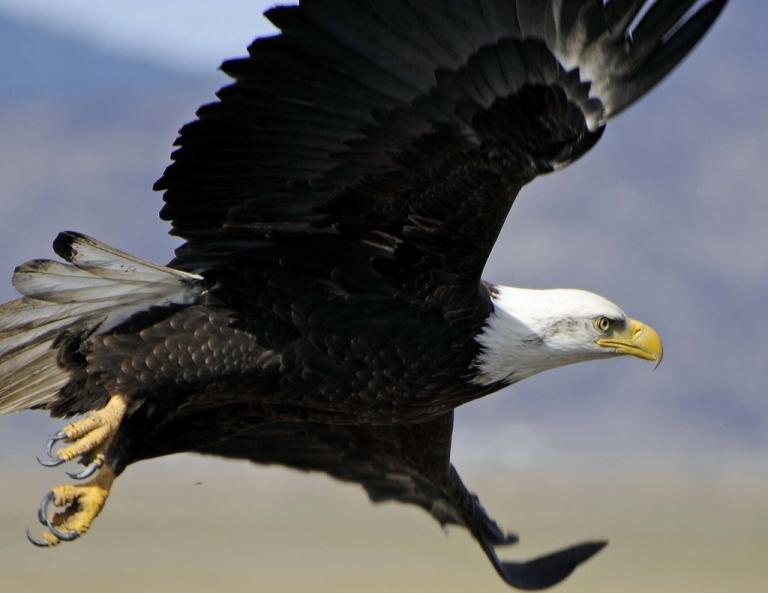
By U.S. Fish and Wildlife Service Headquarters (American Bald Eagle), via Wikimedia Commons
The generalized self-help guru is wrong. We are not just in bondage to our habits, and it is not simply a matter of changing our mind to set ourselves free.
To be free, we must understand our chains and the purpose they serve. Before we slip loose, we must to learn how to live without them.
The Value of Habit
Our inculcated habits, however much we might resent them, provide a useful framework for our lives. But we have been given the habits that shape who we are. And when we begin to grow, we may find that they are a poor fit for who we are becoming.
Sustaining a habit is not hard; that is the point. We eat regularly enough, go to work, watch television, and buy the things that “should” fulfill us. These are all habits. And if that is the life we are happy with, then all is well.
Where we get into “trouble” is when those chains of habit begin to chafe — when we realize that there is a broader world out there beyond what we have been taught, and we make the choice to pursue it.

The Fire from Within, ©2017 Polly Peterson, used with permission
Anyone can set themselves free at any time. The idea that we cannot be free is an illusion. But freedom without the skill to understand and manage it is simply exile from everything we have ever known.
Are we free to simply cast our habits, our chains, our controlled selves aside? Yes, and there are many people in prison who did so unthinkingly.(2)
We must find a way to set ourselves free that is sustainable. Breaking free is easiest thing in the world, but living free is a different matter.
On the Path of Transformation
The Path of Transformation is how we create real change in our lives. Without freedom, we are limited to certain narratives. We will experience birth, training, work, and death. There are variations we call “success” and “failure” but we all live lives of servitude.
Everyone holds onto a thousand habits, and most of those serve us poorly. They were not designed for our benefit, but to maintain the ridiculous balancing act that allows seven billion primates to get along well enough.(3)
Humans manage to live together because most everyone of us walks around constantly restrained. Culture restrains us, but at the same time gives us vast benefits. It is a trade-off, and on the whole, humanity cannot have one without the other.

Change will turn the world upside down. – Photo by author (c)2018
We are all one moment, one choice, from setting ourselves free. The challenge is not seizing freedom, but rather preparing ourselves so that we can maintain it. Anyone can be free for five minutes; living free is the hardest thing in the world.
ProTip: There is one freedom that no one can have: the freedom from consequences. Now, that does not mean that consequences are always what we think they will be.
We use shorthand to understand this idea of consequences. “Sin” is a disruption of a wider world we cannot see. “Karma” is the inevitable result of an action. “Punishment” is how we feel when it happens to us. None of these things are, at their roots, true. But they all have things worth saying about the human experience.
The Nature of Our Chains
As people living in society, we are restrained in mind, body, and spirit. But the most effective of these chains, and the first ones to understand, exist in the mind. These are the easiest chains to see.
We are restrained in our lives by habit of mind. All of our mental resources are taken up interacting with other people in society. From struggling for promotion to obsessing about celebrities’ lives, we dump all of our thinking into the narrow channels of habit set for us.
The first barrier to freedom is that we cannot see it and cannot imagine it. With a few exceptions, everything we know exists inside the metaphorical walls of our minds. And those walls are made of habits.
But those habits are not simple thoughts living in our heads. This is where self-help falls short. Breaking free of the everyday mind is not the end of the path, but only the first step.
Beasts of Burden
The habits that bind us to the everyday world are much like the slip-chains, or “choke” chains, used on aggressive dogs. A choke-chain is a collar that hangs loose as long as we do not struggle against it. Yet when we pull against the chain, it tightens and cuts off our air.
The rules of society work the same way. As long as we walk around complacent, go where we are told, and do what we are supposed to do, our collars feel light and hardly restrain us at all. But when we begin to pull against our collars, we learn the truth.
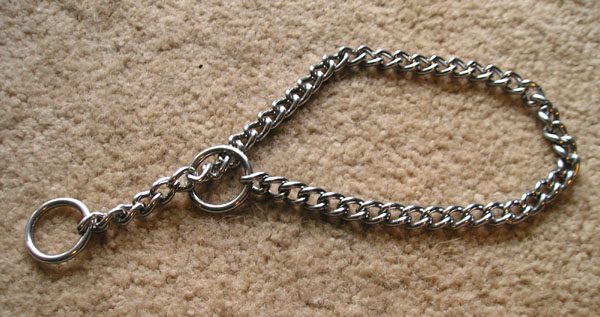
A slip-chain, via wikimedia commons
Human or dog, a choke collar only works against a dumb beast. If we can turn ourselves into something more than brutes ruled only by instinct and desire, then we can puzzle our way out of the collar.
These days, the collars we wear are not made of metal, but of thought and spirit and need. Once we can control our own thoughts, take ownership of our own spirits, and understand the reality of our needs, we can become free.
The Skill of Freedom
The skill that we must learn, in our search for freedom, is to become still. We have to learn to rest the body, silence the mind, and quiet the spirit.
Without that? The moment we slip free of our collars we will transform from beasts of burden to wild animals. And while that might sound wonderful, it will generally be brief. The other primates around us, terrified, will look to their own safety.(4)
And so the basic challenge of daily practice is to learn to control our own minds, bodies, and spirits. And the point of lesson is to learn to do nothing.
To Master Yourself, Do Nothing
We have spent our entire lives learning to “do” things, and in fact to do the things we are told. We have not learned how to not-do anything.
Only by training ourselves to inaction – without thought, without movement, and without desire – can we come to rest. And we begin (not end) by doing nothing.
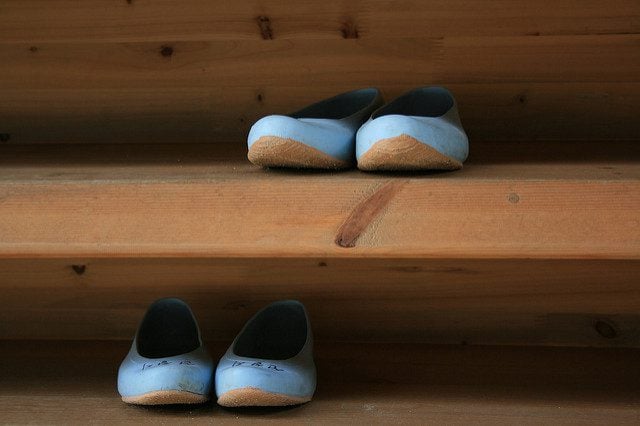
Monk Shoes – (c)2009 Polly Peterson, used with permission
This is why meditation is worth studying. Without knowledge of stillness, we cannot see the motion around us.
Before we can remain still, the chains that bind us also seem to be a part of us. But when we become motionless, entirely silent, then our bonds become apparent. Only by becoming still can we know what pulls us this way and that.
Motion as Meditation
As a counterpoint to learning how to sit still, we can also learn how to move in a controlled fashion. This is a common practice, and can be seen in yoga, in ritual magic, and in the martial arts.
When we talk about these disparate practices, we often think in terms of knowledge and learning. But beyond the process of learning is the sustained daily practice, and this is where we begin to really make progress.
All of these practices will, in time, teach you to bind together the mind, body, and spirit. It might not be the first time, or the hundredth. But eventually, your practice will “do itself” and all your disparate parts will begin to move as one.
Whether our practice is primarily devotion, magical ritual, or self-cultivation hardly matters. There is little use in worrying about what we call our practice or how we feel about it. What matters is that we commit ourselves, day in and day out, to the work.
Notes
(1) I just want to add two points here: First, that nothing in life is free. With the knowledge of how to become anything may also come the wisdom of why some paths are worse choices than others. Second, the transformations I am describing are of state, and not form. I am not talking about turning yourself into a bird, but rather turning yourself into a complete human being.
(2) That is not to say that all people in prisons need to be there. The world is a sight more complicated than that!
(3) I am all for supporting the balancing act that allows humans to make it from day to day in relative peace and prosperity. However, we practitioners, from Christian monks to solitary Wiccans, must able to choose, rather than be chained. Blind faith is servitude.
(4) Do not underestimate other people. Never think that just because someone is not free, they are not dangerous. They may be predictable in certain ways, but freedom and power have little to do with each other.
Previous Post
December 2, 2018
On Developing Skill in Magic
Next Post

January 5, 2019 Three Real Stories of Magic
Browse Our Archives
Select a Category Columns History Holidays Politics Ritual and Practice The Other Side of the Hedge Theology, Ethics, Philosophy
Select a Month June 2019 May 2019 April 2019 March 2019 February 2019 January 2019 December 2018 November 2018 October 2018 September 2018 August 2018 July 2018 June 2018 May 2018 April 2018 March 2018 February 2018 January 2018 November 2017 October 2017 September 2017 August 2017 July 2017 June 2017 May 2017 April 2017 March 2017 February 2017 January 2016 December 2015 November 2015 October 2015 September 2015
TAKE THE
Religious Wisdom Quiz
What was the primary liquid measurement in Biblical times?
Select your answer to see how you score.
Hin Bath Cor Ephah
Related posts from The Other Side of the Hedge




TRENDING AT PATHEOS Pagan

I was recently chatting with someone on Instagram. She asked me what...

While there are many people who share their results, the end of...

On July 23, I saw Christopher Nolan's The Odyssey which is Homer’s...

As I write this two big events have just finished up. One...

Restoring the Watershed of Divine Love
Perhaps cooperation is not something we manufacture through legislation, ideology, or moral...

Many UUs don’t pray because of bad experiences in a previous religion,...
view all Pagan blogs
Ad-Free & Subscriber Log-In Subscription Support
- About Us
- 2026 Calendar
- Videos
- Podcasts
- Library of World Religions
- Faith In Media Tracker
- Advertise With Us
- Write for Us
- Privacy Policy
- Terms of Service
- Do Not Sell My Data
- Contact Us
- Radiant Digital
- Manage Newsletter Subscriptions
- Unsubscribe From Notifications
- Sitemap
Copyright 2008-2026, Patheos. All rights reserved.
Subscription Support Ad-Free & Subscriber Log-In
Follow Patheos