
BuddhistCatholicContemplativeEvangelicalGeneral ChristianHinduJewishLatter-day SaintMuslimNew VisionsProgressive Christian
Beliefs
- Buddhist
- Catholic
- Contemplative
- Evangelical
- General Christian
- Hindu
- Jewish
- Latter-day Saint
- More Voices
- Muslim
- New Visions
- Pagan
- Progressive Christian
Topics
- Religion News
- Food and Religion
- Sports and Religion
- Religious Art
- Religious Music and Entertainment
- Religious Events
- History and Religion
- Style and Religion
- Politics and Religion
- Women in Religion
- Recreation Outdoors and Religion
- Business Finance and Religion
- Careers Workplace and Religion
- Education and Religion
- Family Parenting and Religion
- Health Fitness and Religion
- Home and Religion
- Relationships and Religion
- Technology and Religion
- Travel and Religion
Columnists
- Buddhist Columnists
- Business Finance and Religion Columnists
- Careers Workplace and Religion Columnists
- Catholic Columnists
- Contemplative Columnists
- Education and Religion Columnists
- Evangelists Columnists
- Family Parenting and Religion Columnists
- General Christian Columnists
- Health Fitness and Religion Columnists
- Hindu Columnists
- History and Religion Columnists
- Home and Religion Columnists
- Jewish Columnists
- More Voices Columnists
- Latter Day Columnists
- Muslim Columnists
- New Visions Columnists
- Nonreligious Columnists
- Pagan Columnists
- Politics and Religion Columnists
- Progressive Columnists
- Recreation Outdoors and Religion Columnists
- Relationships and Religion Columnists
- Religion News Columnists
- Religious Art Columnists
- Religious Events Columnists
- Religious Music and Entertainment Columnists
- Sports and Religion Columnists
- Style and Religion Columnists
- Technology and Religion Columnists
- Travel and Religion Columnists
- Women in Religion Columnists
Resource Library
- 2026 Calendar
- Library of World Religions
- The 100 Most Holy Places on Earth
- Patheos Answers
- Podcasts
- Videos
- Faith Leaders Database
- Anglican Episcopalian
- Bahai
- Baptist
- Buddhism
- Christianity
- Confucianism
- Eastern Orthodoxy
- Hinduism
- Holiness and Pentecostal
- ISKCON
- Islam
- Judaism
- Lutheran
- Methodist
- The Church of Jesus Christ of Latter-day Saints
- New Age
- Paganism
- Presbytarian and Reformed
- Protestantism
- Religion Behind the Scenes
- Roman Catholic
- Scientology
- Shia Islam
- Sikhism
- Sufism
- Sunni Islam
- Taoism
- Zen
- See all religions
Research Tools
 Ad-Free & Subscriber Log-In Subscription Support
Ad-Free & Subscriber Log-In Subscription Support
Follow Patheos 

- Trending:
- Forgiveness
- |
- Marriage
- |
- Consciousness
- |
- Death Penalty
- |
- Election
- |
- Halloween
 The Other Side of the Hedge
- Home
- Pagan
- The Wheel of the Year in a Single Breath
The Wheel of the Year in a Single Breath
Last updated on: October 21, 2018 at 9:12 am by Christopher Drysdale
The Wheel of the Year in a Single Breath 2018-10-21T09:12:42-07:00 Christopher Drysdale
Patheos Explore the world's faith through different perspectives on religion and spirituality! Patheos has the views of the prevalent religions and spiritualities of the world.
Autumn has arrived in the valley, and leaves are turning. Gold, red, and brown leaves dance on the trees and litter the streets. There is an anticipation of change in the air. It is in these brief moments, when the season shifts, that we can most easily sense the Wheel.
As the fall comes upon us, we begin to turn within. There is a pause, a silence we cannot explain, only sense. Yet we have little understanding of this process. Most of us grew up fairly divorced from the natural world around us.
We work the same length days all year round, living by the clock rather than the sun. In pursuit of certainty in a chaotic world, we close our eyes to the subtleties around us.
Still, the seasons affect us. As a culture, we simply lack the language to understand those effects.
Striving to live a whole life**(1)** means navigating the tension between our own natures as living beings, as animals, and our roles as productive members of society. We have abandoned many of the natural cycles in our lives, and it is the things that we ignore that come back to bite us.
Turning on the Wheel of the Year
As Pagans, we can talk pretty comfortably about the existence of cycles in nature.(2) We speak easily of the turning of the seasons, waning and waxing of the moon, and even the phases of life.
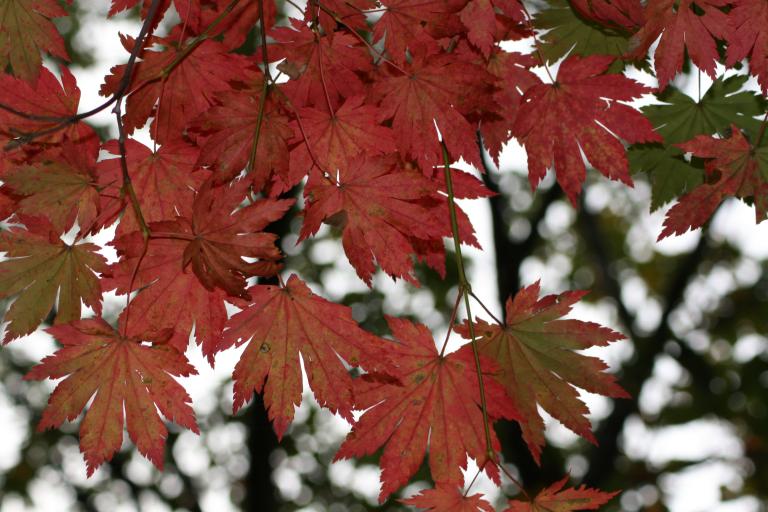
Japanese Maple, Seoraksan National Park, ©2008 by Polly Peterson, used with permission
But the Wheel of the Year is not just a solar festival calendar; that is only the way we first come to understand it. The Wheel is a map for understanding all natural processes and all cycles of change.
In the beginning, we learn the festivals of the year. This is not just about planning holidays. The purpose of the Wheel of the Year is to help us bring our thinking in line with natural cycles. By aligning what we think with the natural world, we can once more find our connection with the world outside of us.
The Wheel is more than a religious calendar. It helps us understand every cycle, and is not just limited to the solar year. The Wheel of the Year is also the Wheel of the Moon, of Life, and of Breath. The wheel provides the Pagan way of understanding change.
The More Things Change
Living in the everyday world, we are obsessed with things. We see the world through a lens of static-ness.
This is a sapling. That is a tree. Over there is a log for a fire, a board in a house, or mulch for a garden. We know that there are connections between these things, but since our learned relationship with the world is based on a thing’s usefulness, there is no value in accepting the inherent continuity.
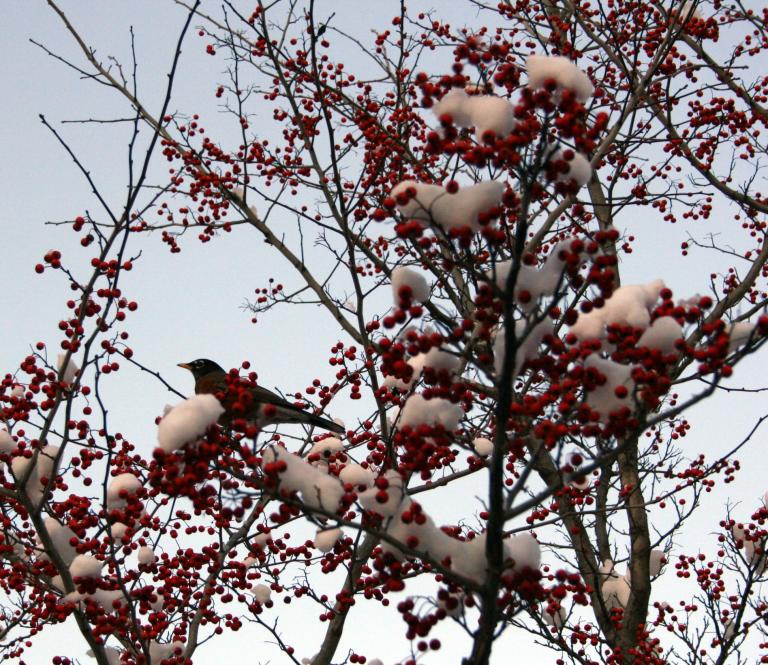
Winter’s First Snowfall ©2010 Polly Peterson, used with permission
If we take a step back, however, the world is not one of things, but of processes. Unfortunately, we only have poor language for understanding that reality. It cannot be easily understood or explained. It must be related mythologically, and then apprehended personally.
When we tell the story of the Wheel of the Year, we imply that is also the Wheel of Life. There is a cycle of birth, life, death, fallow, and rebirth once again.(3)
The story of the year becomes a lens for understanding vast processes beyond the known. If the Wheel of Life were the only cycle, we could scarcely comprehend it. But the world is made of these cycles.
The Wheel of Breath
The Wheel reflects the yearly, monthly, and daily cycles of life. These are real cycles, that guide the paths of both animals and farmers. But there are shorter cycles as well.
Breath is the most basic of needs. We can go without water for a couple of days; food for a few weeks. Breath? In most cases, about seven minutes.
Each breath we take contains the Wheel in miniature. We inhale air, pause for a moment in transition, breathe that transformed air out, and pause once more before inhaling again.
Experiencing the Wheel of Breath
This simple exercise can show how the Wheel is expressed through breath. Begin by finding a seat somewhere quiet where you will not be disturbed, and let yourself relax a bit.
The first goal is to get to a point where you can watch how your mind talks to itself. The second is to see how breathing affects our state of being.
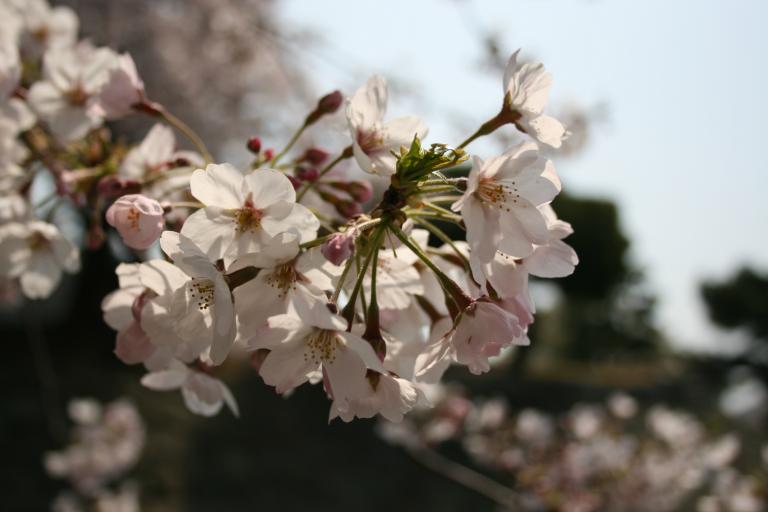
Cherry Blossoms, Naval Academy, Jinhae ©2010 Polly Peterson, used with permission
At first, just let your mind chatter away. There is no need to control it, this is just your identity reaffirming itself to itself.
Now, begin to regulate your breath. Slowly, expel as much air from your lungs as possible. Pause for a few seconds, and then slowly inhale. Hold, then exhale again. Do this slowly. Watch how your mind reacts.
At first, there might be some disturbance as your mind reacts to change. Fairly quickly, however, you will being to see effects.
The moment of complete exhale also creates a slowing, or even lull, in the chatter. It is that transition that matters.(4)
Students beginning to learn to meditate can become frustrated by their inability to quiet the mind. But closer examination shows that we only fail to recognize our moments of success.
Living is living and dead is dead. But those moments of transition, birth and dying, contain powerful shifts. Those same shifts are contained in the beginning and end of a breath.
Seasons and Phases
The Wheel is the same whether we look at a breath or a lifetime. The obviously natural cycles are only the beginning of understanding.
When we see that even “unnatural” processes follow the natural cycles, because they are built on a natural foundation, much of the unpredictability of life falls away. Change stops being a threat, and becomes inevitable and manageable.
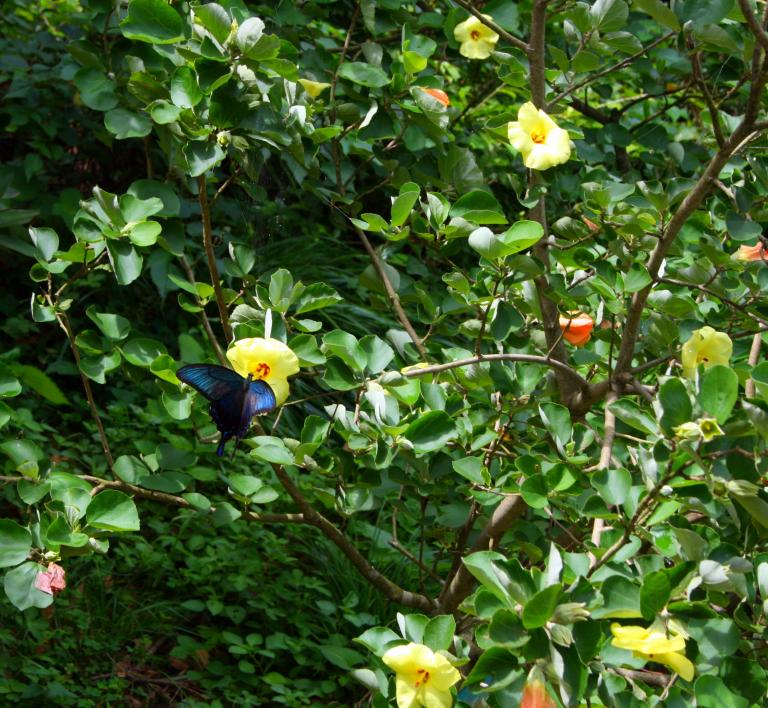
Blue Butterfly, Seongsan Sunrise Peak ©2010 Polly Peterson, used with permission
Yes, we live for a while, we dissolve, we are dead, and we come together once more, just as we have daytime, dusk, night, and dawn. There is summer, fall, and winter, then spring. The breath starts with an inhale, followed by a pause, and the exhale, and a pause once more.
All of these are the Wheel. When we understand, then a year is no different from a day, and there is a lifetime in every breath.
(1) For a long time, it has been the goal of Western religion to make us “good.” But Western mysticism, like all mysticism, is more interested in making us whole.
(2) While the popularity of the Wheel is tied to the deep influence of Wicca on the Pagan community, it is also often (though not always) the link that ties our disparate groups together. Yearly holiday calendars are near-ubiquitous, and often relate to seasonal or agricultural cycles.
(3) Reincarnation often implies that there is a unitary self that passes through phases of birth, life, dying, and rebirth. My experience (as someone who has crossed over and back, more or less fully aware) implies a more nuanced view. While something certainly goes on, and something comes back, it is not properly bounded or truly separate from anything else.
(4) Teachers often talk about how they also learn from their students. Sometimes the idea seems trite. Yet, here is a real-world example: I learned about this particular pause in the mind while trying to explain inner silence to a student. Without him, I would not know. And this is why teachers express such gratitude.
Previous Post

October 13, 2018
This Halloween, Reveal Yourself
Next Post

November 3, 2018 Keep It Secret
Browse Our Archives
Select a Category Columns History Holidays Politics Ritual and Practice The Other Side of the Hedge Theology, Ethics, Philosophy
Select a Month June 2019 May 2019 April 2019 March 2019 February 2019 January 2019 December 2018 November 2018 October 2018 September 2018 August 2018 July 2018 June 2018 May 2018 April 2018 March 2018 February 2018 January 2018 November 2017 October 2017 September 2017 August 2017 July 2017 June 2017 May 2017 April 2017 March 2017 February 2017 January 2016 December 2015 November 2015 October 2015 September 2015
TAKE THE
Religious Wisdom Quiz
What is the lesson of the Parable of the Wheat and the Weeds?
Select your answer to see how you score.
Judgment will separate good and evil Water the crops often Sow only good seed Never trust a stranger
Related posts from The Other Side of the Hedge




TRENDING AT PATHEOS Pagan

When we talk about Greek religion, we often begin with the dodekatheion—the...

I was recently chatting with someone on Instagram. She asked me what...

While there are many people who share their results, the end of...

On July 23, I saw Christopher Nolan's The Odyssey which is Homer’s...

As I write this two big events have just finished up. One...

Restoring the Watershed of Divine Love
Perhaps cooperation is not something we manufacture through legislation, ideology, or moral...
view all Pagan blogs
Ad-Free & Subscriber Log-In Subscription Support
- About Us
- 2026 Calendar
- Videos
- Podcasts
- Library of World Religions
- Faith In Media Tracker
- Advertise With Us
- Write for Us
- Privacy Policy
- Terms of Service
- Do Not Sell My Data
- Contact Us
- Radiant Digital
- Manage Newsletter Subscriptions
- Unsubscribe From Notifications
- Sitemap
Copyright 2008-2026, Patheos. All rights reserved.
Subscription Support Ad-Free & Subscriber Log-In
Follow Patheos