
BuddhistCatholicContemplativeEvangelicalGeneral ChristianHinduJewishLatter-day SaintMuslimNew VisionsProgressive Christian
Beliefs
- Buddhist
- Catholic
- Contemplative
- Evangelical
- General Christian
- Hindu
- Jewish
- Latter-day Saint
- More Voices
- Muslim
- New Visions
- Pagan
- Progressive Christian
Topics
- Religion News
- Food and Religion
- Sports and Religion
- Religious Art
- Religious Music and Entertainment
- Religious Events
- History and Religion
- Style and Religion
- Politics and Religion
- Women in Religion
- Recreation Outdoors and Religion
- Business Finance and Religion
- Careers Workplace and Religion
- Education and Religion
- Family Parenting and Religion
- Health Fitness and Religion
- Home and Religion
- Relationships and Religion
- Technology and Religion
- Travel and Religion
Columnists
- Buddhist Columnists
- Business Finance and Religion Columnists
- Careers Workplace and Religion Columnists
- Catholic Columnists
- Contemplative Columnists
- Education and Religion Columnists
- Evangelists Columnists
- Family Parenting and Religion Columnists
- General Christian Columnists
- Health Fitness and Religion Columnists
- Hindu Columnists
- History and Religion Columnists
- Home and Religion Columnists
- Jewish Columnists
- More Voices Columnists
- Latter Day Columnists
- Muslim Columnists
- New Visions Columnists
- Nonreligious Columnists
- Pagan Columnists
- Politics and Religion Columnists
- Progressive Columnists
- Recreation Outdoors and Religion Columnists
- Relationships and Religion Columnists
- Religion News Columnists
- Religious Art Columnists
- Religious Events Columnists
- Religious Music and Entertainment Columnists
- Sports and Religion Columnists
- Style and Religion Columnists
- Technology and Religion Columnists
- Travel and Religion Columnists
- Women in Religion Columnists
Resource Library
- 2026 Calendar
- Library of World Religions
- The 100 Most Holy Places on Earth
- Patheos Answers
- Podcasts
- Videos
- Faith Leaders Database
- Anglican Episcopalian
- Bahai
- Baptist
- Buddhism
- Christianity
- Confucianism
- Eastern Orthodoxy
- Hinduism
- Holiness and Pentecostal
- ISKCON
- Islam
- Judaism
- Lutheran
- Methodist
- The Church of Jesus Christ of Latter-day Saints
- New Age
- Paganism
- Presbytarian and Reformed
- Protestantism
- Religion Behind the Scenes
- Roman Catholic
- Scientology
- Shia Islam
- Sikhism
- Sufism
- Sunni Islam
- Taoism
- Zen
- See all religions
Research Tools
 Ad-Free & Subscriber Log-In Subscription Support
Ad-Free & Subscriber Log-In Subscription Support
Follow Patheos 

- Trending:
- Forgiveness
- |
- Marriage
- |
- Consciousness
- |
- Death Penalty
- |
- Election
- |
- Halloween
 The Other Side of the Hedge
- Home
- Pagan
- A Deep Dive into Animism
A Deep Dive into Animism
Last updated on: March 9, 2019 at 7:13 am by Christopher Drysdale
A Deep Dive into Animism 2019-03-09T07:13:01-08:00 Christopher Drysdale
Patheos Explore the world's faith through different perspectives on religion and spirituality! Patheos has the views of the prevalent religions and spiritualities of the world.
The very term animism was used by early anthropologists to conjure a more “primitive” world before the eyes of their readers. But there is another part to the conversation.
To be an animist means to understand that the worlds of both the spirit and the physical exist. The two can be experienced, side-by-side. This attitude is not a matter of religion, or belief. It becomes, in time, a matter of phenomenology, and eventually simple practicality.
The idea that the world is alive is kind of cool. But the experience of animism can go so far past that there there are literally no words.
Our minds can easily understand that this rock, or that tree, is alive. That is where we can begin.
Sitting with a Tree
This is a simple exercise to begin to experience the world animisticly. To start, go ahead and find a decent-sized tree, somewhere a bit private and outside enough that its roots are in the earth.
A tree in your back yard would be fine. But the more wild the setting, the easier it will be to get results. A bit of that is the tree, and some of it is you. Simply being in the wilderness will help you break the patterns of interaction that we all develop living in society.
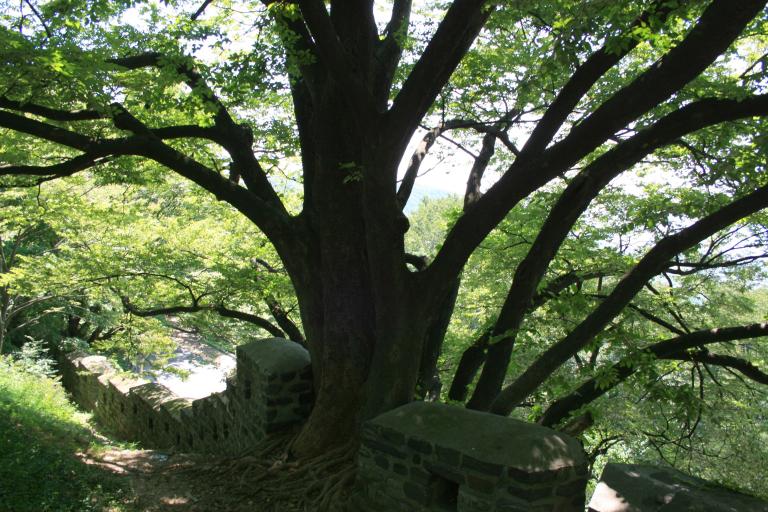
Ancient Tree in a Fortress Wall, Namsan ©2009 Polly Peterson, used with permission
If you live somewhere treeless, you might find some other feature. For this exercise, you will not want to seek out something with the power to overwhelm you. A mountain, for example, would be a poor choice.
If a tree is not an option, I recommend something that is alive, but does not move. The idea is to find something that lives for quite some time, and yet does not stir from the place it lives.
Okay, now here is the hard part to wrap your mind around. I want you to introduce yourself to the tree.
Wait. What does that even mean?
There is a feeling we get when we meet another person. We look at them, get an idea of who they are relative to us, and then we approach and try to allow connection.
In general, people connect easily to one another — we think this is natural, but it is a skill. And since it is a skill, we can practice, develop, and expand it.
You can connect with a tree. As you might imagine, however, trees react slowly to people. Worse, they are not super-impressed by humans.
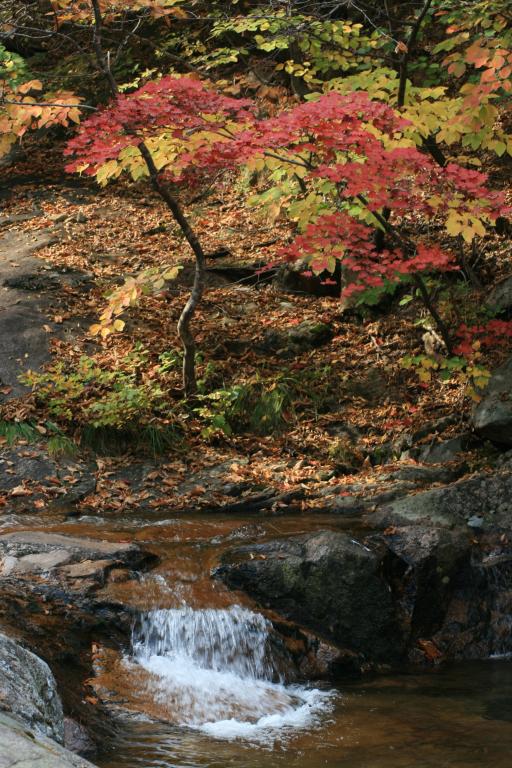
A small waterfall at Seoraksan National Park ©2008 Polly Peterson, used with permission
So, you will need to do your best to hold yourself “open” for a while and let yourself harmonize with the tree.
How can that be done? My suggestion is to grab a seat near the tree and close your eyes. Visualize walking up to the tree and offering to shake his or her hand.
When you get to that point where the tree would respond, be open. At first, this will be a bit difficult. Over time, it will get easier.
Eventually, the tree will become aware of you as well. It is quite an experience.
This might be something that you manage on the first try, or it could take a while. Either way, this is an excellent daily or weekly practice.
ProTip: If you practice this on a regular basis you might find, like I did, that connecting with other people also becomes easier. This was a large part of how I got over my “natural” shyness. I stopped trying to connect to people in my head, and started connecting to them with my heart.
Going Deeper
Sitting with a tree works because, as physical beings, we humans have very little in common with trees. While we move around with our feet, they rest in one place. While we struggle for sustenance daily, their perspective is a matter of years.
And yet we are both alive. As spiritual beings, there is less of a gap. Practicing sitting with a tree is a way of accessing your own spirit, but in a very practical and unassuming way.
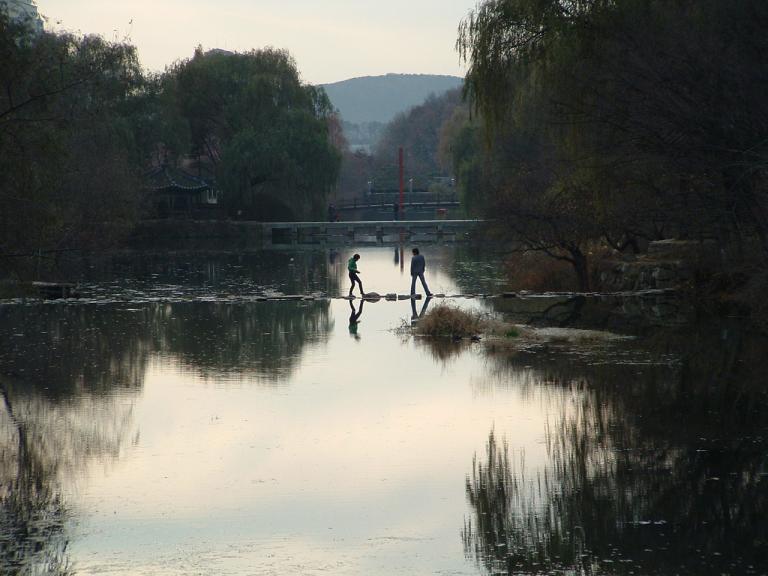
Stepping Stone Bridge ©2008 Polly Peterson, used with permission
The purpose of all this is not to abandon the physical for the spiritual. Instead, the goal is to find the balance and interaction of the two.
When we truly balance the physical and the spiritual within ourselves, the sacred will open to us. But for now, that is nothing to worry about. For now, you can just learn to sit with a tree. And then maybe a rock. Someday a mountain, and on from there.
Sitting with a tree is the first step in experiencing the whole of existence as both physical and spiritual, unified in the sacred. Over time, this practice will force a complete reorientation to the universe. It creates not just a new belief, but an existential crisis that reverberates through our whole lives and echoes the world around us.
The idea of animism is cute. But the reality is as overwhelming as a Christian standing at the foot of God’s throne.(1)
Gaining access to the totality of ourselves means experiencing far more of the universe than we were ever taught exists. It means going beyond belief and beyond the self as we imagine it.
Magic and Animism
There is more to animism than talking to trees. Such practices provide a deeper understanding of the self that changes the way we interact with the world.
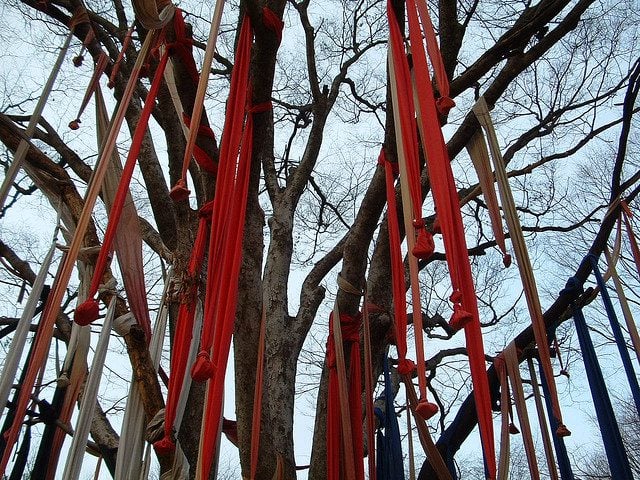
Mudang’s Tree, Korean Folk Village, YongIn, (c)2008 Polly Peterson, used with permission
Animist practice is about more than accessing all of ourselves. Once we have made the connection inside, we need to strengthen these once-abandoned parts of who we are.
One way to do that is through the practice of magic. While everyday “magic” takes up one small corner of the totality of the existence, it is perfect for helping us develop the skills we need to grow.
Most practical magic teaches us to reorient ourselves to our environment. We learn how to become a new kind of person (whether that is a person with love in their life, or a person with a car, or a person with the self-sufficiency of employment).
But magic itself is not the goal. Though it is an excellent first step we cannot skip, we are capable of becoming far more than more effective members of society. There is value in that work, but it is not the end of what can be accomplished.
Human Nature
In order to understand what a person is, we must understand what a mountain is. We all know, as members of Western society, that mountains are not truly alive. And yet we also know, as animists, that they really are. And so mountains become a perfect metaphor for each of us.
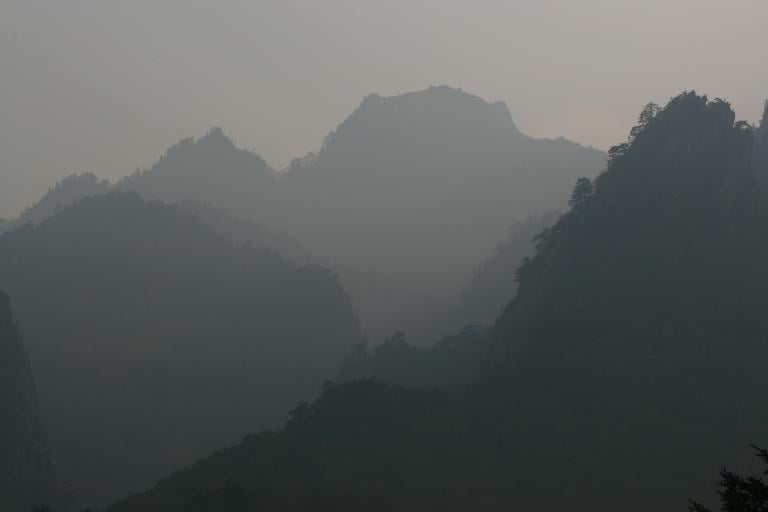
Land of Morning Calm, Seoraksan National Park ©2008 Polly Peterson, used with permission
We are, at the same time, very physical beings and spiritual ones. Any conflict between the two is only because we do not have a deep enough understanding of our own nature.
It is not uncommon, in spiritual circles, to come to believe that the spiritual is more important, more powerful, than the physical. Such an idea is dug deep in the Western psyche. But to be an animist is to be pragmatic about such things.
While training might take us places where we rely more on the spiritual than the physical, the goal in the long run is not to run away from the everyday world, but to accept its own depth and reality.
Being an animist only begins with greeting trees. It is not about the person-hood of other things, “alive” or not. It is, rather, an admission of our own unfathomable nature, matched only by the nature of each and every thing around us.
(1) Straight-up animism is not religion-lite. It is, rather, religion without a safety net.
Previous Post

September 22, 2018
Seeking Silence, Seeking Power
Next Post

October 13, 2018 This Halloween, Reveal Yourself
Browse Our Archives
Select a Category Columns History Holidays Politics Ritual and Practice The Other Side of the Hedge Theology, Ethics, Philosophy
Select a Month June 2019 May 2019 April 2019 March 2019 February 2019 January 2019 December 2018 November 2018 October 2018 September 2018 August 2018 July 2018 June 2018 May 2018 April 2018 March 2018 February 2018 January 2018 November 2017 October 2017 September 2017 August 2017 July 2017 June 2017 May 2017 April 2017 March 2017 February 2017 January 2016 December 2015 November 2015 October 2015 September 2015
TAKE THE
Religious Wisdom Quiz
Who said, "If I perish, I perish"?
Select your answer to see how you score.
Hannah Ruth Deborah Esther
Related posts from The Other Side of the Hedge




TRENDING AT PATHEOS Pagan

I was recently chatting with someone on Instagram. She asked me what...

While there are many people who share their results, the end of...

On July 23, I saw Christopher Nolan's The Odyssey which is Homer’s...

As I write this two big events have just finished up. One...

Restoring the Watershed of Divine Love
Perhaps cooperation is not something we manufacture through legislation, ideology, or moral...

Many UUs don’t pray because of bad experiences in a previous religion,...
view all Pagan blogs
Ad-Free & Subscriber Log-In Subscription Support
- About Us
- 2026 Calendar
- Videos
- Podcasts
- Library of World Religions
- Faith In Media Tracker
- Advertise With Us
- Write for Us
- Privacy Policy
- Terms of Service
- Do Not Sell My Data
- Contact Us
- Radiant Digital
- Manage Newsletter Subscriptions
- Unsubscribe From Notifications
- Sitemap
Copyright 2008-2026, Patheos. All rights reserved.
Subscription Support Ad-Free & Subscriber Log-In
Follow Patheos