
BuddhistCatholicContemplativeEvangelicalGeneral ChristianHinduJewishLatter-day SaintMuslimNew VisionsProgressive Christian
Beliefs
- Buddhist
- Catholic
- Contemplative
- Evangelical
- General Christian
- Hindu
- Jewish
- Latter-day Saint
- More Voices
- Muslim
- New Visions
- Pagan
- Progressive Christian
Topics
- Religion News
- Food and Religion
- Sports and Religion
- Religious Art
- Religious Music and Entertainment
- Religious Events
- History and Religion
- Style and Religion
- Politics and Religion
- Women in Religion
- Recreation Outdoors and Religion
- Business Finance and Religion
- Careers Workplace and Religion
- Education and Religion
- Family Parenting and Religion
- Health Fitness and Religion
- Home and Religion
- Relationships and Religion
- Technology and Religion
- Travel and Religion
Columnists
- Buddhist Columnists
- Business Finance and Religion Columnists
- Careers Workplace and Religion Columnists
- Catholic Columnists
- Contemplative Columnists
- Education and Religion Columnists
- Evangelists Columnists
- Family Parenting and Religion Columnists
- General Christian Columnists
- Health Fitness and Religion Columnists
- Hindu Columnists
- History and Religion Columnists
- Home and Religion Columnists
- Jewish Columnists
- More Voices Columnists
- Latter Day Columnists
- Muslim Columnists
- New Visions Columnists
- Nonreligious Columnists
- Pagan Columnists
- Politics and Religion Columnists
- Progressive Columnists
- Recreation Outdoors and Religion Columnists
- Relationships and Religion Columnists
- Religion News Columnists
- Religious Art Columnists
- Religious Events Columnists
- Religious Music and Entertainment Columnists
- Sports and Religion Columnists
- Style and Religion Columnists
- Technology and Religion Columnists
- Travel and Religion Columnists
- Women in Religion Columnists
Resource Library
- 2026 Calendar
- Library of World Religions
- The 100 Most Holy Places on Earth
- Patheos Answers
- Podcasts
- Videos
- Faith Leaders Database
- Anglican Episcopalian
- Bahai
- Baptist
- Buddhism
- Christianity
- Confucianism
- Eastern Orthodoxy
- Hinduism
- Holiness and Pentecostal
- ISKCON
- Islam
- Judaism
- Lutheran
- Methodist
- The Church of Jesus Christ of Latter-day Saints
- New Age
- Paganism
- Presbytarian and Reformed
- Protestantism
- Religion Behind the Scenes
- Roman Catholic
- Scientology
- Shia Islam
- Sikhism
- Sufism
- Sunni Islam
- Taoism
- Zen
- See all religions
Research Tools
 Ad-Free & Subscriber Log-In Subscription Support
Ad-Free & Subscriber Log-In Subscription Support
Follow Patheos 

- Trending:
- Forgiveness
- |
- Marriage
- |
- Consciousness
- |
- Death Penalty
- |
- Election
- |
- Halloween
 The Other Side of the Hedge
- Home
- Pagan
- Vocation, Vocation, Vocation
Vocation, Vocation, Vocation
Last updated on: September 15, 2018 at 3:15 pm by Christopher Drysdale
Vocation, Vocation, Vocation 2018-09-15T15:11:34-07:00 Christopher Drysdale
Patheos Explore the world's faith through different perspectives on religion and spirituality! Patheos has the views of the prevalent religions and spiritualities of the world.
How can a person rise above everyday life and become a servant of the unseen world? Vocation, vocation, vocation. The way of the priest is one of the three gates to the path of transformation.
Here in the West, we seem to have lost the thread of what it means to be a priest. We think of priests as servants of humanity, people who have given themselves to a greater good. But that good is in the eye of the beholder — and that beholder is not human.
Priests only indirectly serve society. In order to understand the true role of a priest, we must leave aside what everybody knows and delve into a deeper world.
Forging Faith
A vocation (from vocare, to call) is how people begin their path as a priest. Becoming a priest means seeking out, or being sought out by, the greater powers that we refer to as gods.
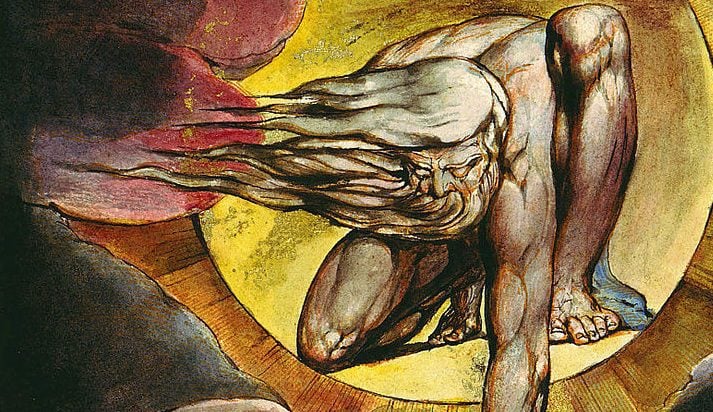
Detail – Europe a Prophecy, William Blake via Wikimedia commons
By forging relationships with deities, people become priests — servants and conduits of the gods’ power into the world. But that role does more than provide power; it also shapes the very spirit and soul of the priest.
These days people commonly refer to their mundane careers as their “vocations.” We even talk about “vocational training.” But while we might feel called to be accountants, lawyers, or welders, these are not callings in the same sense. Though our jobs shape our identities, they do not place us on the bridge between the everyday world and the realm of the gods.
Priests are people set apart. Not by their social role (as servants), but by their commitment to a power outside of the everyday social hierarchy (as servants of the gods).
Social and religious hierarchies get intermixed all the time. Because we intermingle political and religious power so often, we misunderstand what it means to be a priest.
That being said, priesthoods often do have specific social roles. From divining, to healing, to the gathering of knowledge, priests do more than worship the gods. They embody the gods and act on their behest.
Joining the Priesthood
Being a priest means more than just having a calling, and vocation is only the first step on the path. Becoming a priest, in the deepest sense, means placing your very existence in the hands of a greater power. It means accepting the good and the bad in order to become a part of something more.
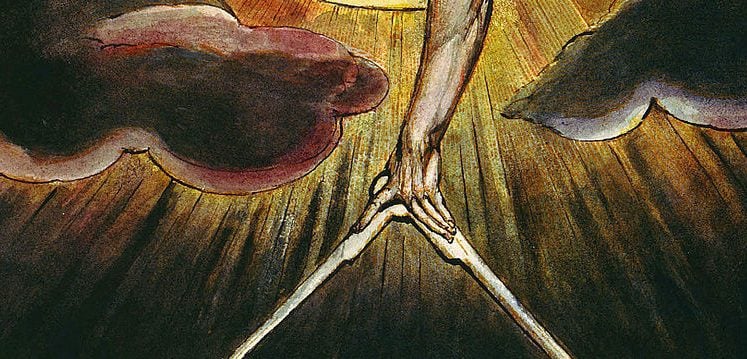
William Blake – Europe: a prophecy (detail)
Because of the heritage of religions around the world, we believe that priests are servants of people in particular and society in general. This is not true.
A priest is, first and foremost, a servant of the gods.(1) Because of the nature of priesthood, true mystical practitioners have more in common with one another than with other followers of their own religion.
Priests are people who have gone beyond vocation and built relationships with gods. We refer to that relationship, from the inside, as faith. Faith is not having the right beliefs; it is simply the ability to feel the connection to a god within yourself.
Serving the Gods
There are many ways we see the gods. The gods distinct individuals. All gods are one god. God is within us. God transcends the universe. The gods are fantasy. The gods are more real than we are. All we know for sure is that it’s complicated.
We can debate the nature of gods and the universe until we are blue in the face. But at the end of the day only an operational definition of gods can really capture human experience.
Experientially, the gods are powers of the universe who seek out and are sought out by humans for a certain type of hierarchical relationship. Beyond that, your mileage may vary.
For whatever reason, gods have an interest in the world in which we live. It is unclear whether they desire to take action, or are themselves the bow wave of the change that must happen.
Either way, the gods call some people to serve. Others times, people reach out to the gods to volunteer. And sometimes, priests do not forge these connections anew, but pass them down from one spiritual generation to the next.
Understanding the Three Calls
To get better a handle on the variation among priestly vocations, we can say that the callings come in three varieties. The first is initiated by the deity; the second is initiated by the future priest; and the third is bestowed by another priest.
Sometimes the call comes out of nowhere. These are the dramatic vocations of literature and hagiography. Culturally, these are the gold standard of vocations. Personally, I do not find them any more or less valid than the other types. It is not the nature of the call, but the quality of the relationship, that defines a priest.
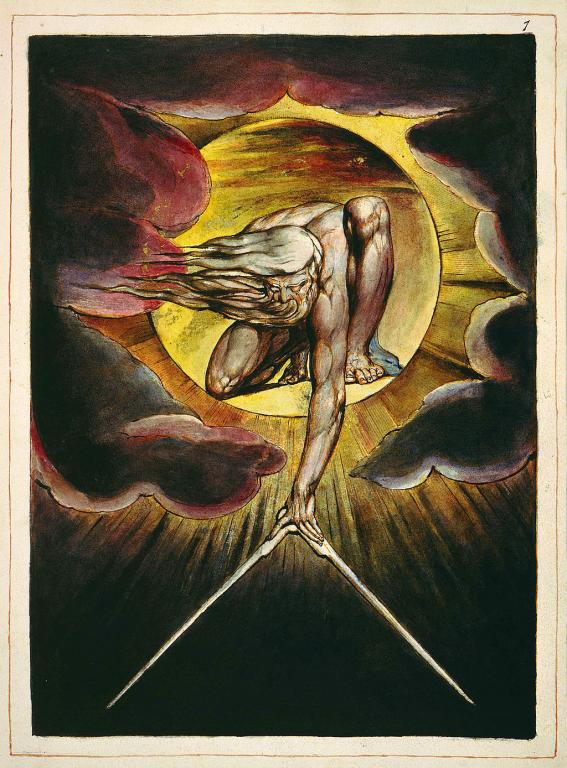
William Blake – Europe: a prophecy – Public Domain, via Wikimedia Commons
Just as much as the gods might seek us, we can seek them as well. Seekers might go looking for a bond with a deity. It could be a specific god, a whole pantheon, or just a general call to see who shows up. This path forward has its own risks, and I can only recommend that anyone going down this path employ discernment, patience, and caution.
Lastly, some well-established priesthoods pass sacred connection down through ritual. The ritual initiation of priests, called ordination, always requires a period of training and testing in advance.
Priests seeking ordination must show proof of their own calling. With oaths, they bind themselves to their gods. This is a combination of the other two methods of initiation. Through training, priests learn how to act as if they were in connection with their gods. By aping those practices, they induce the connection into being.
Choosing to Serve
There is no one right way to build faith — a sacred connection with a god or other power — though I would recommend humility and caution as dual watchwords. The world of the sacred will have real effects on your life. Not all of them will be things you enjoy.
In the long run, the deeper your faith, the more the gods will ask of you. Serving a greater power will not remove your humanity, fix your life, or make anything easier. It is more like having a non-paying job that demands your time and attention.
The first goal of a priest is to make the leap of faith. Beyond that, it is a life in service of something greater than ourselves. Faith, not thought and belief, is the root of priesthood. Above all, a priest embodies sacred connection.
(1) Just to be clear, it is possible to be a priest of a greater power that is not a personified god. The distinction between personified and non-personified forces may be a matter of perspective.
Previous Post

September 8, 2018
Daily Practice, Two Years On
Next Post

September 22, 2018 Seeking Silence, Seeking Power
Browse Our Archives
Select a Category Columns History Holidays Politics Ritual and Practice The Other Side of the Hedge Theology, Ethics, Philosophy
Select a Month June 2019 May 2019 April 2019 March 2019 February 2019 January 2019 December 2018 November 2018 October 2018 September 2018 August 2018 July 2018 June 2018 May 2018 April 2018 March 2018 February 2018 January 2018 November 2017 October 2017 September 2017 August 2017 July 2017 June 2017 May 2017 April 2017 March 2017 February 2017 January 2016 December 2015 November 2015 October 2015 September 2015
TAKE THE
Religious Wisdom Quiz
What animal did Balaam's donkey see that Balaam could not?
Select your answer to see how you score.
An angel A lion A snake A storm
Related posts from The Other Side of the Hedge




TRENDING AT PATHEOS Pagan

I was recently chatting with someone on Instagram. She asked me what...

While there are many people who share their results, the end of...

On July 23, I saw Christopher Nolan's The Odyssey which is Homer’s...

As I write this two big events have just finished up. One...

Restoring the Watershed of Divine Love
Perhaps cooperation is not something we manufacture through legislation, ideology, or moral...

Many UUs don’t pray because of bad experiences in a previous religion,...
view all Pagan blogs
Ad-Free & Subscriber Log-In Subscription Support
- About Us
- 2026 Calendar
- Videos
- Podcasts
- Library of World Religions
- Faith In Media Tracker
- Advertise With Us
- Write for Us
- Privacy Policy
- Terms of Service
- Do Not Sell My Data
- Contact Us
- Radiant Digital
- Manage Newsletter Subscriptions
- Unsubscribe From Notifications
- Sitemap
Copyright 2008-2026, Patheos. All rights reserved.
Subscription Support Ad-Free & Subscriber Log-In
Follow Patheos