
BuddhistCatholicContemplativeEvangelicalGeneral ChristianHinduJewishLatter-day SaintMuslimNew VisionsProgressive Christian
Beliefs
- Buddhist
- Catholic
- Contemplative
- Evangelical
- General Christian
- Hindu
- Jewish
- Latter-day Saint
- More Voices
- Muslim
- New Visions
- Pagan
- Progressive Christian
Topics
- Religion News
- Food and Religion
- Sports and Religion
- Religious Art
- Religious Music and Entertainment
- Religious Events
- History and Religion
- Style and Religion
- Politics and Religion
- Women in Religion
- Recreation Outdoors and Religion
- Business Finance and Religion
- Careers Workplace and Religion
- Education and Religion
- Family Parenting and Religion
- Health Fitness and Religion
- Home and Religion
- Relationships and Religion
- Technology and Religion
- Travel and Religion
Columnists
- Buddhist Columnists
- Business Finance and Religion Columnists
- Careers Workplace and Religion Columnists
- Catholic Columnists
- Contemplative Columnists
- Education and Religion Columnists
- Evangelists Columnists
- Family Parenting and Religion Columnists
- General Christian Columnists
- Health Fitness and Religion Columnists
- Hindu Columnists
- History and Religion Columnists
- Home and Religion Columnists
- Jewish Columnists
- More Voices Columnists
- Latter Day Columnists
- Muslim Columnists
- New Visions Columnists
- Nonreligious Columnists
- Pagan Columnists
- Politics and Religion Columnists
- Progressive Columnists
- Recreation Outdoors and Religion Columnists
- Relationships and Religion Columnists
- Religion News Columnists
- Religious Art Columnists
- Religious Events Columnists
- Religious Music and Entertainment Columnists
- Sports and Religion Columnists
- Style and Religion Columnists
- Technology and Religion Columnists
- Travel and Religion Columnists
- Women in Religion Columnists
Resource Library
- 2026 Calendar
- Library of World Religions
- The 100 Most Holy Places on Earth
- Patheos Answers
- Podcasts
- Videos
- Faith Leaders Database
- Anglican Episcopalian
- Bahai
- Baptist
- Buddhism
- Christianity
- Confucianism
- Eastern Orthodoxy
- Hinduism
- Holiness and Pentecostal
- ISKCON
- Islam
- Judaism
- Lutheran
- Methodist
- The Church of Jesus Christ of Latter-day Saints
- New Age
- Paganism
- Presbytarian and Reformed
- Protestantism
- Religion Behind the Scenes
- Roman Catholic
- Scientology
- Shia Islam
- Sikhism
- Sufism
- Sunni Islam
- Taoism
- Zen
- See all religions
Research Tools
 Ad-Free & Subscriber Log-In Subscription Support
Ad-Free & Subscriber Log-In Subscription Support
Follow Patheos 

- Trending:
- Forgiveness
- |
- Marriage
- |
- Consciousness
- |
- Death Penalty
- |
- Election
- |
- Halloween
 The Other Side of the Hedge
- Home
- Pagan
- Seeking Silence, Seeking Power
Seeking Silence, Seeking Power
Last updated on: September 22, 2018 at 12:09 pm by Christopher Drysdale
Seeking Silence, Seeking Power 2018-09-22T12:09:18-07:00 Christopher Drysdale
Patheos Explore the world's faith through different perspectives on religion and spirituality! Patheos has the views of the prevalent religions and spiritualities of the world.
Inner silence is about stopping the self-talk that, in the long run, keeps us stuck in who we are. This is both an extremely difficult thing to accomplish, and one that is basic to many deeper practices.
Achieving this state of silence is not only possible, it already exists inside us. Inner silence is not something we do, but rather a place we can find inside our minds.
In fact, the name “inner silence” is somewhat misleading. Mostly, what people are looking for is not complete silence.(1) If we quiet one part of the mind, another one suddenly appears. Learning to hear that voice is a good first step.
Identity and the Real
There are two kinds of thoughts that arise inside of the mind. One type of reflects and sustains our self image, while the other reflects the world around us. In everyday life, we are much more reliant on the first, which we think of as our identity.
Inner silence means silencing the self-talk part of the mind, but not the other part. It is only by interrupting this inner chatter that we can get access to the part that originates in the “real.”
So why do we even have that self-talk part of us? Because (and perhaps this is a topic for another day) the “real” is fabulously and terrifyingly more complicated than we have been taught it is. Our identity protects us from dissolving in the onslaught of reality.
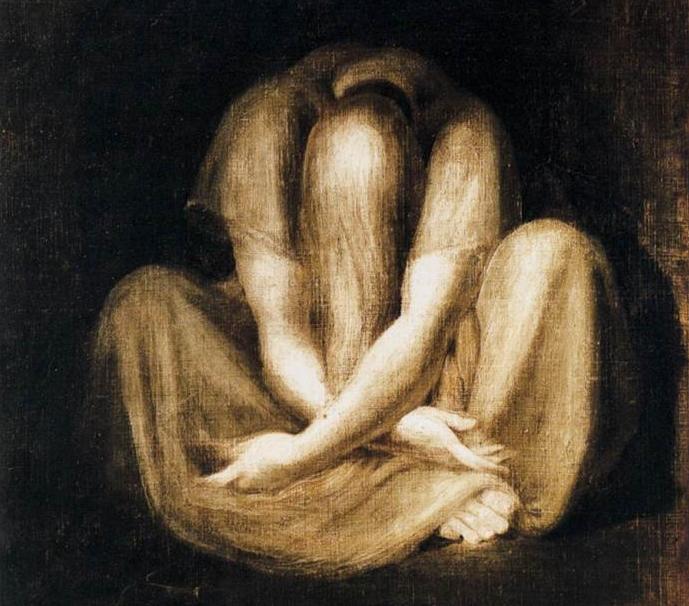
Silence (Detail). Henry Fuseli, via Wikimedia Commons
But our identities go from our protectors to our jailers. In short, what we are looking for is a way to disconnect the talky-part of the mind from the controls. Once that is done, the mind can talk all it wants, but it no longer has the power to constantly jerk us around.
Growing in Power
In order to accomplish inner silence, we have to cultivate our “personal power” — which is just a more appealing way of saying “internal cultivation.” The thing is, internal cultivation sounds dry and boring, but personal power sounds like everything we could wish for. Practically, they are the same thing.
There are a million ways to seek internal power, and not every one of them is for everyone. Specific techniques run the range from sitting in silence, to therapy, to going to the gym.
The purpose of all cultivation techniques, however, is to gather our resources so that we can make the leap to the next level. Instead of listing them, it might be more useful to see what ties all of these activities together.
There are three themes to the ways of building personal power. The first is to gain access to more power. The second is to stop spending power. And the third is to stop leaking power.
Gaining Access to More
The first area of cultivation is the easiest one to understand. If we want more internal power, we can simply pursue access to sources of power.
Some of those sources are internal are some are external. We just have to keep in mind that most everything in life is a trade-off, and make strategic choices.

Lotus Kirlian, by Emmanuel HEREDIA, via Wikimedia Commons
But not all of our power needs to be generated from within. While occult or religious groups might come to mind immediately, any well-functioning group will do.(2)
As a warning, if we take this too far, we end up being defined by external powers. In seeking growth, we have to find a balance between having the resources we need and not losing ourselves in someone else’s goals.
Stop Spending
We can raise our internal energy by cutting off unnecessary expenditure. But simply cutting off outflows, without understanding what they are for, can cause more drama than it is worth.
Most everything in our life is there for some reason. Whether it is your un-awesome job, contentious relationships, or uncomprehending family, all of these are trade-offs.
The pursuit of internal power can sometimes mean leaving “toxic” groups. But only rarely is the first step of progress trashing your life.
It can be even more effective just to stop worrying about things we cannot control. And even when we cannot stop worrying, we can stop arguing with people who disagree. Useless fights are the bane of the practitioner.
![By Photo: Louis-Emile Durandelle (http://www.bassenge.com/) [Public domain], via Wikimedia Commons](https://wp-media.patheos.com/blogs/sites/928/2018/02/Durandelle_Opera_Statues_decoratives_12_Dignite-detail-1.jpg)
Le Nouvel Opéra de Paris. Statues in the Grand Foyer: La Dignité, by Félix Sanzel
ProTip: Two hallmarks of the seasoned practitioner are restraint and strategy. Not every obstacle in life needs to be smashed. Usually it is easier to go around.
Stop Leaking
As much as we can build our personal power by gathering more and not spending it, the most challenging part of cultivation is to stop up the leaks. In cases where people have heavy spirit loss or damage, the tears in their spirits are obvious to a healer. But that is an extreme example.
Everyone “leaks” power into the world; this is normal. For those of us trying to force growth, however, such leaks need to be understood and in some cases plugged or healed.
This is where we benefit from self-knowledge, an understanding of the world, and a willingness to change old patterns that no longer serve us. It is also the area where we can benefit most from a competent teacher. Teachers, more than anyone else, are in a position to reflect back upon ourselves what we need to see.
Seeking Silence
Inner silence allows us to create the conditions for our deeper self to emerge. By attempting to suppress the chatter of the everyday mind, we separate ourselves from our own identity.
It is easy to think that inner silence is the next gate, but it is not. There are a few steps before that one. The tricky bit is that those steps will naturally appear when we seek inner silence.
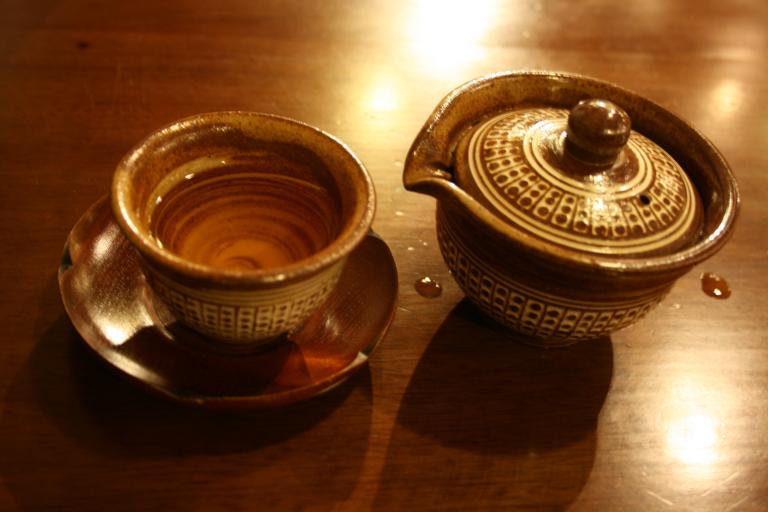
Simplicity is a cup of tea. [Photo (c)2009 by Polly Peterson, used with permission]
To paraphrase a teacher of mine, in the old days, when you had to climb a mountain to learn enlightenment, most of the work was done before you even found your teacher. All he would have to do by the time you found him was say, “Sit. Breathe.” And you would sit there and breathe and what you had not seen before would become apparent.
But now, we do not have to commit before we find a teacher. We can find them on the internet, in the phone book, and pretty much everywhere. So now we have to find the teacher, and then commit.
That teacher might be inside of us, outside of us, or even in the realm of the sacred. But by pursuing silence, we will learn to hear, and eventually listen. It can be a slow process, but it is worthwhile.
The danger, however, is that we will commit to the teacher. Like, love, or even hate your teachers, but commit to the path of becoming, of transformation. And the path is yours. Like silence, you can be shown a bit of the way when you are faltering and confused. But the whole of the path is simply your life. It’s yours.
(1) Complete inner silence can be approached and even briefly accomplished. The methods for doing so are, to say the least, spectacularly risky. Doing so without proper preparation can be a very permanent way to achieve a very temporary goal.
(2) Cultivating relations with deities, from YHWH to Dia Mater, can be an excellent source of power. Because of the spectacular power imbalance between an immortal and a mortal, there are a number of caveats when it comes to direct access to deities.
Previous Post

September 15, 2018
Vocation, Vocation, Vocation
Next Post

October 6, 2018 A Deep Dive into Animism
Browse Our Archives
Select a Category Columns History Holidays Politics Ritual and Practice The Other Side of the Hedge Theology, Ethics, Philosophy
Select a Month June 2019 May 2019 April 2019 March 2019 February 2019 January 2019 December 2018 November 2018 October 2018 September 2018 August 2018 July 2018 June 2018 May 2018 April 2018 March 2018 February 2018 January 2018 November 2017 October 2017 September 2017 August 2017 July 2017 June 2017 May 2017 April 2017 March 2017 February 2017 January 2016 December 2015 November 2015 October 2015 September 2015
TAKE THE
Religious Wisdom Quiz
What was the result of Jesus meeting the Gerasene demoniac?
Select your answer to see how you score.
Demons cast into pigs Bread multiplied A storm calmed A man healed of leprosy
Related posts from The Other Side of the Hedge




TRENDING AT PATHEOS Pagan

I was recently chatting with someone on Instagram. She asked me what...

While there are many people who share their results, the end of...

On July 23, I saw Christopher Nolan's The Odyssey which is Homer’s...

As I write this two big events have just finished up. One...

Restoring the Watershed of Divine Love
Perhaps cooperation is not something we manufacture through legislation, ideology, or moral...

Many UUs don’t pray because of bad experiences in a previous religion,...
view all Pagan blogs
Ad-Free & Subscriber Log-In Subscription Support
- About Us
- 2026 Calendar
- Videos
- Podcasts
- Library of World Religions
- Faith In Media Tracker
- Advertise With Us
- Write for Us
- Privacy Policy
- Terms of Service
- Do Not Sell My Data
- Contact Us
- Radiant Digital
- Manage Newsletter Subscriptions
- Unsubscribe From Notifications
- Sitemap
Copyright 2008-2026, Patheos. All rights reserved.
Subscription Support Ad-Free & Subscriber Log-In
Follow Patheos