
BuddhistCatholicContemplativeEvangelicalGeneral ChristianHinduJewishLatter-day SaintMuslimNew VisionsProgressive Christian
Beliefs
- Buddhist
- Catholic
- Contemplative
- Evangelical
- General Christian
- Hindu
- Jewish
- Latter-day Saint
- More Voices
- Muslim
- New Visions
- Pagan
- Progressive Christian
Topics
- Religion News
- Food and Religion
- Sports and Religion
- Religious Art
- Religious Music and Entertainment
- Religious Events
- History and Religion
- Style and Religion
- Politics and Religion
- Women in Religion
- Recreation Outdoors and Religion
- Business Finance and Religion
- Careers Workplace and Religion
- Education and Religion
- Family Parenting and Religion
- Health Fitness and Religion
- Home and Religion
- Relationships and Religion
- Technology and Religion
- Travel and Religion
Columnists
- Buddhist Columnists
- Business Finance and Religion Columnists
- Careers Workplace and Religion Columnists
- Catholic Columnists
- Contemplative Columnists
- Education and Religion Columnists
- Evangelists Columnists
- Family Parenting and Religion Columnists
- General Christian Columnists
- Health Fitness and Religion Columnists
- Hindu Columnists
- History and Religion Columnists
- Home and Religion Columnists
- Jewish Columnists
- More Voices Columnists
- Latter Day Columnists
- Muslim Columnists
- New Visions Columnists
- Nonreligious Columnists
- Pagan Columnists
- Politics and Religion Columnists
- Progressive Columnists
- Recreation Outdoors and Religion Columnists
- Relationships and Religion Columnists
- Religion News Columnists
- Religious Art Columnists
- Religious Events Columnists
- Religious Music and Entertainment Columnists
- Sports and Religion Columnists
- Style and Religion Columnists
- Technology and Religion Columnists
- Travel and Religion Columnists
- Women in Religion Columnists
Resource Library
- 2026 Calendar
- Library of World Religions
- The 100 Most Holy Places on Earth
- Patheos Answers
- Podcasts
- Videos
- Faith Leaders Database
- Anglican Episcopalian
- Bahai
- Baptist
- Buddhism
- Christianity
- Confucianism
- Eastern Orthodoxy
- Hinduism
- Holiness and Pentecostal
- ISKCON
- Islam
- Judaism
- Lutheran
- Methodist
- The Church of Jesus Christ of Latter-day Saints
- New Age
- Paganism
- Presbytarian and Reformed
- Protestantism
- Religion Behind the Scenes
- Roman Catholic
- Scientology
- Shia Islam
- Sikhism
- Sufism
- Sunni Islam
- Taoism
- Zen
- See all religions
Research Tools
 Ad-Free & Subscriber Log-In Subscription Support
Ad-Free & Subscriber Log-In Subscription Support
Follow Patheos 

- Trending:
- Forgiveness
- |
- Marriage
- |
- Consciousness
- |
- Death Penalty
- |
- Election
- |
- Halloween
 The Other Side of the Hedge
- Home
- Pagan
- Set Goals like a Wizard
Set Goals like a Wizard
Last updated on: July 29, 2018 at 11:51 am by Christopher Drysdale
Set Goals like a Wizard 2018-07-29T11:51:07-07:00 Christopher Drysdale
Patheos Explore the world's faith through different perspectives on religion and spirituality! Patheos has the views of the prevalent religions and spiritualities of the world.
For those of us who have embarked, whether by choice or not, on the Path of Transformation, our lives will never be the same. And while there are many secrets on the Path, there are few good tricks. Though it isn’t sexy, one of the most useful is setting mid-range goals.
While there are more powerful techniques, the advantage of this one is that it is accessible. Most everyone already knows how to get started setting a goal. That is how we function and pay the bills in a relatively hostile world.
Maybe, like me, you were raised to always look to the future. The “perfect” life was the one planned down to the smallest detail and lived as if we knew the goal in the beginning. For a long time, I was jealous of people who knew what they wanted to be at ten. At that age, I could hardly articulate anything about myself.
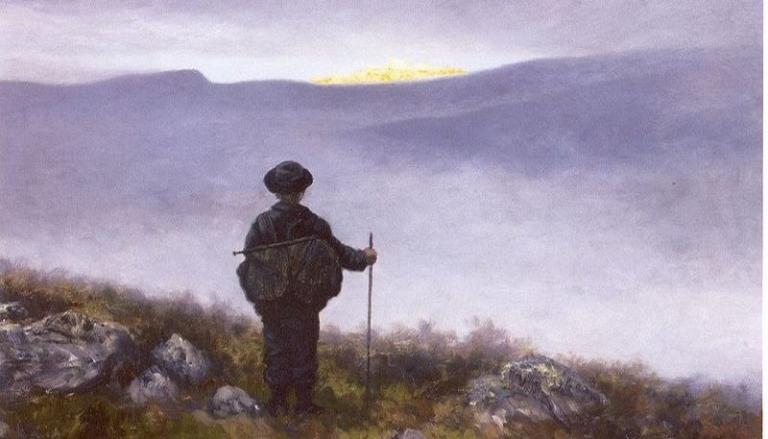
“Soria Moria” by Theodor Kittelsen. From WikiMedia.
One problem with being on the Path is that there is always a finite amount we have learned, and an seeming infinite amount that we have yet to know. Those who live in certainty are certainly wrong.
The Path is Not a Career
In the everyday world, we have a pretty good idea of what’s what. If we choose to study law, we know more or less what lawyers are and where we are going. If we study to be an engineer, we already know who engineers are. There might be a lot we do not know, but we probably have a general idea what our goal is.
The Path is not a career. It does not exist in the everyday world, and there is no understanding its limits. It is impossible, in the beginning, to understand where the Path leads. And for that reason, the lesson we were taught — that planning the future is the path to mastery — does not apply.
We can confuse the Path with careers because the do have some similarities. Sometimes a typical career can preclude following the Path. For instance, I have had four careers, but my deepest aims have never changed. I have just needed different things in different parts of my life.
One Simple Trick to Setting Goals
What I found, about a decade into training, was a simple technique to set definite short-range goals. Rather than just just setting them in my head, I bound myself to them using magic. And then I followed through.

A distant figure on a trail, (c)2018 by author
So, yes, basically I would geas myself**(1)** for short- to mid-term goals — and usually either one at a time, or ones that I was pretty sure would not interfere with each other too much.(2) Such an approach holds risks, but it has advantages as well. Succeed or fail, you will learn lessons about the nature of things.
Two of my early goals that I remember were, “pay off my credit card debt” and “get a decent girlfriend.” And the lessons I learned were that saving money is a skill you can learn (useful) and that a request for a “decent girlfriend” does not create the correct circumstances for a long-term relationship. She was a great girlfriend and not someone I was long-term compatible with. The heartbreak was unimaginable.
Barking up the Wrong Trees
Instead of focusing on achievable goals, too often we spend much of our life longing after things that we “know” we cannot have. The usual reasons for this are threefold.
The first reason is that we want too much, too fast. We want to create the long-term solution to our problems. But we want to do so without the knowledge or skills we need.
In setting goals, it is a mistake to lead with “I want to amass four million dollars so I never have to work again.”(3) A more effective approach is to start with a one-year plan, like “I want to pay off $5,000 in credit card debt.”
It is not that the “$4 mil plan” is completely infeasible; it is just that it is too much to bite off at once. Unless you are in the money business (and good at it), it is impossible to lay out the steps between here and there. Worse, attempting to do so will chew up all of your internal resources and not even get you close to your goal.
The second reason we chase the impossible is that we often do not know what we really want. The cliche of the mid-life crisis is legendary. People make it to a certain point in life, and then they pull a do-over. New career, new spouse, new house, new car — it doesn’t matter. What matters is that whatever we thought was going satisfy us, didn’t.

Change will turn the world upside down. – Photo by author (c)2018
But we do not have to wait until it is too late to realize that we never really knew ourselves and what was important to us. Initiation is, perhaps, a way of telling our greater selves not to wait to help us fix our lives. Self-knowledge can help us not to fall on our faces.
And the third reason we waste our lives, dithering, is that the things we want are often in conflict with each other. This is especially common if we are not pursuing our goal, but instead chasing the symbol of our goal.
For example, if I decide I want to be rich because it would make me feel powerful and safe, I will end up pursuing only money. I might skimp on health, political influence, community, or even pursuing the Path itself.
But if I decide that knowledge, not money, is power then I will spend my life very differently in pursuit of the same goal. I will end up with knowledge, probably with a “serious” education, and very little money.
A Wizard’s Goals
By embarking on the Path of Transformation, we begin a struggle to become what we already are. In short, self-knowledge is key.
While all that is fairly practical advice, you might be asking, “where is the magic?” There is another side to binding ourselves to our goals. We begin to bring all parts of ourselves in line. That is the beginning of completeness, of the True Will.
Instead of spending our lives with the various parts of ourselves fighting for dominance, magical goal setting allows us to hitch them together and begin our journey.
(1) Now, how did I geas myself? Easy. I simply made a list of my yearly goals and burned a candle with a carved incantation over it. With intention. And then I allowed the magic to happen. It’s not complicated, but it is pretty easy to shoot yourself in the foot. That is why short- to mid-range goals are the target, here. Each time we achieve a goal like this, it changes who we are, and realigns all of our future goals.
(2) Picking two impossible-to-reconcile goals and committing to them magically is a great way to break yourself. It is important to choose goals that do not seem to interfere, and then to check the compatibility with sortilege. When dealing with the unseen, divination is your friend.
(3) Apparently, at this time, four million dollars is a reasonable figure for retiring, for one person. So, few people will ever retire. It is a mirage, given to us to keep us locked into an illusion that there will ever be a break from work. As Practitioners, each of us has to make a choice. Either we accept the rules of the game and try to get four million points to get to the next stage, or we play a different game secure in the knowledge that the old game is a sucker’s bet for most of us.
Thanks for reading, and please subscribe below!
Previous Post

July 21, 2018
Spell Books, Training Manuals and Treatises
Next Post

August 11, 2018 Abandon the Known, Pursue the Real
Browse Our Archives
Select a Category Columns History Holidays Politics Ritual and Practice The Other Side of the Hedge Theology, Ethics, Philosophy
Select a Month June 2019 May 2019 April 2019 March 2019 February 2019 January 2019 December 2018 November 2018 October 2018 September 2018 August 2018 July 2018 June 2018 May 2018 April 2018 March 2018 February 2018 January 2018 November 2017 October 2017 September 2017 August 2017 July 2017 June 2017 May 2017 April 2017 March 2017 February 2017 January 2016 December 2015 November 2015 October 2015 September 2015
TAKE THE
Religious Wisdom Quiz
Who said, "Come and see"?
Select your answer to see how you score.
Peter Philip John the Baptist Paul
Related posts from The Other Side of the Hedge




TRENDING AT PATHEOS Pagan

I was recently chatting with someone on Instagram. She asked me what...

While there are many people who share their results, the end of...

On July 23, I saw Christopher Nolan's The Odyssey which is Homer’s...

As I write this two big events have just finished up. One...

Restoring the Watershed of Divine Love
Perhaps cooperation is not something we manufacture through legislation, ideology, or moral...

Many UUs don’t pray because of bad experiences in a previous religion,...
view all Pagan blogs
Ad-Free & Subscriber Log-In Subscription Support
- About Us
- 2026 Calendar
- Videos
- Podcasts
- Library of World Religions
- Faith In Media Tracker
- Advertise With Us
- Write for Us
- Privacy Policy
- Terms of Service
- Do Not Sell My Data
- Contact Us
- Radiant Digital
- Manage Newsletter Subscriptions
- Unsubscribe From Notifications
- Sitemap
Copyright 2008-2026, Patheos. All rights reserved.
Subscription Support Ad-Free & Subscriber Log-In
Follow Patheos