
BuddhistCatholicContemplativeEvangelicalGeneral ChristianHinduJewishLatter-day SaintMuslimNew VisionsProgressive Christian
Beliefs
- Buddhist
- Catholic
- Contemplative
- Evangelical
- General Christian
- Hindu
- Jewish
- Latter-day Saint
- More Voices
- Muslim
- New Visions
- Pagan
- Progressive Christian
Topics
- Religion News
- Food and Religion
- Sports and Religion
- Religious Art
- Religious Music and Entertainment
- Religious Events
- History and Religion
- Style and Religion
- Politics and Religion
- Women in Religion
- Recreation Outdoors and Religion
- Business Finance and Religion
- Careers Workplace and Religion
- Education and Religion
- Family Parenting and Religion
- Health Fitness and Religion
- Home and Religion
- Relationships and Religion
- Technology and Religion
- Travel and Religion
Columnists
- Buddhist Columnists
- Business Finance and Religion Columnists
- Careers Workplace and Religion Columnists
- Catholic Columnists
- Contemplative Columnists
- Education and Religion Columnists
- Evangelists Columnists
- Family Parenting and Religion Columnists
- General Christian Columnists
- Health Fitness and Religion Columnists
- Hindu Columnists
- History and Religion Columnists
- Home and Religion Columnists
- Jewish Columnists
- More Voices Columnists
- Latter Day Columnists
- Muslim Columnists
- New Visions Columnists
- Nonreligious Columnists
- Pagan Columnists
- Politics and Religion Columnists
- Progressive Columnists
- Recreation Outdoors and Religion Columnists
- Relationships and Religion Columnists
- Religion News Columnists
- Religious Art Columnists
- Religious Events Columnists
- Religious Music and Entertainment Columnists
- Sports and Religion Columnists
- Style and Religion Columnists
- Technology and Religion Columnists
- Travel and Religion Columnists
- Women in Religion Columnists
Resource Library
- 2026 Calendar
- Library of World Religions
- The 100 Most Holy Places on Earth
- Patheos Answers
- Podcasts
- Videos
- Faith Leaders Database
- Anglican Episcopalian
- Bahai
- Baptist
- Buddhism
- Christianity
- Confucianism
- Eastern Orthodoxy
- Hinduism
- Holiness and Pentecostal
- ISKCON
- Islam
- Judaism
- Lutheran
- Methodist
- The Church of Jesus Christ of Latter-day Saints
- New Age
- Paganism
- Presbytarian and Reformed
- Protestantism
- Religion Behind the Scenes
- Roman Catholic
- Scientology
- Shia Islam
- Sikhism
- Sufism
- Sunni Islam
- Taoism
- Zen
- See all religions
Research Tools
 Ad-Free & Subscriber Log-In Subscription Support
Ad-Free & Subscriber Log-In Subscription Support
Follow Patheos 

- Trending:
- Forgiveness
- |
- Marriage
- |
- Consciousness
- |
- Death Penalty
- |
- Election
- |
- Halloween
 The Other Side of the Hedge
- Home
- Pagan
- Lost Wisdom: The Journeyman
Lost Wisdom: The Journeyman
Last updated on: May 5, 2018 at 6:54 am by Christopher Drysdale
Lost Wisdom: The Journeyman 2018-05-05T06:54:15-07:00 Christopher Drysdale
Patheos Explore the world's faith through different perspectives on religion and spirituality! Patheos has the views of the prevalent religions and spiritualities of the world.
Apprenticeship over, but not yet tied down with the Master’s reality of students and obligations, the Journeyman lives in the best of both worlds. Yet, outside of a few established traditions**(1)**, we don’t seem to emphasize the value of these community members.
Maybe it’s as simple as the lack of a good gender-neutral version of the word. Journeyperson? Ugh. But whatever we want to call it, this is where the magic happens.
We seem to understand “Apprentice” and “Master” more or less, but have less investment with “Journeyman” or some other in-between stage. But that isn’t so much a liminal state as a normal one. Theoretically, this is where most practitioners would live.
An Eye to the Past
Here in Western Paganism, we pay a fair amount of lip-service to looking back at what has worked in our culture(s). But sometimes it seems like we are aping those behaviors, rather than truly embracing them. We want the strength and resilience of the old, but with the quickness and availability of the new. We might as well wish for a pony.
When it comes to training, there is a long tradition of drudgery — hard and (supposedly) meaningless work that is nonetheless necessary in developing not just skill, but also character and self-respect. These days, we are quick to dismiss any hierarchy as we struggle our way upward to some status we desire. What is worse, we seem determined to ignore the irony of this position.
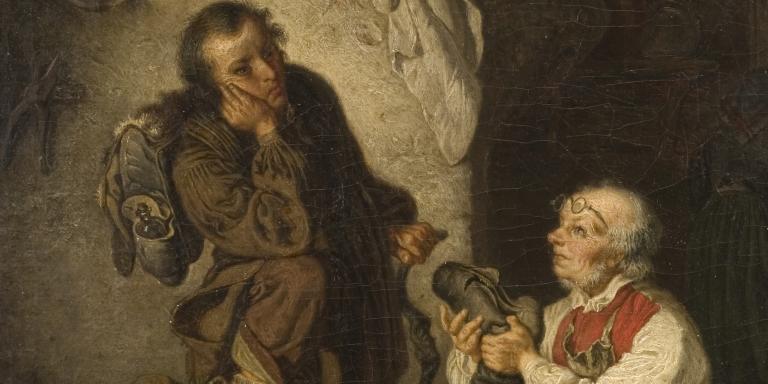
A Traveling Journeyman by Killian Zoll,(Wikimedia Commons)
In any craft, hard work separates the wheat from the chaff. If that is true of a blacksmith, how much more true is it for people who desire to bend something far harder than iron?
The Guild
The medieval path of a recognized tradesman had three levels of involvement: the Apprentice, the Journeyman, and the Master. Under the authority of a guild, an Apprentice was enrolled with a Master, and worked in return for training. Apprentices who developed enough proficiency that they could work independently became Journeymen. Those Journeymen were fully fledged tradesmen who could take part in their craft. A Journeyman might eventually make a bid for the title of Master by making a master work and submitting it (and a bunch of money) to a trade guild.
That is all a simplistic description of a social system that lasted for hundreds of years and drove the economy of Europe. The guild system both reflected and supported the social structures of its time. A close look will show politics and wrangling that centered around the control and regulation of trade. Guilds were for the benefit of the tradesmen, and functioned as monopolies, regulatory bodies, and lobbying groups.
But for us, the key takeaway is that training is more than learning. The Apprentice is in a position where learning is the focus. The Journeyman, however, goes out and gets exposed to a larger world. He finds out what works (or doesn’t) in a much broader context.
The Freemasons
The fact that this three-stage system is part of Western magical traditions can probably be laid at the feet of the Freemasons. It was their structure, with its three grades of initiation, that informed much of the magical revival of the late nineteenth and early twentieth centuries.
The Freemasons were the intellectual and social inheritors of the medieval guild, and thus the bridge between history and the openly magical traditions that sprang up in modernity, perhaps exemplified by the Hermetic Order of the Golden Dawn. Though the ten grades of initiation were a development of the Rosicrucians, the broader “orders” are a rehashing of the Apprentice/Journeyman/Master rankings that are endemic in Western culture.
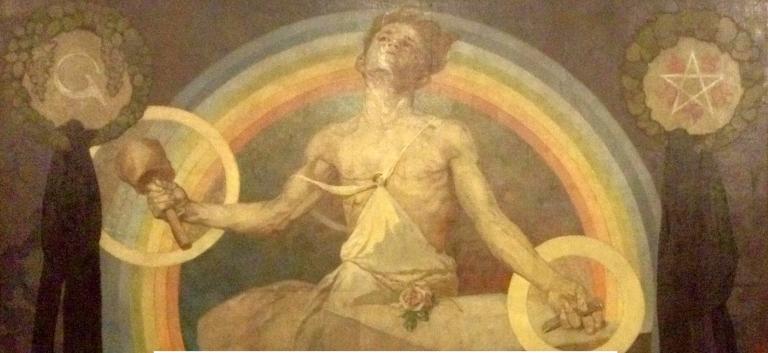
Apprentice free-mason by Alphonse Mucha
In the Golden Dawn, the Adept replaces the Journeyman. While the two are linguistically very different, the role is similar. These are not trainees, but the rank and file members who make up (or should make up) the bulk of the community.
The Journeyman
Today, when we think of these old stages of learning, we have very narrow ideas of what each role entails. Legendary are the trials of the beleaguered apprentice, but not of the strong, recognized bond of mentorship between apprentice and master. We imagine the new journeyman starting out, but hardly think of them as fully-functioning adult members of the trade community. We think of the Master teaching, but turn a blind eye to the necessary politicking that comes whenever people come together.
Journeymen were craftsmen who traveled around and functioned like the consultants and workers of the gig economy of today. They worked job by job, often without access to growth opportunities. They sought to build capital and alliances, to distinguish themselves, and to grow in their craft.
Now, I am not holding up medieval economic practices as a hallmark of fairness. It was a system ripe for, and rife with, abuse. But with that said, the guilds had set up a system that honestly reflected how people grow within a craft. The end of education is the beginning, and not the end, of learning.
The Journey to Mastery
One of the challenges that students of magic face today is that our educational system is not designed for this type of knowledge. Western culture puts a premium on the value of abstract knowledge rather than practical application. This has lead a poorer understanding how we might learn a craft like this.
While there is some abstract learning that is required for the study of magic, there is much more that cannot be transmitted abstractly. Practice and experience build on simple knowledge.(2) That is the reason for the apprentice’s drudgery, and it is also the purpose of the Journeyman’s travels.
Developing knowledge requires study, but developing a craft means study, training, practice, and time. There are no shortcuts for learning a craft.
Rising Beyond Skill
We have a tendency to think about these crafts in terms of skill. Such an approach is practical, but unrealistic. Our common models for learning tend to be products of the Enlightenment. The student is the tabula rasa, the blank slate, who is filled by the teacher. But the best training does not really believe in such things.
While a skill is something that a person can possess, we join a craft. It is more than a raw skill, but (at least for a time) a way of life and understanding the world. We misunderstand the depths of the Journeyman when we define them as someone who has a skill. They are, instead, someone who has an understanding of the world that allows them to change it in some small way. This is as true of a blacksmith as it is of a mage.
This is why, in guilds and in magical training, initiations are such key phenomena. They are so important to self-cultivation and the study of magic that, should the teacher fail to provide them, they will happen on their own.(3)
The Journey Forward
For whatever reasons, Western culture has long focused on apprenticeship, along with its flip-side, mastery. Now, that won’t change overnight (and maybe not at all). But in our own practices, it is long past time for us to recognize that most of our growth happens under our own auspices.
Though there is no guild stopping us from claiming the title, in truth most of us are not Masters. But neither are we unshaped Apprentices. We exist in the fertile middle ground, the realm of the Journeyman. It sometimes seems that we all want to rush ahead to Mastery. But the cultivation of the spirit is no place to “keep up with the Joneses.”
The Journeyman, however, has the freedom we seek – the freedom to grow, to change, to learn, and (occasionally) to fail. It is also the place where we learn to go beyond our teachers and develop both ourselves and our craft in ways that no Apprentice could conceive, and no Master could countenance.
(1) The Grey School of Wizardry hails graduates as Journeymen, for example. The second degree of most lineaged Wiccan covens fulfills the same role.
(2) There are good cognitive reasons for this, having to do with entire categories of experience that are ignored or mislabeled in Western culture. What I have learned through the years is that it is impossible, through argument, expand another person’s mental map. The best we can do is point out where the experience would show up on the map, and direct them there. Creating the new point on the map becomes the experiential task of the learner. While this is true of any education, it is critical when it comes to learning about “hidden” parts of the map.
(3) For more on this, please take a look at my post from a few weeks back, “Becoming Magic” – in which I describe how the cause and placement of the first major initiation determines the flavor of the whole magical experience.
Previous Post
April 27, 2018
Six Hundred Days
Next Post

May 13, 2018 Modern Myth: The Wizard of the Mounds
Browse Our Archives
Select a Category Columns History Holidays Politics Ritual and Practice The Other Side of the Hedge Theology, Ethics, Philosophy
Select a Month June 2019 May 2019 April 2019 March 2019 February 2019 January 2019 December 2018 November 2018 October 2018 September 2018 August 2018 July 2018 June 2018 May 2018 April 2018 March 2018 February 2018 January 2018 November 2017 October 2017 September 2017 August 2017 July 2017 June 2017 May 2017 April 2017 March 2017 February 2017 January 2016 December 2015 November 2015 October 2015 September 2015
TAKE THE
Religious Wisdom Quiz
Which city is known as the "City of Palms" in the Bible?
Select your answer to see how you score.
Jerusalem Jericho Damascus Bethany
Related posts from The Other Side of the Hedge




TRENDING AT PATHEOS Pagan

I was recently chatting with someone on Instagram. She asked me what...

While there are many people who share their results, the end of...

On July 23, I saw Christopher Nolan's The Odyssey which is Homer’s...

As I write this two big events have just finished up. One...

Restoring the Watershed of Divine Love
Perhaps cooperation is not something we manufacture through legislation, ideology, or moral...

Many UUs don’t pray because of bad experiences in a previous religion,...
view all Pagan blogs
Ad-Free & Subscriber Log-In Subscription Support
- About Us
- 2026 Calendar
- Videos
- Podcasts
- Library of World Religions
- Faith In Media Tracker
- Advertise With Us
- Write for Us
- Privacy Policy
- Terms of Service
- Do Not Sell My Data
- Contact Us
- Radiant Digital
- Manage Newsletter Subscriptions
- Unsubscribe From Notifications
- Sitemap
Copyright 2008-2026, Patheos. All rights reserved.
Subscription Support Ad-Free & Subscriber Log-In
Follow Patheos