
BuddhistCatholicContemplativeEvangelicalGeneral ChristianHinduJewishLatter-day SaintMuslimNew VisionsProgressive Christian
Beliefs
- Buddhist
- Catholic
- Contemplative
- Evangelical
- General Christian
- Hindu
- Jewish
- Latter-day Saint
- More Voices
- Muslim
- New Visions
- Pagan
- Progressive Christian
Topics
- Religion News
- Food and Religion
- Sports and Religion
- Religious Art
- Religious Music and Entertainment
- Religious Events
- History and Religion
- Style and Religion
- Politics and Religion
- Women in Religion
- Recreation Outdoors and Religion
- Business Finance and Religion
- Careers Workplace and Religion
- Education and Religion
- Family Parenting and Religion
- Health Fitness and Religion
- Home and Religion
- Relationships and Religion
- Technology and Religion
- Travel and Religion
Columnists
- Buddhist Columnists
- Business Finance and Religion Columnists
- Careers Workplace and Religion Columnists
- Catholic Columnists
- Contemplative Columnists
- Education and Religion Columnists
- Evangelists Columnists
- Family Parenting and Religion Columnists
- General Christian Columnists
- Health Fitness and Religion Columnists
- Hindu Columnists
- History and Religion Columnists
- Home and Religion Columnists
- Jewish Columnists
- More Voices Columnists
- Latter Day Columnists
- Muslim Columnists
- New Visions Columnists
- Nonreligious Columnists
- Pagan Columnists
- Politics and Religion Columnists
- Progressive Columnists
- Recreation Outdoors and Religion Columnists
- Relationships and Religion Columnists
- Religion News Columnists
- Religious Art Columnists
- Religious Events Columnists
- Religious Music and Entertainment Columnists
- Sports and Religion Columnists
- Style and Religion Columnists
- Technology and Religion Columnists
- Travel and Religion Columnists
- Women in Religion Columnists
Resource Library
- 2026 Calendar
- Library of World Religions
- The 100 Most Holy Places on Earth
- Patheos Answers
- Podcasts
- Videos
- Faith Leaders Database
- Anglican Episcopalian
- Bahai
- Baptist
- Buddhism
- Christianity
- Confucianism
- Eastern Orthodoxy
- Hinduism
- Holiness and Pentecostal
- ISKCON
- Islam
- Judaism
- Lutheran
- Methodist
- The Church of Jesus Christ of Latter-day Saints
- New Age
- Paganism
- Presbytarian and Reformed
- Protestantism
- Religion Behind the Scenes
- Roman Catholic
- Scientology
- Shia Islam
- Sikhism
- Sufism
- Sunni Islam
- Taoism
- Zen
- See all religions
Research Tools
 Ad-Free & Subscriber Log-In Subscription Support
Ad-Free & Subscriber Log-In Subscription Support
Follow Patheos 

- Trending:
- Forgiveness
- |
- Marriage
- |
- Consciousness
- |
- Death Penalty
- |
- Election
- |
- Halloween
 The Other Side of the Hedge
- Home
- Pagan
- Becoming Magic
Becoming Magic
Last updated on: April 14, 2018 at 7:50 pm by Christopher Drysdale
Becoming Magic 2018-04-14T19:50:44-07:00 Christopher Drysdale
Patheos Explore the world's faith through different perspectives on religion and spirituality! Patheos has the views of the prevalent religions and spiritualities of the world.
Over on Gone Witching, K.C. Alexander recently posted an exploration of what it means to be “chosen” by the gods, especially those gods who might bestow talent for practicing magic. But being chosen is not the only path to practicing magic. Some are chosen. Some begin by devoting themselves to the art. And while we talk openly of these two ways to begin our work, there is also a hidden path.
How we find the path is an interesting avenue of exploration. Living in a world that looks at magic with equal portions of disbelief, disdain, terror, and a lust for power, we spend little time really delving into why people study magic, how they get there, and whether they would rather be off playing mini-golf.(1)
This question is one with which we all have to wrestle as we seek our own places in the world. I struggled with this question for decades. Though we don’t talk much about it, there are generally two ways to arrive in magic-land. The first is to be “called” – to have a vocation.(2) The second is to pledge oneself to the work, or as some might say, to have devotion.(3)
Vocation and Devotion
It is pretty clear that vocation and devotion, as terms for paths into magic, have religious connotations. Whether we are called or bind ourselves to the path to the divine, these are the words we use to talk about it. That goes back at least as far as our Christian heritage.(4)
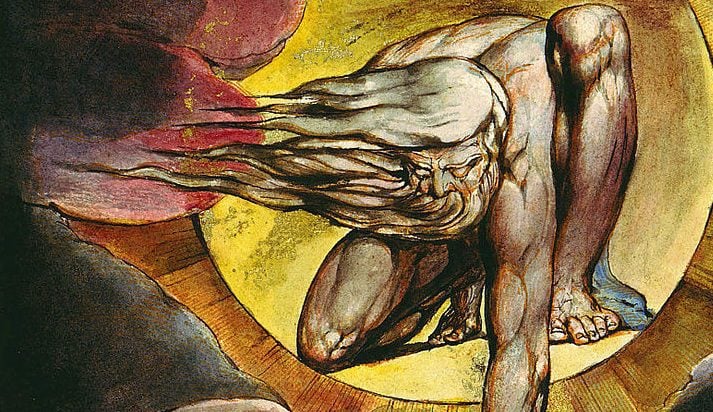
William Blake – Europe: a prophecy (detail)
Yet, neither of these things, vocation or devotion, need be explicitly religious. At least since the mid-16th century, people have been talking about their careers as “vocations.” And going back to the Romans, “devotion” is about pledged loyalty – I suspect originally sworn before the gods, and not to them.
These are the two common paths for learning magic. Where I understand that K.C. and many other struggle is the idea that vocation is somehow the higher path. It is a bias we inherited from our Christian forebears – that direct communion with God or the gods requires the other to initiate that relationship. Such an attitude is, if you’ll pardon my frankness, crap.
Culturally, we prefer “vocation” because it confers immediate legitimacy. With little common understanding of the long process of spiritual maturation, we naively believe that such a calling somehow makes it harder to stray. The West has a long history is being super-afraid of spiritual charlatans, though we seem to accept snake-oil salesmen of every other stripe.
The crux of the problem is that our concept of spirituality is religious by habit. For a variety of culturally significant reasons, we value the transformative religious experience over others. There are only a few ways that Westerners can claim that something is “authentic” – and religion is the big one.
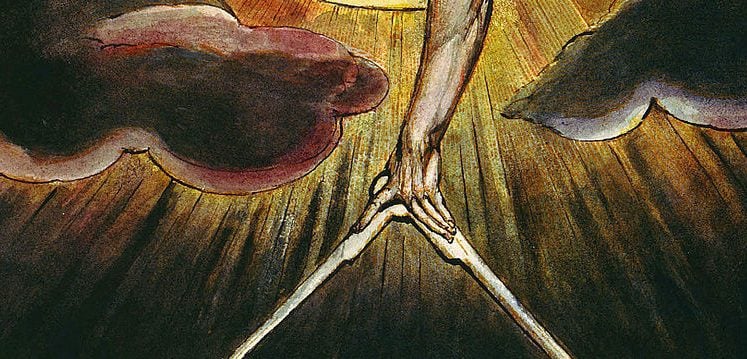
William Blake – Europe: a prophecy (detail)
It’s not that we believe everything, or even anything, that a religious person says. But we believe that they believe it, and that makes “religion” a protected class of thought. Being “godtouched” thus protects the person making the claim.
But culture doesn’t mean much when it comes down to connecting with the sacred. Culture is our starting point; it shapes who we are and flavors our experience, but it is not the point. The point is rather to transcend our everyday, culturally-accepted self and reach for something more.
Spiritually speaking, it is entirely possible to become a magician through devotion to that purpose. Single-minded pursuit of such a goal might not guarantee success, but it is certainly a worthy path.
Magicians, Priests, and the Hidden Path
With that said, I wanted to lay out some thoughts, concepts, and a model for understanding how we grow into being practitioners of magic.(5) Being chosen is one of the three ways to get there.
Without getting into the metaphysics of it all, we can liken spiritual awakening to a baby chick coming out of an egg. Like the chick, we suddenly see a whole world that we had never seen before. And, like the chick, that world is a lot larger than what we initially perceive.
The devotional path to learning magic, the path of the magician, is one where significant work needs to be put in before we ever see outside of ourselves. Magicians open themselves up to a greater world through practice. If we imagine the magician as a chick leaving an egg, these are the little buggers who peck at the shell from the inside until they are big enough and strong enough to emerge more or less on their own.
The magician, then, comes into the world of magic at long last, fully formed and as prepared as anyone can be. If the magician has a guide, it is usually another person who has walked that path themselves.
Those who are called to magic, we might call priests. These priests are like chicks who, while trying to break free of their egg, have an outside force hear their struggles and offer some assistance cracking the shell. The chick analogy seems especially apt, as the newly “born” imprints on the “helper” in a big way — breaking away from such a bond (or binding) is as intense as getting over a bad parent.
The newly awakened priest is nowhere as self-sufficient as the magician. The awakening comes before the hard work, not after. Yet the path to becoming complete is no shorter for it.
![Jacob's Ladder - William Blake [Public domain], via Wikimedia Commons](https://wp-media.patheos.com/blogs/sites/928/2018/04/Blake_jacobsladder-805x1024.jpg)
Jacob’s Ladder – William Blake [Public domain], via Wikimedia Commons
Though it is rarely part of the narrative of magic, there is a third pathway into awakening. We do not understand it well. We might liken them to a certain type of shaman, who falls to an illness and only recovers when they devote themselves to a life bridging the everyday and the spirit.(6)
These shamans are like chicks who have their shell broken accidentally by trauma in life. Most of them die. Many of the rest are never quite right. In the West, those who manage to survive often end up trying to follow one of the other two paths. But this is also how we get a lot of natural psychics, healers, sensitives, and the like.(7)
This typology is a natural extension of understanding the process by which one becomes a practitioner. However, like most things in life, it’s neither only one or the other. In practice there is a fair amount of overlap.
What happens when someone trains for years as a magician, but then calls upon the assistance of an outside power to make the final push? How about the child offered to their gods, but who then breaks away to becomes more self-sufficient? Or (super common) the shaman who trains on one of the other paths?
The important thing to remember is that each of these is a way of starting. A complete person, awakened in body and spirit and with access to the world of the sacred, could start in any of these three ways. Sure, the way you get there will shape how you see it. Followed to its end, each of these paths leads to the same end: a person living fully in the everyday world and yet unified with the divine.
(1) Don’t get me wrong. Studying magic can be rewarding, but it will only circuitously address anything toward the bottom of Maslow’s hierarchy of needs. Magic does not come with a steady paycheck, stability, or social status. Bluntly, we have to plumb the deeper nature of the universe and ourselves on our own time and our own dime.
(2) Vocation, in this sense, originally did have a religious meaning. Around the time of the Protestant Reformation (1517 – 1648), it changed to mean any purpose to which one felt called. Effectively, as the reins of Western religion slipped from the Catholic Church’s hands, people began to find themselves called not just to priesthood, but to all sorts of roles in life. It can refer to everything from a full-blown vision from the world of the sacred down to following in the footsteps of a parent.
(3) Devotion comes from a Latin root that more or less means taking a sacred vow or a pledge of loyalty. Through the Christian tradition, this came to refer more-or-less exclusively to pledges to God. It then moved back toward the original meaning, where we might talk of a “devoted” husband or employee.
(4) In order to be a Christian priest, it is fairly common to have to be able to prove one’s vocation through the process of discernment. And they do not mean it metaphorically – in the Christian world, such a calling is a serious matter. And while we aren’t Christian, Christianity has influenced just about ever aspect of Western culture for about two millennia.
(5) The word “shaman” as used in the West covers a lot of territory. Used in various contexts, it can refer to any of the three types I have outlined. Though the word originally used to denote a specific cultural type of practitioner among the Buryat and related groups, it has taken on a meaning and life of its own in the West.
(6) To get a real sense of the breadth of this category, we only need to think about all those who have Near Death Experiences, or walk away from car accidents and other traumas with an extra sense. Sometimes, the trauma itself can lead to awakening.
(7) It’s worth noting that there are traditions of magic that utilize this type of initiation. From ayahuasca ceremonies to vision quests, teachers may created relatively controlled traumas in order to help their students reach the sacred. I would categorize such people as magicians rather than shamans.
Previous Post

April 7, 2018
The Great Work, Nine to Five
Next Post
April 20, 2018 Daily Practice: Train for Success
Browse Our Archives
Select a Category Columns History Holidays Politics Ritual and Practice The Other Side of the Hedge Theology, Ethics, Philosophy
Select a Month June 2019 May 2019 April 2019 March 2019 February 2019 January 2019 December 2018 November 2018 October 2018 September 2018 August 2018 July 2018 June 2018 May 2018 April 2018 March 2018 February 2018 January 2018 November 2017 October 2017 September 2017 August 2017 July 2017 June 2017 May 2017 April 2017 March 2017 February 2017 January 2016 December 2015 November 2015 October 2015 September 2015
TAKE THE
Religious Wisdom Quiz
True or False: 1 Peter teaches that believers are living stones being built into a spiritual house.
Select your answer to see how you score.
FALSE TRUE
Related posts from The Other Side of the Hedge




TRENDING AT PATHEOS Pagan

I was recently chatting with someone on Instagram. She asked me what...

While there are many people who share their results, the end of...

On July 23, I saw Christopher Nolan's The Odyssey which is Homer’s...

As I write this two big events have just finished up. One...

Restoring the Watershed of Divine Love
Perhaps cooperation is not something we manufacture through legislation, ideology, or moral...

Many UUs don’t pray because of bad experiences in a previous religion,...
view all Pagan blogs
Ad-Free & Subscriber Log-In Subscription Support
- About Us
- 2026 Calendar
- Videos
- Podcasts
- Library of World Religions
- Faith In Media Tracker
- Advertise With Us
- Write for Us
- Privacy Policy
- Terms of Service
- Do Not Sell My Data
- Contact Us
- Radiant Digital
- Manage Newsletter Subscriptions
- Unsubscribe From Notifications
- Sitemap
Copyright 2008-2026, Patheos. All rights reserved.
Subscription Support Ad-Free & Subscriber Log-In
Follow Patheos