
BuddhistCatholicContemplativeEvangelicalGeneral ChristianHinduJewishLatter-day SaintMuslimNew VisionsProgressive Christian
Beliefs
- Buddhist
- Catholic
- Contemplative
- Evangelical
- General Christian
- Hindu
- Jewish
- Latter-day Saint
- More Voices
- Muslim
- New Visions
- Pagan
- Progressive Christian
Topics
- Religion News
- Food and Religion
- Sports and Religion
- Religious Art
- Religious Music and Entertainment
- Religious Events
- History and Religion
- Style and Religion
- Politics and Religion
- Women in Religion
- Recreation Outdoors and Religion
- Business Finance and Religion
- Careers Workplace and Religion
- Education and Religion
- Family Parenting and Religion
- Health Fitness and Religion
- Home and Religion
- Relationships and Religion
- Technology and Religion
- Travel and Religion
Columnists
- Buddhist Columnists
- Business Finance and Religion Columnists
- Careers Workplace and Religion Columnists
- Catholic Columnists
- Contemplative Columnists
- Education and Religion Columnists
- Evangelists Columnists
- Family Parenting and Religion Columnists
- General Christian Columnists
- Health Fitness and Religion Columnists
- Hindu Columnists
- History and Religion Columnists
- Home and Religion Columnists
- Jewish Columnists
- More Voices Columnists
- Latter Day Columnists
- Muslim Columnists
- New Visions Columnists
- Nonreligious Columnists
- Pagan Columnists
- Politics and Religion Columnists
- Progressive Columnists
- Recreation Outdoors and Religion Columnists
- Relationships and Religion Columnists
- Religion News Columnists
- Religious Art Columnists
- Religious Events Columnists
- Religious Music and Entertainment Columnists
- Sports and Religion Columnists
- Style and Religion Columnists
- Technology and Religion Columnists
- Travel and Religion Columnists
- Women in Religion Columnists
Resource Library
- 2026 Calendar
- Library of World Religions
- The 100 Most Holy Places on Earth
- Patheos Answers
- Podcasts
- Videos
- Faith Leaders Database
- Anglican Episcopalian
- Bahai
- Baptist
- Buddhism
- Christianity
- Confucianism
- Eastern Orthodoxy
- Hinduism
- Holiness and Pentecostal
- ISKCON
- Islam
- Judaism
- Lutheran
- Methodist
- The Church of Jesus Christ of Latter-day Saints
- New Age
- Paganism
- Presbytarian and Reformed
- Protestantism
- Religion Behind the Scenes
- Roman Catholic
- Scientology
- Shia Islam
- Sikhism
- Sufism
- Sunni Islam
- Taoism
- Zen
- See all religions
Research Tools
 Ad-Free & Subscriber Log-In Subscription Support
Ad-Free & Subscriber Log-In Subscription Support
Follow Patheos 

- Trending:
- Forgiveness
- |
- Marriage
- |
- Consciousness
- |
- Death Penalty
- |
- Election
- |
- Halloween
 The Other Side of the Hedge
- Home
- Pagan
- The Other Side of the Hedge: The Formula of Mastery
The Other Side of the Hedge: The Formula of Mastery
Last updated on: May 15, 2018 at 6:43 pm by Christopher Drysdale
The Other Side of the Hedge: The Formula of Mastery 2018-05-15T18:43:38-07:00 Christopher Drysdale
Patheos Explore the world's faith through different perspectives on religion and spirituality! Patheos has the views of the prevalent religions and spiritualities of the world.
Whatever discipline we study, the challenges we face are the same. We give meaning to our lives through struggle and work. We explore the depths of who we are. And in the end, we are one family, bound together in the fight against our limitations.
Whether we study magic, martial arts, or meditation, we belong to a larger group I usually refer to as “practitioners.” Many disciplines can provide paths to mastery. And while no list could be exhaustive, everything from dance to tea ceremonies has been used.

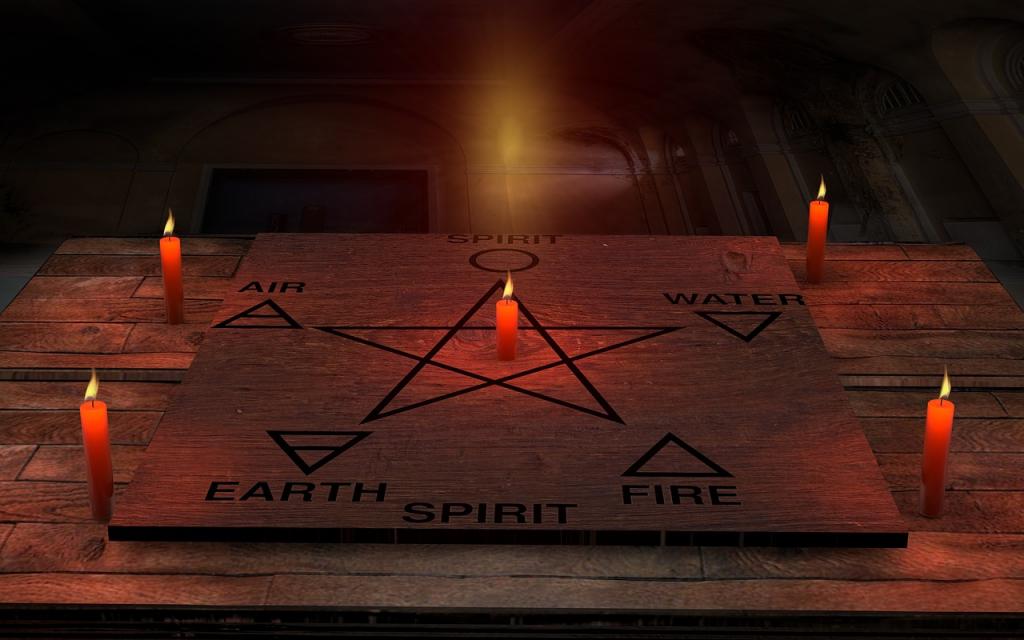
Image by Kalhh via Pixabay. CC0 License.
It doesn’t matter what path you choose, or chooses you. There is no easier path or harder path. There are just paths that are more appealing to us, as individuals.
What binds all of these paths together is not some common bond like hard work, but the way they lead us to the ineffable. Each of these paths, each discipline, can lead us beyond ourselves to something more.
Mastery is a transcendent**(1)** experience that we cultivate in every discipline. Paths of self-cultivation lead not just to social growth or athletic prowess, but to a more complete self. While in the beginning, we cross the old boundaries of the self and become somehow more, as we progress we truly do find that our discipline grows beyond us.
Whether we understand it or not, as disciples we seek the fundamental ground of reality. Some disciplines are really clear about this. In others, you yourself might well be the first to forge that path. But just as all trees grow in the earth, all disciplines are rooted in the reality beyond the everyday world.
Yes, there are a thousand other things we must accomplish – taking care of novices, making a living, growing knowledge of your discipline in the world. All are worthwhile, but all are only parts of the path.
Master of One Thing, Master of Everything
At this point in my life, I don’t expect that any of the obvious skills I learned in the martial arts will ever serve me directly. Now in middle age, I feel pretty confident that I will never need to punch my way out a bad situation.
But all those years of training were not wasted. Beneath all the skills, all the exercise, all the time and money, all the sweat and blood and injury and pain, frustration and exhaustion, there was a priceless lesson that I could not have learned any other way.(2)
Beyond it all, there is mastery. Not just mastering**(3)** a technique or a form, but a mastery of the self. Mastery is reached when we touch the root of all things. And when we master something (anything!) completely, we discover that, in some sense, we have mastered everything. It is a key mystical experience that not only exists across disciplines and cultures, but lies hidden within each of us.
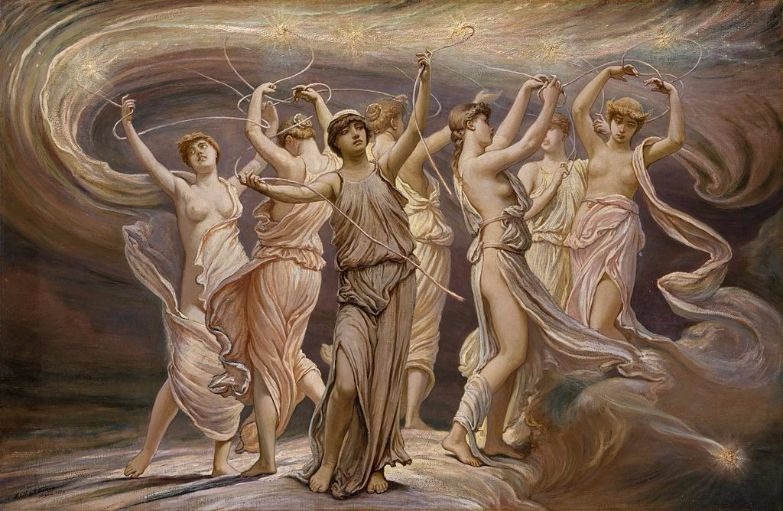
“The Pleiades” (1885) by Elihu Vedder. From WikiMedia.
How to Begin
The path to that mastery can be summed up in a formula that is both simple and obvious. The words themselves are so plain that we’d rather call them impossible. One more time.
We must follow this formula to its inevitable end. These aren’t magic words to be repeated. Instead, we must take heart and follow them. One more time.
Whether with ritual, a kata, or internal alchemy, we will fail ten thousand times on the path to mastery. We will feel discouraged. But mastery will come when, against everything, we persist. One more time.
Hearing the Call
What we need most is often the exact same thing that is hardest for us to learn. It is easy to spend our lives following our talents and inclinations. We could just do what we were taught and see the world in the simple ways we absorbed from our schools and parents and jobs and relationships.
Yet there is always some deeper, half-forgotten part of ourselves that calls us to be more. What we might refer to as our vocation is within us and all around us. To drown out the call, we surround ourselves with fantasies that it is already true.
Action movies are fantasies designed to relieve stress by siphoning off the desire for actual power that burns within us. Every romantic comedy is a band-aid on our longing for true connection. Fantasy substitutes for real spiritual development. Commercials are sleight-of-hand telling us that, instead of fulfilling our true needs, we can substitute some product and it will be just the same.
But simply understanding these tricks does not help. It just makes us feel powerless. And we allow this, because it takes away our culpability. Yet such a terrible perspective does nothing to free us. Until we can admit that we have done this to ourselves, we will not have the self-mastery to loose the chains that hold us to our path.
The world is not bad, or out to get us, or full of meanies.(4) We are not tied to the paths of our lives; we cling to them with mindless ferocity. How do we let go? There’s always more than one way to skin a cat, but the easiest is to find a teacher who has already walked that path.

Photo by Polly Peterson. Used with permission.
First Lesson
The path to mastery is long. I began studying martial arts when I was thirteen years old. It was the mid-80s, and my fantasies were alive with the magic-like power of these mystical paths of knowledge from far-off lands.
Coming of age is never easy; that is why there are so many books and movies about it. Growing up in New Jersey at a time of great cultural stress and flux, everyday reality just plain sucked for a weird, bookish kid like me.
Though materially I wanted for nothing, it was the height of the Cold War and no one knew what the next day would bring. I was too young to be able to inure myself from propaganda so (like so many people do) I just shut myself off from the world. I applied myself to what I could learn. Though my teen self could not have articulated it, I focused on what I could control.
Sure, maybe I fantasized a little too much about awesome ninja skills. But on some level I also recognized that there was something “real” underneath the fantasy. I devoted myself not just to learning a martial art as a path to power, but to new ways of seeing the world that were broader, and more hopeful, than those sold on television and in books.
Applying myself, I sought to learn things that I had little talent for. I was friends with kids who were good athletes, but I never was myself. Every accomplishment I had, I earned the hard way. It was then that I first learned (and studiously ignored) the simple formula of mastery. One more time.
One More Time
In all my years of training, I couldn’t say how many times I have heard a teacher tell me, “one more time.” When we begin to train, we are a thousand miles from mastery, and yet we are told, “one more step.” And of course, that is true. We only have to take one step at a time.
As students, we used to laugh at it. We learned quickly that “one more time” does not mean once more. But what took longer to reveal itself was the deeper meaning. “All you need to do is focus on the next step.” We thought “one more time” was a false promise. It was the first lesson.
All training, especially at the beginning, is a battle. We’re not yet fighting against the limitations of the body or the mind. The first enemy is the ego. We are more likely to give up from frustration than exhaustion. And so our teachers must play games with us. We start as fools, and so we must all be fooled to progress.
Getting Started
It is a paradox. In order to set ourselves free, we need teachers who have the wisdom not just to teach us what we want to learn, but also what we need to know. And to do that, we need to accept that we don’t already know those answers.
The everyday world teaches us that allowing anyone else to have power over us is a sign of weakness. It plays to our vanity and tell us that we are already free and strong and need no one. By accepting that we are strong and free, we keep ourselves weak and bound.
The path forward is to cultivate a deeper self. And in order to do that well, we often need teachers. While we long for freedom in our hearts, we probably have no idea what that would mean in reality. What we know of the broader, deeper world comes from anecdotes and movies and myths. We think that being free means being disconnected.
In order to break past this illusion, we need to know that there is a way out. So, even before we have a teacher, long before the secrets of the universe open themselves to us, there is something we can do.
If you long to be free, to be your truest self, then you likely have many teachers ahead of you on your path. But to begin, find anywhere to start. Find a daily practice that you can grasp. Whether it is thirty seconds of meditation, a cleansing ritual, or a nightly prayer, commit to it.
Commit to your practice with all of the will you can summon. Practice each day. And when your will gets weak, or your attention flags, tell yourself “one more time.” And do it. And then do the same the next day.
The unending challenge of mastery is the struggle to refine ourselves. The path alone will make you a more virtuous person. It will make you a stronger person. It will take you places you cannot yet imagine. But don’t panic. You don’t have to know the goal, only the next step.
—
(1) The word transcendent is often used in misleading ways. Mostly under the impact of Christian theology, it has come to mean “separate from the universe as we know it.” Such definitions pose challenges in that we can rarely or never agree on what this world is. When describing transcendence, it if important to remember that (to wax grammar-y in a footnote) the verb is transitive. Always and forever, we must answer the question “transcend what?”
(2) My path is not for everyone, or really anyone, else. My path was mine. Find yours!
(3) For an excellent discussion on the diverse meanings of “mastery” it is worth taking a look at Forrest E. Morgan’s book, Living the Martial Way.
(4) Admittedly, there are plenty of people in the world who will happily take our share. But I am arguing that such behavior is not personal. The fox doesn’t hate the hare. He’s just being a fox.
Previous Post

February 27, 2018
The Other Side of the Hedge: Dignity for Dunces
Next Post

March 19, 2018 The Other Side of the Hedge: Animal Wisdom
Browse Our Archives
Select a Category Columns History Holidays Politics Ritual and Practice The Other Side of the Hedge Theology, Ethics, Philosophy
Select a Month June 2019 May 2019 April 2019 March 2019 February 2019 January 2019 December 2018 November 2018 October 2018 September 2018 August 2018 July 2018 June 2018 May 2018 April 2018 March 2018 February 2018 January 2018 November 2017 October 2017 September 2017 August 2017 July 2017 June 2017 May 2017 April 2017 March 2017 February 2017 January 2016 December 2015 November 2015 October 2015 September 2015
TAKE THE
Religious Wisdom Quiz
How many times does the book of Genesis mention "God created"?
Select your answer to see how you score.
9 7 5 11
Related posts from The Other Side of the Hedge




TRENDING AT PATHEOS Pagan

I was recently chatting with someone on Instagram. She asked me what...

While there are many people who share their results, the end of...

On July 23, I saw Christopher Nolan's The Odyssey which is Homer’s...

As I write this two big events have just finished up. One...

Restoring the Watershed of Divine Love
Perhaps cooperation is not something we manufacture through legislation, ideology, or moral...

Many UUs don’t pray because of bad experiences in a previous religion,...
view all Pagan blogs
Ad-Free & Subscriber Log-In Subscription Support
- About Us
- 2026 Calendar
- Videos
- Podcasts
- Library of World Religions
- Faith In Media Tracker
- Advertise With Us
- Write for Us
- Privacy Policy
- Terms of Service
- Do Not Sell My Data
- Contact Us
- Radiant Digital
- Manage Newsletter Subscriptions
- Unsubscribe From Notifications
- Sitemap
Copyright 2008-2026, Patheos. All rights reserved.
Subscription Support Ad-Free & Subscriber Log-In
Follow Patheos