
BuddhistCatholicContemplativeEvangelicalGeneral ChristianHinduJewishLatter-day SaintMuslimNew VisionsProgressive Christian
Beliefs
- Buddhist
- Catholic
- Contemplative
- Evangelical
- General Christian
- Hindu
- Jewish
- Latter-day Saint
- More Voices
- Muslim
- New Visions
- Pagan
- Progressive Christian
Topics
- Religion News
- Food and Religion
- Sports and Religion
- Religious Art
- Religious Music and Entertainment
- Religious Events
- History and Religion
- Style and Religion
- Politics and Religion
- Women in Religion
- Recreation Outdoors and Religion
- Business Finance and Religion
- Careers Workplace and Religion
- Education and Religion
- Family Parenting and Religion
- Health Fitness and Religion
- Home and Religion
- Relationships and Religion
- Technology and Religion
- Travel and Religion
Columnists
- Buddhist Columnists
- Business Finance and Religion Columnists
- Careers Workplace and Religion Columnists
- Catholic Columnists
- Contemplative Columnists
- Education and Religion Columnists
- Evangelists Columnists
- Family Parenting and Religion Columnists
- General Christian Columnists
- Health Fitness and Religion Columnists
- Hindu Columnists
- History and Religion Columnists
- Home and Religion Columnists
- Jewish Columnists
- More Voices Columnists
- Latter Day Columnists
- Muslim Columnists
- New Visions Columnists
- Nonreligious Columnists
- Pagan Columnists
- Politics and Religion Columnists
- Progressive Columnists
- Recreation Outdoors and Religion Columnists
- Relationships and Religion Columnists
- Religion News Columnists
- Religious Art Columnists
- Religious Events Columnists
- Religious Music and Entertainment Columnists
- Sports and Religion Columnists
- Style and Religion Columnists
- Technology and Religion Columnists
- Travel and Religion Columnists
- Women in Religion Columnists
Resource Library
- 2026 Calendar
- Library of World Religions
- The 100 Most Holy Places on Earth
- Patheos Answers
- Podcasts
- Videos
- Faith Leaders Database
- Anglican Episcopalian
- Bahai
- Baptist
- Buddhism
- Christianity
- Confucianism
- Eastern Orthodoxy
- Hinduism
- Holiness and Pentecostal
- ISKCON
- Islam
- Judaism
- Lutheran
- Methodist
- The Church of Jesus Christ of Latter-day Saints
- New Age
- Paganism
- Presbytarian and Reformed
- Protestantism
- Religion Behind the Scenes
- Roman Catholic
- Scientology
- Shia Islam
- Sikhism
- Sufism
- Sunni Islam
- Taoism
- Zen
- See all religions
Research Tools
 Ad-Free & Subscriber Log-In Subscription Support
Ad-Free & Subscriber Log-In Subscription Support
Follow Patheos 

- Trending:
- Forgiveness
- |
- Marriage
- |
- Consciousness
- |
- Death Penalty
- |
- Election
- |
- Halloween
 The Other Side of the Hedge
- Home
- Pagan
- The Other Side of the Hedge: Don’t Trust Your Spirit, Train It
The Other Side of the Hedge: Don’t Trust Your Spirit, Train It
Last updated on: April 9, 2017 at 12:58 am by Christopher Drysdale
The Other Side of the Hedge: Don’t Trust Your Spirit, Train It 2017-04-09T00:58:26-07:00 Christopher Drysdale
Patheos Explore the world's faith through different perspectives on religion and spirituality! Patheos has the views of the prevalent religions and spiritualities of the world.
When I was in my mid-twenties and living on the East Coast, I did a lot of driving. I didn’t think anything of driving my hour commute every day. On the weekends, I would head four hours away to see a friend at the drop of a hat. I had this zippy little Nissan Sentra sports coupe, which was probably the most fun car I’ve ever owned.
At the same time, I was also deeply involved in learning everything I could about spirit work. One thing I learned that has stood me in good stead is that roads, like everything else, have spirits. Road spirits, when healthy, are interested in getting everyone to their destinations.
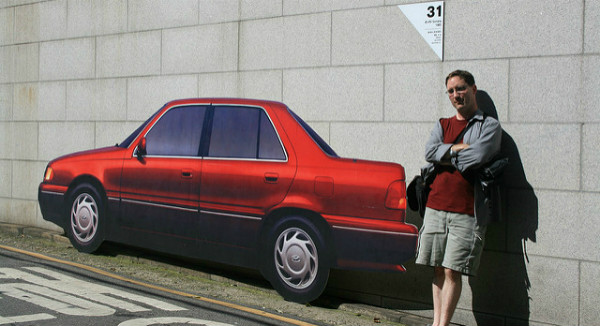
Sonata – Polly Peterson (2009). Used with permission.
By connecting to a road spirit, I could sense any number of useful things: upcoming accidents, speed traps, dangerous drivers, you name it. By merging my spirit with the spirit of the road (carefully!) I could know the unknowable.
It’s not as easy as it sounds. The trick was to merge with the road-spirit, but also to retain self-control. Since there are times and places where an accident is looking to happen, it can be useful to be able to spiritually say, “not it!”
ProTip: We might work with spirits, but at the end of the day it’s also necessary to keep control and take responsibility for ourselves.
Calibrating Our Perceptions
Most people are decent drivers, so learning to spirit-drive isn’t the most useful skill in the world. I suspect that many people intuitively do something like what I’m describing.
Once I could reliably single out upcoming driving events that were down the road, I began to test my predictions. For developing any “psychic” skill, this is a key part of training. Repeatedly, you need to make a prediction, and then watch to see if it comes true.

: Monk Shoes – Polly Peterson (2009). Used with permission.
Both successes and failures are useful results. In truly developing such skills, it is important to accrue vast quantities of data about your predictions. It is especially important to do this when training any skill that either your life or the lives of others will depend on.
In upstate New York, there are thousands of tiny two-lane highways that are forever being blocked by relatively slow-moving trucks. The roads wind among as well as climb up and down the hills, often driving through tree cover. It’s virtually impossible to find a place to pass.
One skill I developed was determining whether it would be safe to pass. Merging with the road-spirit, I would use my own spirit to “ping” the road ahead, almost like spirit-radar. I would seek a “clear” or “not clear” feeling.
Now, I didn’t act on these feelings. Instead, I would watch to see what happened. I would “ping” and then I would start timing. I would count, “one one-thousand, two one-thousand, three one-thousand…” until a car came by the other way and it was clear whether my sense was accurate or not.
This wasn’t something I did once, or for an afternoon, or a weekend. It took constant practice to hone my predictions. This type of practice was how I tested all my “psychic” perceptions. It wasn’t about testing to see if they were “real.” It was a method of calibration.
These skills, over time, developed into a much more fluid, intuitive system. These days, I simply know when the roads are “bad” and avoid trouble spots. But it all began with specific perceptions, not simply trusted, but tested and trained for accuracy.
ProTip: Intuition is situational. Learning to spirit-drive might help with learning to avoid other dangers (physical assault comes to mind), but it’s not the same thing. They need to be trained separately. Context always matters.
Messages from the Spirit
Spirit-driving is a cool trick, and it can occasionally save your life. Maybe more important is understanding that we can’t take every intuition at face value “out of the box.”
Though they may “see” differently, our spirits can be as fallible anything else. They can overreact, fail to notice things, be fooled, be tired, or simply fall short of our expectations.

Photo: Please, Mr. Postman – Polly Peterson (2009) . More permissions granted.
When it comes to dangerous situations, sometimes it’s best to trust your spirit. When your spirit urges you to RUN! that might be exactly what you need to do.
But when it comes to understanding things in the world, I believe that any spirit, even my own, needs to pony up evidence. Trust needs to be built over time.
ProTip: When it comes to messages from the spirit, it’s important to distinguish between verbal messages and nonverbal ones. In my experience, the nonverbal ones tend to be much more immediate and accurate.
Previous Post

April 2, 2017
The Other Side of the Hedge: What is Magic For?
Next Post
April 16, 2017 The Other Side of the Hedge: We All Start as Fools
Browse Our Archives
Select a Category Columns History Holidays Politics Ritual and Practice The Other Side of the Hedge Theology, Ethics, Philosophy
Select a Month June 2019 May 2019 April 2019 March 2019 February 2019 January 2019 December 2018 November 2018 October 2018 September 2018 August 2018 July 2018 June 2018 May 2018 April 2018 March 2018 February 2018 January 2018 November 2017 October 2017 September 2017 August 2017 July 2017 June 2017 May 2017 April 2017 March 2017 February 2017 January 2016 December 2015 November 2015 October 2015 September 2015
TAKE THE
Religious Wisdom Quiz
True or False: Peter raised Tabitha (Dorcas) from the dead in Lydda.
Select your answer to see how you score.
TRUE FALSE
Related posts from The Other Side of the Hedge




TRENDING AT PATHEOS Pagan

I was recently chatting with someone on Instagram. She asked me what...

While there are many people who share their results, the end of...

On July 23, I saw Christopher Nolan's The Odyssey which is Homer’s...

As I write this two big events have just finished up. One...

Restoring the Watershed of Divine Love
Perhaps cooperation is not something we manufacture through legislation, ideology, or moral...

Many UUs don’t pray because of bad experiences in a previous religion,...
view all Pagan blogs
Ad-Free & Subscriber Log-In Subscription Support
- About Us
- 2026 Calendar
- Videos
- Podcasts
- Library of World Religions
- Faith In Media Tracker
- Advertise With Us
- Write for Us
- Privacy Policy
- Terms of Service
- Do Not Sell My Data
- Contact Us
- Radiant Digital
- Manage Newsletter Subscriptions
- Unsubscribe From Notifications
- Sitemap
Copyright 2008-2026, Patheos. All rights reserved.
Subscription Support Ad-Free & Subscriber Log-In
Follow Patheos