
BuddhistCatholicContemplativeEvangelicalGeneral ChristianHinduJewishLatter-day SaintMuslimNew VisionsProgressive Christian
Beliefs
- Buddhist
- Catholic
- Contemplative
- Evangelical
- General Christian
- Hindu
- Jewish
- Latter-day Saint
- More Voices
- Muslim
- New Visions
- Pagan
- Progressive Christian
Topics
- Religion News
- Food and Religion
- Sports and Religion
- Religious Art
- Religious Music and Entertainment
- Religious Events
- History and Religion
- Style and Religion
- Politics and Religion
- Women in Religion
- Recreation Outdoors and Religion
- Business Finance and Religion
- Careers Workplace and Religion
- Education and Religion
- Family Parenting and Religion
- Health Fitness and Religion
- Home and Religion
- Relationships and Religion
- Technology and Religion
- Travel and Religion
Columnists
- Buddhist Columnists
- Business Finance and Religion Columnists
- Careers Workplace and Religion Columnists
- Catholic Columnists
- Contemplative Columnists
- Education and Religion Columnists
- Evangelists Columnists
- Family Parenting and Religion Columnists
- General Christian Columnists
- Health Fitness and Religion Columnists
- Hindu Columnists
- History and Religion Columnists
- Home and Religion Columnists
- Jewish Columnists
- More Voices Columnists
- Latter Day Columnists
- Muslim Columnists
- New Visions Columnists
- Nonreligious Columnists
- Pagan Columnists
- Politics and Religion Columnists
- Progressive Columnists
- Recreation Outdoors and Religion Columnists
- Relationships and Religion Columnists
- Religion News Columnists
- Religious Art Columnists
- Religious Events Columnists
- Religious Music and Entertainment Columnists
- Sports and Religion Columnists
- Style and Religion Columnists
- Technology and Religion Columnists
- Travel and Religion Columnists
- Women in Religion Columnists
Resource Library
- 2026 Calendar
- Library of World Religions
- The 100 Most Holy Places on Earth
- Patheos Answers
- Podcasts
- Videos
- Faith Leaders Database
- Anglican Episcopalian
- Bahai
- Baptist
- Buddhism
- Christianity
- Confucianism
- Eastern Orthodoxy
- Hinduism
- Holiness and Pentecostal
- ISKCON
- Islam
- Judaism
- Lutheran
- Methodist
- The Church of Jesus Christ of Latter-day Saints
- New Age
- Paganism
- Presbytarian and Reformed
- Protestantism
- Religion Behind the Scenes
- Roman Catholic
- Scientology
- Shia Islam
- Sikhism
- Sufism
- Sunni Islam
- Taoism
- Zen
- See all religions
Research Tools
 Ad-Free & Subscriber Log-In Subscription Support
Ad-Free & Subscriber Log-In Subscription Support
Follow Patheos 

- Trending:
- Forgiveness
- |
- Marriage
- |
- Consciousness
- |
- Death Penalty
- |
- Election
- |
- Halloween
 The Other Side of the Hedge
- Home
- Pagan
- The Other Side of the Hedge: Being Neighborly
The Other Side of the Hedge: Being Neighborly
Last updated on: September 6, 2015 at 12:00 pm by Christopher Drysdale
The Other Side of the Hedge: Being Neighborly 2015-09-06T12:00:43-07:00 Christopher Drysdale
Patheos Explore the world's faith through different perspectives on religion and spirituality! Patheos has the views of the prevalent religions and spiritualities of the world.
Land spirits are an important part of paganisms around the world. These are spirits associated with places, whether they might be as small as a stream, or a tree, or as large as a mountain, a village, or a country.
In Europe, such spirits go by a number of names, like the elves and faeries in Britain, and the alfar and landvaettir in much of Scandinavia. But these familiar/well-known examples are just the tip of the iceberg. We can find land spirits almost everywhere, from the Celtic clootie well, to the Korean mudang’s tree, to the Mongolian oboo.

Mudang’s Tree – Polly Peterson (2008) / Flickr.com
Similar patterns can be found around the world. In some parts of Indonesia, clearing land for farms may require sacrifices for the spirits who live there so that farmers will be left unharmed. Specific trees or stones may be left alone, or simply warned ahead of time so that resident spirits have a chance to vacate before the land is disturbed. Spirit-workers, whether mediums, diviners, or priests, often have a role in determining if there is a problem, and then resolving it.
Sometimes I find it strange that we don’t see this pattern much in modern America. Willy-nilly, we build with virtually no regard for the land at all. We shape the land and use it, but find it hard to believe that the land shapes us in return. True to our pioneer myth, we generally see the land’s power as passive, ready to be put to use by a strong, firm hand.
Ignoring those who already inhabit the land has been part of our mythology. But as we move from invaders to inhabitants ourselves, this changes. Knowing how to live in harmony is a skill, and one that many pagans embrace.
Moving In
I have moved a fair amount in my life. It wasn’t always like this, but now when I move to a new place, I survey the local land and the local “mythologies.” I then go and find an appropriate location to introduce myself to the land spirits.
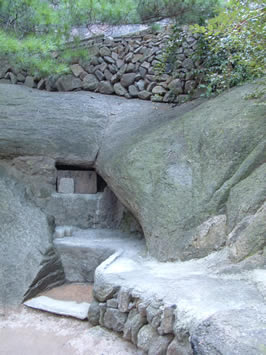
Architecturally Modified Mountainside for Shamanic Rituals – Inwangsan / Polly Peterson, September 2008
When my wife and I lived in Korea for a year, our first weekend trip was to Inwangsan, a mountain associated with Korean shamanist tradition (muism). We left some soju at one of the many impromptu shrines dotting the mountainside, and introduced ourselves to the spirit of the mountain. I must admit, the powerful spirit was singularly unimpressed with our presence.
Inwangsan is an interesting place. Both Buddhist and animist shrines on the mountain are still active, and there was a shop on the mountain that sold a variety of ritual objects. On the way down the mountain, we ran across a woman, probably a mudang (Korean: shaman), ritually tearing cloth. And no, we didn’t stop to snap a picture.
Years later, when we came to the San Francisco Bay Area, my wife and I traveled to the top of Mt. Diablo. This mountain is in many ways the spiritual equivalent of Inwangsan; it has been a holy mountain for the people who have been here ten or more millennia.
We traveled up the mountain and introduced ourselves to all the lands surrounding. Perhaps because of the park system’s strict policy about littering, we neither found shrines nor started one. We simply found a small knoll at the top, and stopped to say hello. We shared some water with some plants there, and asked for permission to stay in the area.

“Mt Diablo” by Hughly741 at en.wikipedia
Transferred from en.wikipedia; transferred to Commons by User:Logan using CommonsHelper
Licensed under Public Domain via Wikimedia Commons.

Wherever we go, the landscape is dotted with places like this. Finding them can be a matter of listening to old stories and keeping your eyes open. As it turns out, Mt. Diablo was named by the Spanish in the area, on account of local spirit beliefs.
A Note of Caution
While recognizing the power of the land spirits is only polite, that doesn’t necessarily mean that you need to dress the part. Wearing any kind of indigenous clothes for ritual is something you should only do when required by someone who has the “proper” authority through that tradition.
On the other hand, be respectful. When going to a sacred site, it might be appropriate to wear long pants and long sleeves, and to take off your hat when speaking with your betters. These are marks of respect in Western culture, and will generally be recognized and appreciated.
Offering some grain, salt, wine, beer, tobacco, soju, or whatever the local spirit-neighbors like is only polite. Dressing up in their clothes to do so is seriously stalker-y.
The Best Way to Have a Good Neighbor Is to Be One
Living well somewhere means getting along with the land spirits just as much as it means getting along with your other neighbors. Being pleasant and non-disruptive is a start in fostering harmony with the land.
When you move into a new place, heading over to your neighbors and introducing yourself is usually the polite thing to do. This is true whether they live in the next apartment or the old tree down the road. If they’ve lived there ten years, you might learn a thing or two. If they’ve lived there three hundred, so much the better!

Click here to like
Patheos Pagan on Facebook.

Click here to like
the Agora on Facebook
The Other Side of the Hedge is published on the first and third Sunday of the month. Subscribe via RSS or e-mail!
Please use the links to the right to keep on top of activities here on the Agora as well as across the entire Patheos Pagan channel.
Previous Post

June 1, 2019
One Thousand Days
Next Post

September 20, 2015 The Other Side of the Hedge: Animism Isn't for Us?
Browse Our Archives
Select a Category Columns History Holidays Politics Ritual and Practice The Other Side of the Hedge Theology, Ethics, Philosophy
Select a Month June 2019 May 2019 April 2019 March 2019 February 2019 January 2019 December 2018 November 2018 October 2018 September 2018 August 2018 July 2018 June 2018 May 2018 April 2018 March 2018 February 2018 January 2018 November 2017 October 2017 September 2017 August 2017 July 2017 June 2017 May 2017 April 2017 March 2017 February 2017 January 2016 December 2015 November 2015 October 2015 September 2015
TAKE THE
Religious Wisdom Quiz
Who found Moses' basket in the Nile?
Select your answer to see how you score.
Jochebed Zipporah Miriam Pharaoh's daughter
Related posts from The Other Side of the Hedge




TRENDING AT PATHEOS Pagan

I was recently chatting with someone on Instagram. She asked me what...

While there are many people who share their results, the end of...

On July 23, I saw Christopher Nolan's The Odyssey which is Homer’s...

As I write this two big events have just finished up. One...

Restoring the Watershed of Divine Love
Perhaps cooperation is not something we manufacture through legislation, ideology, or moral...

Many UUs don’t pray because of bad experiences in a previous religion,...
view all Pagan blogs
Ad-Free & Subscriber Log-In Subscription Support
- About Us
- 2026 Calendar
- Videos
- Podcasts
- Library of World Religions
- Faith In Media Tracker
- Advertise With Us
- Write for Us
- Privacy Policy
- Terms of Service
- Do Not Sell My Data
- Contact Us
- Radiant Digital
- Manage Newsletter Subscriptions
- Unsubscribe From Notifications
- Sitemap
Copyright 2008-2026, Patheos. All rights reserved.
Subscription Support Ad-Free & Subscriber Log-In
Follow Patheos