
BuddhistCatholicContemplativeEvangelicalGeneral ChristianHinduJewishLatter-day SaintMuslimNew VisionsProgressive Christian
Beliefs
- Buddhist
- Catholic
- Contemplative
- Evangelical
- General Christian
- Hindu
- Jewish
- Latter-day Saint
- More Voices
- Muslim
- New Visions
- Pagan
- Progressive Christian
Topics
- Religion News
- Food and Religion
- Sports and Religion
- Religious Art
- Religious Music and Entertainment
- Religious Events
- History and Religion
- Style and Religion
- Politics and Religion
- Women in Religion
- Recreation Outdoors and Religion
- Business Finance and Religion
- Careers Workplace and Religion
- Education and Religion
- Family Parenting and Religion
- Health Fitness and Religion
- Home and Religion
- Relationships and Religion
- Technology and Religion
- Travel and Religion
Columnists
- Buddhist Columnists
- Business Finance and Religion Columnists
- Careers Workplace and Religion Columnists
- Catholic Columnists
- Contemplative Columnists
- Education and Religion Columnists
- Evangelists Columnists
- Family Parenting and Religion Columnists
- General Christian Columnists
- Health Fitness and Religion Columnists
- Hindu Columnists
- History and Religion Columnists
- Home and Religion Columnists
- Jewish Columnists
- More Voices Columnists
- Latter Day Columnists
- Muslim Columnists
- New Visions Columnists
- Nonreligious Columnists
- Pagan Columnists
- Politics and Religion Columnists
- Progressive Columnists
- Recreation Outdoors and Religion Columnists
- Relationships and Religion Columnists
- Religion News Columnists
- Religious Art Columnists
- Religious Events Columnists
- Religious Music and Entertainment Columnists
- Sports and Religion Columnists
- Style and Religion Columnists
- Technology and Religion Columnists
- Travel and Religion Columnists
- Women in Religion Columnists
Resource Library
- 2026 Calendar
- Library of World Religions
- The 100 Most Holy Places on Earth
- Patheos Answers
- Podcasts
- Videos
- Faith Leaders Database
- Anglican Episcopalian
- Bahai
- Baptist
- Buddhism
- Christianity
- Confucianism
- Eastern Orthodoxy
- Hinduism
- Holiness and Pentecostal
- ISKCON
- Islam
- Judaism
- Lutheran
- Methodist
- The Church of Jesus Christ of Latter-day Saints
- New Age
- Paganism
- Presbytarian and Reformed
- Protestantism
- Religion Behind the Scenes
- Roman Catholic
- Scientology
- Shia Islam
- Sikhism
- Sufism
- Sunni Islam
- Taoism
- Zen
- See all religions
Research Tools
 Ad-Free & Subscriber Log-In Subscription Support
Ad-Free & Subscriber Log-In Subscription Support
Follow Patheos 

- Trending:
- Forgiveness
- |
- Marriage
- |
- Consciousness
- |
- Death Penalty
- |
- Election
- |
- Halloween
 Theology of Work Project
- Home
- Business, Finance and Religion
- How to Be a Rich Christian (Part 2: Understanding Poverty)
How to Be a Rich Christian (Part 2: Understanding Poverty)
Last updated on: September 8, 2015 at 12:51 pm by Theology of Work Project
How to Be a Rich Christian (Part 2: Understanding Poverty) 2015-09-08T12:51:49-05:00 Theology of Work Project
Patheos Explore the world's faith through different perspectives on religion and spirituality! Patheos has the views of the prevalent religions and spiritualities of the world.

Image via Pixabay
Part 2: Understanding Poverty
About 1.4 billion of the world’s population live in extreme poverty, meaning they lack the basic necessities of life. A further 1.1 billion live at subsistence level, on a kind of “hand-to-mouth” existence that is only one crisis away from disaster.[1] Economic poverty affects nearly 40 percent of humanity. Given what we have seen in Genesis 1 and 2, this is clearly not how God intended things to be. So why is this the daily reality of so many people?
In a world that was entirely level and fair, good choices would lead to provision and wealth, and poor choices to poverty. In such a cause-and-effect world, the truth of proverbs such as, “In all toil there is profit, but mere talk leads only to poverty,” (Proverbs 14:23) would make perfect sense. Laziness, wasteful indulgence, poor self-discipline and addictive behaviour would all lead naturally to poverty. On the other hand, hard work, careful consumption, healthy self-discipline and freedom from addictions would result in wealth. This may be the case for millions or billions of people in the world today—their relative wealth or poverty being due largely to their own good choices, hard work, and ingenuity. In well-governed societies, among those with equal access to resources and education, and in situations where illness, disaster, family dysfunction, crime, and accidents do not hamper people, individuals’ wealth and poverty may be the fair outcomes of personal effort.
But the truth is that on a global scale, we don’t live in anything close to a level playing field. The fallen world is neither fair nor even-handed. None of us start life from the same position. Our family, community and societal circumstances dictate much about our opportunities in the world. Some of us are fortunate to be born into loving, nurturing families in prosperous countries, with a myriad of abilities and opportunities. Sadly, others are born into circumstances that are resourceless in every sense of the word. They are never given the basis they need to provide for themselves.
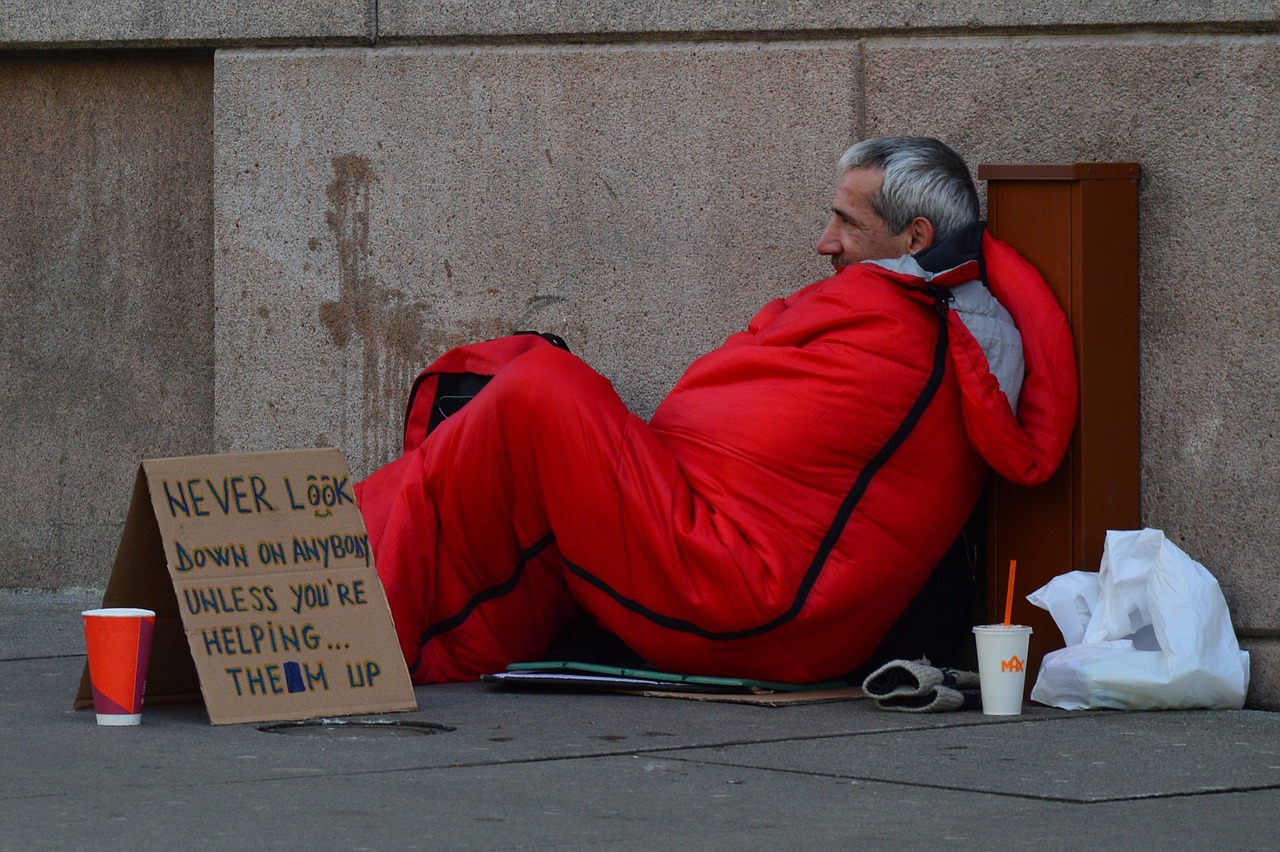
Image via Pixabay
It is true that the majority of poverty is a result of some form of human sin and error. But it is not necessarily their own sin that causes people to lack provision or wealth. Poor government, war, corruption, exploitation by the powerful, lack of education and training, family and social ills that prevent people from reaching their potential, all contribute to many people not having enough, through no fault of their own. In particular, lack of provision often lies in whole or part with social or personal sin against the poor. That is, they are victims of others’ sin. A tyrant confiscates a family’s land, depriving them of their capacity to produce. A factory exploits vulnerable workers by paying below legal wages and threatening those who object. A wealthy landowner strips large tracts of forested land of its vegetation, putting millions of people downstream at risk of flooding. A husband becomes addicted to gambling, and leaves his wife and children penniless. An investment fails because of fraud and deception, leaving a family who had saved hard for the future without means.
Even so, not all poverty is the result of sin, or at least not sin that can be traced to anyone in particular. Some people are unable to provide for their needs because of disability, illness, age or other factors that aren’t anyone’s fault. In the Old Testament, three such groups of people were particularly vulnerable—“the widow, the orphan and the foreigner.” [2] Anticipating this, the Hebrew Law contained regulations that would ensure these people were provided for. [3] Zechariah is typical of the Prophets when he writes: “Thus says the Lord of hosts: Render true judgments, show kindness and mercy to one another; do not oppress the widow, the orphan, the alien, or the poor” (Zechariah 7:9-10).[4]
Other poverty occurs because of the unpredictability of our planet. A natural disaster such as an earthquake, tsunami, drought or flood can devastate whole communities, destroying crops, homes, possessions and livelihoods in a single moment. For example, a quarter of a million people lost their lives in the Boxing Day tsunami in 2004 that swamped coastal Indonesia and other parts of South East Asia, and many more survivors were left homeless and without any means to provide for themselves.
We must be very careful then, not to make assumptions about the reasons for anyone’s situation—rich or poor. So many factors are at work, some of individuals’ own making; many outside their control. The Bible is very realistic in this regard. For example, it has been noted that, “fewer than one-third of the proverbs dealing with rich and poor teach that people get what they deserve, whereas the rest recognize the presence and problem of socio-economic justice.”[5] So while there are times when the Bible connects provision or lack of it with a cause, generally Scripture is less concerned with identifying the particular causes of poverty and more concerned with the obligations of those who have wealth to care for those who lack provision.
Click to Like Theology of Work Project on Facebook

Click to Like Theology of Work Project on Facebook
[1] World Bank, World Development Indicators 2011 (Washington, DC: World Bank Publications, 2011), 65. In the World Bank’s definition, “extreme” poverty means living on less than US$1.25 a day (at purchasing power parity) and “subsistence poverty” means living on less than US$2.00 per day.
[2] The care of these three groups was repeatedly viewed as a yardstick of whether Jewish society was fulfilling its covenantal responsibilities. See, for example, Exodus 22:22; Deuteronomy 10:18; 24:17-22; Psalm 146:9; Isaiah 1:17; Zechariah 7:9-10.
[3] Gleaning was one practice prescribed for this very situation. See, for example, the situation of Ruth and Naomi in Ruth 2:2-3.
[4] See also Jeremiah 7:5-7.
[5] Craig Blomberg, Neither Poverty Nor Riches(Eerdmans, 1999), 65, noting an observation of Norman Gottwald.

Browse Our Archives
Select a Category Advent Ambition Bible and Work Business Calling Christmas Common Good Communication Conflict Culture Disappointment Discipleship Earth Day Easter Economics Environmental Sustainability Envy Faith and the Workplace Family and Work Generosity Giving Gossip Government Gratitude Hospitality Human Flourishing Humility Investing Justice Leadership Lent Local Church Making Mistakes Men and Work Millennials and Work Minimum Wage Money New Year Pastors Patience Pay Politics Poverty Prayer Race Rest Sabbath Sacred vs. Secular Sharing Faith Slavery Song of Songs Status Success Suffering Teamwork Thanksgiving Theology of Work TOW Project News Unemployment Valentine's Day Vocation Women and Work Work Life Balance
Select a Month September 2015 August 2015 July 2015 June 2015 May 2015 April 2015 March 2015 February 2015 January 2015 December 2014 November 2014 October 2014 September 2014 August 2014 July 2014 June 2014 May 2014 April 2014 March 2014 February 2014 January 2014 December 2013
Follow Us!
TAKE THE
Religious Wisdom Quiz
What is the meaning of "Immanuel" in the prophecy of Isaiah?
Select your answer to see how you score.
God the Healer God the Redeemer God Provides God with Us
Related posts from Theology of Work Project

How To Be a Rich Christian: 3 Ways...

How to Be a Rich Christian (3 Key...

How to Be a Rich Christian (Part 4:...

How to Be a Rich Christian (Part 3:...
TRENDING AT PATHEOS Business, Finance and Religion

St. Francis by Bill Droel Pope Leo XIV declares 2026 as “Year...

Catholics are schooled in the faith by memorizing dogmatic points and lots...

The Good News of Our Human Limitations -...
After another day of trying to meet deadlines and working on projects,...

Quiet Holy Attentiveness (podcast) with Sarah Clarkson
We know that quiet is an essential aspect of the spiritual life,...

Every Vocation Everywhere All At Once
What is a vocation? How does it endure through the years? Can...

I promise this is not going to become a Taylor Swift Studies...
view all Business, Finance and Religion blogs
Ad-Free & Subscriber Log-In Subscription Support
- About Us
- 2026 Calendar
- Videos
- Podcasts
- Library of World Religions
- Faith In Media Tracker
- Advertise With Us
- Write for Us
- Privacy Policy
- Terms of Service
- Do Not Sell My Data
- Contact Us
- Radiant Digital
- Manage Newsletter Subscriptions
- Unsubscribe From Notifications
- Sitemap
Copyright 2008-2026, Patheos. All rights reserved.
Subscription Support Ad-Free & Subscriber Log-In
Follow Patheos