
BuddhistCatholicContemplativeEvangelicalGeneral ChristianHinduJewishLatter-day SaintMuslimNew VisionsProgressive Christian
Beliefs
- Buddhist
- Catholic
- Contemplative
- Evangelical
- General Christian
- Hindu
- Jewish
- Latter-day Saint
- More Voices
- Muslim
- New Visions
- Pagan
- Progressive Christian
Topics
- Religion News
- Food and Religion
- Sports and Religion
- Religious Art
- Religious Music and Entertainment
- Religious Events
- History and Religion
- Style and Religion
- Politics and Religion
- Women in Religion
- Recreation Outdoors and Religion
- Business Finance and Religion
- Careers Workplace and Religion
- Education and Religion
- Family Parenting and Religion
- Health Fitness and Religion
- Home and Religion
- Relationships and Religion
- Technology and Religion
- Travel and Religion
Columnists
- Buddhist Columnists
- Business Finance and Religion Columnists
- Careers Workplace and Religion Columnists
- Catholic Columnists
- Contemplative Columnists
- Education and Religion Columnists
- Evangelists Columnists
- Family Parenting and Religion Columnists
- General Christian Columnists
- Health Fitness and Religion Columnists
- Hindu Columnists
- History and Religion Columnists
- Home and Religion Columnists
- Jewish Columnists
- More Voices Columnists
- Latter Day Columnists
- Muslim Columnists
- New Visions Columnists
- Nonreligious Columnists
- Pagan Columnists
- Politics and Religion Columnists
- Progressive Columnists
- Recreation Outdoors and Religion Columnists
- Relationships and Religion Columnists
- Religion News Columnists
- Religious Art Columnists
- Religious Events Columnists
- Religious Music and Entertainment Columnists
- Sports and Religion Columnists
- Style and Religion Columnists
- Technology and Religion Columnists
- Travel and Religion Columnists
- Women in Religion Columnists
Resource Library
- 2026 Calendar
- Library of World Religions
- The 100 Most Holy Places on Earth
- Patheos Answers
- Podcasts
- Videos
- Faith Leaders Database
- Anglican Episcopalian
- Bahai
- Baptist
- Buddhism
- Christianity
- Confucianism
- Eastern Orthodoxy
- Hinduism
- Holiness and Pentecostal
- ISKCON
- Islam
- Judaism
- Lutheran
- Methodist
- The Church of Jesus Christ of Latter-day Saints
- New Age
- Paganism
- Presbytarian and Reformed
- Protestantism
- Religion Behind the Scenes
- Roman Catholic
- Scientology
- Shia Islam
- Sikhism
- Sufism
- Sunni Islam
- Taoism
- Zen
- See all religions
Research Tools
 Ad-Free & Subscriber Log-In Subscription Support
Ad-Free & Subscriber Log-In Subscription Support
Follow Patheos 

- Trending:
- Forgiveness
- |
- Marriage
- |
- Consciousness
- |
- Death Penalty
- |
- Election
- |
- Halloween
 Theology of Work Project
- Home
- Business, Finance and Religion
- Avoiding the Pitfalls of Success: Career Lessons from Joseph
Avoiding the Pitfalls of Success: Career Lessons from Joseph
Last updated on: June 10, 2015 at 12:10 pm by Guest Contributor
Avoiding the Pitfalls of Success: Career Lessons from Joseph 2015-06-10T12:10:30-05:00 Guest Contributor
Patheos Explore the world's faith through different perspectives on religion and spirituality! Patheos has the views of the prevalent religions and spiritualities of the world.

Image via Pixabay
After Joseph told Pharaoh what his dreams meant, and how to deal with the coming famine, Pharaoh decided to put Joseph in charge of the 14 year project of collecting food during the good years, and distributing it during the famine. From his position of power and authority, Pharaoh might have commanded Joseph to do this job as a slave, reporting to one of his officials. But I think Pharaoh had more insight than this. He saw talent in Joseph that he had not seen in his own officials. He also likely knew that giving someone the responsibility for a job without the authority to do it simply would not work. (Interestingly, business leaders struggle with this to this day.)
Joseph’s Promotion
So Pharaoh started with the position description and the reporting structure:
“Since God has made all this known to you, there is no one so discerning and wise as you. You shall be in charge of my palace, and all my people are to submit to your orders. Only with respect to the throne will I be greater than you.’ So Pharaoh said to Joseph, ‘I hereby put you in charge of the whole land of Egypt. . . . I am Pharaoh, but without your word no one will lift hand or foot in all Egypt.” (Genesis 41:39–41, 44)
Talk about a promotion! Few people have the opportunity to move from time in prison to a position of such power and responsibility. Then Pharaoh offered Joseph the compensation package and the trappings that went with his new position:
Pharaoh took his signet ring from his finger and put it on Joseph’s finger. He dressed him in robes of fine linen and put a gold chain around his neck. He had him ride in a chariot as his second-in-command, and men shouted before him, ‘Make way!’ (Genesis 41:42–43)
All of the resources of the kingdom were now at Joseph’s disposal. He had funding for clothes, a company car and a collection of servants. Pharaoh also provided a wife for Joseph. In terms of title, compensation, authority and status, Joseph got it all. It is enough to make a twenty-first-century CEO envious. He was the CEO of the Egyptian International Food Company.
Finding Help at the Top
For a person seeking help in the middle of difficulties and challenges, there are many resources available. Books, articles, and support groups can help in the job search, dealing with illness, and many other types of major life problems. Today, churches sometimes organize prayer around these needs in their congregations.
There seem to be fewer resources available to support someone in times of success. I have never heard a pastor call those who have recently been promoted to come forward for prayer. Yet history will show that at times of peak success, a person is most vulnerable for a fall, in part because it is at this point the person feels self-sufficient, often proud of the good work that elevated him or her to that position. Joseph was now at the zenith of his career. He had it all going for him.
Many Have Failed at the Top

Image via Pixabay
For some, failing the challenge of success has been played out visibly before a large audience. In 2009 Tiger Woods, an internationally acclaimed golfer and celebrity, was near the peak of his
game and career. But in early 2010 a number of affairs came to light. His failures were front-page headlines and lead stories on the news. His personal and professional lives have never recovered. When he confessed to his adulterous relationships, he said:
“I knew my actions were wrong but I convinced myself that normal rules didn’t apply. . . . I felt that I had worked hard my entire life and deserved to enjoy all the temptations around me. I felt I was entitled.”[1]
There couldn’t be a clearer picture of the dangers of success. People can begin to believe that their abilities and the position they’ve attained are all of their own doing. Normal rules no longer apply.
Tiger Woods was not alone in finding failure at the pinnacle of success. The Bible tells us of many similar failures. Consider, for example, the case of Uzziah the king of Judah:
Uzziah provided shields, spears, helmets, coats of armor, bows and slingstones for the entire army. In Jerusalem he made devices invented for use on the towers and on the corner defenses so that the soldiers could shoot arrows and hurl large stones from the walls. His fame spread far and wide, for he was greatly helped until he became powerful. But after Uzziah became powerful, his pride led to his downfall. He was unfaithful to the Lord his God. (2 Chronicles 26:14–16)
Apparently, Uzziah also took on the feeling of entitlement.
3 Keys to Avoiding the Pitfalls of Success

Image via Pixabay
If we read forward in the story, we see little evidence of Joseph failing at this point, little evidence that he forgot that he had come to his new position because of the hand of God. Perhaps if we look carefully at what he did, we may see the steps he took for his own protection against success. These steps are useful for all of us, even when are successes are not anywhere close to the magnitude of success Joseph found.
What did Joseph do to avoid the trap of success? Joseph did three things.
- First, he remained connected to God. We see his dependence on God and acknowledgment of that dependence. This serves as a reminder to us that we are not number one!
- Second, he remained rooted in who he was and found a way to maintain this when he could become self-important. One way this played out for Joseph was with his family. If his two sons were anything like mine, they didn’t care much about what he accomplished in a hard day of work. When he came home, he was Dad, not someone that others bowed down to.
- Third, he made a clear distinction between the work he needed to do and the trappings associated with that work. The chariot, the resources, the clothing were all there to allow him to accomplish a very long and hard task, not as a personal reward. I have seen modern business leaders who forget this distinction.
Success is often associated with a time of celebration—but as we have seen, it is also a time of vulnerability. The life of Joseph has shown us three ways to remain rooted in times of success: Keeping our perspective on who we are before God, who we are in relationship to those around us, and the work we have been given to do. Together these things constitute a life of integrity. We get into trouble when we try to separate them.
[1] Roland Martin, “Tiger, You Owe Me Nothing,” CNN.com, February 19, 2010.
This post is part 4 in a series on career lessons from the story of Joseph.
Part 1: Bad Day at Work?: Career Lessons from Joseph
Part 2: When Work is Unfair: Career Lessons from Joseph
Part 3: Giving Bad News to Your Boss: Career Lessons from Joseph
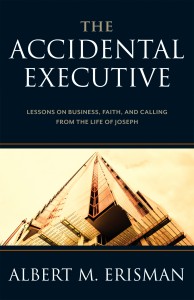 This material is excerpted from The Accidental Executive: Lessons in Business, Faith, and Calling from the Life of Joseph (Hendrickson Press, May 2015), by Al Erisman.
Erisman is the Executive in Residence and the past Director for the Center for Integrity in Business at Seattle Pacific University (SPU). He teaches business ethics and business and technology subjects at SPU and also edits Ethix magazine. He has been on numerous boards for science and technology including projects for the National Academy. He is also a board member for several startup companies. He has a passion for issues related to faith and work and serves on the board of advisors for Theology of Work Project and KIROS, a Christians in Business organization in the Seattle area.

Click to Like Theology of Work Project on Facebook
Previous Post

May 19, 2015
Calling is Purpose-Driven (Part 1 in a Series on Vocation)
Browse Our Archives
Select a Category Advent Ambition Bible and Work Business Calling Christmas Common Good Communication Conflict Culture Disappointment Discipleship Earth Day Easter Economics Environmental Sustainability Envy Faith and the Workplace Family and Work Generosity Giving Gossip Government Gratitude Hospitality Human Flourishing Humility Investing Justice Leadership Lent Local Church Making Mistakes Men and Work Millennials and Work Minimum Wage Money New Year Pastors Patience Pay Politics Poverty Prayer Race Rest Sabbath Sacred vs. Secular Sharing Faith Slavery Song of Songs Status Success Suffering Teamwork Thanksgiving Theology of Work TOW Project News Unemployment Valentine's Day Vocation Women and Work Work Life Balance
Select a Month September 2015 August 2015 July 2015 June 2015 May 2015 April 2015 March 2015 February 2015 January 2015 December 2014 November 2014 October 2014 September 2014 August 2014 July 2014 June 2014 May 2014 April 2014 March 2014 February 2014 January 2014 December 2013
Follow Us!
TAKE THE
Religious Wisdom Quiz
Which city did the believers first call themselves "Christians"?
Select your answer to see how you score.
Corinth Antioch Rome Jerusalem
Related posts from Theology of Work Project

How to Be a Rich Christian (3 Key...

Embedding Faith's Roots Into Your Work

The Power of Plugging Into Silence

Guarding Against Gossip at Work
TRENDING AT PATHEOS Business, Finance and Religion

St. Francis by Bill Droel Pope Leo XIV declares 2026 as “Year...

Catholics are schooled in the faith by memorizing dogmatic points and lots...

The Good News of Our Human Limitations -...
After another day of trying to meet deadlines and working on projects,...

Quiet Holy Attentiveness (podcast) with Sarah Clarkson
We know that quiet is an essential aspect of the spiritual life,...

Every Vocation Everywhere All At Once
What is a vocation? How does it endure through the years? Can...

I promise this is not going to become a Taylor Swift Studies...
view all Business, Finance and Religion blogs
Ad-Free & Subscriber Log-In Subscription Support
- About Us
- 2026 Calendar
- Videos
- Podcasts
- Library of World Religions
- Faith In Media Tracker
- Advertise With Us
- Write for Us
- Privacy Policy
- Terms of Service
- Do Not Sell My Data
- Contact Us
- Radiant Digital
- Manage Newsletter Subscriptions
- Unsubscribe From Notifications
- Sitemap
Copyright 2008-2026, Patheos. All rights reserved.
Subscription Support Ad-Free & Subscriber Log-In
Follow Patheos