
BuddhistCatholicContemplativeEvangelicalGeneral ChristianHinduJewishLatter-day SaintMuslimNew VisionsProgressive Christian
Beliefs
- Buddhist
- Catholic
- Contemplative
- Evangelical
- General Christian
- Hindu
- Jewish
- Latter-day Saint
- More Voices
- Muslim
- New Visions
- Pagan
- Progressive Christian
Topics
- Religion News
- Food and Religion
- Sports and Religion
- Religious Art
- Religious Music and Entertainment
- Religious Events
- History and Religion
- Style and Religion
- Politics and Religion
- Women in Religion
- Recreation Outdoors and Religion
- Business Finance and Religion
- Careers Workplace and Religion
- Education and Religion
- Family Parenting and Religion
- Health Fitness and Religion
- Home and Religion
- Relationships and Religion
- Technology and Religion
- Travel and Religion
Columnists
- Buddhist Columnists
- Business Finance and Religion Columnists
- Careers Workplace and Religion Columnists
- Catholic Columnists
- Contemplative Columnists
- Education and Religion Columnists
- Evangelists Columnists
- Family Parenting and Religion Columnists
- General Christian Columnists
- Health Fitness and Religion Columnists
- Hindu Columnists
- History and Religion Columnists
- Home and Religion Columnists
- Jewish Columnists
- More Voices Columnists
- Latter Day Columnists
- Muslim Columnists
- New Visions Columnists
- Nonreligious Columnists
- Pagan Columnists
- Politics and Religion Columnists
- Progressive Columnists
- Recreation Outdoors and Religion Columnists
- Relationships and Religion Columnists
- Religion News Columnists
- Religious Art Columnists
- Religious Events Columnists
- Religious Music and Entertainment Columnists
- Sports and Religion Columnists
- Style and Religion Columnists
- Technology and Religion Columnists
- Travel and Religion Columnists
- Women in Religion Columnists
Resource Library
- 2026 Calendar
- Library of World Religions
- The 100 Most Holy Places on Earth
- Patheos Answers
- Podcasts
- Videos
- Faith Leaders Database
- Anglican Episcopalian
- Bahai
- Baptist
- Buddhism
- Christianity
- Confucianism
- Eastern Orthodoxy
- Hinduism
- Holiness and Pentecostal
- ISKCON
- Islam
- Judaism
- Lutheran
- Methodist
- The Church of Jesus Christ of Latter-day Saints
- New Age
- Paganism
- Presbytarian and Reformed
- Protestantism
- Religion Behind the Scenes
- Roman Catholic
- Scientology
- Shia Islam
- Sikhism
- Sufism
- Sunni Islam
- Taoism
- Zen
- See all religions
Research Tools
 Ad-Free & Subscriber Log-In Subscription Support
Follow Patheos 

- Trending:
- Advent
- |
- Forgiveness
- |
- Thanksgiving
- |
- Election
- |
- Seasonal Holidays
- |
- Marriage
 Theology of Work Project
- Home
- Business, Finance and Religion
- Handle with Care: What the Bible Says About Sustainability
Handle with Care: What the Bible Says About Sustainability
Last updated on: March 29, 2016 at 3:19 pm by Theology of Work Project
Handle with Care: What the Bible Says About Sustainability 2016-03-29T15:19:01-05:00 Theology of Work Project
Patheos Explore the world's faith through different perspectives on religion and spirituality! Patheos has the views of the prevalent religions and spiritualities of the world.
This post is part of Patheos’ April Public Square, Global Care: Why We Need More Than One Earth Day in a Year.

“So God created humankind in his image, in the image of God he created them; male and female he created them. God blessed them, and God said to them, “Be fruitful and multiply, and fill the earth and subdue it; and have dominion over the fish of the sea and over the birds of the air and over every living thing that moves upon the earth.” – Genesis 1:27-28
God Commissioned People to Steward the Earth’s Resources
A consequence we see in Genesis of being created in God’s image is that we are to “have dominion over…the earth” (Gen. 1:26). As we exercise dominion over the created world, we do it knowing that we mirror God. We are not the originals, but the images, and our duty is to use the original—God—as our pattern, not ourselves.
Therefore, God’s use of the words subdue and dominion in Genesis chapter 1 do not give us permission to run roughshod over any part of his creation. Quite the opposite. We are to act as if we ourselves had the same relationship of love with creation that God does. Subduing the earth includes harnessing its various resources as well as protecting them. Dominion over all living creatures is not a license to abuse them, but a contract from God to care for them.
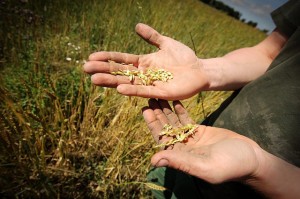
Today we have become especially aware of how pursuit of human self-interest threatens the natural environment. We were meant to tend and care for the Garden (Gen. 2:15). Creation is meant for our use, but not only for our use. Remembering that the air, water, land, plants, and animals are good (Gen. 1:4-31) reminds us that we are meant to sustain and preserve the environment. Our work can either preserve or destroy the clean air, water and land, the biodiversity, the ecosystems and biomes, and even the climate with which God has blessed his creation. Dominion is not the authority to work against God’s creation, but the ability to work for it. [1]
God Equips and Instructs People to Steward the Earth Wisely
We have a fascinating example of God’s detailed instruction for stewardship in the book of Numbers. Numbers 35 instructs the Levite tribe to set up towns scattered throughout the Promised Land. Numbers 35:2–5 details the amount of pasture land each town should have. Measuring from the edge of town, the area for pasture was to extend outward a thousand cubits (about 1500 feet) in each direction, east, south, west and north.
You shall measure, outside the town, for the east side two thousand cubits, for the south side two thousand cubits, for the west side two thousand cubits, and for the north side two thousand cubits, with the town in the middle (Num. 35:5).
Jacob Milgrom has shown that this geographical layout was a very realistic exercise in town planning.[2] The diagram shows a town with pastureland  extending beyond the town diameter in each direction. As the town diameter grows and absorbs the closest pasture, additional pasture land is added so that the pasture remains 1000 cubits beyond the town limits in each direction. (In the diagram the shaded areas remain the same size as they move outward, but the cross-hatched areas get wider as the town center gets wider.)
Mathematically, as the town grows, so does the area of its pasture land, but at a lower rate than the area of the inhabited town center. That means the population is growing faster than agricultural area. For this to continue, agricultural productivity per square meter must increase. Each herder must supply food to more people, freeing more of the population for industrial and service jobs. This is exactly what is required for economic and cultural development. To be sure, the town planning doesn’t cause productivity to increase, but it creates a social-economic structure adapted for rising productivity. It is a remarkably sophisticated example of civic policy creating conditions for sustainable economic growth.
 God bothered to instruct Moses on civic planning based on semi-geometrical growth of pastureland. Numbers 35 illustrates the detailed attention God pays to enabling work that sustains people and creates economic well-being. This suggests that excellence and wisdom are required today to steward the earth’s resources efficiently and sustainably. [3]
We Should Work Within the Limits God Sets
In Genesis, God equips Adam and Eve with specific instructions about the limits of their work. In the midst of the Garden of Eden God plants two trees, the tree of life and the tree of the knowledge of good and evil (Gen. 2:9). The latter tree is off limits. God tells Adam, “You may freely eat of every tree in the garden; but of the tree of the knowledge of good and evil you shall not eat, for in the day that you eat of it, you shall die” (Gen. 2:16-17).

Theologians have speculated at length about why God would put a tree in the Garden of Eden that he didn’t want the inhabitants to use. Various hypotheses are found in the general commentaries, and we need not settle on an answer here. For our purposes, it is enough to observe that not everything that can be done should be done. Human imagination and skill can work with the resources of God’s creation in ways inimical to God’s intents, purposes and commands. If we want to work with God, rather than against him, we must choose to observe the limits God sets, rather than realizing everything possible in creation.
All good work respects God’s limits. There are limits to the earth’s capacity for resource extraction, pollution, habitat modification, and the use of plants and animals for food, clothing and other purposes. In practice it may be hard to know exactly where the line is. Nonetheless, the art of living as God’s image-bearers requires learning to discern where blessings are to be found in observing the limits set by God and evident in creation. [4]
Excerpts from the Theology of Work Bible Commentary, available in print at the Theology of Work Project bookstore, or for free online.
[1] TOW Commentary: God Creates and Equips People to Work (Genesis 1:26; 2:5): Dominion
[2]Jacob Milgrom, “Excursus 74: The Levitical Town: An Exercise in Realistic Planning,” 502–4.
[3] TOW Commentary: Civic Planning for Levitical Towns (Numbers 35:1-5)
[4] TOW Commentary: God Creates and Equips People to Work (Genesis 2:3; 2:5): Limits
Click to Like Theology of Work Project on Facebook

Click to Like Theology of Work Project on Facebook
Previous Post

April 5, 2015
3 Reasons Easter Matters for Your Work
Browse Our Archives
Select a Category Advent Ambition Bible and Work Business Calling Christmas Common Good Communication Conflict Culture Disappointment Discipleship Earth Day Easter Economics Environmental Sustainability Envy Faith and the Workplace Family and Work Generosity Giving Gossip Government Gratitude Hospitality Human Flourishing Humility Investing Justice Leadership Lent Local Church Making Mistakes Men and Work Millennials and Work Minimum Wage Money New Year Pastors Patience Pay Politics Poverty Prayer Race Rest Sabbath Sacred vs. Secular Sharing Faith Slavery Song of Songs Status Success Suffering Teamwork Thanksgiving Theology of Work TOW Project News Unemployment Valentine's Day Vocation Women and Work Work Life Balance
Select a Month September 2015 August 2015 July 2015 June 2015 May 2015 April 2015 March 2015 February 2015 January 2015 December 2014 November 2014 October 2014 September 2014 August 2014 July 2014 June 2014 May 2014 April 2014 March 2014 February 2014 January 2014 December 2013
Follow Us!
TAKE THE
Religious Wisdom Quiz
What does "Apocalypse" mean in Greek?
Select your answer to see how you score.
Redemption Revelation or unveiling End of world Wrath
Related posts from Theology of Work Project
Theology of Work Bible Commentary Vol. 2 Now...

How To Be a Rich Christian: 3 Ways...

How to Be a Rich Christian (3 Key...

How to Be a Rich Christian (Part 3:...
TRENDING AT PATHEOS Business, Finance and Religion

St. Francis by Bill Droel Pope Leo XIV declares 2026 as “Year...

Catholics are schooled in the faith by memorizing dogmatic points and lots...

The Good News of Our Human Limitations -...
After another day of trying to meet deadlines and working on projects,...

Quiet Holy Attentiveness (podcast) with Sarah Clarkson
We know that quiet is an essential aspect of the spiritual life,...

Every Vocation Everywhere All At Once
What is a vocation? How does it endure through the years? Can...

I promise this is not going to become a Taylor Swift Studies...
view all Business, Finance and Religion blogs
Ad-Free & Subscriber Log-In Subscription Support
- About Us
- 2026 Calendar
- Videos
- Podcasts
- Library of World Religions
- Faith In Media Tracker
- Advertise With Us
- Write for Us
- Privacy Policy
- Terms of Service
- Do Not Sell My Data
- Contact Us
- Radiant Digital
- Manage Newsletter Subscriptions
- Unsubscribe From Notifications
- Sitemap
Copyright 2008-2026, Patheos, part of the Radiant Digital network of media brands. All rights reserved.
Subscription Support Ad-Free & Subscriber Log-In
Follow Patheos