
BuddhistCatholicContemplativeEvangelicalGeneral ChristianHinduJewishLatter-day SaintMuslimNew VisionsProgressive Christian
Beliefs
- Buddhist
- Catholic
- Contemplative
- Evangelical
- General Christian
- Hindu
- Jewish
- Latter-day Saint
- More Voices
- Muslim
- New Visions
- Pagan
- Progressive Christian
Topics
- Religion News
- Food and Religion
- Sports and Religion
- Religious Art
- Religious Music and Entertainment
- Religious Events
- History and Religion
- Style and Religion
- Politics and Religion
- Women in Religion
- Recreation Outdoors and Religion
- Business Finance and Religion
- Careers Workplace and Religion
- Education and Religion
- Family Parenting and Religion
- Health Fitness and Religion
- Home and Religion
- Relationships and Religion
- Technology and Religion
- Travel and Religion
Columnists
- Buddhist Columnists
- Business Finance and Religion Columnists
- Careers Workplace and Religion Columnists
- Catholic Columnists
- Contemplative Columnists
- Education and Religion Columnists
- Evangelists Columnists
- Family Parenting and Religion Columnists
- General Christian Columnists
- Health Fitness and Religion Columnists
- Hindu Columnists
- History and Religion Columnists
- Home and Religion Columnists
- Jewish Columnists
- More Voices Columnists
- Latter Day Columnists
- Muslim Columnists
- New Visions Columnists
- Nonreligious Columnists
- Pagan Columnists
- Politics and Religion Columnists
- Progressive Columnists
- Recreation Outdoors and Religion Columnists
- Relationships and Religion Columnists
- Religion News Columnists
- Religious Art Columnists
- Religious Events Columnists
- Religious Music and Entertainment Columnists
- Sports and Religion Columnists
- Style and Religion Columnists
- Technology and Religion Columnists
- Travel and Religion Columnists
- Women in Religion Columnists
Resource Library
- 2026 Calendar
- Library of World Religions
- The 100 Most Holy Places on Earth
- Patheos Answers
- Podcasts
- Videos
- Faith Leaders Database
- Anglican Episcopalian
- Bahai
- Baptist
- Buddhism
- Christianity
- Confucianism
- Eastern Orthodoxy
- Hinduism
- Holiness and Pentecostal
- ISKCON
- Islam
- Judaism
- Lutheran
- Methodist
- The Church of Jesus Christ of Latter-day Saints
- New Age
- Paganism
- Presbytarian and Reformed
- Protestantism
- Religion Behind the Scenes
- Roman Catholic
- Scientology
- Shia Islam
- Sikhism
- Sufism
- Sunni Islam
- Taoism
- Zen
- See all religions
Research Tools
 Ad-Free & Subscriber Log-In Subscription Support
Ad-Free & Subscriber Log-In Subscription Support
Follow Patheos 

- Trending:
- Forgiveness
- |
- Marriage
- |
- Consciousness
- |
- Death Penalty
- |
- Election
- |
- Halloween
 Theology of Work Project
- Home
- Business, Finance and Religion
- Bad Day at Work?: Career Lessons from Joseph
Bad Day at Work?: Career Lessons from Joseph
Last updated on: July 7, 2015 at 3:57 pm by Guest Contributor
Bad Day at Work?: Career Lessons from Joseph 2015-07-07T15:57:04-05:00 Guest Contributor
Patheos Explore the world's faith through different perspectives on religion and spirituality! Patheos has the views of the prevalent religions and spiritualities of the world.

Guest Contributor: Al Erisman
Have you ever had a hard day at work? And when you are able to stop the blame game, you recognize that much of the grief you face is of your own making?
Joseph, son of Jacob, son of Isaac, son of Abraham had such a day. We can look at his story for insight in dealing with our own challenges. But first we need to set the stage for Joseph’s hard day at work.
Dreaming Big
When we first encounter Joseph in Genesis 37, he is seventeen years old. The favoritism his father showed him was evident to all. The Scripture mentions the problem in two ways: it tells us that his father made him a richly ornamented robe (Genesis 37:3), and that Joseph brought “a bad report” about his brothers and their work (Genesis 37:2). We don’t know the nature of his brothers’ offenses, but we do know that reporting this in a straightforward way could not have endeared Joseph to his brothers. Their reaction to him is clear: “When his brothers saw that their father loved him more than any of them, they hated him and could not speak a kind word to him” (Genesis 37:4).
This is enough dysfunction in a home to make it difficult for even a mature person to navigate the political waters. It may be that these experiences helped Joseph later in navigating the politics of Pharaoh’s organization, but for now it was not a pretty sight.
And then he poured gasoline on the fire. He had a dream, and immediately he said to his brothers, “‘Listen to this dream I had: We were binding sheaves of grain out in the field when suddenly my sheaf rose and stood upright, while your sheaves gathered around mine and bowed down to it.’ . . . And [his brothers] hated him all the more because of his dream and what he had said” (Genesis 37:8).

He didn’t learn. “Then he had another dream, and he told it to his brothers. ‘Listen,’ he said, ‘I had another dream, and this time the sun and moon and eleven stars were bowing down to me’” (Genesis 37:9). As a result, “his brothers were jealous of him, but his father kept the matter in mind” (Genesis 37:11).
Joseph had several things working against him at this point. He was a favorite of his father, something he could not control but seemed to enjoy; he was a snitch; and he talked about his two dreams, not learning from the bad reaction to the first when he told the second. Thinking about the context, he would probably have been wise to keep at least the interpretation to himself. It is easy to see him as arrogant here. And it is easy to see why his brothers were jealous and angry.
Joseph’s First Leadership Failure
In this setting, Joseph was given his first leadership assignment—and as we will see, he was not ready for it. His brothers had gone off to Shechem, and Jacob wanted Joseph to check up on them. His instructions were, “Go and see if all is well with your brothers and with the flocks, and bring word back to me” (Genesis 37:14).

Joseph showed a characteristic perseverance in pursuing this task. But he made a huge mistake: he was wearing the “ornate robe” his father had given him as a sign of his favor. What was he thinking? Didn’t he consider how his brothers would react to this mark of all that was wrong in the family? It was like wearing a red shirt to a bull fight. Apparently, Joseph was good at carrying out the mechanics of what his father asked him to do, but he completely forgot to think about what he would do when he found his brothers. Not surprisingly, his brothers reacted negatively to his new leadership. “They saw him in the distance, and before he reached them, they plotted to kill him” (Genesis 37:18).
Joseph lacked awareness of how his actions and words would affect other people. Scientific research has given us some insight into something called “theory of mind,” which John Medina describes in his best-selling book Brain Rules:12 Principles for Surviving and Thriving at Work, Home, and School (Pear Press, 2014). How do people understand a situation from the perspective of others? How does a person get inside the minds of others and imagine what it would be like to experience rewards and punishments from their perspective? This is an incredibly important capability for any leader, and Joseph apparently did not have it yet.
As the brothers saw Joseph coming from a long way off, they recognized him immediately because of his coat. In their rage, they planned to kill him. But the oldest brother Reuben stood up for him, suggesting they detain him and not shed his blood. He had in mind that he could rescue him later and get him back to their father. So the brothers agreed to strip Joseph of his multicolored coat and while Reuben was away they sold him as a slave to a passing caravan.
Starting Over

When the caravan arrived in Egypt, Joseph was sold as a slave to the house of Potiphar, the captain of the guard for the Pharaoh. It would have been easy for Joseph to be self-critical at this point. Why did I wear that coat? Why did I go to my brothers so arrogantly? Or to blame others*. Why did my father send me into that mess? Why are my brothers so horrible? Where is this God I have worshipped? I have followed him more faithfully than my brothers or even my father, and yet he doesn’t seem to care about me.* Or simply to sulk. Why am I in this terrible mess? I don’t deserve this.
But it appears that Joseph did none of these things. The Bible says he remained connected with his God even in a place far away from home, and he applied himself to the work put in front of him. “The Lord was with Joseph so that he prospered, and he lived in the house of his Egyptian master” (Genesis 39:2).
Joseph ignored his failure and immediately got to work on the next opportunity, in this case in Potiphar’s house. And he did this work so well that he got promoted:
Joseph found favor in [his master’s] eyes, and became his attendant. Potiphar put him in charge of his household, and he entrusted to his care everything he owned. . . . The blessing of the Lord was on everything Potiphar had, both in the house and in the field. So Potiphar left in Joseph’s care everything he had; with Joseph in charge, he did not concern himself with anything except the food he ate. (Genesis 39:4–6)
Joseph found himself in a new leadership position—although as a slave, it was not one he would have chosen. He was certainly a long way from home and its familiar surroundings. But he got to work and did this work well.
What an important challenge for us in our own work when the circumstances are not to our liking. It is almost as if Joseph understood what Paul said to the slaves in his day (and to us in our day), “Whatever you do, work at it with all your heart, as working for the Lord and not for men….It is the Lord Christ you are serving.” (Colossians 3:23)
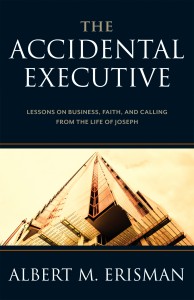 This material is excerpted from The Accidental Executive: Lessons in Business, Faith, and Calling from the Life of Joseph (Hendrickson Press, May 2015), by Al Erisman.
Erisman is the Executive in Residence and the past Director for the Center for Integrity in Business at Seattle Pacific University (SPU). He teaches business ethics and business and technology subjects at SPU and also edits Ethix magazine. He has been on numerous boards for science and technology including projects for the National Academy. He is also a board member for several startup companies. He has a passion for issues related to faith and work and serves on the board of advisors for Theology of Work Project and KIROS, a Christians in Business organization in the Seattle area.
Click to Like Theology of Work Project on Facebook

Click to Like Theology of Work Project on Facebook
Previous Post

April 28, 2015
6 Ideas to Jumpstart Your Personal Bible Study
Next Post

May 5, 2015 Is Church Work a Higher Calling?
Browse Our Archives
Select a Category Advent Ambition Bible and Work Business Calling Christmas Common Good Communication Conflict Culture Disappointment Discipleship Earth Day Easter Economics Environmental Sustainability Envy Faith and the Workplace Family and Work Generosity Giving Gossip Government Gratitude Hospitality Human Flourishing Humility Investing Justice Leadership Lent Local Church Making Mistakes Men and Work Millennials and Work Minimum Wage Money New Year Pastors Patience Pay Politics Poverty Prayer Race Rest Sabbath Sacred vs. Secular Sharing Faith Slavery Song of Songs Status Success Suffering Teamwork Thanksgiving Theology of Work TOW Project News Unemployment Valentine's Day Vocation Women and Work Work Life Balance
Select a Month September 2015 August 2015 July 2015 June 2015 May 2015 April 2015 March 2015 February 2015 January 2015 December 2014 November 2014 October 2014 September 2014 August 2014 July 2014 June 2014 May 2014 April 2014 March 2014 February 2014 January 2014 December 2013
Follow Us!
TAKE THE
Religious Wisdom Quiz
What is a "cubit's" approximate length according to the Bible?
Select your answer to see how you score.
12 inches 18 inches 36 inches 24 inches
Related posts from Theology of Work Project

Theology of Work Bible Commentary Vol. 2 Now...

How to Be a Rich Christian (Part 3:...

How to Be a Rich Christian (Part 1:...

Every Christian is Called to Full Time Ministry
TRENDING AT PATHEOS Business, Finance and Religion

St. Francis by Bill Droel Pope Leo XIV declares 2026 as “Year...

Catholics are schooled in the faith by memorizing dogmatic points and lots...

The Good News of Our Human Limitations -...
After another day of trying to meet deadlines and working on projects,...

Quiet Holy Attentiveness (podcast) with Sarah Clarkson
We know that quiet is an essential aspect of the spiritual life,...

Every Vocation Everywhere All At Once
What is a vocation? How does it endure through the years? Can...

I promise this is not going to become a Taylor Swift Studies...
view all Business, Finance and Religion blogs
Ad-Free & Subscriber Log-In Subscription Support
- About Us
- 2026 Calendar
- Videos
- Podcasts
- Library of World Religions
- Faith In Media Tracker
- Advertise With Us
- Write for Us
- Privacy Policy
- Terms of Service
- Do Not Sell My Data
- Contact Us
- Radiant Digital
- Manage Newsletter Subscriptions
- Unsubscribe From Notifications
- Sitemap
Copyright 2008-2026, Patheos. All rights reserved.
Subscription Support Ad-Free & Subscriber Log-In
Follow Patheos