
BuddhistCatholicContemplativeEvangelicalGeneral ChristianHinduJewishLatter-day SaintMuslimNew VisionsProgressive Christian
Beliefs
- Buddhist
- Catholic
- Contemplative
- Evangelical
- General Christian
- Hindu
- Jewish
- Latter-day Saint
- More Voices
- Muslim
- New Visions
- Pagan
- Progressive Christian
Topics
- Religion News
- Food and Religion
- Sports and Religion
- Religious Art
- Religious Music and Entertainment
- Religious Events
- History and Religion
- Style and Religion
- Politics and Religion
- Women in Religion
- Recreation Outdoors and Religion
- Business Finance and Religion
- Careers Workplace and Religion
- Education and Religion
- Family Parenting and Religion
- Health Fitness and Religion
- Home and Religion
- Relationships and Religion
- Technology and Religion
- Travel and Religion
Columnists
- Buddhist Columnists
- Business Finance and Religion Columnists
- Careers Workplace and Religion Columnists
- Catholic Columnists
- Contemplative Columnists
- Education and Religion Columnists
- Evangelists Columnists
- Family Parenting and Religion Columnists
- General Christian Columnists
- Health Fitness and Religion Columnists
- Hindu Columnists
- History and Religion Columnists
- Home and Religion Columnists
- Jewish Columnists
- More Voices Columnists
- Latter Day Columnists
- Muslim Columnists
- New Visions Columnists
- Nonreligious Columnists
- Pagan Columnists
- Politics and Religion Columnists
- Progressive Columnists
- Recreation Outdoors and Religion Columnists
- Relationships and Religion Columnists
- Religion News Columnists
- Religious Art Columnists
- Religious Events Columnists
- Religious Music and Entertainment Columnists
- Sports and Religion Columnists
- Style and Religion Columnists
- Technology and Religion Columnists
- Travel and Religion Columnists
- Women in Religion Columnists
Resource Library
- 2026 Calendar
- Library of World Religions
- The 100 Most Holy Places on Earth
- Patheos Answers
- Podcasts
- Videos
- Faith Leaders Database
- Anglican Episcopalian
- Bahai
- Baptist
- Buddhism
- Christianity
- Confucianism
- Eastern Orthodoxy
- Hinduism
- Holiness and Pentecostal
- ISKCON
- Islam
- Judaism
- Lutheran
- Methodist
- The Church of Jesus Christ of Latter-day Saints
- New Age
- Paganism
- Presbytarian and Reformed
- Protestantism
- Religion Behind the Scenes
- Roman Catholic
- Scientology
- Shia Islam
- Sikhism
- Sufism
- Sunni Islam
- Taoism
- Zen
- See all religions
Research Tools
 Ad-Free & Subscriber Log-In Subscription Support
Ad-Free & Subscriber Log-In Subscription Support
Follow Patheos 

- Trending:
- Forgiveness
- |
- Marriage
- |
- Consciousness
- |
- Death Penalty
- |
- Election
- |
- Halloween
 Theology of Work Project
- Home
- Business, Finance and Religion
- Gordon-Conwell Seminary Professor Sean McDonough on Making the Most of the Theology of Work Project Resources
Gordon-Conwell Seminary Professor Sean McDonough on Making the Most of the Theology of Work Project Resources
Last updated on: June 10, 2015 at 2:39 pm by Theology of Work Project
Gordon-Conwell Seminary Professor Sean McDonough on Making the Most of the Theology of Work Project Resources 2015-06-10T14:39:40-05:00 Theology of Work Project
Patheos Explore the world's faith through different perspectives on religion and spirituality! Patheos has the views of the prevalent religions and spiritualities of the world.
 We asked Professor Sean McDonough, professor of New Testament at Gordon-Conwell Theological Seminary in South Hamilton, Massachusetts, about how to get the most out of the resources offered by the Theology of Work Project. Here are some of his thoughts on what’s been useful to him as he works with Christian students.
TOW: The Theology of Work Project offers a full Bible Commentary, as well as articles about topics ranging from ethics to how churches are helping people integrate faith and work. What resources have you found the most useful?
The generally most useful one is the article on calling. When I speak particularly on college campuses, you basically have two questions people are always asking “Who should I get married to?” and “What should I do with my life?” Both of these involve calling in some sense. But the latter question “What should I do with my life?,” particularly in Christian circles, is often followed by, “Well, if I’m spiritual, I’ll go into ‘full-time ministry.'” That really restricts people from living life to the fullest, particularly in their work life.
The article on calling does a very nice, clear, common sense job of disabusing people of that notion and liberating them to follow God’s call.
The other resource that I find fun is the finance article. Not because I’m particularly good at finance or have a deep interest in finance—almost the opposite. Actually it’s because I struggle to think about how finance would be a means of serving God. The article is clear about laying out what finance is in essence, acknowledging the problems, but also explaining why it exists and how it exists as part of God’s economy in the broadest sense. If there’s any field that people imagine must be about getting money, about greed, it’s finance. The author does a wonderful job of getting some clarity on how it can serve the kingdom.
TOW: You’re on the steering committee of the Theology of Work Project and you’ve served as an editor for the commentary. How did you get involved?
Well, it’s funny, I had two points of connection. When I was a student at doctoral studies at St. Andrews, one of my best friends there, Darrell Cosden, was working precisely on a theology of work. So we would have a good deal of discussion about it. Later, when I came to Gordon Conwell, Will Messenger, the editor of the project, was working there. I would go along to the theology of work things because he asked me to. And it turns out, I finally figured out that my interest in theology of creation, which I’d always been keen on, really did intersect very meaningfully with the theology of work.
TOW: How can professors teaching seminary students use the Theology of Work Bible Commentary?
In my classes, I find it essential to give students a biblically sound basis for speaking into the work their future congregants will do every day–a total of 2,000 hours per person outside the church every year. Grounded in the biblical text, the commentary compels students to take work as seriously as Scripture does–and Scripture takes work very seriously. Professors can supplement more technical commentaries with the “Theology of Work Bible Commentary.” More importantly, we can assign it to students as a way of bridging the gap between biblical exegesis and everyday life.
Because traditional commentaries rarely touch on matters of the workplace, you will continually be invited to look at the Bible from a fresh angle. The TOW commentary will thus serve as a complement to the commentaries they currently use rather than as competition. If you are teaching a class on Exodus, for instance, you will know of the book’s theological and historical richness. But it may help to be reminded that the Exodus is, among other things, a deliverance from an intolerable work situation. Seeing the text in this light provides a natural opening for discussion about the broader implications of the text for the modern world.
 TOW: What distinguishes the Theology of Work Bible Commentary?
Three things.
The first is quality. On the biblical side of things, we have gathered a team of scholars with extensive experience in original language exegesis. The vast majority of these scholars hold their doctorates in biblical studies from top universities and teach at some of our finest theological schools. What distinguishes the TOW commentary is that we have given equal consideration to quality in the application portions. Each part of the commentary was exhaustively discussed by a worldwide group of business leaders, marketplace ministers, and theologians.
The second is efficiency. While we have endeavored to give readers an appropriate orientation to the literary and historical contexts of the biblical texts, we do not go on at length about things with which readers are already familiar. Instead, the focus is on what the Bible says about work.
This leads naturally to the third point: applicability. As professors training pastors, it is easy for us to huddle in small, self-referential circles of discourse that focus only on the life of the mind. This tends to produce ministers who can speak eloquently about what the Bible meant, but who have very little idea about what it means for the everyday lives of their parishioners.
The TOW commentary provides ready access to exegetically sound applications. This should prove useful to students as they go out into pastoral ministry. It is essential to know that Jesus’ call for integrity in Matthew stems from his revision of the Mosaic law for the first-century messianic community. It is equally essential to think through how integrity should manifest itself in the countless hours the members of the present messianic community spend in the workplace.
Our full interview with Sean was originally posted here, and Sean’s article about the Theology of Work Commentary first appeared here. Thanks to the Oikonomia Network.
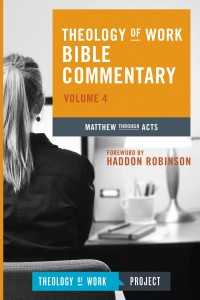
The Theology of Work Bible Commentary is now online for free. The print version will be released on October 24 and is available for pre-order.

Click to Like Theology of Work Project on Facebook
Next Post

October 14, 2014 4 Things Good Bosses Do
Browse Our Archives
Select a Category Advent Ambition Bible and Work Business Calling Christmas Common Good Communication Conflict Culture Disappointment Discipleship Earth Day Easter Economics Environmental Sustainability Envy Faith and the Workplace Family and Work Generosity Giving Gossip Government Gratitude Hospitality Human Flourishing Humility Investing Justice Leadership Lent Local Church Making Mistakes Men and Work Millennials and Work Minimum Wage Money New Year Pastors Patience Pay Politics Poverty Prayer Race Rest Sabbath Sacred vs. Secular Sharing Faith Slavery Song of Songs Status Success Suffering Teamwork Thanksgiving Theology of Work TOW Project News Unemployment Valentine's Day Vocation Women and Work Work Life Balance
Select a Month September 2015 August 2015 July 2015 June 2015 May 2015 April 2015 March 2015 February 2015 January 2015 December 2014 November 2014 October 2014 September 2014 August 2014 July 2014 June 2014 May 2014 April 2014 March 2014 February 2014 January 2014 December 2013
Follow Us!
TAKE THE
Religious Wisdom Quiz
According to 1 John, what three things testify on earth?
Select your answer to see how you score.
Prayer, fasting, and almsgiving The Father, the Son, and the Holy Spirit The Spirit, the water, and the blood Faith, hope, and love
Related posts from Theology of Work Project

Theology of Work Bible Commentary Vol. 2 Now...

How To Be a Rich Christian: 3 Ways...

How to Be a Rich Christian (3 Key...

How to Be a Rich Christian (Part 3:...
TRENDING AT PATHEOS Business, Finance and Religion

St. Francis by Bill Droel Pope Leo XIV declares 2026 as “Year...

Catholics are schooled in the faith by memorizing dogmatic points and lots...

The Good News of Our Human Limitations -...
After another day of trying to meet deadlines and working on projects,...

Quiet Holy Attentiveness (podcast) with Sarah Clarkson
We know that quiet is an essential aspect of the spiritual life,...

Every Vocation Everywhere All At Once
What is a vocation? How does it endure through the years? Can...

I promise this is not going to become a Taylor Swift Studies...
view all Business, Finance and Religion blogs
Ad-Free & Subscriber Log-In Subscription Support
- About Us
- 2026 Calendar
- Videos
- Podcasts
- Library of World Religions
- Faith In Media Tracker
- Advertise With Us
- Write for Us
- Privacy Policy
- Terms of Service
- Do Not Sell My Data
- Contact Us
- Radiant Digital
- Manage Newsletter Subscriptions
- Unsubscribe From Notifications
- Sitemap
Copyright 2008-2026, Patheos. All rights reserved.
Subscription Support Ad-Free & Subscriber Log-In
Follow Patheos