
BuddhistCatholicContemplativeEvangelicalGeneral ChristianHinduJewishLatter-day SaintMuslimNew VisionsProgressive Christian
Beliefs
- Buddhist
- Catholic
- Contemplative
- Evangelical
- General Christian
- Hindu
- Jewish
- Latter-day Saint
- More Voices
- Muslim
- New Visions
- Pagan
- Progressive Christian
Topics
- Religion News
- Food and Religion
- Sports and Religion
- Religious Art
- Religious Music and Entertainment
- Religious Events
- History and Religion
- Style and Religion
- Politics and Religion
- Women in Religion
- Recreation Outdoors and Religion
- Business Finance and Religion
- Careers Workplace and Religion
- Education and Religion
- Family Parenting and Religion
- Health Fitness and Religion
- Home and Religion
- Relationships and Religion
- Technology and Religion
- Travel and Religion
Columnists
- Buddhist Columnists
- Business Finance and Religion Columnists
- Careers Workplace and Religion Columnists
- Catholic Columnists
- Contemplative Columnists
- Education and Religion Columnists
- Evangelists Columnists
- Family Parenting and Religion Columnists
- General Christian Columnists
- Health Fitness and Religion Columnists
- Hindu Columnists
- History and Religion Columnists
- Home and Religion Columnists
- Jewish Columnists
- More Voices Columnists
- Latter Day Columnists
- Muslim Columnists
- New Visions Columnists
- Nonreligious Columnists
- Pagan Columnists
- Politics and Religion Columnists
- Progressive Columnists
- Recreation Outdoors and Religion Columnists
- Relationships and Religion Columnists
- Religion News Columnists
- Religious Art Columnists
- Religious Events Columnists
- Religious Music and Entertainment Columnists
- Sports and Religion Columnists
- Style and Religion Columnists
- Technology and Religion Columnists
- Travel and Religion Columnists
- Women in Religion Columnists
Resource Library
- 2026 Calendar
- Library of World Religions
- The 100 Most Holy Places on Earth
- Patheos Answers
- Podcasts
- Videos
- Faith Leaders Database
- Anglican Episcopalian
- Bahai
- Baptist
- Buddhism
- Christianity
- Confucianism
- Eastern Orthodoxy
- Hinduism
- Holiness and Pentecostal
- ISKCON
- Islam
- Judaism
- Lutheran
- Methodist
- The Church of Jesus Christ of Latter-day Saints
- New Age
- Paganism
- Presbytarian and Reformed
- Protestantism
- Religion Behind the Scenes
- Roman Catholic
- Scientology
- Shia Islam
- Sikhism
- Sufism
- Sunni Islam
- Taoism
- Zen
- See all religions
Research Tools
 Ad-Free & Subscriber Log-In Subscription Support
Ad-Free & Subscriber Log-In Subscription Support
Follow Patheos 

- Trending:
- Forgiveness
- |
- Marriage
- |
- Consciousness
- |
- Death Penalty
- |
- Election
- |
- Halloween
 Theology of Work Project
- Home
- Business, Finance and Religion
- Civic planning in the Bible?
Civic planning in the Bible?
Last updated on: June 5, 2014 at 5:19 pm by Theology of Work Project
Civic planning in the Bible? 2014-06-05T17:19:49-05:00 Theology of Work Project
Patheos Explore the world's faith through different perspectives on religion and spirituality! Patheos has the views of the prevalent religions and spiritualities of the world.
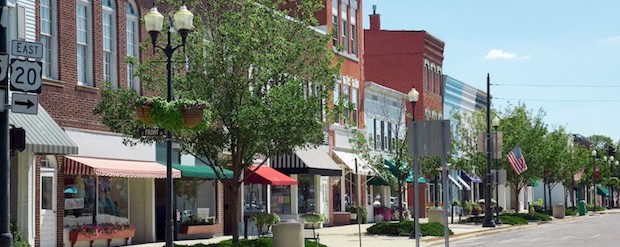
A study of NUMBERS 35:1–5
Unlike the rest of Israel’s tribes, the Levites were to live in towns scattered throughout the Promised Land where they could teach the people the Law and apply it in local courts. Numbers 35:2–5 details the amount of pasture land each town should have. Measuring from the edge of town, the area for pasture was to extend outward a thousand cubits (about 1500 feet) in each direction, east, south, west and north.
You shall measure, outside the town, for the east side two thousand cubits, for the south side two thousand cubits, for the west side two thousand cubits, and for the north side two thousand cubits, with the town in the middle (Num. 35:5).
Jacob Milgrom has shown that this geographical layout was a very realistic exercise in town planning. The diagram shows a town with pastureland extending beyond the town diameter in each direction. As the town diameter grows and absorbs the closest pasture, additional pasture land is added so that the pasture remains 1000 cubits beyond the town limits in each direction. (In the diagram the shaded areas remain the same size as they move outward, but the cross-hatched areas get wider as the town center gets wider.)
Mathematically, as the town grows, so does the area of its pasture land, but at a lower rate than the area of the inhabited town center. That means the population is growing faster than the agricultural area. For this to continue, agricultural productivity per square meter must increase. Each herder must supply food to more people, freeing more of the population for industrial and service jobs. This is exactly what is required for economic and cultural development. To be sure, the town planning doesn’t cause productivity to increase, but it creates a social-economic structure adapted for rising productivity. It is a remarkably sophisticated example of civic policy creating conditions for sustainable economic growth.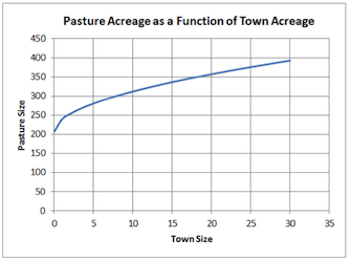
This passage illustrates again the detailed attention God pays to enabling human work that sustains people and creates economic well-being. If God troubles to instruct Moses on civic planning, based on the semi-geometrical growth of pastureland, doesn’t it suggest that God’s people today vigorously pursue all the professions, crafts, arts, academics, and other disciplines that sustain and prosper communities and nations? Perhaps churches and Christians could do more to encourage and celebrate church members’ excellence in all fields of endeavor. Perhaps Christian workers could do more to become excellent at our work as a way of serving our Lord. Is there any reason to believe that excellent city planning, or economics, or child care, or customer service bring less glory to God than heartfelt worship, prayer or Bible study?
From Theology of Work Project. Images: TOW.
Previous Post

March 5, 2014
"God does own this business"
Next Post
March 5, 2014 Economic opportunities for the poor and vulnerable
Browse Our Archives
Select a Category Advent Ambition Bible and Work Business Calling Christmas Common Good Communication Conflict Culture Disappointment Discipleship Earth Day Easter Economics Environmental Sustainability Envy Faith and the Workplace Family and Work Generosity Giving Gossip Government Gratitude Hospitality Human Flourishing Humility Investing Justice Leadership Lent Local Church Making Mistakes Men and Work Millennials and Work Minimum Wage Money New Year Pastors Patience Pay Politics Poverty Prayer Race Rest Sabbath Sacred vs. Secular Sharing Faith Slavery Song of Songs Status Success Suffering Teamwork Thanksgiving Theology of Work TOW Project News Unemployment Valentine's Day Vocation Women and Work Work Life Balance
Select a Month September 2015 August 2015 July 2015 June 2015 May 2015 April 2015 March 2015 February 2015 January 2015 December 2014 November 2014 October 2014 September 2014 August 2014 July 2014 June 2014 May 2014 April 2014 March 2014 February 2014 January 2014 December 2013
Follow Us!
TAKE THE
Religious Wisdom Quiz
Who was the first high priest of Israel?
Select your answer to see how you score.
Aaron Joshua Moses Levi
Related posts from Theology of Work Project
Faith & Work Ministries Partner the Pew and...

Churches are Creating Job-Specific Resources. Should Yours?

What does the Wall Street Journal know about...

Gordon-Conwell Seminary Professor Sean McDonough on Making the...
TRENDING AT PATHEOS Business, Finance and Religion

St. Francis by Bill Droel Pope Leo XIV declares 2026 as “Year...

Catholics are schooled in the faith by memorizing dogmatic points and lots...

The Good News of Our Human Limitations -...
After another day of trying to meet deadlines and working on projects,...

Quiet Holy Attentiveness (podcast) with Sarah Clarkson
We know that quiet is an essential aspect of the spiritual life,...

Every Vocation Everywhere All At Once
What is a vocation? How does it endure through the years? Can...

I promise this is not going to become a Taylor Swift Studies...
view all Business, Finance and Religion blogs
Ad-Free & Subscriber Log-In Subscription Support
- About Us
- 2026 Calendar
- Videos
- Podcasts
- Library of World Religions
- Faith In Media Tracker
- Advertise With Us
- Write for Us
- Privacy Policy
- Terms of Service
- Do Not Sell My Data
- Contact Us
- Radiant Digital
- Manage Newsletter Subscriptions
- Unsubscribe From Notifications
- Sitemap
Copyright 2008-2026, Patheos. All rights reserved.
Subscription Support Ad-Free & Subscriber Log-In
Follow Patheos